
Oracle Critical Patch Update October 2020
Released October 2020 · Oracle's advisory ↗ · ← Critical Patch Update, July 2020 · Critical Patch Update, January 2021 →
230 CVEs in this release, one square each
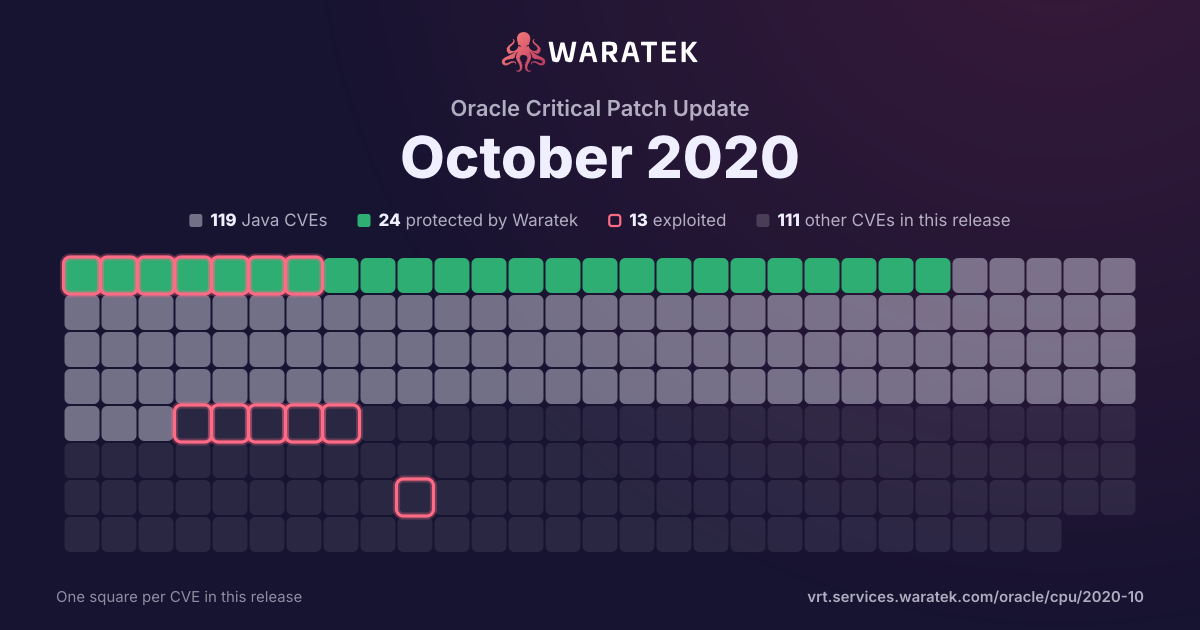
By status
26Protected by Waratek8Mitigation candidate100No exploit published3Outside Waratek scope93Not applicable
13Exploited, marked by the ring
No exploit published. For 78 of them, Oracle's security advisory is the source of public detail.
Protected by Waratek. Waratek RASP can block exploitation of these on systems that have not applied the patch yet.
Overview 48 matches · 14 protected · 8 exploited · 5 CISA KEV · 11 public PoC · 13 EPSS ≥ 0.5
Protected by Waratek
14
29.2%
Rule in development
0
0.0%
Mitigation candidate
7
14.6%
No exploit published
27
56.2%
blocked by ARMR today
14
29.2%
partly blocked
0
0.0%
not blocked
33
68.8%
not established
1
2.1%
unrecorded
0
0.0%
split by
peak 16 / quarter
Q2 171
Protected by Waratek1
Critical1
blocked by ARMR today1
Working exploit published1
Q3 170
Q4 170
Q1 181
Protected by Waratek1
Critical1
blocked by ARMR today1
No public exploit1
Q2 181
No exploit published1
High1
not blocked1
No public exploit1
Q3 181
No exploit published1
Critical1
not blocked1
No public exploit1
Q4 180
Q1 190
Q2 192
Mitigation candidate1
No exploit published1
Medium2
not blocked2
Exploited1
No public exploit1
Q3 195
Protected by Waratek2
Mitigation candidate1
No exploit published2
Critical2
High2
Medium1
blocked by ARMR today2
not blocked2
not established1
Exploited1
Forecast only1
No public exploit3
Q4 197
Protected by Waratek2
No exploit published5
Critical3
High1
Medium3
blocked by ARMR today2
not blocked5
No public exploit7
Q1 204
Protected by Waratek1
Mitigation candidate2
No exploit published1
Critical2
High1
Medium1
blocked by ARMR today1
not blocked3
Exploited1
Proof of concept only1
No public exploit2
Q2 208
Protected by Waratek2
Mitigation candidate2
No exploit published4
Critical1
High1
Medium5
Low1
blocked by ARMR today2
not blocked6
Exploited2
Working exploit published1
No public exploit5
Q3 202
Mitigation candidate1
No exploit published1
Critical1
High1
not blocked2
Working exploit published1
No public exploit1
Q4 2016
Protected by Waratek5
No exploit published11
Critical4
High11
Medium1
blocked by ARMR today5
not blocked11
Exploited3
No public exploit13
Q2 17Q4 17Q2 18Q4 18Q2 19Q4 19Q2 20Q4 20
| CVE | Severity | Published▾ | Status | Exploitation | Description |
|---|---|---|---|---|---|
| CVE-2020-14883 | High | 2020-10-21 | Protected by Waratek | Exploited | Vulnerability in the Oracle WebLogic Server product of Oracle Fusion Middleware (component: Console). Supported versions that are affected are 10.3.6.0.0, 12.1.3.0.0, 12.2.1.3.0, 12.2.1.4.0 and 14.1.1.0.0. Easily exploitable vulnerability allows high privileged attacker with network access via HTTP to compromise Oracle WebLogic Server. Successful attacks of this vulnerability can result in takeover of Oracle WebLogic Server. CVSS 3.1 Base Score 7.2 (Confidentiality, Integrity and Availability impacts). CVSS Vector: (CVSS:3.1/AV:N/AC:L/PR:H/UI:N/S:U/C:H/I:H/A:H). |
| CVE-2020-14882 | Critical | 2020-10-21 | Protected by Waratek | Exploited | Vulnerability in the Oracle WebLogic Server product of Oracle Fusion Middleware (component: Console). Supported versions that are affected are 10.3.6.0.0, 12.1.3.0.0, 12.2.1.3.0, 12.2.1.4.0 and 14.1.1.0.0. Easily exploitable vulnerability allows unauthenticated attacker with network access via HTTP to compromise Oracle WebLogic Server. Successful attacks of this vulnerability can result in takeover of Oracle WebLogic Server. CVSS 3.1 Base Score 9.8 (Confidentiality, Integrity and Availability impacts). CVSS Vector: (CVSS:3.1/AV:N/AC:L/PR:N/UI:N/S:U/C:H/I:H/A:H). |
| CVE-2020-14880 | High | 2020-10-21 | No exploit published | No public exploit | Vulnerability in the BI Publisher product of Oracle Fusion Middleware (component: E-Business Suite - XDO). Supported versions that are affected are 5.5.0.0.0, 11.1.1.9.0, 12.2.1.3.0 and 12.2.1.4.0. Easily exploitable vulnerability allows low privileged attacker with network access via HTTP to compromise BI Publisher. While the vulnerability is in BI Publisher, attacks may significantly impact additional products. Successful attacks of this vulnerability can result in unauthorized access to critical data or complete access to all BI Publisher accessible data as well as unauthorized update, insert or delete access to some of BI Publisher accessible data. CVSS 3.1 Base Score 8.5 (Confidentiality and Integrity impacts). CVSS Vector: (CVSS:3.1/AV:N/AC:L/PR:L/UI:N/S:C/C:H/I:L/A:N). |
| CVE-2020-14879 | High | 2020-10-21 | No exploit published | No public exploit | Vulnerability in the BI Publisher product of Oracle Fusion Middleware (component: E-Business Suite - XDO). Supported versions that are affected are 5.5.0.0.0, 11.1.1.9.0, 12.2.1.3.0 and 12.2.1.4.0. Easily exploitable vulnerability allows low privileged attacker with network access via HTTP to compromise BI Publisher. While the vulnerability is in BI Publisher, attacks may significantly impact additional products. Successful attacks of this vulnerability can result in unauthorized access to critical data or complete access to all BI Publisher accessible data as well as unauthorized update, insert or delete access to some of BI Publisher accessible data. CVSS 3.1 Base Score 8.5 (Confidentiality and Integrity impacts). CVSS Vector: (CVSS:3.1/AV:N/AC:L/PR:L/UI:N/S:C/C:H/I:L/A:N). |
| CVE-2020-14864 | High | 2020-10-21 | Protected by Waratek | Exploited | Vulnerability in the Oracle Business Intelligence Enterprise Edition product of Oracle Fusion Middleware (component: Installation). Supported versions that are affected are 5.5.0.0.0, 12.2.1.3.0 and 12.2.1.4.0. Easily exploitable vulnerability allows unauthenticated attacker with network access via HTTP to compromise Oracle Business Intelligence Enterprise Edition. Successful attacks of this vulnerability can result in unauthorized access to critical data or complete access to all Oracle Business Intelligence Enterprise Edition accessible data. CVSS 3.1 Base Score 7.5 (Confidentiality impacts). CVSS Vector: (CVSS:3.1/AV:N/AC:L/PR:N/UI:N/S:U/C:H/I:N/A:N). |
| CVE-2020-14859 | Critical | 2020-10-21 | Protected by Waratek | No public exploit | Vulnerability in the Oracle WebLogic Server product of Oracle Fusion Middleware (component: Core). Supported versions that are affected are 10.3.6.0.0, 12.1.3.0.0, 12.2.1.3.0, 12.2.1.4.0 and 14.1.1.0.0. Easily exploitable vulnerability allows unauthenticated attacker with network access via IIOP, T3 to compromise Oracle WebLogic Server. Successful attacks of this vulnerability can result in takeover of Oracle WebLogic Server. CVSS 3.1 Base Score 9.8 (Confidentiality, Integrity and Availability impacts). CVSS Vector: (CVSS:3.1/AV:N/AC:L/PR:N/UI:N/S:U/C:H/I:H/A:H). |
| CVE-2020-14843 | High | 2020-10-21 | No exploit published | No public exploit | Vulnerability in the Oracle Business Intelligence Enterprise Edition product of Oracle Fusion Middleware (component: Analytics Actions). Supported versions that are affected are 5.5.0.0.0, 12.2.1.3.0 and 12.2.1.4.0. Easily exploitable vulnerability allows unauthenticated attacker with network access via HTTP to compromise Oracle Business Intelligence Enterprise Edition. Successful attacks require human interaction from a person other than the attacker and while the vulnerability is in Oracle Business Intelligence Enterprise Edition, attacks may significantly impact additional products. Successful attacks of this vulnerability can result in unauthorized update, insert or delete access to some of Oracle Business Intelligence Enterprise Edition accessible data as well as unauthorized read access to a subset of Oracle Business Intelligence Enterprise Edition accessible data and unauthorized ability to cause a partial denial of service (partial DOS) of Oracle Business Intelligence Enterprise Edition. CVSS 3.1 Base Score 7.1 (Confidentiality, Integrity and Availability impacts). CVSS Vector: (CVSS:3.1/AV:N/AC:L/PR:N/UI:R/S:C/C:L/I:L/A:L). |
| CVE-2020-14842 | High | 2020-10-21 | No exploit published | No public exploit | Vulnerability in the BI Publisher product of Oracle Fusion Middleware (component: BI Publisher Security). Supported versions that are affected are 5.5.0.0.0, 11.1.1.9.0, 12.2.1.3.0 and 12.2.1.4.0. Easily exploitable vulnerability allows unauthenticated attacker with network access via HTTP to compromise BI Publisher. Successful attacks require human interaction from a person other than the attacker and while the vulnerability is in BI Publisher, attacks may significantly impact additional products. Successful attacks of this vulnerability can result in unauthorized access to critical data or complete access to all BI Publisher accessible data as well as unauthorized update, insert or delete access to some of BI Publisher accessible data. CVSS 3.1 Base Score 8.2 (Confidentiality and Integrity impacts). CVSS Vector: (CVSS:3.1/AV:N/AC:L/PR:N/UI:R/S:C/C:H/I:L/A:N). |
| CVE-2020-14841 | Critical | 2020-10-21 | Protected by Waratek | No public exploit | Vulnerability in the Oracle WebLogic Server product of Oracle Fusion Middleware (component: Core). Supported versions that are affected are 10.3.6.0.0, 12.1.3.0.0, 12.2.1.3.0, 12.2.1.4.0 and 14.1.1.0.0. Easily exploitable vulnerability allows unauthenticated attacker with network access via IIOP to compromise Oracle WebLogic Server. Successful attacks of this vulnerability can result in takeover of Oracle WebLogic Server. CVSS 3.1 Base Score 9.8 (Confidentiality, Integrity and Availability impacts). CVSS Vector: (CVSS:3.1/AV:N/AC:L/PR:N/UI:N/S:U/C:H/I:H/A:H). |
| CVE-2020-14825 | Critical | 2020-10-21 | No exploit published | No public exploit | Vulnerability in the Oracle WebLogic Server product of Oracle Fusion Middleware (component: Core). Supported versions that are affected are 12.2.1.3.0, 12.2.1.4.0 and 14.1.1.0.0. Easily exploitable vulnerability allows unauthenticated attacker with network access via IIOP, T3 to compromise Oracle WebLogic Server. Successful attacks of this vulnerability can result in takeover of Oracle WebLogic Server. CVSS 3.1 Base Score 9.8 (Confidentiality, Integrity and Availability impacts). CVSS Vector: (CVSS:3.1/AV:N/AC:L/PR:N/UI:N/S:U/C:H/I:H/A:H). |
| CVE-2020-14820 | High | 2020-10-21 | No exploit published | No public exploit | Vulnerability in the Oracle WebLogic Server product of Oracle Fusion Middleware (component: Core). Supported versions that are affected are 10.3.6.0.0, 12.1.3.0.0, 12.2.1.3.0, 12.2.1.4.0 and 14.1.1.0.0. Easily exploitable vulnerability allows unauthenticated attacker with network access via IIOP, T3 to compromise Oracle WebLogic Server. Successful attacks of this vulnerability can result in unauthorized access to critical data or complete access to all Oracle WebLogic Server accessible data. CVSS 3.1 Base Score 7.5 (Confidentiality impacts). CVSS Vector: (CVSS:3.1/AV:N/AC:L/PR:N/UI:N/S:U/C:H/I:N/A:N). |
| CVE-2020-14815 | High | 2020-10-21 | No exploit published | No public exploit | Vulnerability in the Oracle Business Intelligence Enterprise Edition product of Oracle Fusion Middleware (component: Analytics Actions). Supported versions that are affected are 5.5.0.0.0, 12.2.1.3.0 and 12.2.1.4.0. Easily exploitable vulnerability allows unauthenticated attacker with network access via HTTP to compromise Oracle Business Intelligence Enterprise Edition. Successful attacks require human interaction from a person other than the attacker and while the vulnerability is in Oracle Business Intelligence Enterprise Edition, attacks may significantly impact additional products. Successful attacks of this vulnerability can result in unauthorized access to critical data or complete access to all Oracle Business Intelligence Enterprise Edition accessible data as well as unauthorized update, insert or delete access to some of Oracle Business Intelligence Enterprise Edition accessible data. CVSS 3.1 Base Score 8.2 (Confidentiality and Integrity impacts). CVSS Vector: (CVSS:3.1/AV:N/AC:L/PR:N/UI:R/S:C/C:H/I:L/A:N). |
| CVE-2020-14784 | High | 2020-10-21 | No exploit published | No public exploit | Vulnerability in the Oracle BI Publisher product of Oracle Fusion Middleware (component: Mobile Service). Supported versions that are affected are 11.1.1.9.0, 12.2.1.3.0 and 12.2.1.4.0. Easily exploitable vulnerability allows unauthenticated attacker with network access via HTTP to compromise Oracle BI Publisher. Successful attacks require human interaction from a person other than the attacker and while the vulnerability is in Oracle BI Publisher, attacks may significantly impact additional products. Successful attacks of this vulnerability can result in unauthorized access to critical data or complete access to all Oracle BI Publisher accessible data as well as unauthorized update, insert or delete access to some of Oracle BI Publisher accessible data. CVSS 3.1 Base Score 8.2 (Confidentiality and Integrity impacts). CVSS Vector: (CVSS:3.1/AV:N/AC:L/PR:N/UI:R/S:C/C:H/I:L/A:N). |
| CVE-2020-14780 | High | 2020-10-21 | No exploit published | No public exploit | Vulnerability in the BI Publisher product of Oracle Fusion Middleware (component: BI Publisher Security). Supported versions that are affected are 5.5.0.0.0, 11.1.1.9.0, 12.2.1.3.0 and 12.2.1.4.0. Easily exploitable vulnerability allows unauthenticated attacker with network access via HTTP to compromise BI Publisher. Successful attacks require human interaction from a person other than the attacker. Successful attacks of this vulnerability can result in unauthorized access to critical data or complete access to all BI Publisher accessible data as well as unauthorized update, insert or delete access to some of BI Publisher accessible data. CVSS 3.1 Base Score 7.1 (Confidentiality and Integrity impacts). CVSS Vector: (CVSS:3.1/AV:N/AC:L/PR:N/UI:R/S:U/C:H/I:L/A:N). |
| CVE-2020-14766 | High | 2020-10-21 | No exploit published | No public exploit | Vulnerability in the Oracle Business Intelligence Enterprise Edition product of Oracle Fusion Middleware (component: Analytics Web Administration). Supported versions that are affected are 5.5.0.0.0, 11.1.1.9.0, 12.2.1.3.0 and 12.2.1.4.0. Easily exploitable vulnerability allows low privileged attacker with network access via HTTP to compromise Oracle Business Intelligence Enterprise Edition. Successful attacks of this vulnerability can result in unauthorized access to critical data or complete access to all Oracle Business Intelligence Enterprise Edition accessible data as well as unauthorized update, insert or delete access to some of Oracle Business Intelligence Enterprise Edition accessible data. CVSS 3.1 Base Score 7.1 (Confidentiality and Integrity impacts). CVSS Vector: (CVSS:3.1/AV:N/AC:L/PR:L/UI:N/S:U/C:H/I:L/A:N). |
| CVE-2020-14757 | Medium | 2020-10-21 | No exploit published | No public exploit | Vulnerability in the Oracle WebLogic Server product of Oracle Fusion Middleware (component: Web Services). The supported version that is affected is 12.2.1.3.0. Difficult to exploit vulnerability allows unauthenticated attacker with network access via HTTP to compromise Oracle WebLogic Server. Successful attacks require human interaction from a person other than the attacker. Successful attacks of this vulnerability can result in unauthorized creation, deletion or modification access to critical data or all Oracle WebLogic Server accessible data as well as unauthorized access to critical data or complete access to all Oracle WebLogic Server accessible data. CVSS 3.1 Base Score 6.8 (Confidentiality and Integrity impacts). CVSS Vector: (CVSS:3.1/AV:N/AC:H/PR:N/UI:R/S:U/C:H/I:H/A:N). |
| CVE-2020-13935 | High | 2020-07-14 | Mitigation candidate | Working exploit published | The payload length in a WebSocket frame was not correctly validated in Apache Tomcat 10.0.0-M1 to 10.0.0-M6, 9.0.0.M1 to 9.0.36, 8.5.0 to 8.5.56 and 7.0.27 to 7.0.104. Invalid payload lengths could trigger an infinite loop. Multiple requests with invalid payload lengths could lead to a denial of service. |
| CVE-2019-17638 | Critical | 2020-07-09 | No exploit published | No public exploit | In Eclipse Jetty, versions 9.4.27.v20200227 to 9.4.29.v20200521, in case of too large response headers, Jetty throws an exception to produce an HTTP 431 error. When this happens, the ByteBuffer containing the HTTP response headers is released back to the ByteBufferPool twice. Because of this double release, two threads can acquire the same ByteBuffer from the pool and while thread1 is about to use the ByteBuffer to write response1 data, thread2 fills the ByteBuffer with other data. Thread1 then proceeds to write the buffer that now contains different data. This results in client1, which issued request1 seeing data from another request or response which could contain sensitive data belonging to client2 (HTTP session ids, authentication credentials, etc.). If the Jetty version cannot be upgraded, the vulnerability can be significantly reduced by configuring a responseHeaderSize significantly larger than the requestHeaderSize (12KB responseHeaderSize and 8KB requestHeaderSize). |
| CVE-2020-9484 | High | 2020-05-20 | Protected by Waratek | Working exploit published | When using Apache Tomcat versions 10.0.0-M1 to 10.0.0-M4, 9.0.0.M1 to 9.0.34, 8.5.0 to 8.5.54 and 7.0.0 to 7.0.103 if a) an attacker is able to control the contents and name of a file on the server; and b) the server is configured to use the PersistenceManager with a FileStore; and c) the PersistenceManager is configured with sessionAttributeValueClassNameFilter="null" (the default unless a SecurityManager is used) or a sufficiently lax filter to allow the attacker provided object to be deserialized; and d) the attacker knows the relative file path from the storage location used by FileStore to the file the attacker has control over; then, using a specifically crafted request, the attacker will be able to trigger remote code execution via deserialization of the file under their control. Note that all of conditions a) to d) must be true for the attack to succeed. |
| CVE-2020-1945 | Medium | 2020-05-14 | No exploit published | No public exploit | Apache Ant 1.1 to 1.9.14 and 1.10.0 to 1.10.7 uses the default temporary directory identified by the Java system property java.io.tmpdir for several tasks and may thus leak sensitive information. The fixcrlf and replaceregexp tasks also copy files from the temporary directory back into the build tree allowing an attacker to inject modified source files into the build process. |
| CVE-2020-1941 | Medium | 2020-05-14 | No exploit published | No public exploit | In Apache ActiveMQ 5.0.0 to 5.15.11, the webconsole admin GUI is open to XSS, in the view that lists the contents of a queue. |
| CVE-2020-10683 | Critical | 2020-05-01 | Protected by Waratek | No public exploit | dom4j before 2.0.3 and 2.1.x before 2.1.3 allows external DTDs and External Entities by default, which might enable XXE attacks. However, there is popular external documentation from OWASP showing how to enable the safe, non-default behavior in any application that uses dom4j. |
| CVE-2020-11023 | Medium | 2020-04-29 | Mitigation candidate | Exploited | In jQuery versions greater than or equal to 1.0.3 and before 3.5.0, passing HTML containing <option> elements from untrusted sources - even after sanitizing it - to one of jQuery's DOM manipulation methods (i.e. .html(), .append(), and others) may execute untrusted code. This problem is patched in jQuery 3.5.0. |
| CVE-2020-11022 | Medium | 2020-04-29 | Mitigation candidate | Exploited | In jQuery starting with 1.12.0 and before 3.5.0, passing HTML from untrusted sources - even after sanitizing it - to one of jQuery's DOM manipulation methods (i.e. .html(), .append(), and others) may execute untrusted code. This problem is patched in jQuery 3.5.0. |
| CVE-2020-9489 | Medium | 2020-04-27 | No exploit published | No public exploit | A carefully crafted or corrupt file may trigger a System.exit in Tika's OneNote Parser. Crafted or corrupted files can also cause out of memory errors and/or infinite loops in Tika's ICNSParser, MP3Parser, MP4Parser, SAS7BDATParser, OneNoteParser and ImageParser. Apache Tika users should upgrade to 1.24.1 or later. The vulnerabilities in the MP4Parser were partially fixed by upgrading the com.googlecode:isoparser:1.1.22 dependency to org.tallison:isoparser:1.9.41.2. For unrelated security reasons, we upgraded org.apache.cxf to 3.3.6 as part of the 1.24.1 release. |
| CVE-2020-9488 | Low | 2020-04-27 | No exploit published | No public exploit | Improper validation of certificate with host mismatch in Apache Log4j SMTP appender. This could allow an SMTPS connection to be intercepted by a man-in-the-middle attack which could leak any log messages sent through that appender. Fixed in Apache Log4j 2.12.3 and 2.13.1 |
| CVE-2020-1951 | Medium | 2020-03-23 | No exploit published | No public exploit | A carefully crafted or corrupt PSD file can cause an infinite loop in Apache Tika's PSDParser in versions 1.0-1.23. |
| CVE-2020-9546 | Critical | 2020-03-02 | Mitigation candidate | No public exploit | FasterXML jackson-databind 2.x before 2.9.10.4 mishandles the interaction between serialization gadgets and typing, related to org.apache.hadoop.shaded.com.zaxxer.hikari.HikariConfig (aka shaded hikari-config). |
| CVE-2020-5398 | High | 2020-01-17 | Mitigation candidate | Proof of concept only | In Spring Framework, versions 5.2.x prior to 5.2.3, versions 5.1.x prior to 5.1.13, and versions 5.0.x prior to 5.0.16, an application is vulnerable to a reflected file download (RFD) attack when it sets a "Content-Disposition" header in the response where the filename attribute is derived from user supplied input. |
| CVE-2020-2555 | Critical | 2020-01-15 | Protected by Waratek | Exploited | Vulnerability in the Oracle Coherence product of Oracle Fusion Middleware (component: Caching,CacheStore,Invocation). Supported versions that are affected are 3.7.1.0, 12.1.3.0.0, 12.2.1.3.0 and 12.2.1.4.0. Easily exploitable vulnerability allows unauthenticated attacker with network access via T3 to compromise Oracle Coherence. Successful attacks of this vulnerability can result in takeover of Oracle Coherence. CVSS 3.0 Base Score 9.8 (Confidentiality, Integrity and Availability impacts). CVSS Vector: (CVSS:3.0/AV:N/AC:L/PR:N/UI:N/S:U/C:H/I:H/A:H). |
| CVE-2019-12415 | Medium | 2019-10-23 | Protected by Waratek | No public exploit | In Apache POI up to 4.1.0, when using the tool XSSFExportToXml to convert user-provided Microsoft Excel documents, a specially crafted document can allow an attacker to read files from the local filesystem or from internal network resources via XML External Entity (XXE) Processing. |
| CVE-2019-2904 | Critical | 2019-10-16 | No exploit published | No public exploit | Vulnerability in the Oracle JDeveloper and ADF product of Oracle Fusion Middleware (component: ADF Faces). Supported versions that are affected are 11.1.1.9.0, 12.1.3.0.0 and 12.2.1.3.0. Easily exploitable vulnerability allows unauthenticated attacker with network access via HTTP to compromise Oracle JDeveloper and ADF. Successful attacks of this vulnerability can result in takeover of Oracle JDeveloper and ADF. CVSS 3.0 Base Score 9.8 (Confidentiality, Integrity and Availability impacts). CVSS Vector: (CVSS:3.0/AV:N/AC:L/PR:N/UI:N/S:U/C:H/I:H/A:H). |
| CVE-2019-2897 | Medium | 2019-10-16 | No exploit published | No public exploit | Vulnerability in the Oracle Business Intelligence Enterprise Edition product of Oracle Fusion Middleware (component: Analytics Actions). Supported versions that are affected are 12.2.1.3.0 and 12.2.1.4.0. Easily exploitable vulnerability allows low privileged attacker with network access via HTTP to compromise Oracle Business Intelligence Enterprise Edition. While the vulnerability is in Oracle Business Intelligence Enterprise Edition, attacks may significantly impact additional products. Successful attacks of this vulnerability can result in unauthorized update, insert or delete access to some of Oracle Business Intelligence Enterprise Edition accessible data as well as unauthorized read access to a subset of Oracle Business Intelligence Enterprise Edition accessible data. CVSS 3.0 Base Score 6.4 (Confidentiality and Integrity impacts). CVSS Vector: (CVSS:3.0/AV:N/AC:L/PR:L/UI:N/S:C/C:L/I:L/A:N). |
| CVE-2019-17531 | Critical | 2019-10-12 | No exploit published | No public exploit | A Polymorphic Typing issue was discovered in FasterXML jackson-databind 2.0.0 through 2.9.10. When Default Typing is enabled (either globally or for a specific property) for an externally exposed JSON endpoint and the service has the apache-log4j-extra (version 1.2.x) jar in the classpath, and an attacker can provide a JNDI service to access, it is possible to make the service execute a malicious payload. |
| CVE-2019-17359 | High | 2019-10-08 | No exploit published | No public exploit | The ASN.1 parser in Bouncy Castle Crypto (aka BC Java) 1.63 can trigger a large attempted memory allocation, and resultant OutOfMemoryError error, via crafted ASN.1 data. This is fixed in 1.64. |
| CVE-2019-17267 | Critical | 2019-10-07 | No exploit published | No public exploit | A Polymorphic Typing issue was discovered in FasterXML jackson-databind before 2.9.10. It is related to net.sf.ehcache.hibernate.EhcacheJtaTransactionManagerLookup. |
| CVE-2019-17091 | Medium | 2019-10-02 | Protected by Waratek | No public exploit | faces/context/PartialViewContextImpl.java in Eclipse Mojarra, as used in Mojarra for Eclipse EE4J before 2.3.10 and Mojarra JavaServer Faces before 2.2.20, allows Reflected XSS because a client window field is mishandled. |
| CVE-2019-10097 | High | 2019-09-26 | Mitigation candidate | Exploited | In Apache HTTP Server 2.4.32-2.4.39, when mod_remoteip was configured to use a trusted intermediary proxy server using the "PROXY" protocol, a specially crafted PROXY header could trigger a stack buffer overflow or NULL pointer deference. This vulnerability could only be triggered by a trusted proxy and not by untrusted HTTP clients. |
| CVE-2019-3740 | Medium | 2019-09-18 | No exploit published | No public exploit | RSA BSAFE Crypto-J versions prior to 6.2.5 are vulnerable to an Information Exposure Through Timing Discrepancy vulnerabilities during DSA key generation. A malicious remote attacker could potentially exploit those vulnerabilities to recover DSA keys. |
| CVE-2019-12402 | High | 2019-08-30 | No exploit published | No public exploit | The file name encoding algorithm used internally in Apache Commons Compress 1.15 to 1.18 can get into an infinite loop when faced with specially crafted inputs. This can lead to a denial of service attack if an attacker can choose the file names inside of an archive created by Compress. |
| CVE-2019-13990 | Critical | 2019-07-26 | Protected by Waratek | No public exploit | initDocumentParser in xml/XMLSchedulingDataProcessor.java in Terracotta Quartz Scheduler through 2.3.0 allows XXE attacks via a job description. |
| CVE-2019-10173 | Critical | 2019-07-23 | Protected by Waratek | Forecast only | It was found that xstream API version 1.4.10 before 1.4.11 introduced a regression for a previous deserialization flaw. If the security framework has not been initialized, it may allow a remote attacker to run arbitrary shell commands when unmarshalling XML or any supported format. e.g. JSON. (regression of CVE-2013-7285) |
| CVE-2019-10247 | Medium | 2019-04-22 | No exploit published | No public exploit | In Eclipse Jetty version 7.x, 8.x, 9.2.27 and older, 9.3.26 and older, and 9.4.16 and older, the server running on any OS and Jetty version combination will reveal the configured fully qualified directory base resource location on the output of the 404 error for not finding a Context that matches the requested path. The default server behavior on jetty-distribution and jetty-home will include at the end of the Handler tree a DefaultHandler, which is responsible for reporting this 404 error, it presents the various configured contexts as HTML for users to click through to. This produced HTML includes output that contains the configured fully qualified directory base resource location for each context. |
| CVE-2019-11358 | Medium | 2019-04-20 | Mitigation candidate | Exploited | jQuery before 3.4.0, as used in Drupal, Backdrop CMS, and other products, mishandles jQuery.extend(true, {}, ...) because of Object.prototype pollution. If an unsanitized source object contained an enumerable __proto__ property, it could extend the native Object.prototype. |
| CVE-2018-11058 | Critical | 2018-09-14 | No exploit published | No public exploit | RSA BSAFE Micro Edition Suite, versions prior to 4.0.11 (in 4.0.x) and prior to 4.1.6 (in 4.1.x), and RSA BSAFE Crypto-C Micro Edition, version prior to 4.0.5.3 (in 4.0.x) contain a Buffer Over-Read vulnerability when parsing ASN.1 data. A remote attacker could use maliciously constructed ASN.1 data that would result in such issue. |
| CVE-2018-2765 | High | 2018-04-19 | No exploit published | No public exploit | Vulnerability in the Oracle Security Service component of Oracle Fusion Middleware (subcomponent: Oracle SSL API). Supported versions that are affected are 11.1.1.9.0, 12.1.3.0.0, 12.2.1.2.0 and 12.2.1.3.0. Easily exploitable vulnerability allows unauthenticated attacker with network access via HTTPS to compromise Oracle Security Service. Successful attacks of this vulnerability can result in unauthorized access to critical data or complete access to all Oracle Security Service accessible data. CVSS 3.0 Base Score 7.5 (Confidentiality impacts). CVSS Vector: (CVSS:3.0/AV:N/AC:L/PR:N/UI:N/S:U/C:H/I:N/A:N). |
| CVE-2018-8088 | Critical | 2018-03-20 | Protected by Waratek | No public exploit | org.slf4j.ext.EventData in the slf4j-ext module in QOS.CH SLF4J before 1.8.0-beta2 allows remote attackers to bypass intended access restrictions via crafted data. EventData in the slf4j-ext module in QOS.CH SLF4J, has been fixed in SLF4J versions 1.7.26 later and in the 2.0.x series. |
| CVE-2017-5645 | Critical | 2017-04-17 | Protected by Waratek | Working exploit published | In Apache Log4j 2.x before 2.8.2, when using the TCP socket server or UDP socket server to receive serialized log events from another application, a specially crafted binary payload can be sent that, when deserialized, can execute arbitrary code. |