
Oracle Critical Patch Update October 2020
Released October 2020 · Oracle's advisory ↗ · ← Critical Patch Update, July 2020 · Critical Patch Update, January 2021 →
230 CVEs in this release, one square each
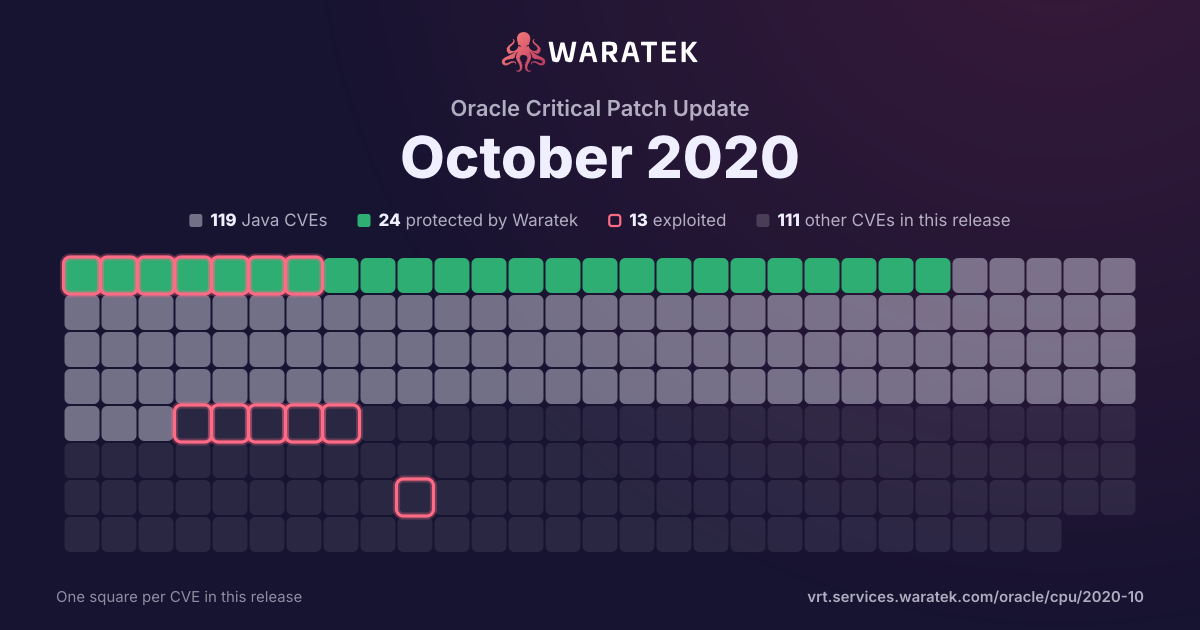
By status
26Protected by Waratek8Mitigation candidate100No exploit published3Outside Waratek scope93Not applicable
13Exploited, marked by the ring
No exploit published. For 78 of them, Oracle's security advisory is the source of public detail.
Protected by Waratek. Waratek RASP can block exploitation of these on systems that have not applied the patch yet.
Overview 7 matches · 0 protected · 0 exploited · 0 CISA KEV · 0 public PoC · 0 EPSS ≥ 0.5
7matches
0protected0.0%
0exploited0.0%
0CISA KEV0.0%
0public PoC0.0%
0EPSS ≥ 0.50.0%
Protected by Waratek
0
0.0%
Rule in development
0
0.0%
Mitigation candidate
1
14.3%
No exploit published
6
85.7%
blocked by ARMR today
0
0.0%
partly blocked
0
0.0%
not blocked
7
100.0%
not established
0
0.0%
unrecorded
0
0.0%
Exploited
0
0.0%
Working exploit published
0
0.0%
Proof of concept only
0
0.0%
Forecast only
0
0.0%
No public exploit
7
100.0%
split by
peak 3 / quarter
Q3 181
No exploit published1
Critical1
not blocked1
No public exploit1
Q4 180
Q1 190
Q2 190
Q3 190
Q4 193
No exploit published3
Critical3
not blocked3
No public exploit3
Q1 201
Mitigation candidate1
Critical1
not blocked1
No public exploit1
Q2 200
Q3 201
No exploit published1
Critical1
not blocked1
No public exploit1
Q4 201
No exploit published1
Critical1
not blocked1
No public exploit1
Q3 18Q4 18Q1 19Q2 19Q3 19Q4 19Q1 20Q2 20Q3 20Q4 20
| CVE | Severity | Published▾ | Status | Exploitation | Description |
|---|---|---|---|---|---|
| CVE-2020-14825 | Critical | 2020-10-21 | No exploit published | No public exploit | Vulnerability in the Oracle WebLogic Server product of Oracle Fusion Middleware (component: Core). Supported versions that are affected are 12.2.1.3.0, 12.2.1.4.0 and 14.1.1.0.0. Easily exploitable vulnerability allows unauthenticated attacker with network access via IIOP, T3 to compromise Oracle WebLogic Server. Successful attacks of this vulnerability can result in takeover of Oracle WebLogic Server. CVSS 3.1 Base Score 9.8 (Confidentiality, Integrity and Availability impacts). CVSS Vector: (CVSS:3.1/AV:N/AC:L/PR:N/UI:N/S:U/C:H/I:H/A:H). |
| CVE-2019-17638 | Critical | 2020-07-09 | No exploit published | No public exploit | In Eclipse Jetty, versions 9.4.27.v20200227 to 9.4.29.v20200521, in case of too large response headers, Jetty throws an exception to produce an HTTP 431 error. When this happens, the ByteBuffer containing the HTTP response headers is released back to the ByteBufferPool twice. Because of this double release, two threads can acquire the same ByteBuffer from the pool and while thread1 is about to use the ByteBuffer to write response1 data, thread2 fills the ByteBuffer with other data. Thread1 then proceeds to write the buffer that now contains different data. This results in client1, which issued request1 seeing data from another request or response which could contain sensitive data belonging to client2 (HTTP session ids, authentication credentials, etc.). If the Jetty version cannot be upgraded, the vulnerability can be significantly reduced by configuring a responseHeaderSize significantly larger than the requestHeaderSize (12KB responseHeaderSize and 8KB requestHeaderSize). |
| CVE-2020-9546 | Critical | 2020-03-02 | Mitigation candidate | No public exploit | FasterXML jackson-databind 2.x before 2.9.10.4 mishandles the interaction between serialization gadgets and typing, related to org.apache.hadoop.shaded.com.zaxxer.hikari.HikariConfig (aka shaded hikari-config). |
| CVE-2019-2904 | Critical | 2019-10-16 | No exploit published | No public exploit | Vulnerability in the Oracle JDeveloper and ADF product of Oracle Fusion Middleware (component: ADF Faces). Supported versions that are affected are 11.1.1.9.0, 12.1.3.0.0 and 12.2.1.3.0. Easily exploitable vulnerability allows unauthenticated attacker with network access via HTTP to compromise Oracle JDeveloper and ADF. Successful attacks of this vulnerability can result in takeover of Oracle JDeveloper and ADF. CVSS 3.0 Base Score 9.8 (Confidentiality, Integrity and Availability impacts). CVSS Vector: (CVSS:3.0/AV:N/AC:L/PR:N/UI:N/S:U/C:H/I:H/A:H). |
| CVE-2019-17531 | Critical | 2019-10-12 | No exploit published | No public exploit | A Polymorphic Typing issue was discovered in FasterXML jackson-databind 2.0.0 through 2.9.10. When Default Typing is enabled (either globally or for a specific property) for an externally exposed JSON endpoint and the service has the apache-log4j-extra (version 1.2.x) jar in the classpath, and an attacker can provide a JNDI service to access, it is possible to make the service execute a malicious payload. |
| CVE-2019-17267 | Critical | 2019-10-07 | No exploit published | No public exploit | A Polymorphic Typing issue was discovered in FasterXML jackson-databind before 2.9.10. It is related to net.sf.ehcache.hibernate.EhcacheJtaTransactionManagerLookup. |
| CVE-2018-11058 | Critical | 2018-09-14 | No exploit published | No public exploit | RSA BSAFE Micro Edition Suite, versions prior to 4.0.11 (in 4.0.x) and prior to 4.1.6 (in 4.1.x), and RSA BSAFE Crypto-C Micro Edition, version prior to 4.0.5.3 (in 4.0.x) contain a Buffer Over-Read vulnerability when parsing ASN.1 data. A remote attacker could use maliciously constructed ASN.1 data that would result in such issue. |