
Oracle Critical Patch Update October 2020
Released October 2020 · Oracle's advisory ↗ · ← Critical Patch Update, July 2020 · Critical Patch Update, January 2021 →
230 CVEs in this release, one square each
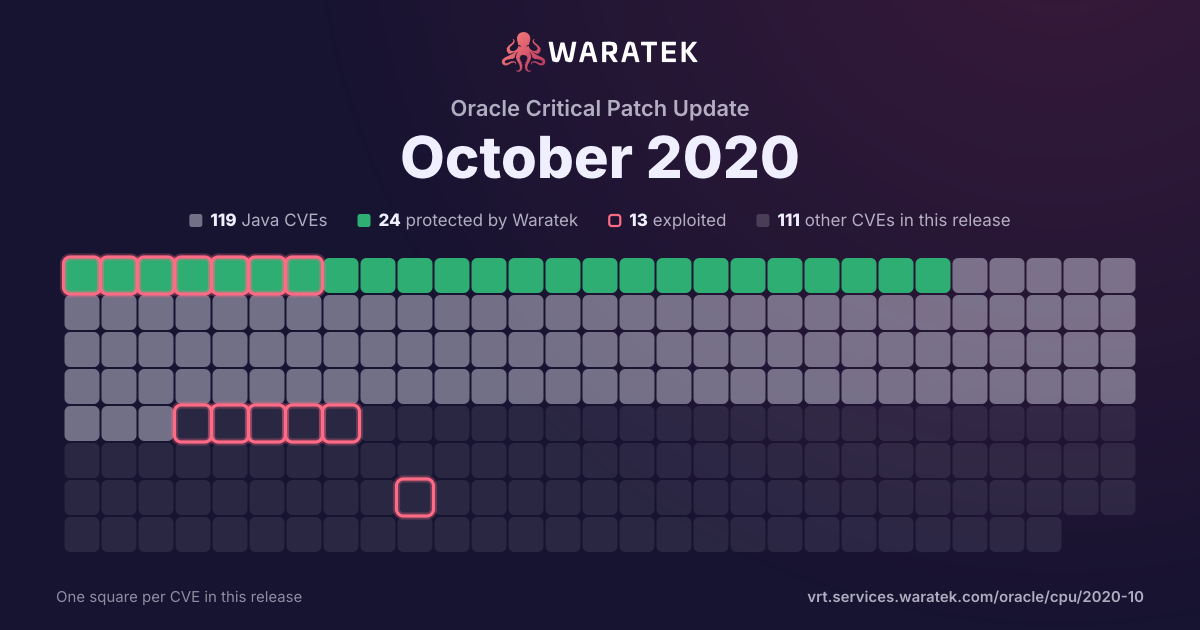
By status
25Protected by Waratek3Mitigation candidate101No exploit published3Outside Waratek scope98Not applicable
13Exploited, marked by the ring
No exploit published. For 77 of them, Oracle's security advisory is the source of public detail.
Protected by Waratek. Waratek RASP can block exploitation of these on systems that have not applied the patch yet.
Overview 5 matches · 2 protected · 0 exploited · 0 CISA KEV · 0 public PoC · 0 EPSS ≥ 0.5
Protected by Waratek
2
40.0%
Rule in development
0
0.0%
Mitigation candidate
0
0.0%
No exploit published
3
60.0%
blocked by ARMR today
2
40.0%
partly blocked
0
0.0%
not blocked
3
60.0%
not established
0
0.0%
unrecorded
0
0.0%
Exploited
0
0.0%
Working exploit published
0
0.0%
Proof of concept only
0
0.0%
Forecast only
0
0.0%
No public exploit
5
100.0%
| CVE | Severity | Published▾ | Status | Exploitation | Description |
|---|---|---|---|---|---|
| CVE-2019-12415 | Medium | 2019-10-23 | Protected by Waratek | No public exploit | In Apache POI up to 4.1.0, when using the tool XSSFExportToXml to convert user-provided Microsoft Excel documents, a specially crafted document can allow an attacker to read files from the local filesystem or from internal network resources via XML External Entity (XXE) Processing. |
| CVE-2019-2904 | Critical | 2019-10-16 | No exploit published | No public exploit | Vulnerability in the Oracle JDeveloper and ADF product of Oracle Fusion Middleware (component: ADF Faces). Supported versions that are affected are 11.1.1.9.0, 12.1.3.0.0 and 12.2.1.3.0. Easily exploitable vulnerability allows unauthenticated attacker with network access via HTTP to compromise Oracle JDeveloper and ADF. Successful attacks of this vulnerability can result in takeover of Oracle JDeveloper and ADF. CVSS 3.0 Base Score 9.8 (Confidentiality, Integrity and Availability impacts). CVSS Vector: (CVSS:3.0/AV:N/AC:L/PR:N/UI:N/S:U/C:H/I:H/A:H). |
| CVE-2019-17495 | Critical | 2019-10-10 | No exploit published | No public exploit | A Cascading Style Sheets (CSS) injection vulnerability in Swagger UI before 3.23.11 allows attackers to use the Relative Path Overwrite (RPO) technique to perform CSS-based input field value exfiltration, such as exfiltration of a CSRF token value. In other words, this product intentionally allows the embedding of untrusted JSON data from remote servers, but it was not previously known that <style>@import within the JSON data was a functional attack method. |
| CVE-2019-17359 | High | 2019-10-08 | No exploit published | No public exploit | The ASN.1 parser in Bouncy Castle Crypto (aka BC Java) 1.63 can trigger a large attempted memory allocation, and resultant OutOfMemoryError error, via crafted ASN.1 data. This is fixed in 1.64. |
| CVE-2019-17091 | Medium | 2019-10-02 | Protected by Waratek | No public exploit | faces/context/PartialViewContextImpl.java in Eclipse Mojarra, as used in Mojarra for Eclipse EE4J before 2.3.10 and Mojarra JavaServer Faces before 2.2.20, allows Reflected XSS because a client window field is mishandled. |