
Oracle Critical Patch Update October 2020
Released October 2020 · Oracle's advisory ↗ · ← Critical Patch Update, July 2020 · Critical Patch Update, January 2021 →
230 CVEs in this release, one square each
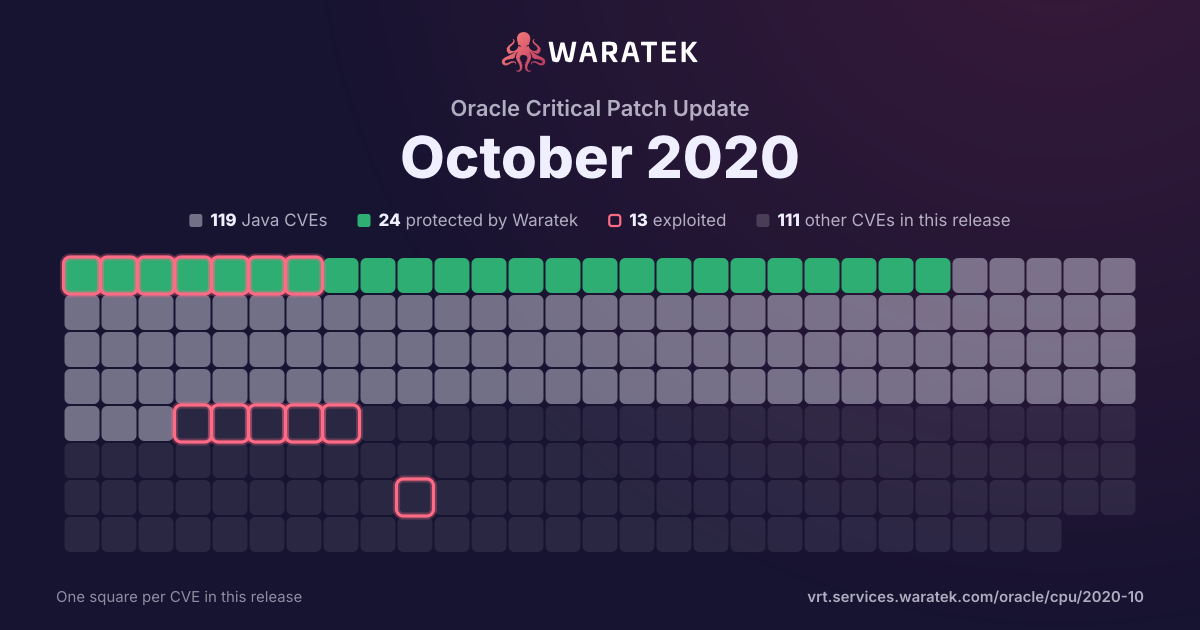
By status
25Protected by Waratek8Mitigation candidate101No exploit published3Outside Waratek scope93Not applicable
13Exploited, marked by the ring
No exploit published. For 77 of them, Oracle's security advisory is the source of public detail.
Protected by Waratek. Waratek RASP can block exploitation of these on systems that have not applied the patch yet.
Overview 4 matches · 1 protected · 2 exploited · 0 CISA KEV · 3 public PoC
Protected by Waratek
1
25.0%
Rule in development
0
0.0%
Mitigation candidate
3
75.0%
No exploit published
0
0.0%
blocked by ARMR today
1
25.0%
partly blocked
0
0.0%
not blocked
3
75.0%
not established
0
0.0%
unrecorded
0
0.0%
Exploited
2
50.0%
Working exploit published
0
0.0%
Proof of concept only
1
25.0%
Forecast only
1
25.0%
No public exploit
0
0.0%
split by
peak 1 / month
Apr 191
Mitigation candidate1
Medium1
not blocked1
Exploited1
May 190
Jun 190
Jul 191
Protected by Waratek1
Critical1
blocked by ARMR today1
Forecast only1
Aug 190
Sep 190
Oct 190
Nov 190
Dec 190
Jan 201
Mitigation candidate1
High1
not blocked1
Proof of concept only1
Feb 200
Mar 200
Apr 201
Mitigation candidate1
Medium1
not blocked1
Exploited1
Apr 19Jun 19Aug 19Oct 19Dec 19Feb 20Apr 20
| CVE | Severity | Published▾ | Status | Exploitation | Description |
|---|---|---|---|---|---|
| CVE-2020-11022 | Medium | 2020-04-29 | Mitigation candidate | Exploited | In jQuery starting with 1.12.0 and before 3.5.0, passing HTML from untrusted sources - even after sanitizing it - to one of jQuery's DOM manipulation methods (i.e. .html(), .append(), and others) may execute untrusted code. This problem is patched in jQuery 3.5.0. |
| CVE-2020-5398 | High | 2020-01-17 | Mitigation candidate | Proof of concept only | In Spring Framework, versions 5.2.x prior to 5.2.3, versions 5.1.x prior to 5.1.13, and versions 5.0.x prior to 5.0.16, an application is vulnerable to a reflected file download (RFD) attack when it sets a "Content-Disposition" header in the response where the filename attribute is derived from user supplied input. |
| CVE-2019-10173 | Critical | 2019-07-23 | Protected by Waratek | Forecast only | It was found that xstream API version 1.4.10 before 1.4.11 introduced a regression for a previous deserialization flaw. If the security framework has not been initialized, it may allow a remote attacker to run arbitrary shell commands when unmarshalling XML or any supported format. e.g. JSON. (regression of CVE-2013-7285) |
| CVE-2019-11358 | Medium | 2019-04-20 | Mitigation candidate | Exploited | jQuery before 3.4.0, as used in Drupal, Backdrop CMS, and other products, mishandles jQuery.extend(true, {}, ...) because of Object.prototype pollution. If an unsanitized source object contained an enumerable __proto__ property, it could extend the native Object.prototype. |