
Oracle Critical Patch Update October 2020
Released October 2020 · Oracle's advisory ↗ · ← Critical Patch Update, July 2020 · Critical Patch Update, January 2021 →
230 CVEs in this release, one square each
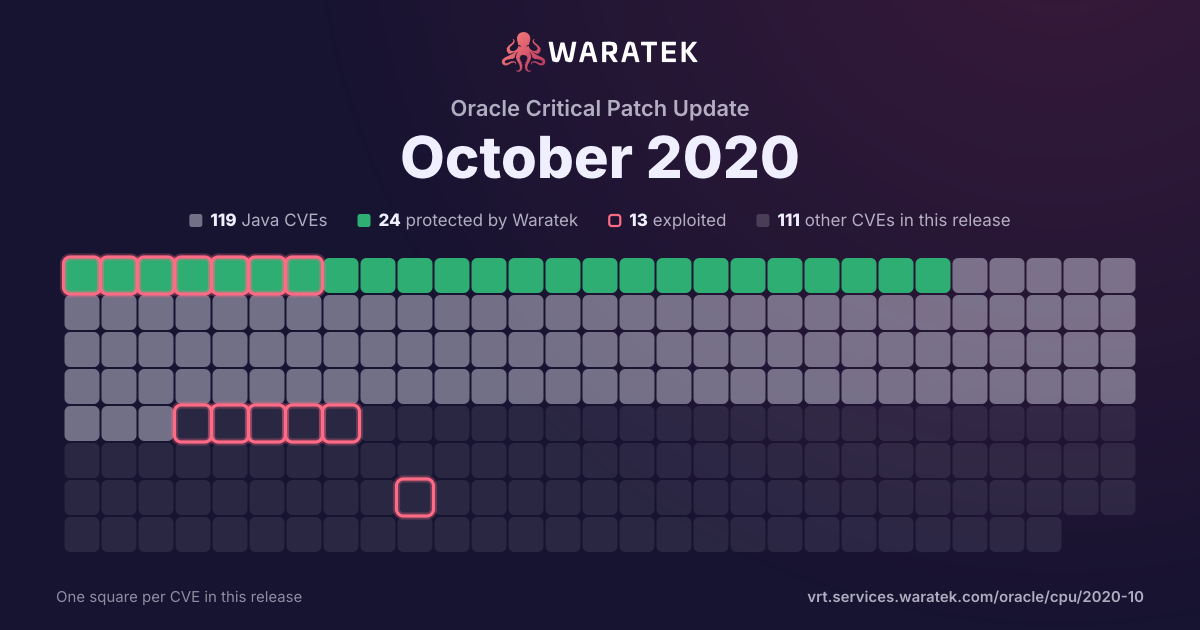
By status
24Protected by Waratek2Mitigation candidate93No exploit published64Outside Waratek scope47Not applicable
13Exploited, marked by the ring
No exploit published. For 75 of them, Oracle's security advisory is the source of public detail.
Protected by Waratek. Waratek RASP can block exploitation of these on systems that have not applied the patch yet.
Overview 47 matches · 0 in Waratek scope · 0 protected · 1 exploited · 1 CISA KEV · 2 public PoC · 2 EPSS ≥ 0.5
47matches
0in Waratek scope0.0%
0protected0.0%
1exploited2.1%
1CISA KEV2.1%
2public PoC4.3%
2EPSS ≥ 0.54.3%
Protected by Waratek
0
0.0%
Rule in development
0
0.0%
Mitigation candidate
0
0.0%
No exploit published
0
0.0%
Outside Waratek scope
0
0.0%
Not applicable
47
100.0%
Withdrawn CVE
0
0.0%
blocked by ARMR today
0
0.0%
partly blocked
0
0.0%
not blocked
47
100.0%
not established
0
0.0%
unrecorded
0
0.0%
Exploited
1
2.1%
Working exploit published
0
0.0%
Proof of concept only
1
2.1%
Forecast only
0
0.0%
No public exploit
45
95.7%
split by
peak 35 / quarter
Q3 171
Not applicable1
Critical1
not blocked1
No public exploit1
Q4 170
Q1 180
Q2 180
Q3 181
Not applicable1
Medium1
not blocked1
No public exploit1
Q4 180
Q1 190
Q2 192
Not applicable2
Critical1
High1
not blocked2
Proof of concept only1
No public exploit1
Q3 192
Not applicable2
High1
Medium1
not blocked2
No public exploit2
Q4 190
Q1 200
Q2 205
Not applicable5
High1
Medium4
not blocked5
No public exploit5
Q3 201
Not applicable1
High1
not blocked1
No public exploit1
Q4 2035
Not applicable35
Critical1
High5
Medium24
Low5
not blocked35
Exploited1
No public exploit34
Q4 17Q2 18Q4 18Q2 19Q4 19Q2 20Q4 20
| CVE | Severity | Published▾ | Status | Exploitation | Description |
|---|---|---|---|---|---|
| CVE-2020-14900 | Medium | 2020-10-21 | Not applicable | No public exploit | Vulnerability in the Oracle Application Express Group Calendar component of Oracle Database Server. The supported version that is affected is Prior to 20.2. Easily exploitable vulnerability allows low privileged attacker having Valid User Account privilege with network access via HTTP to compromise Oracle Application Express Group Calendar. Successful attacks require human interaction from a person other than the attacker and while the vulnerability is in Oracle Application Express Group Calendar, attacks may significantly impact additional products. Successful attacks of this vulnerability can result in unauthorized update, insert or delete access to some of Oracle Application Express Group Calendar accessible data as well as unauthorized read access to a subset of Oracle Application Express Group Calendar accessible data. CVSS 3.1 Base Score 5.4 (Confidentiality and Integrity impacts). CVSS Vector: (CVSS:3.1/AV:N/AC:L/PR:L/UI:R/S:C/C:L/I:L/A:N). |
| CVE-2020-14899 | Medium | 2020-10-21 | Not applicable | No public exploit | Vulnerability in the Oracle Application Express Data Reporter component of Oracle Database Server. The supported version that is affected is Prior to 20.2. Easily exploitable vulnerability allows low privileged attacker having Valid User Account privilege with network access via HTTP to compromise Oracle Application Express Data Reporter. Successful attacks require human interaction from a person other than the attacker and while the vulnerability is in Oracle Application Express Data Reporter, attacks may significantly impact additional products. Successful attacks of this vulnerability can result in unauthorized update, insert or delete access to some of Oracle Application Express Data Reporter accessible data as well as unauthorized read access to a subset of Oracle Application Express Data Reporter accessible data. CVSS 3.1 Base Score 5.4 (Confidentiality and Integrity impacts). CVSS Vector: (CVSS:3.1/AV:N/AC:L/PR:L/UI:R/S:C/C:L/I:L/A:N). |
| CVE-2020-14898 | Medium | 2020-10-21 | Not applicable | No public exploit | Vulnerability in the Oracle Application Express Packaged Apps component of Oracle Database Server. The supported version that is affected is Prior to 20.2. Easily exploitable vulnerability allows low privileged attacker having Valid User Account privilege with network access via HTTP to compromise Oracle Application Express Packaged Apps. Successful attacks require human interaction from a person other than the attacker and while the vulnerability is in Oracle Application Express Packaged Apps, attacks may significantly impact additional products. Successful attacks of this vulnerability can result in unauthorized update, insert or delete access to some of Oracle Application Express Packaged Apps accessible data as well as unauthorized read access to a subset of Oracle Application Express Packaged Apps accessible data. CVSS 3.1 Base Score 5.4 (Confidentiality and Integrity impacts). CVSS Vector: (CVSS:3.1/AV:N/AC:L/PR:L/UI:R/S:C/C:L/I:L/A:N). |
| CVE-2020-14893 | Medium | 2020-10-21 | Not applicable | No public exploit | Vulnerability in the MySQL Server product of Oracle MySQL (component: Server: Optimizer). Supported versions that are affected are 8.0.21 and prior. Easily exploitable vulnerability allows high privileged attacker with network access via multiple protocols to compromise MySQL Server. Successful attacks of this vulnerability can result in unauthorized ability to cause a hang or frequently repeatable crash (complete DOS) of MySQL Server. CVSS 3.1 Base Score 4.9 (Availability impacts). CVSS Vector: (CVSS:3.1/AV:N/AC:L/PR:H/UI:N/S:U/C:N/I:N/A:H). |
| CVE-2020-14892 | Medium | 2020-10-21 | Not applicable | No public exploit | Vulnerability in the Oracle VM VirtualBox product of Oracle Virtualization (component: Core). The supported version that is affected is Prior to 6.1.16. Easily exploitable vulnerability allows low privileged attacker with logon to the infrastructure where Oracle VM VirtualBox executes to compromise Oracle VM VirtualBox. Successful attacks of this vulnerability can result in unauthorized ability to cause a hang or frequently repeatable crash (complete DOS) of Oracle VM VirtualBox. CVSS 3.1 Base Score 5.5 (Availability impacts). CVSS Vector: (CVSS:3.1/AV:L/AC:L/PR:L/UI:N/S:U/C:N/I:N/A:H). |
| CVE-2020-14891 | Medium | 2020-10-21 | Not applicable | No public exploit | Vulnerability in the MySQL Server product of Oracle MySQL (component: Server: Optimizer). Supported versions that are affected are 8.0.21 and prior. Easily exploitable vulnerability allows high privileged attacker with network access via multiple protocols to compromise MySQL Server. Successful attacks of this vulnerability can result in unauthorized ability to cause a hang or frequently repeatable crash (complete DOS) of MySQL Server. CVSS 3.1 Base Score 4.9 (Availability impacts). CVSS Vector: (CVSS:3.1/AV:N/AC:L/PR:H/UI:N/S:U/C:N/I:N/A:H). |
| CVE-2020-14889 | Medium | 2020-10-21 | Not applicable | No public exploit | Vulnerability in the Oracle VM VirtualBox product of Oracle Virtualization (component: Core). The supported version that is affected is Prior to 6.1.16. Easily exploitable vulnerability allows high privileged attacker with logon to the infrastructure where Oracle VM VirtualBox executes to compromise Oracle VM VirtualBox. While the vulnerability is in Oracle VM VirtualBox, attacks may significantly impact additional products. Successful attacks of this vulnerability can result in unauthorized access to critical data or complete access to all Oracle VM VirtualBox accessible data. CVSS 3.1 Base Score 6.0 (Confidentiality impacts). CVSS Vector: (CVSS:3.1/AV:L/AC:L/PR:H/UI:N/S:C/C:H/I:N/A:N). |
| CVE-2020-14888 | Medium | 2020-10-21 | Not applicable | No public exploit | Vulnerability in the MySQL Server product of Oracle MySQL (component: Server: Optimizer). Supported versions that are affected are 8.0.21 and prior. Easily exploitable vulnerability allows high privileged attacker with network access via multiple protocols to compromise MySQL Server. Successful attacks of this vulnerability can result in unauthorized ability to cause a hang or frequently repeatable crash (complete DOS) of MySQL Server. CVSS 3.1 Base Score 4.9 (Availability impacts). CVSS Vector: (CVSS:3.1/AV:N/AC:L/PR:H/UI:N/S:U/C:N/I:N/A:H). |
| CVE-2020-14886 | Medium | 2020-10-21 | Not applicable | No public exploit | Vulnerability in the Oracle VM VirtualBox product of Oracle Virtualization (component: Core). The supported version that is affected is Prior to 6.1.16. Easily exploitable vulnerability allows high privileged attacker with logon to the infrastructure where Oracle VM VirtualBox executes to compromise Oracle VM VirtualBox. While the vulnerability is in Oracle VM VirtualBox, attacks may significantly impact additional products. Successful attacks of this vulnerability can result in unauthorized access to critical data or complete access to all Oracle VM VirtualBox accessible data. CVSS 3.1 Base Score 6.0 (Confidentiality impacts). CVSS Vector: (CVSS:3.1/AV:L/AC:L/PR:H/UI:N/S:C/C:H/I:N/A:N). |
| CVE-2020-14885 | Medium | 2020-10-21 | Not applicable | No public exploit | Vulnerability in the Oracle VM VirtualBox product of Oracle Virtualization (component: Core). The supported version that is affected is Prior to 6.1.16. Easily exploitable vulnerability allows high privileged attacker with logon to the infrastructure where Oracle VM VirtualBox executes to compromise Oracle VM VirtualBox. While the vulnerability is in Oracle VM VirtualBox, attacks may significantly impact additional products. Successful attacks of this vulnerability can result in unauthorized access to critical data or complete access to all Oracle VM VirtualBox accessible data. CVSS 3.1 Base Score 6.0 (Confidentiality impacts). CVSS Vector: (CVSS:3.1/AV:L/AC:L/PR:H/UI:N/S:C/C:H/I:N/A:N). |
| CVE-2020-14884 | Medium | 2020-10-21 | Not applicable | No public exploit | Vulnerability in the Oracle VM VirtualBox product of Oracle Virtualization (component: Core). The supported version that is affected is Prior to 6.1.16. Easily exploitable vulnerability allows high privileged attacker with logon to the infrastructure where Oracle VM VirtualBox executes to compromise Oracle VM VirtualBox. While the vulnerability is in Oracle VM VirtualBox, attacks may significantly impact additional products. Successful attacks of this vulnerability can result in unauthorized access to critical data or complete access to all Oracle VM VirtualBox accessible data. CVSS 3.1 Base Score 6.0 (Confidentiality impacts). CVSS Vector: (CVSS:3.1/AV:L/AC:L/PR:H/UI:N/S:C/C:H/I:N/A:N). |
| CVE-2020-14881 | Medium | 2020-10-21 | Not applicable | No public exploit | Vulnerability in the Oracle VM VirtualBox product of Oracle Virtualization (component: Core). The supported version that is affected is Prior to 6.1.16. Easily exploitable vulnerability allows high privileged attacker with logon to the infrastructure where Oracle VM VirtualBox executes to compromise Oracle VM VirtualBox. While the vulnerability is in Oracle VM VirtualBox, attacks may significantly impact additional products. Successful attacks of this vulnerability can result in unauthorized access to critical data or complete access to all Oracle VM VirtualBox accessible data. CVSS 3.1 Base Score 6.0 (Confidentiality impacts). CVSS Vector: (CVSS:3.1/AV:L/AC:L/PR:H/UI:N/S:C/C:H/I:N/A:N). |
| CVE-2020-14878 | High | 2020-10-21 | Not applicable | No public exploit | Vulnerability in the MySQL Server product of Oracle MySQL (component: Server: Security: LDAP Auth). Supported versions that are affected are 8.0.21 and prior. Easily exploitable vulnerability allows low privileged attacker with access to the physical communication segment attached to the hardware where the MySQL Server executes to compromise MySQL Server. Successful attacks of this vulnerability can result in takeover of MySQL Server. CVSS 3.1 Base Score 8.0 (Confidentiality, Integrity and Availability impacts). CVSS Vector: (CVSS:3.1/AV:A/AC:L/PR:L/UI:N/S:U/C:H/I:H/A:H). |
| CVE-2020-14873 | Medium | 2020-10-21 | Not applicable | No public exploit | Vulnerability in the MySQL Server product of Oracle MySQL (component: Server: Logging). Supported versions that are affected are 8.0.21 and prior. Difficult to exploit vulnerability allows high privileged attacker with network access via multiple protocols to compromise MySQL Server. Successful attacks of this vulnerability can result in unauthorized ability to cause a hang or frequently repeatable crash (complete DOS) of MySQL Server. CVSS 3.1 Base Score 4.4 (Availability impacts). CVSS Vector: (CVSS:3.1/AV:N/AC:H/PR:H/UI:N/S:U/C:N/I:N/A:H). |
| CVE-2020-14872 | High | 2020-10-21 | Not applicable | No public exploit | Vulnerability in the Oracle VM VirtualBox product of Oracle Virtualization (component: Core). The supported version that is affected is Prior to 6.1.16. Easily exploitable vulnerability allows high privileged attacker with logon to the infrastructure where Oracle VM VirtualBox executes to compromise Oracle VM VirtualBox. While the vulnerability is in Oracle VM VirtualBox, attacks may significantly impact additional products. Successful attacks of this vulnerability can result in takeover of Oracle VM VirtualBox. CVSS 3.1 Base Score 8.2 (Confidentiality, Integrity and Availability impacts). CVSS Vector: (CVSS:3.1/AV:L/AC:L/PR:H/UI:N/S:C/C:H/I:H/A:H). |
| CVE-2020-14871 | Critical | 2020-10-21 | Not applicable | Exploited | Vulnerability in the Oracle Solaris product of Oracle Systems (component: Pluggable authentication module). Supported versions that are affected are 10 and 11. Easily exploitable vulnerability allows unauthenticated attacker with network access via multiple protocols to compromise Oracle Solaris. While the vulnerability is in Oracle Solaris, attacks may significantly impact additional products. Successful attacks of this vulnerability can result in takeover of Oracle Solaris. Note: This CVE is not exploitable for Solaris 11.1 and later releases, and ZFSSA 8.7 and later releases, thus the CVSS Base Score is 0.0. CVSS 3.1 Base Score 10.0 (Confidentiality, Integrity and Availability impacts). CVSS Vector: (CVSS:3.1/AV:N/AC:L/PR:N/UI:N/S:C/C:H/I:H/A:H). |
| CVE-2020-14870 | Medium | 2020-10-21 | Not applicable | No public exploit | Vulnerability in the MySQL Server product of Oracle MySQL (component: Server: X Plugin). Supported versions that are affected are 8.0.21 and prior. Easily exploitable vulnerability allows high privileged attacker with network access via multiple protocols to compromise MySQL Server. Successful attacks of this vulnerability can result in unauthorized ability to cause a hang or frequently repeatable crash (complete DOS) of MySQL Server. CVSS 3.1 Base Score 4.9 (Availability impacts). CVSS Vector: (CVSS:3.1/AV:N/AC:L/PR:H/UI:N/S:U/C:N/I:N/A:H). |
| CVE-2020-14853 | Medium | 2020-10-21 | Not applicable | No public exploit | Vulnerability in the MySQL Cluster product of Oracle MySQL (component: Cluster: NDBCluster Plugin). Supported versions that are affected are 8.0.21 and prior. Easily exploitable vulnerability allows low privileged attacker with network access via multiple protocols to compromise MySQL Cluster. Successful attacks require human interaction from a person other than the attacker. Successful attacks of this vulnerability can result in unauthorized update, insert or delete access to some of MySQL Cluster accessible data and unauthorized ability to cause a partial denial of service (partial DOS) of MySQL Cluster. CVSS 3.1 Base Score 4.6 (Integrity and Availability impacts). CVSS Vector: (CVSS:3.1/AV:N/AC:L/PR:L/UI:R/S:U/C:N/I:L/A:L). |
| CVE-2020-14818 | Low | 2020-10-21 | Not applicable | No public exploit | Vulnerability in the Oracle Solaris product of Oracle Systems (component: Utility). The supported version that is affected is 11. Difficult to exploit vulnerability allows low privileged attacker with network access via SSH to compromise Oracle Solaris. Successful attacks require human interaction from a person other than the attacker and while the vulnerability is in Oracle Solaris, attacks may significantly impact additional products. Successful attacks of this vulnerability can result in unauthorized update, insert or delete access to some of Oracle Solaris accessible data. CVSS 3.1 Base Score 3.0 (Integrity impacts). CVSS Vector: (CVSS:3.1/AV:N/AC:H/PR:L/UI:R/S:C/C:N/I:L/A:N). |
| CVE-2020-14814 | Medium | 2020-10-21 | Not applicable | No public exploit | Vulnerability in the MySQL Server product of Oracle MySQL (component: Server: DML). Supported versions that are affected are 8.0.21 and prior. Easily exploitable vulnerability allows high privileged attacker with network access via multiple protocols to compromise MySQL Server. Successful attacks of this vulnerability can result in unauthorized ability to cause a hang or frequently repeatable crash (complete DOS) of MySQL Server. CVSS 3.1 Base Score 4.9 (Availability impacts). CVSS Vector: (CVSS:3.1/AV:N/AC:L/PR:H/UI:N/S:U/C:N/I:N/A:H). |
| CVE-2020-14810 | Medium | 2020-10-21 | Not applicable | No public exploit | Vulnerability in the Oracle Hospitality Suite8 product of Oracle Hospitality Applications (component: WebConnect). Supported versions that are affected are 8.10.2 and 8.11-8.14. Easily exploitable vulnerability allows unauthenticated attacker with network access via HTTP to compromise Oracle Hospitality Suite8. Successful attacks require human interaction from a person other than the attacker. Successful attacks of this vulnerability can result in unauthorized update, insert or delete access to some of Oracle Hospitality Suite8 accessible data as well as unauthorized read access to a subset of Oracle Hospitality Suite8 accessible data. CVSS 3.1 Base Score 5.4 (Confidentiality and Integrity impacts). CVSS Vector: (CVSS:3.1/AV:N/AC:L/PR:N/UI:R/S:U/C:L/I:L/A:N). |
| CVE-2020-14807 | High | 2020-10-21 | Not applicable | No public exploit | Vulnerability in the Oracle Hospitality Suite8 product of Oracle Hospitality Applications (component: WebConnect). Supported versions that are affected are 8.10.2 and 8.11-8.14. Easily exploitable vulnerability allows unauthenticated attacker with network access via HTTP to compromise Oracle Hospitality Suite8. Successful attacks require human interaction from a person other than the attacker. Successful attacks of this vulnerability can result in unauthorized access to critical data or complete access to all Oracle Hospitality Suite8 accessible data as well as unauthorized update, insert or delete access to some of Oracle Hospitality Suite8 accessible data. CVSS 3.1 Base Score 7.1 (Confidentiality and Integrity impacts). CVSS Vector: (CVSS:3.1/AV:N/AC:L/PR:N/UI:R/S:U/C:H/I:L/A:N). |
| CVE-2020-14783 | Medium | 2020-10-21 | Not applicable | No public exploit | Vulnerability in the Oracle Hospitality RES 3700 product of Oracle Food and Beverage Applications (component: CAL). The supported version that is affected is 5.7. Easily exploitable vulnerability allows unauthenticated attacker with network access via TCP to compromise Oracle Hospitality RES 3700. Successful attacks of this vulnerability can result in unauthorized read access to a subset of Oracle Hospitality RES 3700 accessible data. CVSS 3.1 Base Score 5.3 (Confidentiality impacts). CVSS Vector: (CVSS:3.1/AV:N/AC:L/PR:N/UI:N/S:U/C:L/I:N/A:N). |
| CVE-2020-14763 | Medium | 2020-10-21 | Not applicable | No public exploit | Vulnerability in the Oracle Application Express Quick Poll component of Oracle Database Server. The supported version that is affected is Prior to 20.2. Easily exploitable vulnerability allows low privileged attacker having Valid User Account privilege with network access via HTTP to compromise Oracle Application Express Quick Poll. Successful attacks require human interaction from a person other than the attacker and while the vulnerability is in Oracle Application Express Quick Poll, attacks may significantly impact additional products. Successful attacks of this vulnerability can result in unauthorized update, insert or delete access to some of Oracle Application Express Quick Poll accessible data as well as unauthorized read access to a subset of Oracle Application Express Quick Poll accessible data. CVSS 3.1 Base Score 5.4 (Confidentiality and Integrity impacts). CVSS Vector: (CVSS:3.1/AV:N/AC:L/PR:L/UI:R/S:C/C:L/I:L/A:N). |
| CVE-2020-14762 | Medium | 2020-10-21 | Not applicable | No public exploit | Vulnerability in the Oracle Application Express component of Oracle Database Server. The supported version that is affected is Prior to 20.2. Easily exploitable vulnerability allows low privileged attacker having SQL Workshop privilege with network access via HTTP to compromise Oracle Application Express. Successful attacks require human interaction from a person other than the attacker and while the vulnerability is in Oracle Application Express, attacks may significantly impact additional products. Successful attacks of this vulnerability can result in unauthorized update, insert or delete access to some of Oracle Application Express accessible data as well as unauthorized read access to a subset of Oracle Application Express accessible data. CVSS 3.1 Base Score 5.4 (Confidentiality and Integrity impacts). CVSS Vector: (CVSS:3.1/AV:N/AC:L/PR:L/UI:R/S:C/C:L/I:L/A:N). |
| CVE-2020-14760 | Medium | 2020-10-21 | Not applicable | No public exploit | Vulnerability in the MySQL Server product of Oracle MySQL (component: Server: Optimizer). Supported versions that are affected are 5.7.31 and prior. Easily exploitable vulnerability allows high privileged attacker with network access via multiple protocols to compromise MySQL Server. Successful attacks of this vulnerability can result in unauthorized ability to cause a hang or frequently repeatable crash (complete DOS) of MySQL Server as well as unauthorized update, insert or delete access to some of MySQL Server accessible data. CVSS 3.1 Base Score 5.5 (Integrity and Availability impacts). CVSS Vector: (CVSS:3.1/AV:N/AC:L/PR:H/UI:N/S:U/C:N/I:L/A:H). |
| CVE-2020-14759 | Low | 2020-10-21 | Not applicable | No public exploit | Vulnerability in the Oracle Solaris product of Oracle Systems (component: Kernel). The supported version that is affected is 11. Difficult to exploit vulnerability allows low privileged attacker with logon to the infrastructure where Oracle Solaris executes to compromise Oracle Solaris. Successful attacks require human interaction from a person other than the attacker and while the vulnerability is in Oracle Solaris, attacks may significantly impact additional products. Successful attacks of this vulnerability can result in unauthorized update, insert or delete access to some of Oracle Solaris accessible data. CVSS 3.1 Base Score 2.5 (Integrity impacts). CVSS Vector: (CVSS:3.1/AV:L/AC:H/PR:L/UI:R/S:C/C:N/I:L/A:N). |
| CVE-2020-14758 | Medium | 2020-10-21 | Not applicable | No public exploit | Vulnerability in the Oracle Solaris product of Oracle Systems (component: Kernel). The supported version that is affected is 11. Easily exploitable vulnerability allows low privileged attacker with logon to the infrastructure where Oracle Solaris executes to compromise Oracle Solaris. Successful attacks require human interaction from a person other than the attacker. Successful attacks of this vulnerability can result in unauthorized access to critical data or complete access to all Oracle Solaris accessible data and unauthorized ability to cause a partial denial of service (partial DOS) of Oracle Solaris. CVSS 3.1 Base Score 5.6 (Confidentiality and Availability impacts). CVSS Vector: (CVSS:3.1/AV:L/AC:L/PR:L/UI:R/S:U/C:H/I:N/A:L). |
| CVE-2020-14754 | Medium | 2020-10-21 | Not applicable | No public exploit | Vulnerability in the Oracle Solaris product of Oracle Systems (component: Filesystem). The supported version that is affected is 11. Easily exploitable vulnerability allows low privileged attacker with logon to the infrastructure where Oracle Solaris executes to compromise Oracle Solaris. Successful attacks of this vulnerability can result in unauthorized ability to cause a hang or frequently repeatable crash (complete DOS) of Oracle Solaris. CVSS 3.1 Base Score 5.5 (Availability impacts). CVSS Vector: (CVSS:3.1/AV:L/AC:L/PR:L/UI:N/S:U/C:N/I:N/A:H). |
| CVE-2020-14743 | Low | 2020-10-21 | Not applicable | No public exploit | Vulnerability in the Java VM component of Oracle Database Server. Supported versions that are affected are 11.2.0.4, 12.1.0.2, 12.2.0.1, 18c and 19c. Difficult to exploit vulnerability allows low privileged attacker having Create Procedure privilege with network access via multiple protocols to compromise Java VM. Successful attacks of this vulnerability can result in unauthorized update, insert or delete access to some of Java VM accessible data. CVSS 3.1 Base Score 3.1 (Integrity impacts). CVSS Vector: (CVSS:3.1/AV:N/AC:H/PR:L/UI:N/S:U/C:N/I:L/A:N). |
| CVE-2020-14742 | Low | 2020-10-21 | Not applicable | No public exploit | Vulnerability in the Core RDBMS component of Oracle Database Server. Supported versions that are affected are 11.2.0.4, 12.1.0.2, 12.2.0.1, 18c and 19c. Easily exploitable vulnerability allows high privileged attacker having SYSDBA level account privilege with network access via Oracle Net to compromise Core RDBMS. Successful attacks of this vulnerability can result in unauthorized update, insert or delete access to some of Core RDBMS accessible data. CVSS 3.1 Base Score 2.7 (Integrity impacts). CVSS Vector: (CVSS:3.1/AV:N/AC:L/PR:H/UI:N/S:U/C:N/I:L/A:N). |
| CVE-2020-14741 | Medium | 2020-10-21 | Not applicable | No public exploit | Vulnerability in the Database Filesystem component of Oracle Database Server. Supported versions that are affected are 11.2.0.4, 12.1.0.2 and 12.2.0.1. Easily exploitable vulnerability allows high privileged attacker having Resource, Create Table, Create View, Create Procedure, Dbfs_role privilege with network access via Oracle Net to compromise Database Filesystem. Successful attacks of this vulnerability can result in unauthorized ability to cause a hang or frequently repeatable crash (complete DOS) of Database Filesystem. CVSS 3.1 Base Score 4.9 (Availability impacts). CVSS Vector: (CVSS:3.1/AV:N/AC:L/PR:H/UI:N/S:U/C:N/I:N/A:H). |
| CVE-2020-14736 | Low | 2020-10-21 | Not applicable | No public exploit | Vulnerability in the Database Vault component of Oracle Database Server. Supported versions that are affected are 11.2.0.4, 12.1.0.2 and 12.2.0.1. Easily exploitable vulnerability allows high privileged attacker having Create Public Synonym privilege with network access via Oracle Net to compromise Database Vault. Successful attacks of this vulnerability can result in unauthorized update, insert or delete access to some of Database Vault accessible data as well as unauthorized read access to a subset of Database Vault accessible data. CVSS 3.1 Base Score 3.8 (Confidentiality and Integrity impacts). CVSS Vector: (CVSS:3.1/AV:N/AC:L/PR:H/UI:N/S:U/C:L/I:L/A:N). |
| CVE-2020-14735 | High | 2020-10-21 | Not applicable | No public exploit | Vulnerability in the Scheduler component of Oracle Database Server. Supported versions that are affected are 11.2.0.4, 12.1.0.2, 12.2.0.1, 18c and 19c. Easily exploitable vulnerability allows low privileged attacker having Local Logon privilege with logon to the infrastructure where Scheduler executes to compromise Scheduler. While the vulnerability is in Scheduler, attacks may significantly impact additional products. Successful attacks of this vulnerability can result in takeover of Scheduler. CVSS 3.1 Base Score 8.8 (Confidentiality, Integrity and Availability impacts). CVSS Vector: (CVSS:3.1/AV:L/AC:L/PR:L/UI:N/S:C/C:H/I:H/A:H). |
| CVE-2020-14734 | High | 2020-10-21 | Not applicable | No public exploit | Vulnerability in the Oracle Text component of Oracle Database Server. Supported versions that are affected are 11.2.0.4, 12.1.0.2, 12.2.0.1, 18c and 19c. Difficult to exploit vulnerability allows unauthenticated attacker with network access via Oracle Net to compromise Oracle Text. Successful attacks of this vulnerability can result in takeover of Oracle Text. CVSS 3.1 Base Score 8.1 (Confidentiality, Integrity and Availability impacts). CVSS Vector: (CVSS:3.1/AV:N/AC:H/PR:N/UI:N/S:U/C:H/I:H/A:H). |
| CVE-2020-8174 | High | 2020-07-24 | Not applicable | No public exploit | napi_get_value_string_*() allows various kinds of memory corruption in node < 10.21.0, 12.18.0, and < 14.4.0. |
| CVE-2020-15389 | Medium | 2020-06-29 | Not applicable | No public exploit | jp2/opj_decompress.c in OpenJPEG through 2.3.1 has a use-after-free that can be triggered if there is a mix of valid and invalid files in a directory operated on by the decompressor. Triggering a double-free may also be possible. This is related to calling opj_image_destroy twice. |
| CVE-2020-3235 | High | 2020-06-03 | Not applicable | No public exploit | A vulnerability in the Simple Network Management Protocol (SNMP) subsystem of Cisco IOS Software and Cisco IOS XE Software on Catalyst 4500 Series Switches could allow an authenticated, remote attacker to cause a denial of service (DoS) condition. The vulnerability is due to insufficient input validation when the software processes specific SNMP object identifiers. An attacker could exploit this vulnerability by sending a crafted SNMP packet to an affected device. A successful exploit could allow the attacker to cause the affected device to reload, resulting in a DoS condition. Note: To exploit this vulnerability by using SNMPv2c or earlier, the attacker must know the SNMP read-only community string for an affected system. To exploit this vulnerability by using SNMPv3, the attacker must know the user credentials for the affected system. |
| CVE-2020-13631 | Medium | 2020-05-27 | Not applicable | No public exploit | SQLite before 3.32.0 allows a virtual table to be renamed to the name of one of its shadow tables, related to alter.c and build.c. |
| CVE-2019-11048 | Medium | 2020-05-20 | Not applicable | No public exploit | In PHP versions 7.2.x below 7.2.31, 7.3.x below 7.3.18 and 7.4.x below 7.4.6, when HTTP file uploads are allowed, supplying overly long filenames or field names could lead PHP engine to try to allocate oversized memory storage, hit the memory limit and stop processing the request, without cleaning up temporary files created by upload request. This potentially could lead to accumulation of uncleaned temporary files exhausting the disk space on the target server. |
| CVE-2020-10722 | Medium | 2020-05-19 | Not applicable | No public exploit | A vulnerability was found in DPDK versions 18.05 and above. A missing check for an integer overflow in vhost_user_set_log_base() could result in a smaller memory map than requested, possibly allowing memory corruption. |
| CVE-2019-1547 | Medium | 2019-09-10 | Not applicable | No public exploit | Normally in OpenSSL EC groups always have a co-factor present and this is used in side channel resistant code paths. However, in some cases, it is possible to construct a group using explicit parameters (instead of using a named curve). In those cases it is possible that such a group does not have the cofactor present. This can occur even where all the parameters match a known named curve. If such a curve is used then OpenSSL falls back to non-side channel resistant code paths which may result in full key recovery during an ECDSA signature operation. In order to be vulnerable an attacker would have to have the ability to time the creation of a large number of signatures where explicit parameters with no co-factor present are in use by an application using libcrypto. For the avoidance of doubt libssl is not vulnerable because explicit parameters are never used. Fixed in OpenSSL 1.1.1d (Affected 1.1.1-1.1.1c). Fixed in OpenSSL 1.1.0l (Affected 1.1.0-1.1.0k). Fixed in OpenSSL 1.0.2t (Affected 1.0.2-1.0.2s). |
| CVE-2019-1010239 | High | 2019-07-19 | Not applicable | No public exploit | DaveGamble/cJSON cJSON 1.7.8 is affected by: Improper Check for Unusual or Exceptional Conditions. The impact is: Null dereference, so attack can cause denial of service. The component is: cJSON_GetObjectItemCaseSensitive() function. The attack vector is: crafted json file. The fixed version is: 1.7.9 and later. |
| CVE-2019-12900 | Critical | 2019-06-19 | Not applicable | No public exploit | BZ2_decompress in decompress.c in bzip2 through 1.0.6 has an out-of-bounds write when there are many selectors. |
| CVE-2019-11477 | High | 2019-06-19 | Not applicable | Proof of concept only | Jonathan Looney discovered that the TCP_SKB_CB(skb)->tcp_gso_segs value was subject to an integer overflow in the Linux kernel when handling TCP Selective Acknowledgments (SACKs). A remote attacker could use this to cause a denial of service. This has been fixed in stable kernel releases 4.4.182, 4.9.182, 4.14.127, 4.19.52, 5.1.11, and is fixed in commit 3b4929f65b0d8249f19a50245cd88ed1a2f78cff. |
| CVE-2018-3693 | Medium | 2018-07-10 | Not applicable | No public exploit | Systems with microprocessors utilizing speculative execution and branch prediction may allow unauthorized disclosure of information to an attacker with local user access via a speculative buffer overflow and side-channel analysis. |
| CVE-2017-9800 | Critical | 2017-08-11 | Not applicable | No public exploit | A maliciously constructed svn+ssh:// URL would cause Subversion clients before 1.8.19, 1.9.x before 1.9.7, and 1.10.0.x through 1.10.0-alpha3 to run an arbitrary shell command. Such a URL could be generated by a malicious server, by a malicious user committing to a honest server (to attack another user of that server's repositories), or by a proxy server. The vulnerability affects all clients, including those that use file://, http://, and plain (untunneled) svn://. |