
Oracle Critical Patch Update October 2020
Released October 2020 · Oracle's advisory ↗ · ← Critical Patch Update, July 2020 · Critical Patch Update, January 2021 →
230 CVEs in this release, one square each
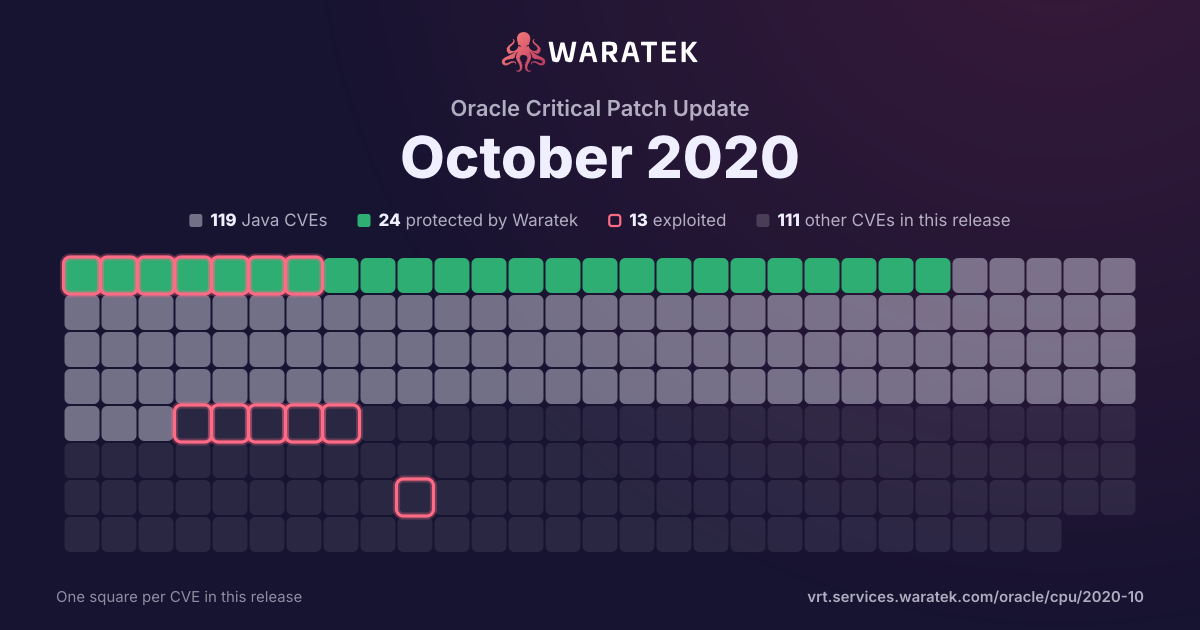
By status
24Protected by Waratek2Mitigation candidate93No exploit published64Outside Waratek scope47Not applicable
13Exploited, marked by the ring
No exploit published. For 75 of them, Oracle's security advisory is the source of public detail.
Protected by Waratek. Waratek RASP can block exploitation of these on systems that have not applied the patch yet.
Overview 6 matches · 4 protected · 3 exploited · 3 CISA KEV · 5 EPSS ≥ 0.5
Protected by Waratek
5
83.3%
Rule in development
0
0.0%
Mitigation candidate
1
16.7%
No exploit published
0
0.0%
blocked by ARMR today
4
66.7%
partly blocked
1
16.7%
not blocked
1
16.7%
not established
0
0.0%
unrecorded
0
0.0%
Exploited
3
50.0%
Working exploit published
2
33.3%
Proof of concept only
1
16.7%
Forecast only
0
0.0%
No public exploit
0
0.0%
split by
peak 2 / quarter
Q4 171
Protected by Waratek1
High1
blocked by ARMR today1
Proof of concept only1
Q1 180
Q2 180
Q3 180
Q4 180
Q1 190
Q2 190
Q3 190
Q4 191
Protected by Waratek1
High1
partly blocked1
Exploited1
Q1 200
Q2 201
Protected by Waratek1
High1
blocked by ARMR today1
Working exploit published1
Q3 201
Mitigation candidate1
High1
not blocked1
Working exploit published1
Q4 202
Protected by Waratek2
High2
blocked by ARMR today2
Exploited2
Q4 17Q2 18Q4 18Q2 19Q4 19Q2 20Q4 20
| CVE | Severity | Published▾ | Status | Exploitation | Description |
|---|---|---|---|---|---|
| CVE-2020-14883 | High | 2020-10-21 | Protected by Waratek | Exploited | Vulnerability in the Oracle WebLogic Server product of Oracle Fusion Middleware (component: Console). Supported versions that are affected are 10.3.6.0.0, 12.1.3.0.0, 12.2.1.3.0, 12.2.1.4.0 and 14.1.1.0.0. Easily exploitable vulnerability allows high privileged attacker with network access via HTTP to compromise Oracle WebLogic Server. Successful attacks of this vulnerability can result in takeover of Oracle WebLogic Server. CVSS 3.1 Base Score 7.2 (Confidentiality, Integrity and Availability impacts). CVSS Vector: (CVSS:3.1/AV:N/AC:L/PR:H/UI:N/S:U/C:H/I:H/A:H). |
| CVE-2020-14864 | High | 2020-10-21 | Protected by Waratek | Exploited | Vulnerability in the Oracle Business Intelligence Enterprise Edition product of Oracle Fusion Middleware (component: Installation). Supported versions that are affected are 5.5.0.0.0, 12.2.1.3.0 and 12.2.1.4.0. Easily exploitable vulnerability allows unauthenticated attacker with network access via HTTP to compromise Oracle Business Intelligence Enterprise Edition. Successful attacks of this vulnerability can result in unauthorized access to critical data or complete access to all Oracle Business Intelligence Enterprise Edition accessible data. CVSS 3.1 Base Score 7.5 (Confidentiality impacts). CVSS Vector: (CVSS:3.1/AV:N/AC:L/PR:N/UI:N/S:U/C:H/I:N/A:N). |
| CVE-2020-13935 | High | 2020-07-14 | Mitigation candidate | Working exploit published | The payload length in a WebSocket frame was not correctly validated in Apache Tomcat 10.0.0-M1 to 10.0.0-M6, 9.0.0.M1 to 9.0.36, 8.5.0 to 8.5.56 and 7.0.27 to 7.0.104. Invalid payload lengths could trigger an infinite loop. Multiple requests with invalid payload lengths could lead to a denial of service. |
| CVE-2020-9484 | High | 2020-05-20 | Protected by Waratek | Working exploit published | When using Apache Tomcat versions 10.0.0-M1 to 10.0.0-M4, 9.0.0.M1 to 9.0.34, 8.5.0 to 8.5.54 and 7.0.0 to 7.0.103 if a) an attacker is able to control the contents and name of a file on the server; and b) the server is configured to use the PersistenceManager with a FileStore; and c) the PersistenceManager is configured with sessionAttributeValueClassNameFilter="null" (the default unless a SecurityManager is used) or a sufficiently lax filter to allow the attacker provided object to be deserialized; and d) the attacker knows the relative file path from the storage location used by FileStore to the file the attacker has control over; then, using a specifically crafted request, the attacker will be able to trigger remote code execution via deserialization of the file under their control. Note that all of conditions a) to d) must be true for the attack to succeed. |
| CVE-2019-17558 | High | 2019-12-30 | Protected by Waratek | Exploited | Apache Solr 5.0.0 to Apache Solr 8.3.1 are vulnerable to a Remote Code Execution through the VelocityResponseWriter. A Velocity template can be provided through Velocity templates in a configset `velocity/` directory or as a parameter. A user defined configset could contain renderable, potentially malicious, templates. Parameter provided templates are disabled by default, but can be enabled by setting `params.resource.loader.enabled` by defining a response writer with that setting set to `true`. Defining a response writer requires configuration API access. Solr 8.4 removed the params resource loader entirely, and only enables the configset-provided template rendering when the configset is `trusted` (has been uploaded by an authenticated user). |
| CVE-2017-9096 | High | 2017-11-08 | Protected by Waratek | Proof of concept only | The XML parsers in iText before 5.5.12 and 7.x before 7.0.3 do not disable external entities, which might allow remote attackers to conduct XML external entity (XXE) attacks via a crafted PDF. |