
Oracle Critical Patch Update July 2020
Released July 2020 · Oracle's advisory ↗ · ← Critical Patch Update, April 2020 · Critical Patch Update, October 2020 →
285 CVEs in this release, one square each
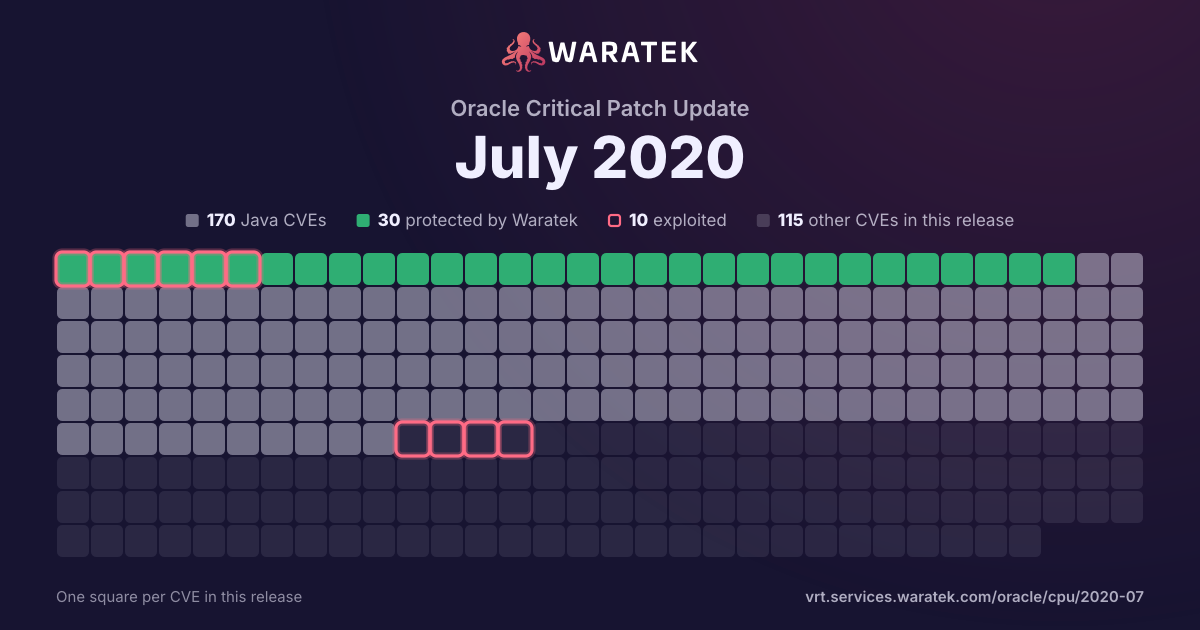
By status
32Protected by Waratek6Mitigation candidate151No exploit published8Outside Waratek scope88Not applicable
10Exploited, marked by the ring
No exploit published. For 132 of them, Oracle's security advisory is the source of public detail.
Protected by Waratek. Waratek RASP can block exploitation of these on systems that have not applied the patch yet.
Overview 15 matches · 0 in Waratek scope · 0 protected · 0 exploited · 0 CISA KEV · 2 public PoC · 1 EPSS ≥ 0.5
15matches
0in Waratek scope0.0%
0protected0.0%
0exploited0.0%
0CISA KEV0.0%
2public PoC13.3%
1EPSS ≥ 0.56.7%
Protected by Waratek
0
0.0%
Rule in development
0
0.0%
Mitigation candidate
0
0.0%
No exploit published
0
0.0%
Outside Waratek scope
0
0.0%
Not applicable
15
100.0%
Withdrawn CVE
0
0.0%
blocked by ARMR today
0
0.0%
partly blocked
0
0.0%
not blocked
15
100.0%
not established
0
0.0%
unrecorded
0
0.0%
Exploited
0
0.0%
Working exploit published
0
0.0%
Proof of concept only
3
20.0%
Forecast only
0
0.0%
No public exploit
12
80.0%
split by
peak 3 / quarter
Q2 171
Not applicable1
Critical1
not blocked1
No public exploit1
Q3 170
Q4 171
Not applicable1
High1
not blocked1
No public exploit1
Q1 180
Q2 181
Not applicable1
High1
not blocked1
No public exploit1
Q3 180
Q4 181
Not applicable1
Critical1
not blocked1
No public exploit1
Q1 191
Not applicable1
Medium1
not blocked1
Proof of concept only1
Q2 191
Not applicable1
Critical1
not blocked1
No public exploit1
Q3 192
Not applicable2
High1
Medium1
not blocked2
No public exploit2
Q4 192
Not applicable2
Medium2
not blocked2
No public exploit2
Q1 203
Not applicable3
Critical1
High2
not blocked3
Proof of concept only1
No public exploit2
Q2 202
Not applicable2
Critical1
High1
not blocked2
Proof of concept only1
No public exploit1
Q2 17Q4 17Q2 18Q4 18Q2 19Q4 19Q2 20
| CVE | Severity | Published▾ | Status | Exploitation | Description |
|---|---|---|---|---|---|
| CVE-2020-1967 | High | 2020-04-21 | Not applicable | Proof of concept only | Server or client applications that call the SSL_check_chain() function during or after a TLS 1.3 handshake may crash due to a NULL pointer dereference as a result of incorrect handling of the "signature_algorithms_cert" TLS extension. The crash occurs if an invalid or unrecognised signature algorithm is received from the peer. This could be exploited by a malicious peer in a Denial of Service attack. OpenSSL version 1.1.1d, 1.1.1e, and 1.1.1f are affected by this issue. This issue did not affect OpenSSL versions prior to 1.1.1d. Fixed in OpenSSL 1.1.1g (Affected 1.1.1d-1.1.1f). |
| CVE-2020-11656 | Critical | 2020-04-09 | Not applicable | No public exploit | In SQLite through 3.31.1, the ALTER TABLE implementation has a use-after-free, as demonstrated by an ORDER BY clause that belongs to a compound SELECT statement. |
| CVE-2020-7060 | Critical | 2020-02-10 | Not applicable | No public exploit | When using certain mbstring functions to convert multibyte encodings, in PHP versions 7.2.x below 7.2.27, 7.3.x below 7.3.14 and 7.4.x below 7.4.2 it is possible to supply data that will cause function mbfl_filt_conv_big5_wchar to read past the allocated buffer. This may lead to information disclosure or crash. |
| CVE-2020-8112 | High | 2020-01-28 | Not applicable | No public exploit | opj_t1_clbl_decode_processor in openjp2/t1.c in OpenJPEG 2.3.1 through 2020-01-28 has a heap-based buffer overflow in the qmfbid==1 case, a different issue than CVE-2020-6851. |
| CVE-2020-7595 | High | 2020-01-21 | Not applicable | Proof of concept only | xmlStringLenDecodeEntities in parser.c in libxml2 2.9.10 has an infinite loop in a certain end-of-file situation. |
| CVE-2019-1551 | Medium | 2019-12-06 | Not applicable | No public exploit | There is an overflow bug in the x64_64 Montgomery squaring procedure used in exponentiation with 512-bit moduli. No EC algorithms are affected. Analysis suggests that attacks against 2-prime RSA1024, 3-prime RSA1536, and DSA1024 as a result of this defect would be very difficult to perform and are not believed likely. Attacks against DH512 are considered just feasible. However, for an attack the target would have to re-use the DH512 private key, which is not recommended anyway. Also applications directly using the low level API BN_mod_exp may be affected if they use BN_FLG_CONSTTIME. Fixed in OpenSSL 1.1.1e (Affected 1.1.1-1.1.1d). Fixed in OpenSSL 1.0.2u (Affected 1.0.2-1.0.2t). |
| CVE-2018-12207 | Medium | 2019-11-14 | Not applicable | No public exploit | Improper invalidation for page table updates by a virtual guest operating system for multiple Intel(R) Processors may allow an authenticated user to potentially enable denial of service of the host system via local access. |
| CVE-2019-1547 | Medium | 2019-09-10 | Not applicable | No public exploit | Normally in OpenSSL EC groups always have a co-factor present and this is used in side channel resistant code paths. However, in some cases, it is possible to construct a group using explicit parameters (instead of using a named curve). In those cases it is possible that such a group does not have the cofactor present. This can occur even where all the parameters match a known named curve. If such a curve is used then OpenSSL falls back to non-side channel resistant code paths which may result in full key recovery during an ECDSA signature operation. In order to be vulnerable an attacker would have to have the ability to time the creation of a large number of signatures where explicit parameters with no co-factor present are in use by an application using libcrypto. For the avoidance of doubt libssl is not vulnerable because explicit parameters are never used. Fixed in OpenSSL 1.1.1d (Affected 1.1.1-1.1.1c). Fixed in OpenSSL 1.1.0l (Affected 1.1.0-1.1.0k). Fixed in OpenSSL 1.0.2t (Affected 1.0.2-1.0.2s). |
| CVE-2019-16056 | High | 2019-09-06 | Not applicable | No public exploit | An issue was discovered in Python through 2.7.16, 3.x through 3.5.7, 3.6.x through 3.6.9, and 3.7.x through 3.7.4. The email module wrongly parses email addresses that contain multiple @ characters. An application that uses the email module and implements some kind of checks on the From/To headers of a message could be tricked into accepting an email address that should be denied. An attack may be the same as in CVE-2019-11340; however, this CVE applies to Python more generally. |
| CVE-2019-8457 | Critical | 2019-05-30 | Not applicable | No public exploit | SQLite3 from 3.6.0 to and including 3.27.2 is vulnerable to heap out-of-bound read in the rtreenode() function when handling invalid rtree tables. |
| CVE-2019-5489 | Medium | 2019-01-07 | Not applicable | Proof of concept only | The mincore() implementation in mm/mincore.c in the Linux kernel through 4.19.13 allowed local attackers to observe page cache access patterns of other processes on the same system, potentially allowing sniffing of secret information. (Fixing this affects the output of the fincore program.) Limited remote exploitation may be possible, as demonstrated by latency differences in accessing public files from an Apache HTTP Server. |
| CVE-2018-18314 | Critical | 2018-12-07 | Not applicable | No public exploit | Perl before 5.26.3 has a buffer overflow via a crafted regular expression that triggers invalid write operations. |
| CVE-2017-10140 | High | 2018-04-16 | Not applicable | No public exploit | Postfix before 2.11.10, 3.0.x before 3.0.10, 3.1.x before 3.1.6, and 3.2.x before 3.2.2 might allow local users to gain privileges by leveraging undocumented functionality in Berkeley DB 2.x and later, related to reading settings from DB_CONFIG in the current directory. |
| CVE-2017-0861 | High | 2017-11-16 | Not applicable | No public exploit | Use-after-free vulnerability in the snd_pcm_info function in the ALSA subsystem in the Linux kernel allows attackers to gain privileges via unspecified vectors. |
| CVE-2016-9843 | Critical | 2017-05-23 | Not applicable | No public exploit | The crc32_big function in crc32.c in zlib 1.2.8 might allow context-dependent attackers to have unspecified impact via vectors involving big-endian CRC calculation. |