
Oracle Critical Patch Update July 2020
Released July 2020 · Oracle's advisory ↗ · ← Critical Patch Update, April 2020 · Critical Patch Update, October 2020 →
285 CVEs in this release, one square each
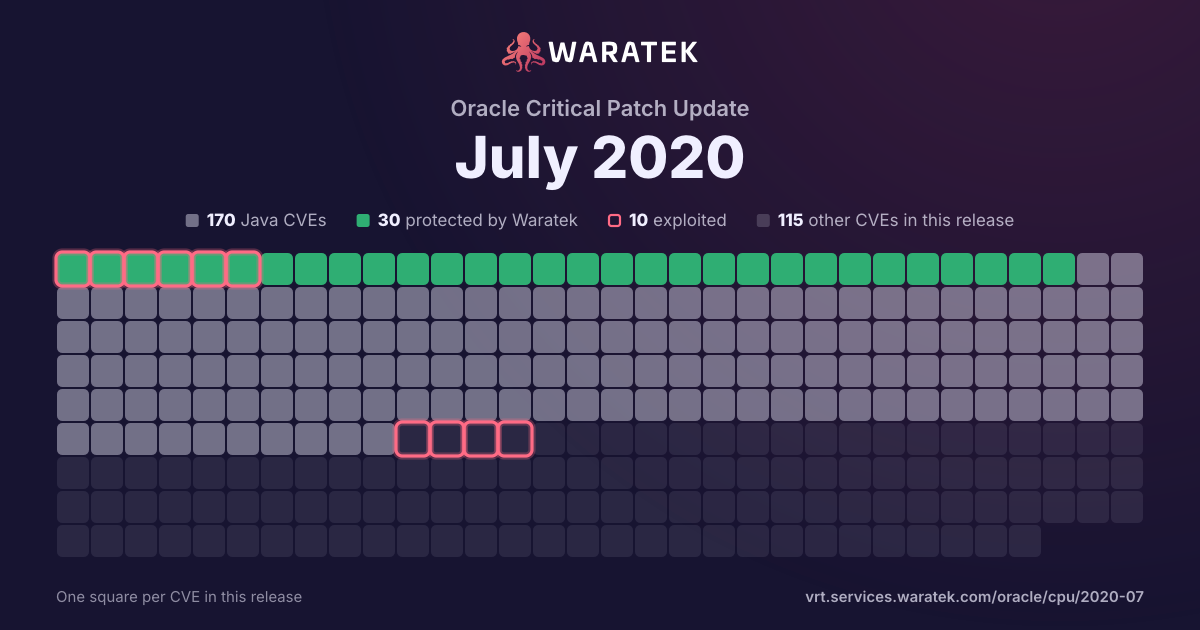
By status
32Protected by Waratek6Mitigation candidate151No exploit published8Outside Waratek scope88Not applicable
10Exploited, marked by the ring
No exploit published. For 132 of them, Oracle's security advisory is the source of public detail.
Protected by Waratek. Waratek RASP can block exploitation of these on systems that have not applied the patch yet.
Overview 6 matches · 4 in Waratek scope · 1 protected · 3 exploited · 0 CISA KEV · 4 public PoC · 2 EPSS ≥ 0.5
6matches
4in Waratek scope66.7%
1protected16.7%
3exploited50.0%
0CISA KEV0.0%
4public PoC66.7%
2EPSS ≥ 0.533.3%
Protected by Waratek
1
16.7%
Rule in development
0
0.0%
Mitigation candidate
2
33.3%
No exploit published
1
16.7%
Outside Waratek scope
1
16.7%
Not applicable
1
16.7%
Withdrawn CVE
0
0.0%
blocked by ARMR today
1
16.7%
partly blocked
0
0.0%
not blocked
5
83.3%
not established
0
0.0%
unrecorded
0
0.0%
Exploited
3
50.0%
Working exploit published
0
0.0%
Proof of concept only
1
16.7%
Forecast only
0
0.0%
No public exploit
2
33.3%
split by
peak 2 / month
Jan 181
Mitigation candidate1
Medium1
not blocked1
Exploited1
Feb 180
Mar 180
Apr 181
Protected by Waratek1
Medium1
blocked by ARMR today1
No public exploit1
May 181
Outside Waratek scope1
Medium1
not blocked1
Exploited1
Jun 180
Jul 180
Aug 180
Sep 180
Oct 180
Nov 180
Dec 180
Jan 191
Not applicable1
Medium1
not blocked1
Proof of concept only1
Feb 190
Mar 190
Apr 192
Mitigation candidate1
No exploit published1
Medium2
not blocked2
Exploited1
No public exploit1
Feb 18Apr 18Jun 18Aug 18Oct 18Dec 18Feb 19Apr 19
| CVE | Severity | Published▾ | Status | Exploitation | Description |
|---|---|---|---|---|---|
| CVE-2019-10247 | Medium | 2019-04-22 | No exploit published | No public exploit | In Eclipse Jetty version 7.x, 8.x, 9.2.27 and older, 9.3.26 and older, and 9.4.16 and older, the server running on any OS and Jetty version combination will reveal the configured fully qualified directory base resource location on the output of the 404 error for not finding a Context that matches the requested path. The default server behavior on jetty-distribution and jetty-home will include at the end of the Handler tree a DefaultHandler, which is responsible for reporting this 404 error, it presents the various configured contexts as HTML for users to click through to. This produced HTML includes output that contains the configured fully qualified directory base resource location for each context. |
| CVE-2019-11358 | Medium | 2019-04-20 | Mitigation candidate | Exploited | jQuery before 3.4.0, as used in Drupal, Backdrop CMS, and other products, mishandles jQuery.extend(true, {}, ...) because of Object.prototype pollution. If an unsanitized source object contained an enumerable __proto__ property, it could extend the native Object.prototype. |
| CVE-2019-5489 | Medium | 2019-01-07 | Not applicable | Proof of concept only | The mincore() implementation in mm/mincore.c in the Linux kernel through 4.19.13 allowed local attackers to observe page cache access patterns of other processes on the same system, potentially allowing sniffing of secret information. (Fixing this affects the output of the fincore program.) Limited remote exploitation may be possible, as demonstrated by latency differences in accessing public files from an Apache HTTP Server. |
| CVE-2018-3639 | Medium | 2018-05-22 | Outside Waratek scope | Exploited | Systems with microprocessors utilizing speculative execution and speculative execution of memory reads before the addresses of all prior memory writes are known may allow unauthorized disclosure of information to an attacker with local user access via a side-channel analysis, aka Speculative Store Bypass (SSB), Variant 4. |
| CVE-2018-10237 | Medium | 2018-04-26 | Protected by Waratek | No public exploit | Unbounded memory allocation in Google Guava 11.0 through 24.x before 24.1.1 allows remote attackers to conduct denial of service attacks against servers that depend on this library and deserialize attacker-provided data, because the AtomicDoubleArray class (when serialized with Java serialization) and the CompoundOrdering class (when serialized with GWT serialization) perform eager allocation without appropriate checks on what a client has sent and whether the data size is reasonable. |
| CVE-2015-9251 | Medium | 2018-01-18 | Mitigation candidate | Exploited | jQuery before 3.0.0 is vulnerable to Cross-site Scripting (XSS) attacks when a cross-domain Ajax request is performed without the dataType option, causing text/javascript responses to be executed. |