
Oracle Critical Patch Update July 2020
Released July 2020 · Oracle's advisory ↗ · ← Critical Patch Update, April 2020 · Critical Patch Update, October 2020 →
285 CVEs in this release, one square each
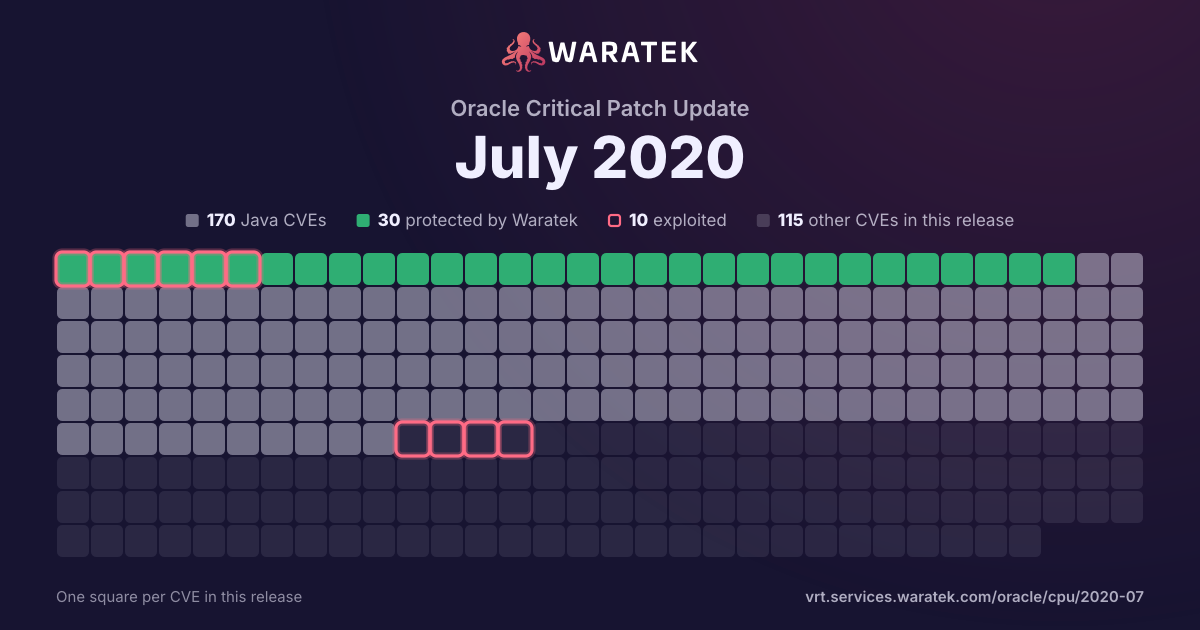
By status
32Protected by Waratek6Mitigation candidate151No exploit published8Outside Waratek scope88Not applicable
10Exploited, marked by the ring
No exploit published. For 132 of them, Oracle's security advisory is the source of public detail.
Protected by Waratek. Waratek RASP can block exploitation of these on systems that have not applied the patch yet.
Overview 9 matches · 7 in Waratek scope · 3 protected · 0 exploited · 0 CISA KEV · 0 public PoC · 0 EPSS ≥ 0.5
9matches
7in Waratek scope77.8%
3protected33.3%
0exploited0.0%
0CISA KEV0.0%
0public PoC0.0%
0EPSS ≥ 0.50.0%
Protected by Waratek
3
33.3%
Rule in development
0
0.0%
Mitigation candidate
0
0.0%
No exploit published
4
44.4%
Outside Waratek scope
0
0.0%
Not applicable
2
22.2%
Withdrawn CVE
0
0.0%
blocked by ARMR today
3
33.3%
partly blocked
0
0.0%
not blocked
6
66.7%
not established
0
0.0%
unrecorded
0
0.0%
Exploited
0
0.0%
Working exploit published
0
0.0%
Proof of concept only
0
0.0%
Forecast only
0
0.0%
No public exploit
9
100.0%
split by
peak 4 / month
Jul 194
Protected by Waratek2
No exploit published2
Critical2
High2
blocked by ARMR today2
not blocked2
No public exploit4
Aug 192
Protected by Waratek1
No exploit published1
High2
blocked by ARMR today1
not blocked1
No public exploit2
Sep 193
No exploit published1
Not applicable2
High1
Medium2
not blocked3
No public exploit3
Jul 19Aug 19Sep 19
| CVE | Severity | Published▾ | Status | Exploitation | Description |
|---|---|---|---|---|---|
| CVE-2019-3740 | Medium | 2019-09-18 | No exploit published | No public exploit | RSA BSAFE Crypto-J versions prior to 6.2.5 are vulnerable to an Information Exposure Through Timing Discrepancy vulnerabilities during DSA key generation. A malicious remote attacker could potentially exploit those vulnerabilities to recover DSA keys. |
| CVE-2019-1547 | Medium | 2019-09-10 | Not applicable | No public exploit | Normally in OpenSSL EC groups always have a co-factor present and this is used in side channel resistant code paths. However, in some cases, it is possible to construct a group using explicit parameters (instead of using a named curve). In those cases it is possible that such a group does not have the cofactor present. This can occur even where all the parameters match a known named curve. If such a curve is used then OpenSSL falls back to non-side channel resistant code paths which may result in full key recovery during an ECDSA signature operation. In order to be vulnerable an attacker would have to have the ability to time the creation of a large number of signatures where explicit parameters with no co-factor present are in use by an application using libcrypto. For the avoidance of doubt libssl is not vulnerable because explicit parameters are never used. Fixed in OpenSSL 1.1.1d (Affected 1.1.1-1.1.1c). Fixed in OpenSSL 1.1.0l (Affected 1.1.0-1.1.0k). Fixed in OpenSSL 1.0.2t (Affected 1.0.2-1.0.2s). |
| CVE-2019-16056 | High | 2019-09-06 | Not applicable | No public exploit | An issue was discovered in Python through 2.7.16, 3.x through 3.5.7, 3.6.x through 3.6.9, and 3.7.x through 3.7.4. The email module wrongly parses email addresses that contain multiple @ characters. An application that uses the email module and implements some kind of checks on the From/To headers of a message could be tricked into accepting an email address that should be denied. An attack may be the same as in CVE-2019-11340; however, this CVE applies to Python more generally. |
| CVE-2019-12402 | High | 2019-08-30 | No exploit published | No public exploit | The file name encoding algorithm used internally in Apache Commons Compress 1.15 to 1.18 can get into an infinite loop when faced with specially crafted inputs. This can lead to a denial of service attack if an attacker can choose the file names inside of an archive created by Compress. |
| CVE-2019-10086 | High | 2019-08-20 | Protected by Waratek | No public exploit | In Apache Commons Beanutils 1.9.2, a special BeanIntrospector class was added which allows suppressing the ability for an attacker to access the classloader via the class property available on all Java objects. We, however were not using this by default characteristic of the PropertyUtilsBean. |
| CVE-2019-14379 | Critical | 2019-07-29 | Protected by Waratek | No public exploit | SubTypeValidator.java in FasterXML jackson-databind before 2.9.9.2 mishandles default typing when ehcache is used (because of net.sf.ehcache.transaction.manager.DefaultTransactionManagerLookup), leading to remote code execution. |
| CVE-2019-13990 | Critical | 2019-07-26 | Protected by Waratek | No public exploit | initDocumentParser in xml/XMLSchedulingDataProcessor.java in Terracotta Quartz Scheduler through 2.3.0 allows XXE attacks via a job description. |
| CVE-2019-10193 | High | 2019-07-11 | No exploit published | No public exploit | A stack-buffer overflow vulnerability was found in the Redis hyperloglog data structure versions 3.x before 3.2.13, 4.x before 4.0.14 and 5.x before 5.0.4. By corrupting a hyperloglog using the SETRANGE command, an attacker could cause Redis to perform controlled increments of up to 12 bytes past the end of a stack-allocated buffer. |
| CVE-2018-17196 | High | 2019-07-11 | No exploit published | No public exploit | In Apache Kafka versions between 0.11.0.0 and 2.1.0, it is possible to manually craft a Produce request which bypasses transaction/idempotent ACL validation. Only authenticated clients with Write permission on the respective topics are able to exploit this vulnerability. Users should upgrade to 2.1.1 or later where this vulnerability has been fixed. |