
Oracle Critical Patch Update July 2020
Released July 2020 · Oracle's advisory ↗ · ← Critical Patch Update, April 2020 · Critical Patch Update, October 2020 →
285 CVEs in this release, one square each
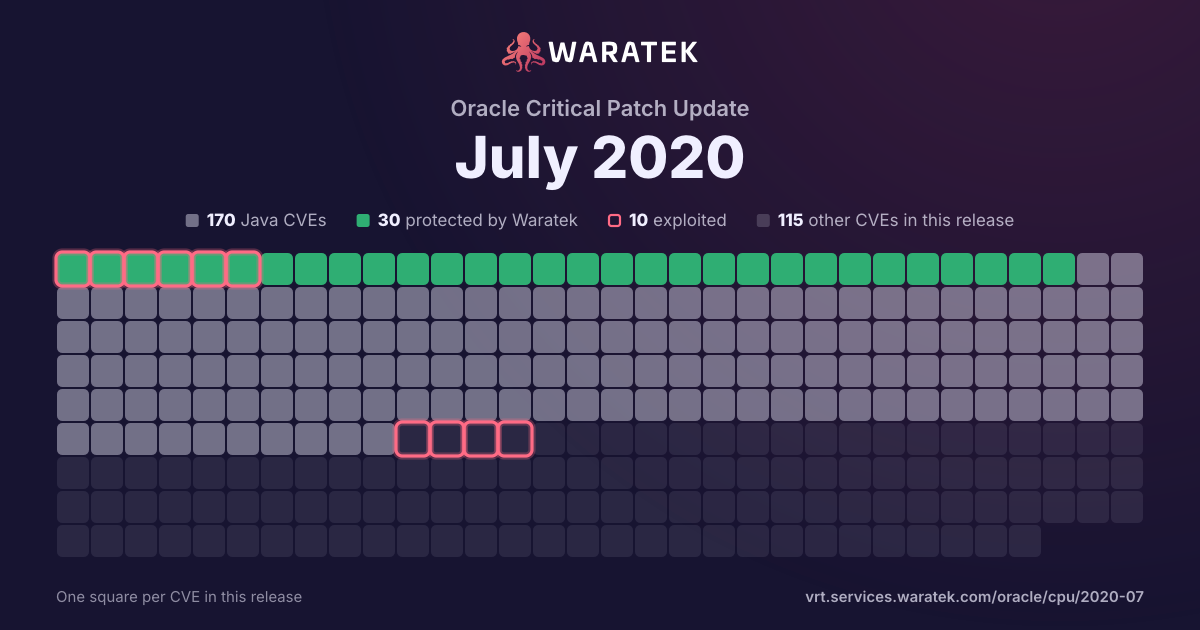
By status
32Protected by Waratek6Mitigation candidate151No exploit published8Outside Waratek scope88Not applicable
10Exploited, marked by the ring
No exploit published. For 132 of them, Oracle's security advisory is the source of public detail.
Protected by Waratek. Waratek RASP can block exploitation of these on systems that have not applied the patch yet.
Overview 162 matches · 15 protected · 0 exploited · 0 CISA KEV · 0 public PoC · 0 EPSS ≥ 0.5
Protected by Waratek
15
9.3%
Rule in development
0
0.0%
Mitigation candidate
1
0.6%
No exploit published
146
90.1%
blocked by ARMR today
15
9.3%
partly blocked
0
0.0%
not blocked
147
90.7%
not established
0
0.0%
unrecorded
0
0.0%
Exploited
0
0.0%
Working exploit published
0
0.0%
Proof of concept only
0
0.0%
Forecast only
0
0.0%
No public exploit
162
100.0%
split by
peak 131 / month
Mar 192
Protected by Waratek1
No exploit published1
High2
blocked by ARMR today1
not blocked1
No public exploit2
Apr 191
No exploit published1
Medium1
not blocked1
No public exploit1
May 192
Protected by Waratek2
High2
blocked by ARMR today2
No public exploit2
Jun 190
Jul 194
Protected by Waratek2
No exploit published2
Critical2
High2
blocked by ARMR today2
not blocked2
No public exploit4
Aug 192
Protected by Waratek1
No exploit published1
High2
blocked by ARMR today1
not blocked1
No public exploit2
Sep 191
No exploit published1
Medium1
not blocked1
No public exploit1
Oct 196
Protected by Waratek2
No exploit published4
Critical3
High1
Medium2
blocked by ARMR today2
not blocked4
No public exploit6
Nov 190
Dec 191
Protected by Waratek1
High1
blocked by ARMR today1
No public exploit1
Jan 202
No exploit published2
High1
Medium1
not blocked2
No public exploit2
Feb 201
No exploit published1
Medium1
not blocked1
No public exploit1
Mar 204
Mitigation candidate1
No exploit published3
Critical2
High1
Medium1
not blocked4
No public exploit4
Apr 201
No exploit published1
Low1
not blocked1
No public exploit1
May 203
Protected by Waratek1
No exploit published2
Critical1
Medium2
blocked by ARMR today1
not blocked2
No public exploit3
Jun 201
No exploit published1
High1
not blocked1
No public exploit1
Jul 20131
Protected by Waratek5
No exploit published126
Critical8
High51
Medium61
Low11
blocked by ARMR today5
not blocked126
No public exploit131
Mar 19May 19Jul 19Sep 19Nov 19Jan 20Mar 20May 20Jul 20
| CVE | Severity | Published▾ | Status | Exploitation | Description |
|---|---|---|---|---|---|
| CVE-2020-14571 | High | 2020-07-15 | No exploit published | No public exploit | Vulnerability in the Oracle BI Publisher product of Oracle Fusion Middleware (component: Mobile Service). Supported versions that are affected are 11.1.1.9.0, 12.2.1.3.0 and 12.2.1.4.0. Easily exploitable vulnerability allows unauthenticated attacker with network access via HTTP to compromise Oracle BI Publisher. While the vulnerability is in Oracle BI Publisher, attacks may significantly impact additional products. Successful attacks of this vulnerability can result in unauthorized update, insert or delete access to some of Oracle BI Publisher accessible data as well as unauthorized read access to a subset of Oracle BI Publisher accessible data. CVSS 3.1 Base Score 7.2 (Confidentiality and Integrity impacts). CVSS Vector: (CVSS:3.1/AV:N/AC:L/PR:N/UI:N/S:C/C:L/I:L/A:N). |
| CVE-2020-14570 | High | 2020-07-15 | No exploit published | No public exploit | Vulnerability in the Oracle BI Publisher product of Oracle Fusion Middleware (component: Mobile Service). Supported versions that are affected are 11.1.1.9.0, 12.2.1.3.0 and 12.2.1.4.0. Easily exploitable vulnerability allows unauthenticated attacker with network access via HTTP to compromise Oracle BI Publisher. Successful attacks require human interaction from a person other than the attacker. Successful attacks of this vulnerability can result in unauthorized access to critical data or complete access to all Oracle BI Publisher accessible data as well as unauthorized update, insert or delete access to some of Oracle BI Publisher accessible data. CVSS 3.1 Base Score 7.1 (Confidentiality and Integrity impacts). CVSS Vector: (CVSS:3.1/AV:N/AC:L/PR:N/UI:R/S:U/C:H/I:L/A:N). |
| CVE-2020-14569 | High | 2020-07-15 | No exploit published | No public exploit | Vulnerability in the Oracle FLEXCUBE Investor Servicing product of Oracle Financial Services Applications (component: Infrastructure). Supported versions that are affected are 12.1.0, 12.3.0, 12.4.0, 14.0.0 and 14.1.0. Easily exploitable vulnerability allows low privileged attacker with network access via HTTP to compromise Oracle FLEXCUBE Investor Servicing. Successful attacks of this vulnerability can result in unauthorized creation, deletion or modification access to critical data or all Oracle FLEXCUBE Investor Servicing accessible data as well as unauthorized access to critical data or complete access to all Oracle FLEXCUBE Investor Servicing accessible data. CVSS 3.1 Base Score 8.1 (Confidentiality and Integrity impacts). CVSS Vector: (CVSS:3.1/AV:N/AC:L/PR:L/UI:N/S:U/C:H/I:H/A:N). |
| CVE-2020-14566 | Medium | 2020-07-15 | No exploit published | No public exploit | Vulnerability in the Primavera Portfolio Management product of Oracle Construction and Engineering (component: Web Access). Supported versions that are affected are 16.1.0.0-16.1.5.1, 18.0.0.0-18.0.2.0 and 19.0.0.0. Easily exploitable vulnerability allows unauthenticated attacker with network access via HTTP to compromise Primavera Portfolio Management. Successful attacks require human interaction from a person other than the attacker. Successful attacks of this vulnerability can result in unauthorized update, insert or delete access to some of Primavera Portfolio Management accessible data. CVSS 3.1 Base Score 4.3 (Integrity impacts). CVSS Vector: (CVSS:3.1/AV:N/AC:L/PR:N/UI:R/S:U/C:N/I:L/A:N). |
| CVE-2020-14565 | High | 2020-07-15 | No exploit published | No public exploit | Vulnerability in the Oracle Unified Directory product of Oracle Fusion Middleware (component: Security). Supported versions that are affected are 11.1.2.3.0, 12.2.1.3.0 and 12.2.1.4.0. Easily exploitable vulnerability allows high privileged attacker with network access via HTTP to compromise Oracle Unified Directory. Successful attacks require human interaction from a person other than the attacker and while the vulnerability is in Oracle Unified Directory, attacks may significantly impact additional products. Successful attacks of this vulnerability can result in unauthorized creation, deletion or modification access to critical data or all Oracle Unified Directory accessible data and unauthorized ability to cause a hang or frequently repeatable crash (complete DOS) of Oracle Unified Directory. CVSS 3.1 Base Score 8.1 (Integrity and Availability impacts). CVSS Vector: (CVSS:3.1/AV:N/AC:L/PR:H/UI:R/S:C/C:N/I:H/A:H). |
| CVE-2020-14564 | Low | 2020-07-15 | No exploit published | No public exploit | Vulnerability in the PeopleSoft Enterprise PeopleTools product of Oracle PeopleSoft (component: Environment Mgmt Console). Supported versions that are affected are 8.56, 8.57 and 8.58. Easily exploitable vulnerability allows high privileged attacker with network access via HTTP to compromise PeopleSoft Enterprise PeopleTools. Successful attacks of this vulnerability can result in unauthorized update, insert or delete access to some of PeopleSoft Enterprise PeopleTools accessible data. CVSS 3.1 Base Score 2.7 (Integrity impacts). CVSS Vector: (CVSS:3.1/AV:N/AC:L/PR:H/UI:N/S:U/C:N/I:L/A:N). |
| CVE-2020-14563 | Medium | 2020-07-15 | No exploit published | No public exploit | Vulnerability in the Oracle Enterprise Communications Broker product of Oracle Communications Applications (component: WebGUI). Supported versions that are affected are 3.0.0-3.2.0. Easily exploitable vulnerability allows unauthenticated attacker with network access via HTTP to compromise Oracle Enterprise Communications Broker. Successful attacks require human interaction from a person other than the attacker and while the vulnerability is in Oracle Enterprise Communications Broker, attacks may significantly impact additional products. Successful attacks of this vulnerability can result in unauthorized update, insert or delete access to some of Oracle Enterprise Communications Broker accessible data as well as unauthorized read access to a subset of Oracle Enterprise Communications Broker accessible data. CVSS 3.1 Base Score 6.1 (Confidentiality and Integrity impacts). CVSS Vector: (CVSS:3.1/AV:N/AC:L/PR:N/UI:R/S:C/C:L/I:L/A:N). |
| CVE-2020-14561 | High | 2020-07-15 | No exploit published | No public exploit | Vulnerability in the Oracle Hospitality Reporting and Analytics product of Oracle Food and Beverage Applications (component: Installation). The supported version that is affected is 9.1.0. Easily exploitable vulnerability allows low privileged attacker with logon to the infrastructure where Oracle Hospitality Reporting and Analytics executes to compromise Oracle Hospitality Reporting and Analytics. Successful attacks require human interaction from a person other than the attacker. Successful attacks of this vulnerability can result in takeover of Oracle Hospitality Reporting and Analytics. CVSS 3.1 Base Score 7.3 (Confidentiality, Integrity and Availability impacts). CVSS Vector: (CVSS:3.1/AV:L/AC:L/PR:L/UI:R/S:U/C:H/I:H/A:H). |
| CVE-2020-14560 | Medium | 2020-07-15 | No exploit published | No public exploit | Vulnerability in the Oracle Hyperion BI+ product of Oracle Hyperion (component: UI and Visualization). The supported version that is affected is 11.1.2.4. Difficult to exploit vulnerability allows high privileged attacker with network access via HTTP to compromise Oracle Hyperion BI+. Successful attacks require human interaction from a person other than the attacker. Successful attacks of this vulnerability can result in unauthorized access to critical data or complete access to all Oracle Hyperion BI+ accessible data. CVSS 3.1 Base Score 4.2 (Confidentiality impacts). CVSS Vector: (CVSS:3.1/AV:N/AC:H/PR:H/UI:R/S:U/C:H/I:N/A:N). |
| CVE-2020-14558 | Medium | 2020-07-15 | No exploit published | No public exploit | Vulnerability in the PeopleSoft Enterprise PeopleTools product of Oracle PeopleSoft (component: Portal). Supported versions that are affected are 8.56, 8.57 and 8.58. Easily exploitable vulnerability allows unauthenticated attacker with network access via HTTP to compromise PeopleSoft Enterprise PeopleTools. Successful attacks of this vulnerability can result in unauthorized read access to a subset of PeopleSoft Enterprise PeopleTools accessible data. CVSS 3.1 Base Score 5.3 (Confidentiality impacts). CVSS Vector: (CVSS:3.1/AV:N/AC:L/PR:N/UI:N/S:U/C:L/I:N/A:N). |
| CVE-2020-14557 | Medium | 2020-07-15 | No exploit published | No public exploit | Vulnerability in the Oracle WebLogic Server product of Oracle Fusion Middleware (component: Web Container). Supported versions that are affected are 12.1.3.0.0, 12.2.1.3.0, 12.2.1.4.0 and 14.1.1.0.0. Difficult to exploit vulnerability allows unauthenticated attacker with network access via HTTP to compromise Oracle WebLogic Server. Successful attacks require human interaction from a person other than the attacker. Successful attacks of this vulnerability can result in unauthorized creation, deletion or modification access to critical data or all Oracle WebLogic Server accessible data as well as unauthorized access to critical data or complete access to all Oracle WebLogic Server accessible data. CVSS 3.1 Base Score 6.8 (Confidentiality and Integrity impacts). CVSS Vector: (CVSS:3.1/AV:N/AC:H/PR:N/UI:R/S:U/C:H/I:H/A:N). |
| CVE-2020-14556 | Medium | 2020-07-15 | Protected by Waratek | No public exploit | Vulnerability in the Java SE, Java SE Embedded product of Oracle Java SE (component: Libraries). Supported versions that are affected are Java SE: 8u251, 11.0.7 and 14.0.1; Java SE Embedded: 8u251. Difficult to exploit vulnerability allows unauthenticated attacker with network access via multiple protocols to compromise Java SE, Java SE Embedded. Successful attacks of this vulnerability can result in unauthorized update, insert or delete access to some of Java SE, Java SE Embedded accessible data as well as unauthorized read access to a subset of Java SE, Java SE Embedded accessible data. Note: Applies to client and server deployment of Java. This vulnerability can be exploited through sandboxed Java Web Start applications and sandboxed Java applets. It can also be exploited by supplying data to APIs in the specified Component without using sandboxed Java Web Start applications or sandboxed Java applets, such as through a web service. CVSS 3.1 Base Score 4.8 (Confidentiality and Integrity impacts). CVSS Vector: (CVSS:3.1/AV:N/AC:H/PR:N/UI:N/S:U/C:L/I:L/A:N). |
| CVE-2020-14555 | Medium | 2020-07-15 | No exploit published | No public exploit | Vulnerability in the Oracle Marketing product of Oracle E-Business Suite (component: Marketing Administration). Supported versions that are affected are 12.1.1-12.1.3 and 12.2.3-12.2.9. Easily exploitable vulnerability allows unauthenticated attacker with network access via HTTP to compromise Oracle Marketing. Successful attacks require human interaction from a person other than the attacker and while the vulnerability is in Oracle Marketing, attacks may significantly impact additional products. Successful attacks of this vulnerability can result in unauthorized update, insert or delete access to some of Oracle Marketing accessible data. CVSS 3.1 Base Score 4.7 (Integrity impacts). CVSS Vector: (CVSS:3.1/AV:N/AC:L/PR:N/UI:R/S:C/C:N/I:L/A:N). |
| CVE-2020-14554 | Medium | 2020-07-15 | No exploit published | No public exploit | Vulnerability in the Oracle Application Object Library product of Oracle E-Business Suite (component: Diagnostics). Supported versions that are affected are 12.1.3 and 12.2.3-12.2.8. Easily exploitable vulnerability allows unauthenticated attacker with network access via HTTP to compromise Oracle Application Object Library. Successful attacks require human interaction from a person other than the attacker and while the vulnerability is in Oracle Application Object Library, attacks may significantly impact additional products. Successful attacks of this vulnerability can result in unauthorized update, insert or delete access to some of Oracle Application Object Library accessible data. CVSS 3.1 Base Score 4.7 (Integrity impacts). CVSS Vector: (CVSS:3.1/AV:N/AC:L/PR:N/UI:R/S:C/C:N/I:L/A:N). |
| CVE-2020-14552 | Medium | 2020-07-15 | No exploit published | No public exploit | Vulnerability in the Oracle WebCenter Portal product of Oracle Fusion Middleware (component: Security Framework). Supported versions that are affected are 11.1.1.9.0, 12.2.1.3.0 and 12.2.1.4.0. Easily exploitable vulnerability allows low privileged attacker with network access via HTTP to compromise Oracle WebCenter Portal. Successful attacks require human interaction from a person other than the attacker and while the vulnerability is in Oracle WebCenter Portal, attacks may significantly impact additional products. Successful attacks of this vulnerability can result in unauthorized access to critical data or complete access to all Oracle WebCenter Portal accessible data. CVSS 3.1 Base Score 6.8 (Confidentiality impacts). CVSS Vector: (CVSS:3.1/AV:N/AC:L/PR:L/UI:R/S:C/C:H/I:N/A:N). |
| CVE-2020-14549 | Medium | 2020-07-15 | No exploit published | No public exploit | Vulnerability in the Primavera Portfolio Management product of Oracle Construction and Engineering (component: Web Server). Supported versions that are affected are 16.1.0.0-16.1.5.1, 18.0.0.0-18.0.2.0 and 19.0.0.0. Difficult to exploit vulnerability allows unauthenticated attacker with network access via HTTPS to compromise Primavera Portfolio Management. Successful attacks require human interaction from a person other than the attacker. Successful attacks of this vulnerability can result in unauthorized access to critical data or complete access to all Primavera Portfolio Management accessible data as well as unauthorized update, insert or delete access to some of Primavera Portfolio Management accessible data. CVSS 3.1 Base Score 5.9 (Confidentiality and Integrity impacts). CVSS Vector: (CVSS:3.1/AV:N/AC:H/PR:N/UI:R/S:U/C:H/I:L/A:N). |
| CVE-2020-14548 | Low | 2020-07-15 | No exploit published | No public exploit | Vulnerability in the Oracle Business Intelligence Enterprise Edition product of Oracle Fusion Middleware (component: Analytics Web General). Supported versions that are affected are 12.2.1.3.0 and 12.2.1.4.0. Difficult to exploit vulnerability allows unauthenticated attacker with network access via HTTP to compromise Oracle Business Intelligence Enterprise Edition. Successful attacks require human interaction from a person other than the attacker and while the vulnerability is in Oracle Business Intelligence Enterprise Edition, attacks may significantly impact additional products. Successful attacks of this vulnerability can result in unauthorized read access to a subset of Oracle Business Intelligence Enterprise Edition accessible data. CVSS 3.1 Base Score 3.4 (Confidentiality impacts). CVSS Vector: (CVSS:3.1/AV:N/AC:H/PR:N/UI:R/S:C/C:L/I:N/A:N). |
| CVE-2020-14546 | Medium | 2020-07-15 | No exploit published | No public exploit | Vulnerability in the Hyperion Financial Close Management product of Oracle Hyperion (component: Close Manager). The supported version that is affected is 11.1.2.4. Difficult to exploit vulnerability allows high privileged attacker with network access via HTTP to compromise Hyperion Financial Close Management. Successful attacks require human interaction from a person other than the attacker. Successful attacks of this vulnerability can result in unauthorized creation, deletion or modification access to critical data or all Hyperion Financial Close Management accessible data. CVSS 3.1 Base Score 4.2 (Integrity impacts). CVSS Vector: (CVSS:3.1/AV:N/AC:H/PR:H/UI:R/S:U/C:N/I:H/A:N). |
| CVE-2020-14544 | Medium | 2020-07-15 | No exploit published | No public exploit | Vulnerability in the Oracle Transportation Management product of Oracle Supply Chain (component: Data, Domain & Function Security). The supported version that is affected is 6.4.3. Easily exploitable vulnerability allows low privileged attacker with network access via HTTP to compromise Oracle Transportation Management. Successful attacks of this vulnerability can result in unauthorized read access to a subset of Oracle Transportation Management accessible data. CVSS 3.1 Base Score 4.3 (Confidentiality impacts). CVSS Vector: (CVSS:3.1/AV:N/AC:L/PR:L/UI:N/S:U/C:L/I:N/A:N). |
| CVE-2020-14543 | High | 2020-07-15 | No exploit published | No public exploit | Vulnerability in the Oracle Hospitality Reporting and Analytics product of Oracle Food and Beverage Applications (component: Installation). The supported version that is affected is 9.1.0. Easily exploitable vulnerability allows low privileged attacker with logon to the infrastructure where Oracle Hospitality Reporting and Analytics executes to compromise Oracle Hospitality Reporting and Analytics. Successful attacks require human interaction from a person other than the attacker. Successful attacks of this vulnerability can result in takeover of Oracle Hospitality Reporting and Analytics. CVSS 3.1 Base Score 7.3 (Confidentiality, Integrity and Availability impacts). CVSS Vector: (CVSS:3.1/AV:L/AC:L/PR:L/UI:R/S:U/C:H/I:H/A:H). |
| CVE-2020-14541 | Low | 2020-07-15 | No exploit published | No public exploit | Vulnerability in the Hyperion Financial Close Management product of Oracle Hyperion (component: Close Manager). The supported version that is affected is 11.1.2.4. Difficult to exploit vulnerability allows high privileged attacker with network access via HTTP to compromise Hyperion Financial Close Management. Successful attacks require human interaction from a person other than the attacker. Successful attacks of this vulnerability can result in unauthorized update, insert or delete access to some of Hyperion Financial Close Management accessible data. CVSS 3.1 Base Score 2.0 (Integrity impacts). CVSS Vector: (CVSS:3.1/AV:N/AC:H/PR:H/UI:R/S:U/C:N/I:L/A:N). |
| CVE-2020-14536 | High | 2020-07-15 | No exploit published | No public exploit | Vulnerability in the Oracle Commerce Guided Search / Oracle Commerce Experience Manager product of Oracle Commerce (component: Workbench). Supported versions that are affected are 11.0, 11.1, 11.2 and prior to 11.3.1. Difficult to exploit vulnerability allows unauthenticated attacker with network access via HTTP to compromise Oracle Commerce Guided Search / Oracle Commerce Experience Manager. Successful attacks of this vulnerability can result in unauthorized creation, deletion or modification access to critical data or all Oracle Commerce Guided Search / Oracle Commerce Experience Manager accessible data as well as unauthorized access to critical data or complete access to all Oracle Commerce Guided Search / Oracle Commerce Experience Manager accessible data. CVSS 3.1 Base Score 7.4 (Confidentiality and Integrity impacts). CVSS Vector: (CVSS:3.1/AV:N/AC:H/PR:N/UI:N/S:U/C:H/I:H/A:N). |
| CVE-2020-14535 | High | 2020-07-15 | No exploit published | No public exploit | Vulnerability in the Oracle Commerce Service Center product of Oracle Commerce (component: Commerce Service Center). Supported versions that are affected are 11.1, 11.2 and prior to 11.3.1. Difficult to exploit vulnerability allows unauthenticated attacker with network access via HTTP to compromise Oracle Commerce Service Center. Successful attacks of this vulnerability can result in unauthorized creation, deletion or modification access to critical data or all Oracle Commerce Service Center accessible data as well as unauthorized access to critical data or complete access to all Oracle Commerce Service Center accessible data. CVSS 3.1 Base Score 7.4 (Confidentiality and Integrity impacts). CVSS Vector: (CVSS:3.1/AV:N/AC:H/PR:N/UI:N/S:U/C:H/I:H/A:N). |
| CVE-2020-14534 | High | 2020-07-15 | No exploit published | No public exploit | Vulnerability in the Oracle Applications Framework product of Oracle E-Business Suite (component: Popups). The supported version that is affected is 12.2.9. Easily exploitable vulnerability allows unauthenticated attacker with network access via HTTP to compromise Oracle Applications Framework. Successful attacks require human interaction from a person other than the attacker and while the vulnerability is in Oracle Applications Framework, attacks may significantly impact additional products. Successful attacks of this vulnerability can result in unauthorized access to critical data or complete access to all Oracle Applications Framework accessible data as well as unauthorized update, insert or delete access to some of Oracle Applications Framework accessible data. CVSS 3.1 Base Score 8.2 (Confidentiality and Integrity impacts). CVSS Vector: (CVSS:3.1/AV:N/AC:L/PR:N/UI:R/S:C/C:H/I:L/A:N). |
| CVE-2020-14533 | Low | 2020-07-15 | No exploit published | No public exploit | Vulnerability in the Oracle Commerce Platform product of Oracle Commerce (component: Dynamo Application Framework). Supported versions that are affected are 11.1, 11.2 and prior to 11.3.1. Easily exploitable vulnerability allows high privileged attacker with network access via HTTP to compromise Oracle Commerce Platform. Successful attacks require human interaction from a person other than the attacker. Successful attacks of this vulnerability can result in unauthorized update, insert or delete access to some of Oracle Commerce Platform accessible data as well as unauthorized read access to a subset of Oracle Commerce Platform accessible data. CVSS 3.1 Base Score 3.5 (Confidentiality and Integrity impacts). CVSS Vector: (CVSS:3.1/AV:N/AC:L/PR:H/UI:R/S:U/C:L/I:L/A:N). |
| CVE-2020-14532 | Medium | 2020-07-15 | No exploit published | No public exploit | Vulnerability in the Oracle Commerce Platform product of Oracle Commerce (component: Dynamo Application Framework). Supported versions that are affected are 11.1, 11.2 and prior to 11.3.1. Easily exploitable vulnerability allows unauthenticated attacker with network access via HTTP to compromise Oracle Commerce Platform. Successful attacks require human interaction from a person other than the attacker and while the vulnerability is in Oracle Commerce Platform, attacks may significantly impact additional products. Successful attacks of this vulnerability can result in unauthorized update, insert or delete access to some of Oracle Commerce Platform accessible data. CVSS 3.1 Base Score 4.7 (Integrity impacts). CVSS Vector: (CVSS:3.1/AV:N/AC:L/PR:N/UI:R/S:C/C:N/I:L/A:N). |
| CVE-2020-14531 | Medium | 2020-07-15 | No exploit published | No public exploit | Vulnerability in the Siebel UI Framework product of Oracle Siebel CRM (component: SWSE Server). Supported versions that are affected are 20.6 and prior. Difficult to exploit vulnerability allows unauthenticated attacker with network access via HTTP to compromise Siebel UI Framework. Successful attacks require human interaction from a person other than the attacker. Successful attacks of this vulnerability can result in unauthorized access to critical data or complete access to all Siebel UI Framework accessible data as well as unauthorized update, insert or delete access to some of Siebel UI Framework accessible data. CVSS 3.1 Base Score 5.9 (Confidentiality and Integrity impacts). CVSS Vector: (CVSS:3.1/AV:N/AC:H/PR:N/UI:R/S:U/C:H/I:L/A:N). |
| CVE-2020-14530 | Medium | 2020-07-15 | No exploit published | No public exploit | Vulnerability in the Oracle Security Service product of Oracle Fusion Middleware (component: None). The supported version that is affected is 11.1.1.9.0. Difficult to exploit vulnerability allows unauthenticated attacker with network access via HTTPS to compromise Oracle Security Service. Successful attacks of this vulnerability can result in unauthorized access to critical data or complete access to all Oracle Security Service accessible data. CVSS 3.1 Base Score 5.9 (Confidentiality impacts). CVSS Vector: (CVSS:3.1/AV:N/AC:H/PR:N/UI:N/S:U/C:H/I:N/A:N). |
| CVE-2020-14529 | Medium | 2020-07-15 | No exploit published | No public exploit | Vulnerability in the Primavera Portfolio Management product of Oracle Construction and Engineering (component: Investor Module). Supported versions that are affected are 16.1.0.0-16.1.5.1, 18.0.0.0-18.0.2.0 and 19.0.0.0. Easily exploitable vulnerability allows low privileged attacker with network access via HTTP to compromise Primavera Portfolio Management. Successful attacks require human interaction from a person other than the attacker and while the vulnerability is in Primavera Portfolio Management, attacks may significantly impact additional products. Successful attacks of this vulnerability can result in unauthorized update, insert or delete access to some of Primavera Portfolio Management accessible data as well as unauthorized read access to a subset of Primavera Portfolio Management accessible data. CVSS 3.1 Base Score 5.4 (Confidentiality and Integrity impacts). CVSS Vector: (CVSS:3.1/AV:N/AC:L/PR:L/UI:R/S:C/C:L/I:L/A:N). |
| CVE-2020-14528 | Medium | 2020-07-15 | No exploit published | No public exploit | Vulnerability in the Primavera Portfolio Management product of Oracle Construction and Engineering (component: Web Access). Supported versions that are affected are 16.1.0.0-16.1.5.1, 18.0.0.0-18.0.2.0 and 19.0.0.0. Easily exploitable vulnerability allows unauthenticated attacker with network access via HTTP to compromise Primavera Portfolio Management. Successful attacks require human interaction from a person other than the attacker and while the vulnerability is in Primavera Portfolio Management, attacks may significantly impact additional products. Successful attacks of this vulnerability can result in unauthorized update, insert or delete access to some of Primavera Portfolio Management accessible data as well as unauthorized read access to a subset of Primavera Portfolio Management accessible data. CVSS 3.1 Base Score 6.1 (Confidentiality and Integrity impacts). CVSS Vector: (CVSS:3.1/AV:N/AC:L/PR:N/UI:R/S:C/C:L/I:L/A:N). |
| CVE-2020-14527 | Medium | 2020-07-15 | No exploit published | No public exploit | Vulnerability in the Primavera Portfolio Management product of Oracle Construction and Engineering (component: Web Access). Supported versions that are affected are 16.1.0.0-16.1.5.1, 18.0.0.0-18.0.2.0 and 19.0.0.0. Difficult to exploit vulnerability allows unauthenticated attacker with network access via HTTP to compromise Primavera Portfolio Management. Successful attacks require human interaction from a person other than the attacker. Successful attacks of this vulnerability can result in unauthorized access to critical data or complete access to all Primavera Portfolio Management accessible data as well as unauthorized update, insert or delete access to some of Primavera Portfolio Management accessible data. CVSS 3.1 Base Score 5.9 (Confidentiality and Integrity impacts). CVSS Vector: (CVSS:3.1/AV:N/AC:H/PR:N/UI:R/S:U/C:H/I:L/A:N). |
| CVE-2020-11080 | High | 2020-06-03 | No exploit published | No public exploit | In nghttp2 before version 1.41.0, the overly large HTTP/2 SETTINGS frame payload causes denial of service. The proof of concept attack involves a malicious client constructing a SETTINGS frame with a length of 14,400 bytes (2400 individual settings entries) over and over again. The attack causes the CPU to spike at 100%. nghttp2 v1.41.0 fixes this vulnerability. There is a workaround to this vulnerability. Implement nghttp2_on_frame_recv_callback callback, and if received frame is SETTINGS frame and the number of settings entries are large (e.g., > 32), then drop the connection. |
| CVE-2020-1945 | Medium | 2020-05-14 | No exploit published | No public exploit | Apache Ant 1.1 to 1.9.14 and 1.10.0 to 1.10.7 uses the default temporary directory identified by the Java system property java.io.tmpdir for several tasks and may thus leak sensitive information. The fixcrlf and replaceregexp tasks also copy files from the temporary directory back into the build tree allowing an attacker to inject modified source files into the build process. |
| CVE-2020-1941 | Medium | 2020-05-14 | No exploit published | No public exploit | In Apache ActiveMQ 5.0.0 to 5.15.11, the webconsole admin GUI is open to XSS, in the view that lists the contents of a queue. |
| CVE-2020-10683 | Critical | 2020-05-01 | Protected by Waratek | No public exploit | dom4j before 2.0.3 and 2.1.x before 2.1.3 allows external DTDs and External Entities by default, which might enable XXE attacks. However, there is popular external documentation from OWASP showing how to enable the safe, non-default behavior in any application that uses dom4j. |
| CVE-2020-9488 | Low | 2020-04-27 | No exploit published | No public exploit | Improper validation of certificate with host mismatch in Apache Log4j SMTP appender. This could allow an SMTPS connection to be intercepted by a man-in-the-middle attack which could leak any log messages sent through that appender. Fixed in Apache Log4j 2.12.3 and 2.13.1 |
| CVE-2019-17560 | Critical | 2020-03-30 | No exploit published | No public exploit | The "Apache NetBeans" autoupdate system does not validate SSL certificates and hostnames for https based downloads. This allows an attacker to intercept downloads of autoupdates and modify the download, potentially injecting malicious code. “Apache NetBeans" versions up to and including 11.2 are affected by this vulnerability. |
| CVE-2020-1951 | Medium | 2020-03-23 | No exploit published | No public exploit | A carefully crafted or corrupt PSD file can cause an infinite loop in Apache Tika's PSDParser in versions 1.0-1.23. |
| CVE-2020-5258 | High | 2020-03-10 | No exploit published | No public exploit | In affected versions of dojo (NPM package), the deepCopy method is vulnerable to Prototype Pollution. Prototype Pollution refers to the ability to inject properties into existing JavaScript language construct prototypes, such as objects. An attacker manipulates these attributes to overwrite, or pollute, a JavaScript application object prototype of the base object by injecting other values. This has been patched in versions 1.12.8, 1.13.7, 1.14.6, 1.15.3 and 1.16.2 |
| CVE-2020-9546 | Critical | 2020-03-02 | Mitigation candidate | No public exploit | FasterXML jackson-databind 2.x before 2.9.10.4 mishandles the interaction between serialization gadgets and typing, related to org.apache.hadoop.shaded.com.zaxxer.hikari.HikariConfig (aka shaded hikari-config). |
| CVE-2019-17569 | Medium | 2020-02-24 | No exploit published | No public exploit | The refactoring present in Apache Tomcat 9.0.28 to 9.0.30, 8.5.48 to 8.5.50 and 7.0.98 to 7.0.99 introduced a regression. The result of the regression was that invalid Transfer-Encoding headers were incorrectly processed leading to a possibility of HTTP Request Smuggling if Tomcat was located behind a reverse proxy that incorrectly handled the invalid Transfer-Encoding header in a particular manner. Such a reverse proxy is considered unlikely. |
| CVE-2019-12423 | High | 2020-01-16 | No exploit published | No public exploit | Apache CXF ships with a OpenId Connect JWK Keys service, which allows a client to obtain the public keys in JWK format, which can then be used to verify the signature of tokens issued by the service. Typically, the service obtains the public key from a local keystore (JKS/PKCS12) by specifing the path of the keystore and the alias of the keystore entry. This case is not vulnerable. However it is also possible to obtain the keys from a JWK keystore file, by setting the configuration parameter "rs.security.keystore.type" to "jwk". For this case all keys are returned in this file "as is", including all private key and secret key credentials. This is an obvious security risk if the user has configured the signature keystore file with private or secret key credentials. From CXF 3.3.5 and 3.2.12, it is mandatory to specify an alias corresponding to the id of the key in the JWK file, and only this key is returned. In addition, any private key information is omitted by default. "oct" keys, which contain secret keys, are not returned at all. |
| CVE-2019-14862 | Medium | 2020-01-02 | No exploit published | No public exploit | There is a vulnerability in knockout before version 3.5.0-beta, where after escaping the context of the web application, the web application delivers data to its users along with other trusted dynamic content, without validating it. |
| CVE-2019-17563 | High | 2019-12-23 | Protected by Waratek | No public exploit | When using FORM authentication with Apache Tomcat 9.0.0.M1 to 9.0.29, 8.5.0 to 8.5.49 and 7.0.0 to 7.0.98 there was a narrow window where an attacker could perform a session fixation attack. The window was considered too narrow for an exploit to be practical but, erring on the side of caution, this issue has been treated as a security vulnerability. |
| CVE-2019-12415 | Medium | 2019-10-23 | Protected by Waratek | No public exploit | In Apache POI up to 4.1.0, when using the tool XSSFExportToXml to convert user-provided Microsoft Excel documents, a specially crafted document can allow an attacker to read files from the local filesystem or from internal network resources via XML External Entity (XXE) Processing. |
| CVE-2019-2904 | Critical | 2019-10-16 | No exploit published | No public exploit | Vulnerability in the Oracle JDeveloper and ADF product of Oracle Fusion Middleware (component: ADF Faces). Supported versions that are affected are 11.1.1.9.0, 12.1.3.0.0 and 12.2.1.3.0. Easily exploitable vulnerability allows unauthenticated attacker with network access via HTTP to compromise Oracle JDeveloper and ADF. Successful attacks of this vulnerability can result in takeover of Oracle JDeveloper and ADF. CVSS 3.0 Base Score 9.8 (Confidentiality, Integrity and Availability impacts). CVSS Vector: (CVSS:3.0/AV:N/AC:L/PR:N/UI:N/S:U/C:H/I:H/A:H). |
| CVE-2019-17531 | Critical | 2019-10-12 | No exploit published | No public exploit | A Polymorphic Typing issue was discovered in FasterXML jackson-databind 2.0.0 through 2.9.10. When Default Typing is enabled (either globally or for a specific property) for an externally exposed JSON endpoint and the service has the apache-log4j-extra (version 1.2.x) jar in the classpath, and an attacker can provide a JNDI service to access, it is possible to make the service execute a malicious payload. |
| CVE-2019-17359 | High | 2019-10-08 | No exploit published | No public exploit | The ASN.1 parser in Bouncy Castle Crypto (aka BC Java) 1.63 can trigger a large attempted memory allocation, and resultant OutOfMemoryError error, via crafted ASN.1 data. This is fixed in 1.64. |
| CVE-2019-17091 | Medium | 2019-10-02 | Protected by Waratek | No public exploit | faces/context/PartialViewContextImpl.java in Eclipse Mojarra, as used in Mojarra for Eclipse EE4J before 2.3.10 and Mojarra JavaServer Faces before 2.2.20, allows Reflected XSS because a client window field is mishandled. |
| CVE-2019-16943 | Critical | 2019-10-01 | No exploit published | No public exploit | A Polymorphic Typing issue was discovered in FasterXML jackson-databind 2.0.0 through 2.9.10. When Default Typing is enabled (either globally or for a specific property) for an externally exposed JSON endpoint and the service has the p6spy (3.8.6) jar in the classpath, and an attacker can find an RMI service endpoint to access, it is possible to make the service execute a malicious payload. This issue exists because of com.p6spy.engine.spy.P6DataSource mishandling. |
| CVE-2019-3740 | Medium | 2019-09-18 | No exploit published | No public exploit | RSA BSAFE Crypto-J versions prior to 6.2.5 are vulnerable to an Information Exposure Through Timing Discrepancy vulnerabilities during DSA key generation. A malicious remote attacker could potentially exploit those vulnerabilities to recover DSA keys. |
| CVE-2019-12402 | High | 2019-08-30 | No exploit published | No public exploit | The file name encoding algorithm used internally in Apache Commons Compress 1.15 to 1.18 can get into an infinite loop when faced with specially crafted inputs. This can lead to a denial of service attack if an attacker can choose the file names inside of an archive created by Compress. |
| CVE-2019-10086 | High | 2019-08-20 | Protected by Waratek | No public exploit | In Apache Commons Beanutils 1.9.2, a special BeanIntrospector class was added which allows suppressing the ability for an attacker to access the classloader via the class property available on all Java objects. We, however were not using this by default characteristic of the PropertyUtilsBean. |
| CVE-2019-14379 | Critical | 2019-07-29 | Protected by Waratek | No public exploit | SubTypeValidator.java in FasterXML jackson-databind before 2.9.9.2 mishandles default typing when ehcache is used (because of net.sf.ehcache.transaction.manager.DefaultTransactionManagerLookup), leading to remote code execution. |
| CVE-2019-13990 | Critical | 2019-07-26 | Protected by Waratek | No public exploit | initDocumentParser in xml/XMLSchedulingDataProcessor.java in Terracotta Quartz Scheduler through 2.3.0 allows XXE attacks via a job description. |
| CVE-2019-10193 | High | 2019-07-11 | No exploit published | No public exploit | A stack-buffer overflow vulnerability was found in the Redis hyperloglog data structure versions 3.x before 3.2.13, 4.x before 4.0.14 and 5.x before 5.0.4. By corrupting a hyperloglog using the SETRANGE command, an attacker could cause Redis to perform controlled increments of up to 12 bytes past the end of a stack-allocated buffer. |
| CVE-2018-17196 | High | 2019-07-11 | No exploit published | No public exploit | In Apache Kafka versions between 0.11.0.0 and 2.1.0, it is possible to manually craft a Produce request which bypasses transaction/idempotent ACL validation. Only authenticated clients with Write permission on the respective topics are able to exploit this vulnerability. Users should upgrade to 2.1.1 or later where this vulnerability has been fixed. |
| CVE-2019-0188 | High | 2019-05-28 | Protected by Waratek | No public exploit | Apache Camel prior to 2.24.0 contains an XML external entity injection (XXE) vulnerability (CWE-611) due to using an outdated vulnerable JSON-lib library. This affects only the camel-xmljson component, which was removed. |
| CVE-2019-12086 | High | 2019-05-17 | Protected by Waratek | No public exploit | A Polymorphic Typing issue was discovered in FasterXML jackson-databind 2.x before 2.9.9. When Default Typing is enabled (either globally or for a specific property) for an externally exposed JSON endpoint, the service has the mysql-connector-java jar (8.0.14 or earlier) in the classpath, and an attacker can host a crafted MySQL server reachable by the victim, an attacker can send a crafted JSON message that allows them to read arbitrary local files on the server. This occurs because of missing com.mysql.cj.jdbc.admin.MiniAdmin validation. |
| CVE-2019-10247 | Medium | 2019-04-22 | No exploit published | No public exploit | In Eclipse Jetty version 7.x, 8.x, 9.2.27 and older, 9.3.26 and older, and 9.4.16 and older, the server running on any OS and Jetty version combination will reveal the configured fully qualified directory base resource location on the output of the 404 error for not finding a Context that matches the requested path. The default server behavior on jetty-distribution and jetty-home will include at the end of the Handler tree a DefaultHandler, which is responsible for reporting this 404 error, it presents the various configured contexts as HTML for users to click through to. This produced HTML includes output that contains the configured fully qualified directory base resource location for each context. |
| CVE-2019-0222 | High | 2019-03-28 | No exploit published | No public exploit | In Apache ActiveMQ 5.0.0 - 5.15.8, unmarshalling corrupt MQTT frame can lead to broker Out of Memory exception making it unresponsive. |
| CVE-2018-12023 | High | 2019-03-21 | Protected by Waratek | No public exploit | An issue was discovered in FasterXML jackson-databind prior to 2.7.9.4, 2.8.11.2, and 2.9.6. When Default Typing is enabled (either globally or for a specific property), the service has the Oracle JDBC jar in the classpath, and an attacker can provide an LDAP service to access, it is possible to make the service execute a malicious payload. |