
Oracle Critical Patch Update July 2020
Released July 2020 · Oracle's advisory ↗ · ← Critical Patch Update, April 2020 · Critical Patch Update, October 2020 →
285 CVEs in this release, one square each
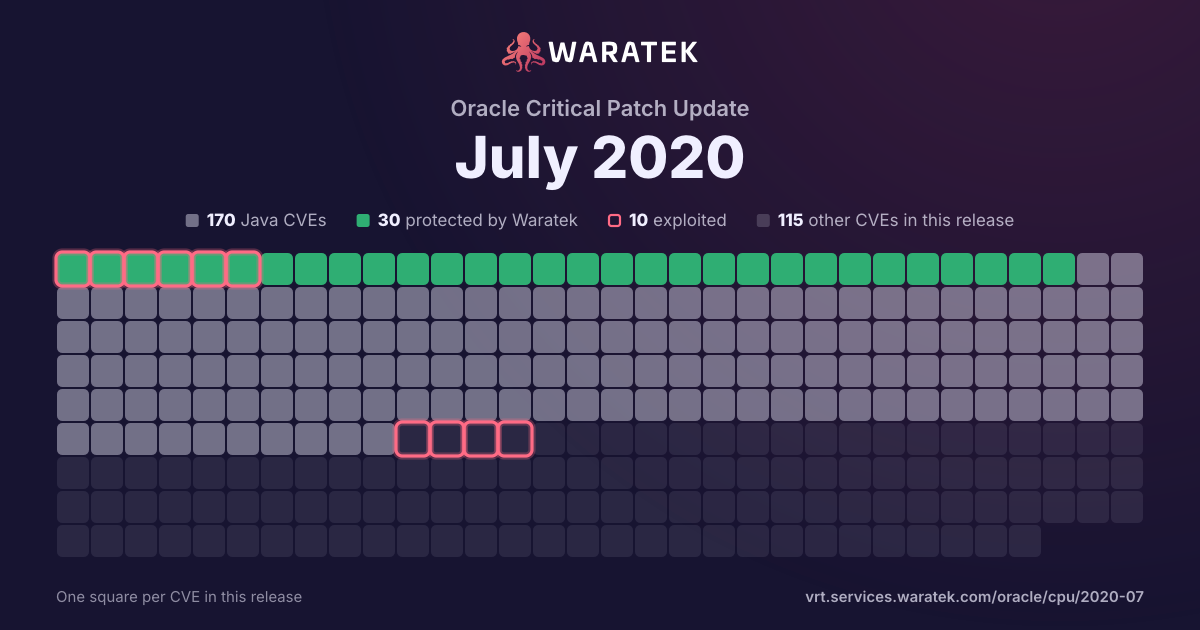
By status
31Protected by Waratek6Mitigation candidate152No exploit published8Outside Waratek scope88Not applicable
10Exploited, marked by the ring
No exploit published. For 131 of them, Oracle's security advisory is the source of public detail.
Protected by Waratek. Waratek RASP can block exploitation of these on systems that have not applied the patch yet.
Overview 10 matches · 0 exploited · 0 CISA KEV · 0 public PoC · 0 EPSS ≥ 0.5
10matches
0exploited0.0%
0CISA KEV0.0%
0public PoC0.0%
0EPSS ≥ 0.50.0%
Protected by Waratek
10
100.0%
Rule in development
0
0.0%
Mitigation candidate
0
0.0%
No exploit published
0
0.0%
blocked by ARMR today
10
100.0%
partly blocked
0
0.0%
not blocked
0
0.0%
not established
0
0.0%
unrecorded
0
0.0%
Exploited
0
0.0%
Working exploit published
0
0.0%
Proof of concept only
0
0.0%
Forecast only
0
0.0%
No public exploit
10
100.0%
split by
peak 3 / quarter
Q4 171
Protected by Waratek1
Critical1
blocked by ARMR today1
No public exploit1
Q1 180
Q2 181
Protected by Waratek1
Critical1
blocked by ARMR today1
No public exploit1
Q3 180
Q4 180
Q1 191
Protected by Waratek1
High1
blocked by ARMR today1
No public exploit1
Q2 191
Protected by Waratek1
High1
blocked by ARMR today1
No public exploit1
Q3 193
Protected by Waratek3
Critical2
High1
blocked by ARMR today3
No public exploit3
Q4 192
Protected by Waratek2
Medium2
blocked by ARMR today2
No public exploit2
Q1 200
Q2 201
Protected by Waratek1
Critical1
blocked by ARMR today1
No public exploit1
Q4 17Q1 18Q2 18Q3 18Q4 18Q1 19Q2 19Q3 19Q4 19Q1 20Q2 20
| CVE | Severity | Published▾ | Status | Exploitation | Description |
|---|---|---|---|---|---|
| CVE-2020-10683 | Critical | 2020-05-01 | Protected by Waratek | No public exploit | dom4j before 2.0.3 and 2.1.x before 2.1.3 allows external DTDs and External Entities by default, which might enable XXE attacks. However, there is popular external documentation from OWASP showing how to enable the safe, non-default behavior in any application that uses dom4j. |
| CVE-2019-12415 | Medium | 2019-10-23 | Protected by Waratek | No public exploit | In Apache POI up to 4.1.0, when using the tool XSSFExportToXml to convert user-provided Microsoft Excel documents, a specially crafted document can allow an attacker to read files from the local filesystem or from internal network resources via XML External Entity (XXE) Processing. |
| CVE-2019-17091 | Medium | 2019-10-02 | Protected by Waratek | No public exploit | faces/context/PartialViewContextImpl.java in Eclipse Mojarra, as used in Mojarra for Eclipse EE4J before 2.3.10 and Mojarra JavaServer Faces before 2.2.20, allows Reflected XSS because a client window field is mishandled. |
| CVE-2019-10086 | High | 2019-08-20 | Protected by Waratek | No public exploit | In Apache Commons Beanutils 1.9.2, a special BeanIntrospector class was added which allows suppressing the ability for an attacker to access the classloader via the class property available on all Java objects. We, however were not using this by default characteristic of the PropertyUtilsBean. |
| CVE-2019-14379 | Critical | 2019-07-29 | Protected by Waratek | No public exploit | SubTypeValidator.java in FasterXML jackson-databind before 2.9.9.2 mishandles default typing when ehcache is used (because of net.sf.ehcache.transaction.manager.DefaultTransactionManagerLookup), leading to remote code execution. |
| CVE-2019-13990 | Critical | 2019-07-26 | Protected by Waratek | No public exploit | initDocumentParser in xml/XMLSchedulingDataProcessor.java in Terracotta Quartz Scheduler through 2.3.0 allows XXE attacks via a job description. |
| CVE-2019-0188 | High | 2019-05-28 | Protected by Waratek | No public exploit | Apache Camel prior to 2.24.0 contains an XML external entity injection (XXE) vulnerability (CWE-611) due to using an outdated vulnerable JSON-lib library. This affects only the camel-xmljson component, which was removed. |
| CVE-2018-12023 | High | 2019-03-21 | Protected by Waratek | No public exploit | An issue was discovered in FasterXML jackson-databind prior to 2.7.9.4, 2.8.11.2, and 2.9.6. When Default Typing is enabled (either globally or for a specific property), the service has the Oracle JDBC jar in the classpath, and an attacker can provide an LDAP service to access, it is possible to make the service execute a malicious payload. |
| CVE-2018-8013 | Critical | 2018-05-24 | Protected by Waratek | No public exploit | In Apache Batik 1.x before 1.10, when deserializing subclass of `AbstractDocument`, the class takes a string from the inputStream as the class name which then use it to call the no-arg constructor of the class. Fix was to check the class type before calling newInstance in deserialization. |
| CVE-2017-15708 | Critical | 2017-12-11 | Protected by Waratek | No public exploit | In Apache Synapse, by default no authentication is required for Java Remote Method Invocation (RMI). So Apache Synapse 3.0.1 or all previous releases (3.0.0, 2.1.0, 2.0.0, 1.2, 1.1.2, 1.1.1) allows remote code execution attacks that can be performed by injecting specially crafted serialized objects. And the presence of Apache Commons Collections 3.2.1 (commons-collections-3.2.1.jar) or previous versions in Synapse distribution makes this exploitable. To mitigate the issue, we need to limit RMI access to trusted users only. Further upgrading to 3.0.1 version will eliminate the risk of having said Commons Collection version. In Synapse 3.0.1, Commons Collection has been updated to 3.2.2 version. |