
Oracle Critical Patch Update July 2020
Released July 2020 · Oracle's advisory ↗ · ← Critical Patch Update, April 2020 · Critical Patch Update, October 2020 →
285 CVEs in this release, one square each
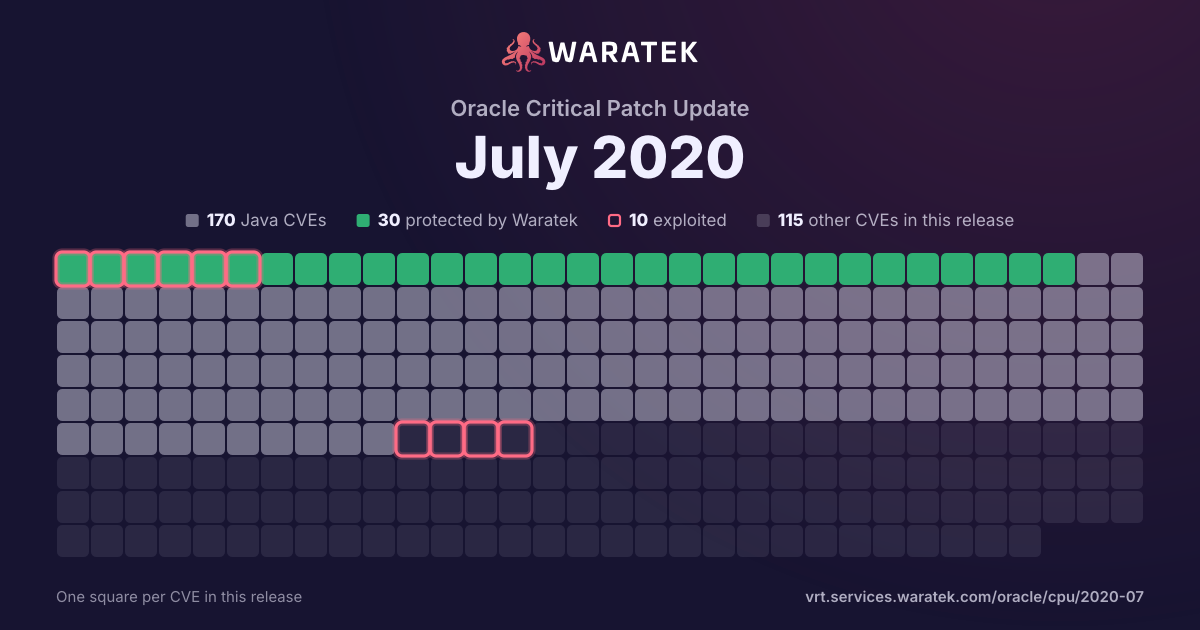
By status
31Protected by Waratek3Mitigation candidate152No exploit published8Outside Waratek scope91Not applicable
10Exploited, marked by the ring
No exploit published. For 131 of them, Oracle's security advisory is the source of public detail.
Protected by Waratek. Waratek RASP can block exploitation of these on systems that have not applied the patch yet.
Overview 4 matches · 1 protected · 0 exploited · 0 CISA KEV · 1 public PoC · 1 EPSS ≥ 0.5
Protected by Waratek
1
25.0%
Rule in development
0
0.0%
Mitigation candidate
0
0.0%
No exploit published
3
75.0%
blocked by ARMR today
1
25.0%
partly blocked
0
0.0%
not blocked
3
75.0%
not established
0
0.0%
unrecorded
0
0.0%
Exploited
0
0.0%
Working exploit published
1
25.0%
Proof of concept only
0
0.0%
Forecast only
0
0.0%
No public exploit
3
75.0%
split by
peak 2 / month
Mar 20Apr 20May 20Jun 20Jul 20
| CVE | Severity | Published▾ | Status | Exploitation | Description |
|---|---|---|---|---|---|
| CVE-2020-14630 | High | 2020-07-15 | No exploit published | No public exploit | Vulnerability in the Oracle Enterprise Session Border Controller product of Oracle Communications Applications (component: File Upload). Supported versions that are affected are 8.1.0, 8.2.0 and 8.3.0. Easily exploitable vulnerability allows high privileged attacker with network access via HTTP to compromise Oracle Enterprise Session Border Controller. Successful attacks require human interaction from a person other than the attacker and while the vulnerability is in Oracle Enterprise Session Border Controller, attacks may significantly impact additional products. Successful attacks of this vulnerability can result in unauthorized ability to cause a hang or frequently repeatable crash (complete DOS) of Oracle Enterprise Session Border Controller as well as unauthorized update, insert or delete access to some of Oracle Enterprise Session Border Controller accessible data and unauthorized read access to a subset of Oracle Enterprise Session Border Controller accessible data. CVSS 3.1 Base Score 7.5 (Confidentiality, Integrity and Availability impacts). CVSS Vector: (CVSS:3.1/AV:N/AC:L/PR:H/UI:R/S:C/C:L/I:L/A:H). |
| CVE-2020-14580 | High | 2020-07-15 | No exploit published | No public exploit | Vulnerability in the Oracle Communications Session Border Controller product of Oracle Communications Applications (component: System Admin). Supported versions that are affected are 8.1.0, 8.2.0 and 8.3.0. Easily exploitable vulnerability allows low privileged attacker with network access via SSH to compromise Oracle Communications Session Border Controller. Successful attacks require human interaction from a person other than the attacker and while the vulnerability is in Oracle Communications Session Border Controller, attacks may significantly impact additional products. Successful attacks of this vulnerability can result in unauthorized access to critical data or complete access to all Oracle Communications Session Border Controller accessible data as well as unauthorized update, insert or delete access to some of Oracle Communications Session Border Controller accessible data and unauthorized ability to cause a partial denial of service (partial DOS) of Oracle Communications Session Border Controller. CVSS 3.1 Base Score 8.2 (Confidentiality, Integrity and Availability impacts). CVSS Vector: (CVSS:3.1/AV:N/AC:L/PR:L/UI:R/S:C/C:H/I:L/A:L). |
| CVE-2020-9484 | High | 2020-05-20 | Protected by Waratek | Working exploit published | When using Apache Tomcat versions 10.0.0-M1 to 10.0.0-M4, 9.0.0.M1 to 9.0.34, 8.5.0 to 8.5.54 and 7.0.0 to 7.0.103 if a) an attacker is able to control the contents and name of a file on the server; and b) the server is configured to use the PersistenceManager with a FileStore; and c) the PersistenceManager is configured with sessionAttributeValueClassNameFilter="null" (the default unless a SecurityManager is used) or a sufficiently lax filter to allow the attacker provided object to be deserialized; and d) the attacker knows the relative file path from the storage location used by FileStore to the file the attacker has control over; then, using a specifically crafted request, the attacker will be able to trigger remote code execution via deserialization of the file under their control. Note that all of conditions a) to d) must be true for the attack to succeed. |
| CVE-2020-5258 | High | 2020-03-10 | No exploit published | No public exploit | In affected versions of dojo (NPM package), the deepCopy method is vulnerable to Prototype Pollution. Prototype Pollution refers to the ability to inject properties into existing JavaScript language construct prototypes, such as objects. An attacker manipulates these attributes to overwrite, or pollute, a JavaScript application object prototype of the base object by injecting other values. This has been patched in versions 1.12.8, 1.13.7, 1.14.6, 1.15.3 and 1.16.2 |