
Oracle Critical Patch Update July 2020
Released July 2020 · Oracle's advisory ↗ · ← Critical Patch Update, April 2020 · Critical Patch Update, October 2020 →
285 CVEs in this release, one square each
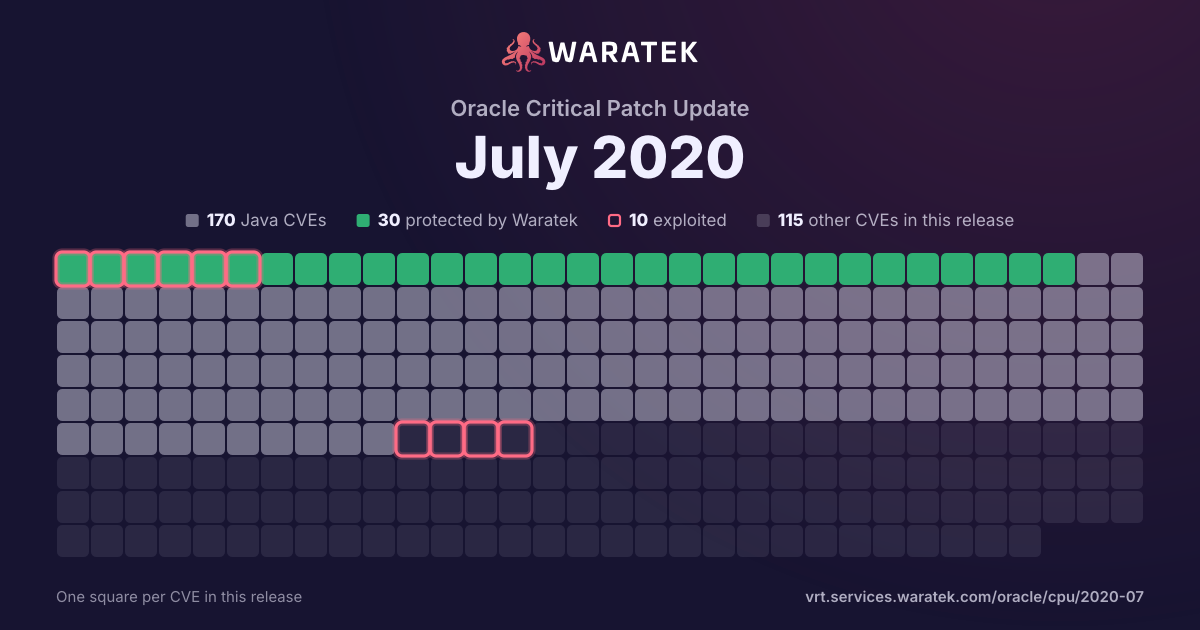
By status
32Protected by Waratek6Mitigation candidate151No exploit published8Outside Waratek scope88Not applicable
10Exploited, marked by the ring
No exploit published. For 132 of them, Oracle's security advisory is the source of public detail.
Protected by Waratek. Waratek RASP can block exploitation of these on systems that have not applied the patch yet.
Overview 14 matches · 1 protected · 3 exploited · 0 CISA KEV · 3 public PoC · 3 EPSS ≥ 0.5
Protected by Waratek
1
7.1%
Rule in development
0
0.0%
Mitigation candidate
3
21.4%
No exploit published
10
71.4%
blocked by ARMR today
1
7.1%
partly blocked
0
0.0%
not blocked
13
92.9%
not established
0
0.0%
unrecorded
0
0.0%
Exploited
3
21.4%
Working exploit published
0
0.0%
Proof of concept only
0
0.0%
Forecast only
1
7.1%
No public exploit
10
71.4%
split by
peak 4 / quarter
Q1 181
Mitigation candidate1
Medium1
not blocked1
Exploited1
Q2 180
Q3 180
Q4 180
Q1 190
Q2 192
Mitigation candidate1
No exploit published1
Medium2
not blocked2
Exploited1
No public exploit1
Q3 191
No exploit published1
Medium1
not blocked1
No public exploit1
Q4 191
Protected by Waratek1
Medium1
blocked by ARMR today1
No public exploit1
Q1 201
No exploit published1
Medium1
not blocked1
No public exploit1
Q2 204
Mitigation candidate1
No exploit published3
Medium4
not blocked4
Exploited1
Forecast only1
No public exploit2
Q3 204
No exploit published4
Medium4
not blocked4
No public exploit4
Q1 18Q2 18Q3 18Q4 18Q1 19Q2 19Q3 19Q4 19Q1 20Q2 20Q3 20
| CVE | Severity | Published▾ | Status | Exploitation | Description |
|---|---|---|---|---|---|
| CVE-2020-14722 | Medium | 2020-07-15 | No exploit published | No public exploit | Vulnerability in the Oracle Enterprise Communications Broker product of Oracle Communications Applications (component: WebGUI). Supported versions that are affected are 3.0.0-3.2.0. Difficult to exploit vulnerability allows unauthenticated attacker with network access via HTTP to compromise Oracle Enterprise Communications Broker. Successful attacks require human interaction from a person other than the attacker and while the vulnerability is in Oracle Enterprise Communications Broker, attacks may significantly impact additional products. Successful attacks of this vulnerability can result in unauthorized update, insert or delete access to some of Oracle Enterprise Communications Broker accessible data as well as unauthorized read access to a subset of Oracle Enterprise Communications Broker accessible data and unauthorized ability to cause a partial denial of service (partial DOS) of Oracle Enterprise Communications Broker. CVSS 3.1 Base Score 5.8 (Confidentiality, Integrity and Availability impacts). CVSS Vector: (CVSS:3.1/AV:N/AC:H/PR:N/UI:R/S:C/C:L/I:L/A:L). |
| CVE-2020-14721 | Medium | 2020-07-15 | No exploit published | No public exploit | Vulnerability in the Oracle Enterprise Communications Broker product of Oracle Communications Applications (component: WebGUI). Supported versions that are affected are 3.0.0-3.2.0. Easily exploitable vulnerability allows low privileged attacker with network access via HTTP to compromise Oracle Enterprise Communications Broker. Successful attacks of this vulnerability can result in unauthorized update, insert or delete access to some of Oracle Enterprise Communications Broker accessible data as well as unauthorized read access to a subset of Oracle Enterprise Communications Broker accessible data and unauthorized ability to cause a partial denial of service (partial DOS) of Oracle Enterprise Communications Broker. CVSS 3.1 Base Score 6.3 (Confidentiality, Integrity and Availability impacts). CVSS Vector: (CVSS:3.1/AV:N/AC:L/PR:L/UI:N/S:U/C:L/I:L/A:L). |
| CVE-2020-14574 | Medium | 2020-07-15 | No exploit published | No public exploit | Vulnerability in the Oracle Communications Interactive Session Recorder product of Oracle Communications Applications (component: FACE). Supported versions that are affected are 6.1-6.4. Difficult to exploit vulnerability allows high privileged attacker with logon to the infrastructure where Oracle Communications Interactive Session Recorder executes to compromise Oracle Communications Interactive Session Recorder. Successful attacks of this vulnerability can result in unauthorized access to critical data or complete access to all Oracle Communications Interactive Session Recorder accessible data as well as unauthorized update, insert or delete access to some of Oracle Communications Interactive Session Recorder accessible data. CVSS 3.1 Base Score 4.7 (Confidentiality and Integrity impacts). CVSS Vector: (CVSS:3.1/AV:L/AC:H/PR:H/UI:N/S:U/C:H/I:L/A:N). |
| CVE-2020-14563 | Medium | 2020-07-15 | No exploit published | No public exploit | Vulnerability in the Oracle Enterprise Communications Broker product of Oracle Communications Applications (component: WebGUI). Supported versions that are affected are 3.0.0-3.2.0. Easily exploitable vulnerability allows unauthenticated attacker with network access via HTTP to compromise Oracle Enterprise Communications Broker. Successful attacks require human interaction from a person other than the attacker and while the vulnerability is in Oracle Enterprise Communications Broker, attacks may significantly impact additional products. Successful attacks of this vulnerability can result in unauthorized update, insert or delete access to some of Oracle Enterprise Communications Broker accessible data as well as unauthorized read access to a subset of Oracle Enterprise Communications Broker accessible data. CVSS 3.1 Base Score 6.1 (Confidentiality and Integrity impacts). CVSS Vector: (CVSS:3.1/AV:N/AC:L/PR:N/UI:R/S:C/C:L/I:L/A:N). |
| CVE-2020-1945 | Medium | 2020-05-14 | No exploit published | No public exploit | Apache Ant 1.1 to 1.9.14 and 1.10.0 to 1.10.7 uses the default temporary directory identified by the Java system property java.io.tmpdir for several tasks and may thus leak sensitive information. The fixcrlf and replaceregexp tasks also copy files from the temporary directory back into the build tree allowing an attacker to inject modified source files into the build process. |
| CVE-2020-1941 | Medium | 2020-05-14 | No exploit published | No public exploit | In Apache ActiveMQ 5.0.0 to 5.15.11, the webconsole admin GUI is open to XSS, in the view that lists the contents of a queue. |
| CVE-2020-11022 | Medium | 2020-04-29 | Mitigation candidate | Exploited | In jQuery starting with 1.12.0 and before 3.5.0, passing HTML from untrusted sources - even after sanitizing it - to one of jQuery's DOM manipulation methods (i.e. .html(), .append(), and others) may execute untrusted code. This problem is patched in jQuery 3.5.0. |
| CVE-2020-1934 | Medium | 2020-04-01 | No exploit published | Forecast only | In Apache HTTP Server 2.4.0 to 2.4.41, mod_proxy_ftp may use uninitialized memory when proxying to a malicious FTP server. |
| CVE-2020-1951 | Medium | 2020-03-23 | No exploit published | No public exploit | A carefully crafted or corrupt PSD file can cause an infinite loop in Apache Tika's PSDParser in versions 1.0-1.23. |
| CVE-2019-17091 | Medium | 2019-10-02 | Protected by Waratek | No public exploit | faces/context/PartialViewContextImpl.java in Eclipse Mojarra, as used in Mojarra for Eclipse EE4J before 2.3.10 and Mojarra JavaServer Faces before 2.2.20, allows Reflected XSS because a client window field is mishandled. |
| CVE-2019-3740 | Medium | 2019-09-18 | No exploit published | No public exploit | RSA BSAFE Crypto-J versions prior to 6.2.5 are vulnerable to an Information Exposure Through Timing Discrepancy vulnerabilities during DSA key generation. A malicious remote attacker could potentially exploit those vulnerabilities to recover DSA keys. |
| CVE-2019-10247 | Medium | 2019-04-22 | No exploit published | No public exploit | In Eclipse Jetty version 7.x, 8.x, 9.2.27 and older, 9.3.26 and older, and 9.4.16 and older, the server running on any OS and Jetty version combination will reveal the configured fully qualified directory base resource location on the output of the 404 error for not finding a Context that matches the requested path. The default server behavior on jetty-distribution and jetty-home will include at the end of the Handler tree a DefaultHandler, which is responsible for reporting this 404 error, it presents the various configured contexts as HTML for users to click through to. This produced HTML includes output that contains the configured fully qualified directory base resource location for each context. |
| CVE-2019-11358 | Medium | 2019-04-20 | Mitigation candidate | Exploited | jQuery before 3.4.0, as used in Drupal, Backdrop CMS, and other products, mishandles jQuery.extend(true, {}, ...) because of Object.prototype pollution. If an unsanitized source object contained an enumerable __proto__ property, it could extend the native Object.prototype. |
| CVE-2015-9251 | Medium | 2018-01-18 | Mitigation candidate | Exploited | jQuery before 3.0.0 is vulnerable to Cross-site Scripting (XSS) attacks when a cross-domain Ajax request is performed without the dataType option, causing text/javascript responses to be executed. |