
Oracle Critical Patch Update July 2020
Released July 2020 · Oracle's advisory ↗ · ← Critical Patch Update, April 2020 · Critical Patch Update, October 2020 →
285 CVEs in this release, one square each
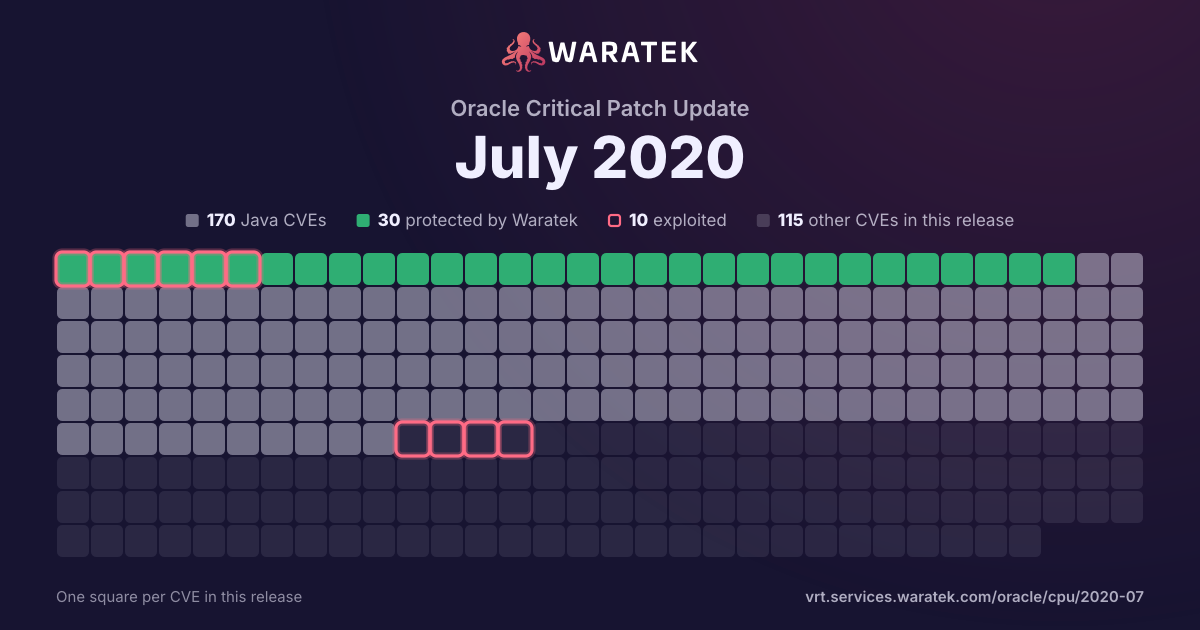
By status
30Protected by Waratek1Mitigation candidate139No exploit published68Outside Waratek scope47Not applicable
10Exploited, marked by the ring
No exploit published. For 126 of them, Oracle's security advisory is the source of public detail.
Protected by Waratek. Waratek RASP can block exploitation of these on systems that have not applied the patch yet.
Overview 11 matches · 3 protected · 0 exploited · 0 CISA KEV · 0 public PoC · 0 EPSS ≥ 0.5
Protected by Waratek
3
27.3%
Rule in development
0
0.0%
Mitigation candidate
0
0.0%
No exploit published
8
72.7%
blocked by ARMR today
3
27.3%
partly blocked
0
0.0%
not blocked
8
72.7%
not established
0
0.0%
unrecorded
0
0.0%
Exploited
0
0.0%
Working exploit published
0
0.0%
Proof of concept only
0
0.0%
Forecast only
0
0.0%
No public exploit
11
100.0%
split by
peak 11 / month
Jul 20
| CVE | Severity | Published▾ | Status | Exploitation | Description |
|---|---|---|---|---|---|
| CVE-2020-14616 | Low | 2020-07-15 | No exploit published | No public exploit | Vulnerability in the Oracle Hospitality Reporting and Analytics product of Oracle Food and Beverage Applications (component: Reporting). The supported version that is affected is 9.1.0. Easily exploitable vulnerability allows high privileged attacker with network access via HTTP to compromise Oracle Hospitality Reporting and Analytics. Successful attacks of this vulnerability can result in unauthorized read access to a subset of Oracle Hospitality Reporting and Analytics accessible data. CVSS 3.1 Base Score 2.7 (Confidentiality impacts). CVSS Vector: (CVSS:3.1/AV:N/AC:L/PR:H/UI:N/S:U/C:L/I:N/A:N). |
| CVE-2020-14590 | Low | 2020-07-15 | No exploit published | No public exploit | Vulnerability in the Oracle Applications Framework product of Oracle E-Business Suite (component: Page Request). Supported versions that are affected are 12.1.3 and 12.2.3-12.2.9. Easily exploitable vulnerability allows high privileged attacker with network access via HTTP to compromise Oracle Applications Framework. Successful attacks of this vulnerability can result in unauthorized read access to a subset of Oracle Applications Framework accessible data. CVSS 3.1 Base Score 2.7 (Confidentiality impacts). CVSS Vector: (CVSS:3.1/AV:N/AC:L/PR:H/UI:N/S:U/C:L/I:N/A:N). |
| CVE-2020-14581 | Low | 2020-07-15 | No exploit published | No public exploit | Vulnerability in the Java SE, Java SE Embedded product of Oracle Java SE (component: 2D). Supported versions that are affected are Java SE: 8u251, 11.0.7 and 14.0.1; Java SE Embedded: 8u251. Difficult to exploit vulnerability allows unauthenticated attacker with network access via multiple protocols to compromise Java SE, Java SE Embedded. Successful attacks of this vulnerability can result in unauthorized read access to a subset of Java SE, Java SE Embedded accessible data. Note: Applies to client and server deployment of Java. This vulnerability can be exploited through sandboxed Java Web Start applications and sandboxed Java applets. It can also be exploited by supplying data to APIs in the specified Component without using sandboxed Java Web Start applications or sandboxed Java applets, such as through a web service. CVSS 3.1 Base Score 3.7 (Confidentiality impacts). CVSS Vector: (CVSS:3.1/AV:N/AC:H/PR:N/UI:N/S:U/C:L/I:N/A:N). |
| CVE-2020-14579 | Low | 2020-07-15 | Protected by Waratek | No public exploit | Vulnerability in the Java SE, Java SE Embedded product of Oracle Java SE (component: Libraries). Supported versions that are affected are Java SE: 7u261 and 8u251; Java SE Embedded: 8u251. Difficult to exploit vulnerability allows unauthenticated attacker with network access via multiple protocols to compromise Java SE, Java SE Embedded. Successful attacks of this vulnerability can result in unauthorized ability to cause a partial denial of service (partial DOS) of Java SE, Java SE Embedded. Note: Applies to client and server deployment of Java. This vulnerability can be exploited through sandboxed Java Web Start applications and sandboxed Java applets. It can also be exploited by supplying data to APIs in the specified Component without using sandboxed Java Web Start applications or sandboxed Java applets, such as through a web service. CVSS 3.1 Base Score 3.7 (Availability impacts). CVSS Vector: (CVSS:3.1/AV:N/AC:H/PR:N/UI:N/S:U/C:N/I:N/A:L). |
| CVE-2020-14578 | Low | 2020-07-15 | Protected by Waratek | No public exploit | Vulnerability in the Java SE, Java SE Embedded product of Oracle Java SE (component: Libraries). Supported versions that are affected are Java SE: 7u261 and 8u251; Java SE Embedded: 8u251. Difficult to exploit vulnerability allows unauthenticated attacker with network access via multiple protocols to compromise Java SE, Java SE Embedded. Successful attacks of this vulnerability can result in unauthorized ability to cause a partial denial of service (partial DOS) of Java SE, Java SE Embedded. Note: Applies to client and server deployment of Java. This vulnerability can be exploited through sandboxed Java Web Start applications and sandboxed Java applets. It can also be exploited by supplying data to APIs in the specified Component without using sandboxed Java Web Start applications or sandboxed Java applets, such as through a web service. CVSS 3.1 Base Score 3.7 (Availability impacts). CVSS Vector: (CVSS:3.1/AV:N/AC:H/PR:N/UI:N/S:U/C:N/I:N/A:L). |
| CVE-2020-14577 | Low | 2020-07-15 | Protected by Waratek | No public exploit | Vulnerability in the Java SE, Java SE Embedded product of Oracle Java SE (component: JSSE). Supported versions that are affected are Java SE: 7u261, 8u251, 11.0.7 and 14.0.1; Java SE Embedded: 8u251. Difficult to exploit vulnerability allows unauthenticated attacker with network access via TLS to compromise Java SE, Java SE Embedded. Successful attacks of this vulnerability can result in unauthorized read access to a subset of Java SE, Java SE Embedded accessible data. Note: Applies to client and server deployment of Java. This vulnerability can be exploited through sandboxed Java Web Start applications and sandboxed Java applets. It can also be exploited by supplying data to APIs in the specified Component without using sandboxed Java Web Start applications or sandboxed Java applets, such as through a web service. CVSS 3.1 Base Score 3.7 (Confidentiality impacts). CVSS Vector: (CVSS:3.1/AV:N/AC:H/PR:N/UI:N/S:U/C:L/I:N/A:N). |
| CVE-2020-14573 | Low | 2020-07-15 | No exploit published | No public exploit | Vulnerability in the Java SE product of Oracle Java SE (component: Hotspot). Supported versions that are affected are Java SE: 11.0.7 and 14.0.1. Difficult to exploit vulnerability allows unauthenticated attacker with network access via multiple protocols to compromise Java SE. Successful attacks of this vulnerability can result in unauthorized update, insert or delete access to some of Java SE accessible data. Note: Applies to client and server deployment of Java. This vulnerability can be exploited through sandboxed Java Web Start applications and sandboxed Java applets. It can also be exploited by supplying data to APIs in the specified Component without using sandboxed Java Web Start applications or sandboxed Java applets, such as through a web service. CVSS 3.1 Base Score 3.7 (Integrity impacts). CVSS Vector: (CVSS:3.1/AV:N/AC:H/PR:N/UI:N/S:U/C:N/I:L/A:N). |
| CVE-2020-14564 | Low | 2020-07-15 | No exploit published | No public exploit | Vulnerability in the PeopleSoft Enterprise PeopleTools product of Oracle PeopleSoft (component: Environment Mgmt Console). Supported versions that are affected are 8.56, 8.57 and 8.58. Easily exploitable vulnerability allows high privileged attacker with network access via HTTP to compromise PeopleSoft Enterprise PeopleTools. Successful attacks of this vulnerability can result in unauthorized update, insert or delete access to some of PeopleSoft Enterprise PeopleTools accessible data. CVSS 3.1 Base Score 2.7 (Integrity impacts). CVSS Vector: (CVSS:3.1/AV:N/AC:L/PR:H/UI:N/S:U/C:N/I:L/A:N). |
| CVE-2020-14548 | Low | 2020-07-15 | No exploit published | No public exploit | Vulnerability in the Oracle Business Intelligence Enterprise Edition product of Oracle Fusion Middleware (component: Analytics Web General). Supported versions that are affected are 12.2.1.3.0 and 12.2.1.4.0. Difficult to exploit vulnerability allows unauthenticated attacker with network access via HTTP to compromise Oracle Business Intelligence Enterprise Edition. Successful attacks require human interaction from a person other than the attacker and while the vulnerability is in Oracle Business Intelligence Enterprise Edition, attacks may significantly impact additional products. Successful attacks of this vulnerability can result in unauthorized read access to a subset of Oracle Business Intelligence Enterprise Edition accessible data. CVSS 3.1 Base Score 3.4 (Confidentiality impacts). CVSS Vector: (CVSS:3.1/AV:N/AC:H/PR:N/UI:R/S:C/C:L/I:N/A:N). |
| CVE-2020-14541 | Low | 2020-07-15 | No exploit published | No public exploit | Vulnerability in the Hyperion Financial Close Management product of Oracle Hyperion (component: Close Manager). The supported version that is affected is 11.1.2.4. Difficult to exploit vulnerability allows high privileged attacker with network access via HTTP to compromise Hyperion Financial Close Management. Successful attacks require human interaction from a person other than the attacker. Successful attacks of this vulnerability can result in unauthorized update, insert or delete access to some of Hyperion Financial Close Management accessible data. CVSS 3.1 Base Score 2.0 (Integrity impacts). CVSS Vector: (CVSS:3.1/AV:N/AC:H/PR:H/UI:R/S:U/C:N/I:L/A:N). |
| CVE-2020-14533 | Low | 2020-07-15 | No exploit published | No public exploit | Vulnerability in the Oracle Commerce Platform product of Oracle Commerce (component: Dynamo Application Framework). Supported versions that are affected are 11.1, 11.2 and prior to 11.3.1. Easily exploitable vulnerability allows high privileged attacker with network access via HTTP to compromise Oracle Commerce Platform. Successful attacks require human interaction from a person other than the attacker. Successful attacks of this vulnerability can result in unauthorized update, insert or delete access to some of Oracle Commerce Platform accessible data as well as unauthorized read access to a subset of Oracle Commerce Platform accessible data. CVSS 3.1 Base Score 3.5 (Confidentiality and Integrity impacts). CVSS Vector: (CVSS:3.1/AV:N/AC:L/PR:H/UI:R/S:U/C:L/I:L/A:N). |