
Oracle Critical Patch Update April 2020
Released April 2020 · Oracle's advisory ↗ · ← Critical Patch Update, January 2020 · Critical Patch Update, July 2020 →
300 CVEs in this release, one square each
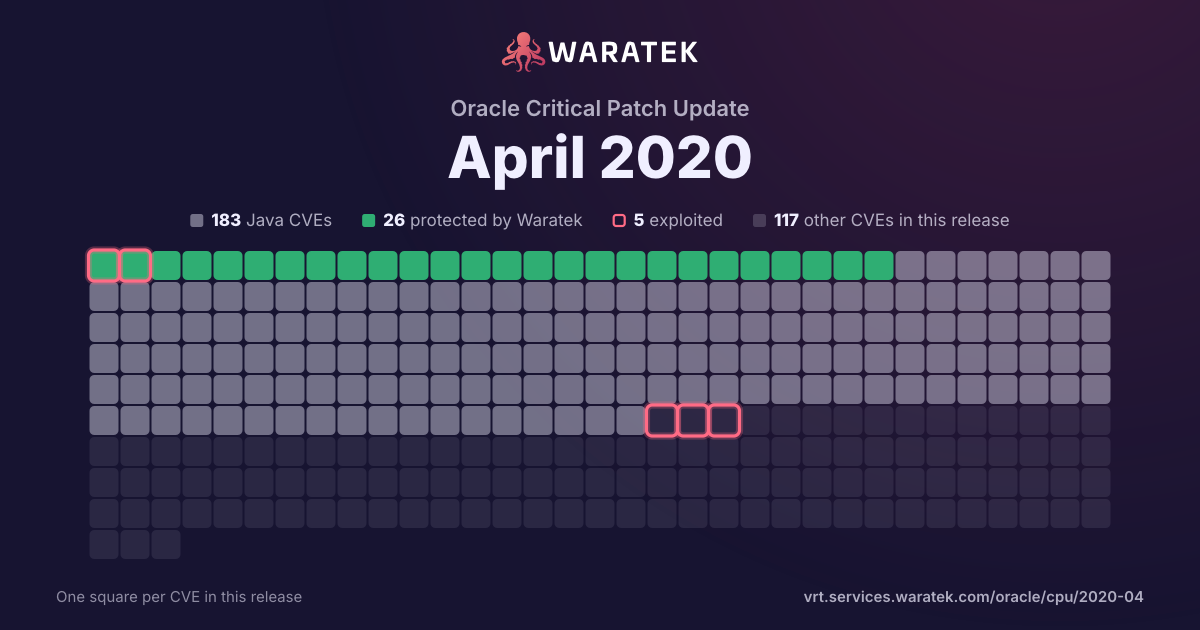
By status
28Protected by Waratek7Mitigation candidate166No exploit published6Outside Waratek scope92Not applicable1Withdrawn CVE
5Exploited, marked by the ring
No exploit published. For 145 of them, Oracle's security advisory is the source of public detail.
Protected by Waratek. Waratek RASP can block exploitation of these on systems that have not applied the patch yet.
Overview 16 matches · 11 in Waratek scope · 4 protected · 2 exploited · 0 CISA KEV · 2 public PoC · 2 EPSS ≥ 0.5
16matches
11in Waratek scope68.8%
4protected25.0%
2exploited12.5%
0CISA KEV0.0%
2public PoC12.5%
2EPSS ≥ 0.512.5%
Protected by Waratek
4
25.0%
Rule in development
0
0.0%
Mitigation candidate
2
12.5%
No exploit published
5
31.2%
Outside Waratek scope
0
0.0%
Not applicable
5
31.2%
Withdrawn CVE
0
0.0%
blocked by ARMR today
4
25.0%
partly blocked
0
0.0%
not blocked
12
75.0%
not established
0
0.0%
unrecorded
0
0.0%
Exploited
2
12.5%
Working exploit published
0
0.0%
Proof of concept only
0
0.0%
Forecast only
1
6.2%
No public exploit
13
81.2%
split by
peak 3 / quarter
Q4 151
No exploit published1
Medium1
not blocked1
No public exploit1
Q1 160
Q2 160
Q3 160
Q4 160
Q1 171
No exploit published1
Medium1
not blocked1
No public exploit1
Q2 170
Q3 171
Protected by Waratek1
Medium1
blocked by ARMR today1
No public exploit1
Q4 170
Q1 182
Mitigation candidate1
Not applicable1
Medium2
not blocked2
Exploited1
Forecast only1
Q2 181
Protected by Waratek1
Medium1
blocked by ARMR today1
No public exploit1
Q3 180
Q4 183
No exploit published2
Not applicable1
Medium3
not blocked3
No public exploit3
Q1 190
Q2 192
Mitigation candidate1
No exploit published1
Medium2
not blocked2
Exploited1
No public exploit1
Q3 193
Not applicable3
Medium3
not blocked3
No public exploit3
Q4 192
Protected by Waratek2
Medium2
blocked by ARMR today2
No public exploit2
Q4 15Q2 16Q4 16Q2 17Q4 17Q2 18Q4 18Q2 19Q4 19
| CVE | Severity | Published▾ | Status | Exploitation | Description |
|---|---|---|---|---|---|
| CVE-2019-12415 | Medium | 2019-10-23 | Protected by Waratek | No public exploit | In Apache POI up to 4.1.0, when using the tool XSSFExportToXml to convert user-provided Microsoft Excel documents, a specially crafted document can allow an attacker to read files from the local filesystem or from internal network resources via XML External Entity (XXE) Processing. |
| CVE-2019-17091 | Medium | 2019-10-02 | Protected by Waratek | No public exploit | faces/context/PartialViewContextImpl.java in Eclipse Mojarra, as used in Mojarra for Eclipse EE4J before 2.3.10 and Mojarra JavaServer Faces before 2.2.20, allows Reflected XSS because a client window field is mishandled. |
| CVE-2019-1547 | Medium | 2019-09-10 | Not applicable | No public exploit | Normally in OpenSSL EC groups always have a co-factor present and this is used in side channel resistant code paths. However, in some cases, it is possible to construct a group using explicit parameters (instead of using a named curve). In those cases it is possible that such a group does not have the cofactor present. This can occur even where all the parameters match a known named curve. If such a curve is used then OpenSSL falls back to non-side channel resistant code paths which may result in full key recovery during an ECDSA signature operation. In order to be vulnerable an attacker would have to have the ability to time the creation of a large number of signatures where explicit parameters with no co-factor present are in use by an application using libcrypto. For the avoidance of doubt libssl is not vulnerable because explicit parameters are never used. Fixed in OpenSSL 1.1.1d (Affected 1.1.1-1.1.1c). Fixed in OpenSSL 1.1.0l (Affected 1.1.0-1.1.0k). Fixed in OpenSSL 1.0.2t (Affected 1.0.2-1.0.2s). |
| CVE-2019-16168 | Medium | 2019-09-09 | Not applicable | No public exploit | In SQLite through 3.29.0, whereLoopAddBtreeIndex in sqlite3.c can crash a browser or other application because of missing validation of a sqlite_stat1 sz field, aka a "severe division by zero in the query planner." |
| CVE-2018-20852 | Medium | 2019-07-13 | Not applicable | No public exploit | http.cookiejar.DefaultPolicy.domain_return_ok in Lib/http/cookiejar.py in Python before 3.7.3 does not correctly validate the domain: it can be tricked into sending existing cookies to the wrong server. An attacker may abuse this flaw by using a server with a hostname that has another valid hostname as a suffix (e.g., pythonicexample.com to steal cookies for example.com). When a program uses http.cookiejar.DefaultPolicy and tries to do an HTTP connection to an attacker-controlled server, existing cookies can be leaked to the attacker. This affects 2.x through 2.7.16, 3.x before 3.4.10, 3.5.x before 3.5.7, 3.6.x before 3.6.9, and 3.7.x before 3.7.3. |
| CVE-2019-10247 | Medium | 2019-04-22 | No exploit published | No public exploit | In Eclipse Jetty version 7.x, 8.x, 9.2.27 and older, 9.3.26 and older, and 9.4.16 and older, the server running on any OS and Jetty version combination will reveal the configured fully qualified directory base resource location on the output of the 404 error for not finding a Context that matches the requested path. The default server behavior on jetty-distribution and jetty-home will include at the end of the Handler tree a DefaultHandler, which is responsible for reporting this 404 error, it presents the various configured contexts as HTML for users to click through to. This produced HTML includes output that contains the configured fully qualified directory base resource location for each context. |
| CVE-2019-11358 | Medium | 2019-04-20 | Mitigation candidate | Exploited | jQuery before 3.4.0, as used in Drupal, Backdrop CMS, and other products, mishandles jQuery.extend(true, {}, ...) because of Object.prototype pollution. If an unsanitized source object contained an enumerable __proto__ property, it could extend the native Object.prototype. |
| CVE-2018-20622 | Medium | 2018-12-31 | Not applicable | No public exploit | JasPer 2.0.14 has a memory leak in base/jas_malloc.c in libjasper.a when "--output-format jp2" is used. |
| CVE-2018-17197 | Medium | 2018-12-24 | No exploit published | No public exploit | A carefully crafted or corrupt sqlite file can cause an infinite loop in Apache Tika's SQLite3Parser in versions 1.8-1.19.1 of Apache Tika. |
| CVE-2018-11797 | Medium | 2018-10-05 | No exploit published | No public exploit | In Apache PDFBox 1.8.0 to 1.8.15 and 2.0.0RC1 to 2.0.11, a carefully crafted PDF file can trigger an extremely long running computation when parsing the page tree. |
| CVE-2018-10237 | Medium | 2018-04-26 | Protected by Waratek | No public exploit | Unbounded memory allocation in Google Guava 11.0 through 24.x before 24.1.1 allows remote attackers to conduct denial of service attacks against servers that depend on this library and deserialize attacker-provided data, because the AtomicDoubleArray class (when serialized with Java serialization) and the CompoundOrdering class (when serialized with GWT serialization) perform eager allocation without appropriate checks on what a client has sent and whether the data size is reasonable. |
| CVE-2015-9251 | Medium | 2018-01-18 | Mitigation candidate | Exploited | jQuery before 3.0.0 is vulnerable to Cross-site Scripting (XSS) attacks when a cross-domain Ajax request is performed without the dataType option, causing text/javascript responses to be executed. |
| CVE-2018-5712 | Medium | 2018-01-16 | Not applicable | Forecast only | An issue was discovered in PHP before 5.6.33, 7.0.x before 7.0.27, 7.1.x before 7.1.13, and 7.2.x before 7.2.1. There is Reflected XSS on the PHAR 404 error page via the URI of a request for a .phar file. |
| CVE-2017-14735 | Medium | 2017-09-25 | Protected by Waratek | No public exploit | OWASP AntiSamy before 1.5.7 allows XSS via HTML5 entities, as demonstrated by use of : to construct a javascript: URL. |
| CVE-2016-7103 | Medium | 2017-03-15 | No exploit published | No public exploit | Cross-site scripting (XSS) vulnerability in jQuery UI before 1.12.0 might allow remote attackers to inject arbitrary web script or HTML via the closeText parameter of the dialog function. |
| CVE-2015-7940 | Medium | 2015-11-09 | No exploit published | No public exploit | The Bouncy Castle Java library before 1.51 does not validate a point is withing the elliptic curve, which makes it easier for remote attackers to obtain private keys via a series of crafted elliptic curve Diffie Hellman (ECDH) key exchanges, aka an "invalid curve attack." |