
Oracle Critical Patch Update April 2020
Released April 2020 · Oracle's advisory ↗ · ← Critical Patch Update, January 2020 · Critical Patch Update, July 2020 →
300 CVEs in this release, one square each
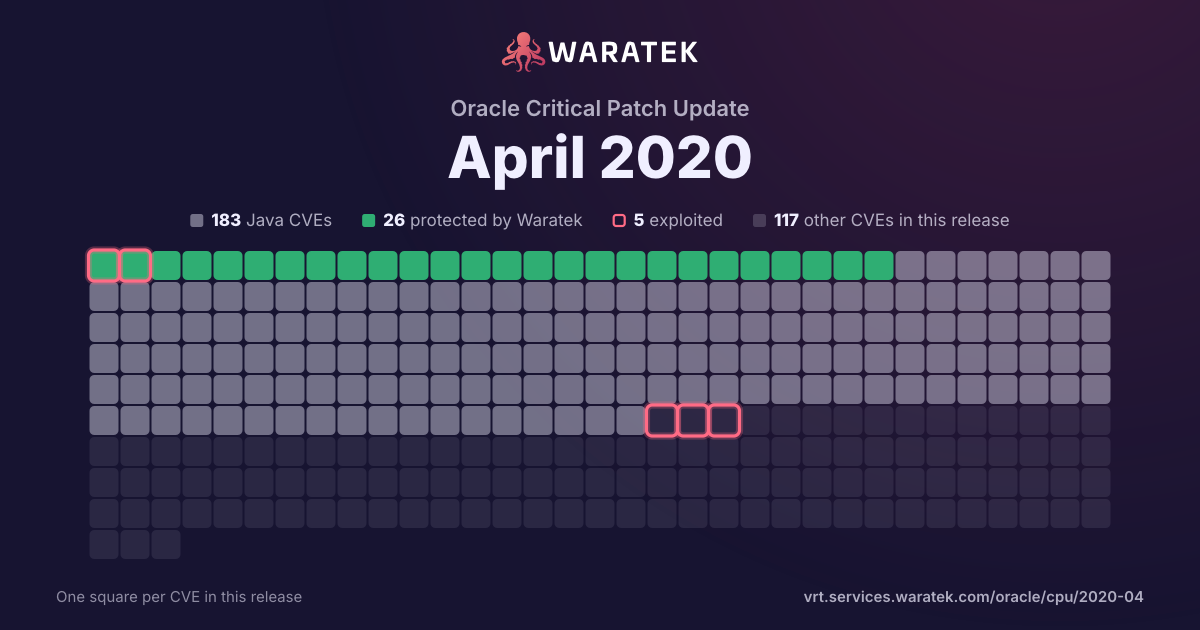
By status
28Protected by Waratek7Mitigation candidate166No exploit published6Outside Waratek scope92Not applicable1Withdrawn CVE
5Exploited, marked by the ring
No exploit published. For 145 of them, Oracle's security advisory is the source of public detail.
Protected by Waratek. Waratek RASP can block exploitation of these on systems that have not applied the patch yet.
Overview 9 matches · 7 in Waratek scope · 2 protected · 1 exploited · 0 CISA KEV · 1 public PoC · 1 EPSS ≥ 0.5
9matches
7in Waratek scope77.8%
2protected22.2%
1exploited11.1%
0CISA KEV0.0%
1public PoC11.1%
1EPSS ≥ 0.511.1%
Protected by Waratek
2
22.2%
Rule in development
0
0.0%
Mitigation candidate
1
11.1%
No exploit published
4
44.4%
Outside Waratek scope
0
0.0%
Not applicable
2
22.2%
Withdrawn CVE
0
0.0%
blocked by ARMR today
2
22.2%
partly blocked
0
0.0%
not blocked
7
77.8%
not established
0
0.0%
unrecorded
0
0.0%
Exploited
1
11.1%
Working exploit published
0
0.0%
Proof of concept only
0
0.0%
Forecast only
1
11.1%
No public exploit
7
77.8%
split by
peak 3 / quarter
Q4 151
No exploit published1
Medium1
not blocked1
No public exploit1
Q1 160
Q2 160
Q3 160
Q4 160
Q1 171
No exploit published1
Medium1
not blocked1
No public exploit1
Q2 170
Q3 171
Protected by Waratek1
Medium1
blocked by ARMR today1
No public exploit1
Q4 170
Q1 182
Mitigation candidate1
Not applicable1
Medium2
not blocked2
Exploited1
Forecast only1
Q2 181
Protected by Waratek1
Medium1
blocked by ARMR today1
No public exploit1
Q3 180
Q4 183
No exploit published2
Not applicable1
Medium3
not blocked3
No public exploit3
Q4 15Q2 16Q4 16Q2 17Q4 17Q2 18Q4 18
| CVE | Severity | Published▾ | Status | Exploitation | Description |
|---|---|---|---|---|---|
| CVE-2018-20622 | Medium | 2018-12-31 | Not applicable | No public exploit | JasPer 2.0.14 has a memory leak in base/jas_malloc.c in libjasper.a when "--output-format jp2" is used. |
| CVE-2018-17197 | Medium | 2018-12-24 | No exploit published | No public exploit | A carefully crafted or corrupt sqlite file can cause an infinite loop in Apache Tika's SQLite3Parser in versions 1.8-1.19.1 of Apache Tika. |
| CVE-2018-11797 | Medium | 2018-10-05 | No exploit published | No public exploit | In Apache PDFBox 1.8.0 to 1.8.15 and 2.0.0RC1 to 2.0.11, a carefully crafted PDF file can trigger an extremely long running computation when parsing the page tree. |
| CVE-2018-10237 | Medium | 2018-04-26 | Protected by Waratek | No public exploit | Unbounded memory allocation in Google Guava 11.0 through 24.x before 24.1.1 allows remote attackers to conduct denial of service attacks against servers that depend on this library and deserialize attacker-provided data, because the AtomicDoubleArray class (when serialized with Java serialization) and the CompoundOrdering class (when serialized with GWT serialization) perform eager allocation without appropriate checks on what a client has sent and whether the data size is reasonable. |
| CVE-2015-9251 | Medium | 2018-01-18 | Mitigation candidate | Exploited | jQuery before 3.0.0 is vulnerable to Cross-site Scripting (XSS) attacks when a cross-domain Ajax request is performed without the dataType option, causing text/javascript responses to be executed. |
| CVE-2018-5712 | Medium | 2018-01-16 | Not applicable | Forecast only | An issue was discovered in PHP before 5.6.33, 7.0.x before 7.0.27, 7.1.x before 7.1.13, and 7.2.x before 7.2.1. There is Reflected XSS on the PHAR 404 error page via the URI of a request for a .phar file. |
| CVE-2017-14735 | Medium | 2017-09-25 | Protected by Waratek | No public exploit | OWASP AntiSamy before 1.5.7 allows XSS via HTML5 entities, as demonstrated by use of : to construct a javascript: URL. |
| CVE-2016-7103 | Medium | 2017-03-15 | No exploit published | No public exploit | Cross-site scripting (XSS) vulnerability in jQuery UI before 1.12.0 might allow remote attackers to inject arbitrary web script or HTML via the closeText parameter of the dialog function. |
| CVE-2015-7940 | Medium | 2015-11-09 | No exploit published | No public exploit | The Bouncy Castle Java library before 1.51 does not validate a point is withing the elliptic curve, which makes it easier for remote attackers to obtain private keys via a series of crafted elliptic curve Diffie Hellman (ECDH) key exchanges, aka an "invalid curve attack." |