
Oracle Critical Patch Update April 2020
Released April 2020 · Oracle's advisory ↗ · ← Critical Patch Update, January 2020 · Critical Patch Update, July 2020 →
300 CVEs in this release, one square each
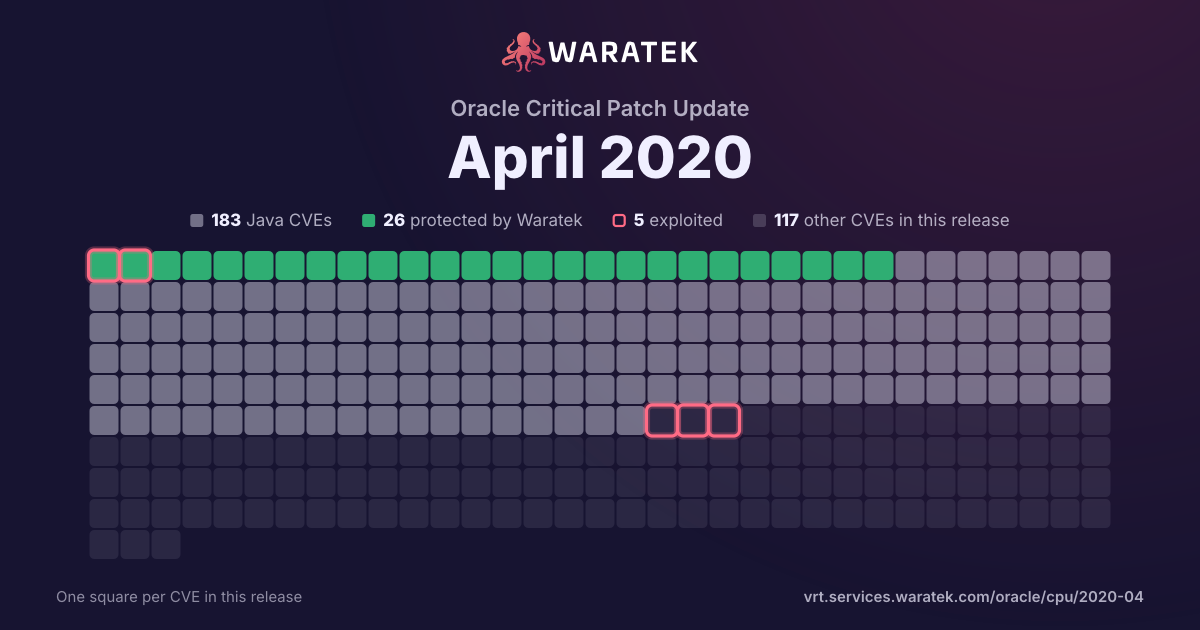
By status
26Protected by Waratek7Mitigation candidate168No exploit published6Outside Waratek scope92Not applicable1Withdrawn CVE
5Exploited, marked by the ring
No exploit published. For 145 of them, Oracle's security advisory is the source of public detail.
Protected by Waratek. Waratek RASP can block exploitation of these on systems that have not applied the patch yet.
Overview 7 matches · 1 exploited · 1 CISA KEV · 2 public PoC · 3 EPSS ≥ 0.5
Protected by Waratek
7
100.0%
Rule in development
0
0.0%
Mitigation candidate
0
0.0%
No exploit published
0
0.0%
blocked by ARMR today
7
100.0%
partly blocked
0
0.0%
not blocked
0
0.0%
not established
0
0.0%
unrecorded
0
0.0%
Exploited
1
14.3%
Working exploit published
0
0.0%
Proof of concept only
1
14.3%
Forecast only
1
14.3%
No public exploit
4
57.1%
split by
peak 2 / month
Jul 192
Protected by Waratek2
Critical2
blocked by ARMR today2
Forecast only1
No public exploit1
Aug 191
Protected by Waratek1
High1
blocked by ARMR today1
No public exploit1
Sep 190
Oct 192
Protected by Waratek2
Medium2
blocked by ARMR today2
No public exploit2
Nov 190
Dec 191
Protected by Waratek1
Critical1
blocked by ARMR today1
Proof of concept only1
Jan 200
Feb 200
Mar 200
Apr 201
Protected by Waratek1
Critical1
blocked by ARMR today1
Exploited1
Jul 19Aug 19Sep 19Oct 19Nov 19Dec 19Jan 20Feb 20Mar 20Apr 20
| CVE | Severity | Published▾ | Status | Exploitation | Description |
|---|---|---|---|---|---|
| CVE-2020-2883 | Critical | 2020-04-15 | Protected by Waratek | Exploited | Vulnerability in the Oracle WebLogic Server product of Oracle Fusion Middleware (component: Core). Supported versions that are affected are 10.3.6.0.0, 12.1.3.0.0, 12.2.1.3.0 and 12.2.1.4.0. Easily exploitable vulnerability allows unauthenticated attacker with network access via IIOP, T3 to compromise Oracle WebLogic Server. Successful attacks of this vulnerability can result in takeover of Oracle WebLogic Server. CVSS 3.0 Base Score 9.8 (Confidentiality, Integrity and Availability impacts). CVSS Vector: (CVSS:3.0/AV:N/AC:L/PR:N/UI:N/S:U/C:H/I:H/A:H). |
| CVE-2019-17571 | Critical | 2019-12-20 | Protected by Waratek | Proof of concept only | Included in Log4j 1.2 is a SocketServer class that is vulnerable to deserialization of untrusted data which can be exploited to remotely execute arbitrary code when combined with a deserialization gadget when listening to untrusted network traffic for log data. This affects Log4j versions up to 1.2 up to 1.2.17. |
| CVE-2019-12415 | Medium | 2019-10-23 | Protected by Waratek | No public exploit | In Apache POI up to 4.1.0, when using the tool XSSFExportToXml to convert user-provided Microsoft Excel documents, a specially crafted document can allow an attacker to read files from the local filesystem or from internal network resources via XML External Entity (XXE) Processing. |
| CVE-2019-17091 | Medium | 2019-10-02 | Protected by Waratek | No public exploit | faces/context/PartialViewContextImpl.java in Eclipse Mojarra, as used in Mojarra for Eclipse EE4J before 2.3.10 and Mojarra JavaServer Faces before 2.2.20, allows Reflected XSS because a client window field is mishandled. |
| CVE-2019-10086 | High | 2019-08-20 | Protected by Waratek | No public exploit | In Apache Commons Beanutils 1.9.2, a special BeanIntrospector class was added which allows suppressing the ability for an attacker to access the classloader via the class property available on all Java objects. We, however were not using this by default characteristic of the PropertyUtilsBean. |
| CVE-2019-13990 | Critical | 2019-07-26 | Protected by Waratek | No public exploit | initDocumentParser in xml/XMLSchedulingDataProcessor.java in Terracotta Quartz Scheduler through 2.3.0 allows XXE attacks via a job description. |
| CVE-2019-10173 | Critical | 2019-07-23 | Protected by Waratek | Forecast only | It was found that xstream API version 1.4.10 before 1.4.11 introduced a regression for a previous deserialization flaw. If the security framework has not been initialized, it may allow a remote attacker to run arbitrary shell commands when unmarshalling XML or any supported format. e.g. JSON. (regression of CVE-2013-7285) |