
Oracle Critical Patch Update April 2020
Released April 2020 · Oracle's advisory ↗ · ← Critical Patch Update, January 2020 · Critical Patch Update, July 2020 →
300 CVEs in this release, one square each
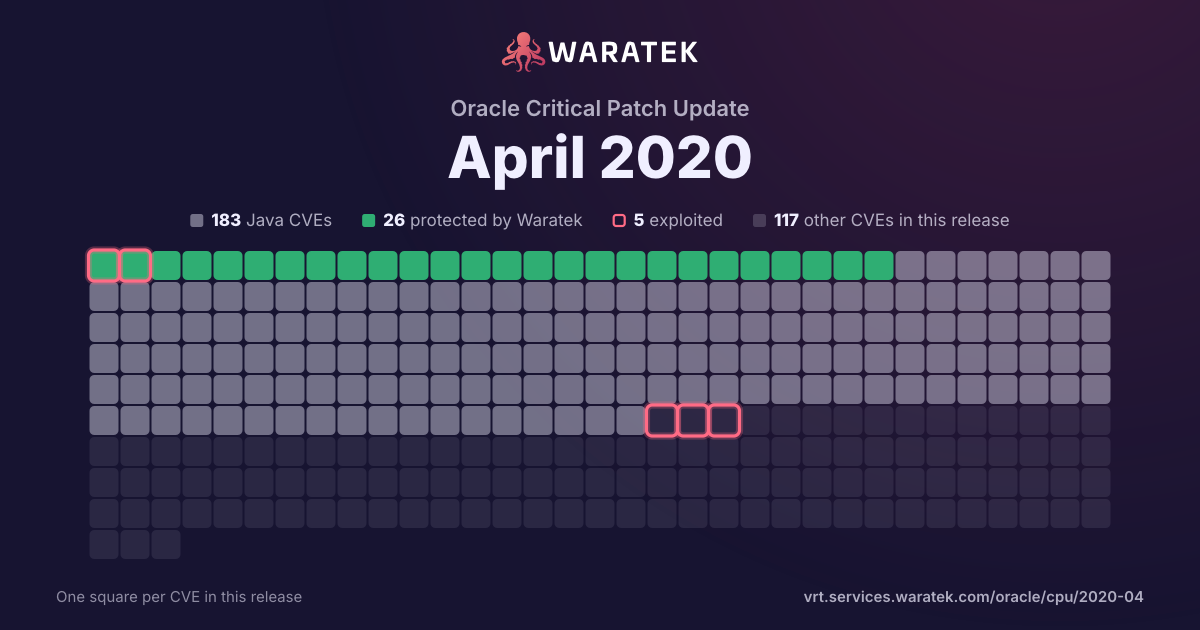
By status
28Protected by Waratek7Mitigation candidate166No exploit published6Outside Waratek scope92Not applicable1Withdrawn CVE
5Exploited, marked by the ring
No exploit published. For 145 of them, Oracle's security advisory is the source of public detail.
Protected by Waratek. Waratek RASP can block exploitation of these on systems that have not applied the patch yet.
Overview 3 matches · 1 protected · 2 exploited · 1 CISA KEV
Protected by Waratek
1
33.3%
Rule in development
0
0.0%
Mitigation candidate
2
66.7%
No exploit published
0
0.0%
blocked by ARMR today
1
33.3%
partly blocked
0
0.0%
not blocked
2
66.7%
not established
0
0.0%
unrecorded
0
0.0%
Exploited
2
66.7%
Working exploit published
1
33.3%
Proof of concept only
0
0.0%
Forecast only
0
0.0%
No public exploit
0
0.0%
split by
peak 2 / quarter
Q2 17Q3 17Q4 17Q1 18Q2 18Q3 18Q4 18Q1 19Q2 19
| CVE | Severity | Published▾ | Status | Exploitation | Description |
|---|---|---|---|---|---|
| CVE-2019-11358 | Medium | 2019-04-20 | Mitigation candidate | Exploited | jQuery before 3.4.0, as used in Drupal, Backdrop CMS, and other products, mishandles jQuery.extend(true, {}, ...) because of Object.prototype pollution. If an unsanitized source object contained an enumerable __proto__ property, it could extend the native Object.prototype. |
| CVE-2019-0211 | High | 2019-04-08 | Mitigation candidate | Exploited | In Apache HTTP Server 2.4 releases 2.4.17 to 2.4.38, with MPM event, worker or prefork, code executing in less-privileged child processes or threads (including scripts executed by an in-process scripting interpreter) could execute arbitrary code with the privileges of the parent process (usually root) by manipulating the scoreboard. Non-Unix systems are not affected. |
| CVE-2017-5645 | Critical | 2017-04-17 | Protected by Waratek | Working exploit published | In Apache Log4j 2.x before 2.8.2, when using the TCP socket server or UDP socket server to receive serialized log events from another application, a specially crafted binary payload can be sent that, when deserialized, can execute arbitrary code. |