
Oracle Critical Patch Update April 2020
Released April 2020 · Oracle's advisory ↗ · ← Critical Patch Update, January 2020 · Critical Patch Update, July 2020 →
300 CVEs in this release, one square each
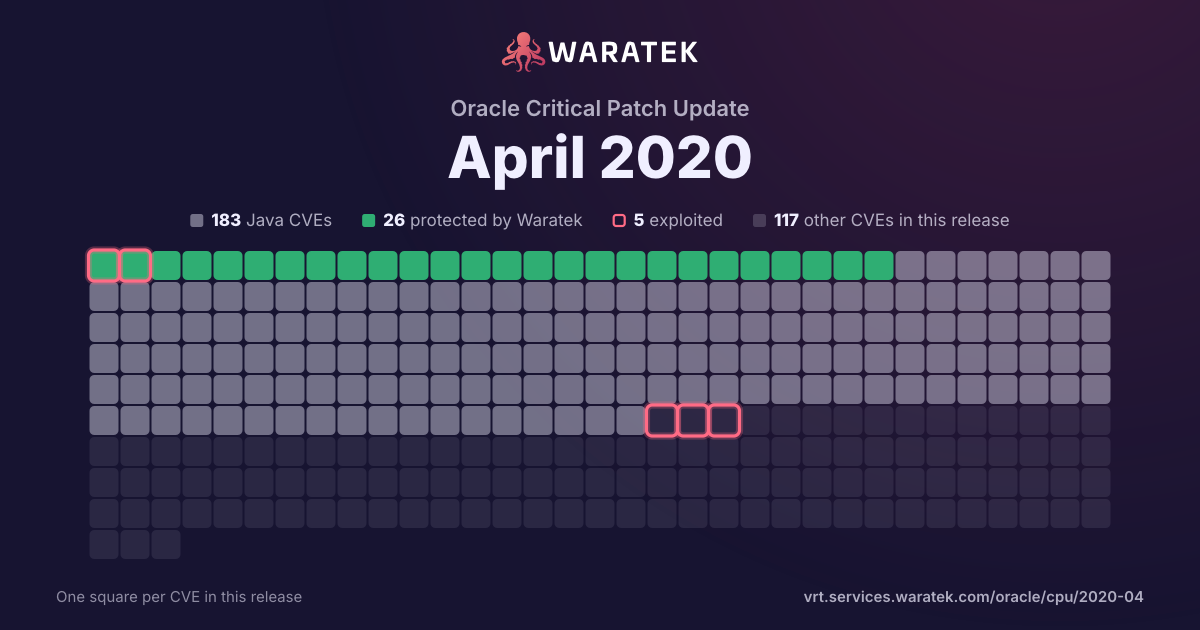
By status
26Protected by Waratek1Mitigation candidate156No exploit published60Outside Waratek scope56Not applicable1Withdrawn CVE
5Exploited, marked by the ring
No exploit published. For 141 of them, Oracle's security advisory is the source of public detail.
Protected by Waratek. Waratek RASP can block exploitation of these on systems that have not applied the patch yet.
Overview 26 matches · 2 exploited · 1 CISA KEV · 4 public PoC · 5 EPSS ≥ 0.5
Protected by Waratek
26
100.0%
Rule in development
0
0.0%
Mitigation candidate
0
0.0%
No exploit published
0
0.0%
Outside Waratek scope
0
0.0%
Not applicable
0
0.0%
Withdrawn CVE
0
0.0%
blocked by ARMR today
26
100.0%
partly blocked
0
0.0%
not blocked
0
0.0%
not established
0
0.0%
unrecorded
0
0.0%
split by
peak 11 / quarter
Q1 151
Protected by Waratek1
High1
blocked by ARMR today1
No public exploit1
Q2 150
Q3 150
Q4 150
Q1 160
Q2 160
Q3 160
Q4 161
Protected by Waratek1
Critical1
blocked by ARMR today1
No public exploit1
Q1 170
Q2 171
Protected by Waratek1
Critical1
blocked by ARMR today1
Working exploit published1
Q3 172
Protected by Waratek2
Critical1
Medium1
blocked by ARMR today2
No public exploit2
Q4 170
Q1 180
Q2 181
Protected by Waratek1
Medium1
blocked by ARMR today1
No public exploit1
Q3 181
Protected by Waratek1
High1
blocked by ARMR today1
No public exploit1
Q4 180
Q1 190
Q2 191
Protected by Waratek1
Critical1
blocked by ARMR today1
Exploited1
Q3 193
Protected by Waratek3
Critical2
High1
blocked by ARMR today3
Forecast only1
No public exploit2
Q4 194
Protected by Waratek4
Critical1
High1
Medium2
blocked by ARMR today4
Proof of concept only1
No public exploit3
Q1 200
Q2 2011
Protected by Waratek11
Critical2
High1
Medium3
Low5
blocked by ARMR today11
Exploited1
No public exploit10
Q2 15Q4 15Q2 16Q4 16Q2 17Q4 17Q2 18Q4 18Q2 19Q4 19Q2 20
| CVE | Severity | Published▾ | Status | Exploitation | Description |
|---|---|---|---|---|---|
| CVE-2020-2915 | Critical | 2020-04-15 | Protected by Waratek | No public exploit | Vulnerability in the Oracle Coherence product of Oracle Fusion Middleware (component: Caching, CacheStore, Invocation). Supported versions that are affected are 3.7.1.0, 12.1.3.0.0, 12.2.1.3.0 and 12.2.1.4.0. Easily exploitable vulnerability allows unauthenticated attacker with network access via IIOP, T3 to compromise Oracle Coherence. Successful attacks of this vulnerability can result in takeover of Oracle Coherence. CVSS 3.0 Base Score 9.8 (Confidentiality, Integrity and Availability impacts). CVSS Vector: (CVSS:3.0/AV:N/AC:L/PR:N/UI:N/S:U/C:H/I:H/A:H). |
| CVE-2020-2883 | Critical | 2020-04-15 | Protected by Waratek | Exploited | Vulnerability in the Oracle WebLogic Server product of Oracle Fusion Middleware (component: Core). Supported versions that are affected are 10.3.6.0.0, 12.1.3.0.0, 12.2.1.3.0 and 12.2.1.4.0. Easily exploitable vulnerability allows unauthenticated attacker with network access via IIOP, T3 to compromise Oracle WebLogic Server. Successful attacks of this vulnerability can result in takeover of Oracle WebLogic Server. CVSS 3.0 Base Score 9.8 (Confidentiality, Integrity and Availability impacts). CVSS Vector: (CVSS:3.0/AV:N/AC:L/PR:N/UI:N/S:U/C:H/I:H/A:H). |
| CVE-2020-2830 | Medium | 2020-04-15 | Protected by Waratek | No public exploit | Vulnerability in the Java SE, Java SE Embedded product of Oracle Java SE (component: Concurrency). Supported versions that are affected are Java SE: 7u251, 8u241, 11.0.6 and 14; Java SE Embedded: 8u241. Easily exploitable vulnerability allows unauthenticated attacker with network access via multiple protocols to compromise Java SE, Java SE Embedded. Successful attacks of this vulnerability can result in unauthorized ability to cause a partial denial of service (partial DOS) of Java SE, Java SE Embedded. Note: Applies to client and server deployment of Java. This vulnerability can be exploited through sandboxed Java Web Start applications and sandboxed Java applets. It can also be exploited by supplying data to APIs in the specified Component without using sandboxed Java Web Start applications or sandboxed Java applets, such as through a web service. CVSS 3.0 Base Score 5.3 (Availability impacts). CVSS Vector: (CVSS:3.0/AV:N/AC:L/PR:N/UI:N/S:U/C:N/I:N/A:L). |
| CVE-2020-2816 | High | 2020-04-15 | Protected by Waratek | No public exploit | Vulnerability in the Java SE product of Oracle Java SE (component: JSSE). Supported versions that are affected are Java SE: 11.0.6 and 14. Easily exploitable vulnerability allows unauthenticated attacker with network access via HTTPS to compromise Java SE. Successful attacks of this vulnerability can result in unauthorized creation, deletion or modification access to critical data or all Java SE accessible data. Note: This vulnerability can only be exploited by supplying data to APIs in the specified Component without using Untrusted Java Web Start applications or Untrusted Java applets, such as through a web service. CVSS 3.0 Base Score 7.5 (Integrity impacts). CVSS Vector: (CVSS:3.0/AV:N/AC:L/PR:N/UI:N/S:U/C:N/I:H/A:N). |
| CVE-2020-2800 | Medium | 2020-04-15 | Protected by Waratek | No public exploit | Vulnerability in the Java SE, Java SE Embedded product of Oracle Java SE (component: Lightweight HTTP Server). Supported versions that are affected are Java SE: 7u251, 8u241, 11.0.6 and 14; Java SE Embedded: 8u241. Difficult to exploit vulnerability allows unauthenticated attacker with network access via multiple protocols to compromise Java SE, Java SE Embedded. Successful attacks of this vulnerability can result in unauthorized update, insert or delete access to some of Java SE, Java SE Embedded accessible data as well as unauthorized read access to a subset of Java SE, Java SE Embedded accessible data. Note: This vulnerability can only be exploited by supplying data to APIs in the specified Component without using Untrusted Java Web Start applications or Untrusted Java applets, such as through a web service. CVSS 3.0 Base Score 4.8 (Confidentiality and Integrity impacts). CVSS Vector: (CVSS:3.0/AV:N/AC:H/PR:N/UI:N/S:U/C:L/I:L/A:N). |
| CVE-2020-2781 | Medium | 2020-04-15 | Protected by Waratek | No public exploit | Vulnerability in the Java SE, Java SE Embedded product of Oracle Java SE (component: JSSE). Supported versions that are affected are Java SE: 7u251, 8u241, 11.0.6 and 14; Java SE Embedded: 8u241. Easily exploitable vulnerability allows unauthenticated attacker with network access via HTTPS to compromise Java SE, Java SE Embedded. Successful attacks of this vulnerability can result in unauthorized ability to cause a partial denial of service (partial DOS) of Java SE, Java SE Embedded. Note: Applies to client and server deployment of Java. This vulnerability can be exploited through sandboxed Java Web Start applications and sandboxed Java applets. It can also be exploited by supplying data to APIs in the specified Component without using sandboxed Java Web Start applications or sandboxed Java applets, such as through a web service. CVSS 3.0 Base Score 5.3 (Availability impacts). CVSS Vector: (CVSS:3.0/AV:N/AC:L/PR:N/UI:N/S:U/C:N/I:N/A:L). |
| CVE-2020-2773 | Low | 2020-04-15 | Protected by Waratek | No public exploit | Vulnerability in the Java SE, Java SE Embedded product of Oracle Java SE (component: Security). Supported versions that are affected are Java SE: 7u251, 8u241, 11.0.6 and 14; Java SE Embedded: 8u241. Difficult to exploit vulnerability allows unauthenticated attacker with network access via multiple protocols to compromise Java SE, Java SE Embedded. Successful attacks of this vulnerability can result in unauthorized ability to cause a partial denial of service (partial DOS) of Java SE, Java SE Embedded. Note: Applies to client and server deployment of Java. This vulnerability can be exploited through sandboxed Java Web Start applications and sandboxed Java applets. It can also be exploited by supplying data to APIs in the specified Component without using sandboxed Java Web Start applications or sandboxed Java applets, such as through a web service. CVSS 3.0 Base Score 3.7 (Availability impacts). CVSS Vector: (CVSS:3.0/AV:N/AC:H/PR:N/UI:N/S:U/C:N/I:N/A:L). |
| CVE-2020-2757 | Low | 2020-04-15 | Protected by Waratek | No public exploit | Vulnerability in the Java SE, Java SE Embedded product of Oracle Java SE (component: Serialization). Supported versions that are affected are Java SE: 7u251, 8u241, 11.0.6 and 14; Java SE Embedded: 8u241. Difficult to exploit vulnerability allows unauthenticated attacker with network access via multiple protocols to compromise Java SE, Java SE Embedded. Successful attacks of this vulnerability can result in unauthorized ability to cause a partial denial of service (partial DOS) of Java SE, Java SE Embedded. Note: Applies to client and server deployment of Java. This vulnerability can be exploited through sandboxed Java Web Start applications and sandboxed Java applets. It can also be exploited by supplying data to APIs in the specified Component without using sandboxed Java Web Start applications or sandboxed Java applets, such as through a web service. CVSS 3.0 Base Score 3.7 (Availability impacts). CVSS Vector: (CVSS:3.0/AV:N/AC:H/PR:N/UI:N/S:U/C:N/I:N/A:L). |
| CVE-2020-2756 | Low | 2020-04-15 | Protected by Waratek | No public exploit | Vulnerability in the Java SE, Java SE Embedded product of Oracle Java SE (component: Serialization). Supported versions that are affected are Java SE: 7u251, 8u241, 11.0.6 and 14; Java SE Embedded: 8u241. Difficult to exploit vulnerability allows unauthenticated attacker with network access via multiple protocols to compromise Java SE, Java SE Embedded. Successful attacks of this vulnerability can result in unauthorized ability to cause a partial denial of service (partial DOS) of Java SE, Java SE Embedded. Note: Applies to client and server deployment of Java. This vulnerability can be exploited through sandboxed Java Web Start applications and sandboxed Java applets. It can also be exploited by supplying data to APIs in the specified Component without using sandboxed Java Web Start applications or sandboxed Java applets, such as through a web service. CVSS 3.0 Base Score 3.7 (Availability impacts). CVSS Vector: (CVSS:3.0/AV:N/AC:H/PR:N/UI:N/S:U/C:N/I:N/A:L). |
| CVE-2020-2755 | Low | 2020-04-15 | Protected by Waratek | No public exploit | Vulnerability in the Java SE, Java SE Embedded product of Oracle Java SE (component: Scripting). Supported versions that are affected are Java SE: 8u241, 11.0.6 and 14; Java SE Embedded: 8u241. Difficult to exploit vulnerability allows unauthenticated attacker with network access via multiple protocols to compromise Java SE, Java SE Embedded. Successful attacks of this vulnerability can result in unauthorized ability to cause a partial denial of service (partial DOS) of Java SE, Java SE Embedded. Note: Applies to client and server deployment of Java. This vulnerability can be exploited through sandboxed Java Web Start applications and sandboxed Java applets. It can also be exploited by supplying data to APIs in the specified Component without using sandboxed Java Web Start applications or sandboxed Java applets, such as through a web service. CVSS 3.0 Base Score 3.7 (Availability impacts). CVSS Vector: (CVSS:3.0/AV:N/AC:H/PR:N/UI:N/S:U/C:N/I:N/A:L). |
| CVE-2020-2754 | Low | 2020-04-15 | Protected by Waratek | No public exploit | Vulnerability in the Java SE, Java SE Embedded product of Oracle Java SE (component: Scripting). Supported versions that are affected are Java SE: 8u241, 11.0.6 and 14; Java SE Embedded: 8u241. Difficult to exploit vulnerability allows unauthenticated attacker with network access via multiple protocols to compromise Java SE, Java SE Embedded. Successful attacks of this vulnerability can result in unauthorized ability to cause a partial denial of service (partial DOS) of Java SE, Java SE Embedded. Note: Applies to client and server deployment of Java. This vulnerability can be exploited through sandboxed Java Web Start applications and sandboxed Java applets. It can also be exploited by supplying data to APIs in the specified Component without using sandboxed Java Web Start applications or sandboxed Java applets, such as through a web service. CVSS 3.0 Base Score 3.7 (Availability impacts). CVSS Vector: (CVSS:3.0/AV:N/AC:H/PR:N/UI:N/S:U/C:N/I:N/A:L). |
| CVE-2019-17563 | High | 2019-12-23 | Protected by Waratek | No public exploit | When using FORM authentication with Apache Tomcat 9.0.0.M1 to 9.0.29, 8.5.0 to 8.5.49 and 7.0.0 to 7.0.98 there was a narrow window where an attacker could perform a session fixation attack. The window was considered too narrow for an exploit to be practical but, erring on the side of caution, this issue has been treated as a security vulnerability. |
| CVE-2019-17571 | Critical | 2019-12-20 | Protected by Waratek | Proof of concept only | Included in Log4j 1.2 is a SocketServer class that is vulnerable to deserialization of untrusted data which can be exploited to remotely execute arbitrary code when combined with a deserialization gadget when listening to untrusted network traffic for log data. This affects Log4j versions up to 1.2 up to 1.2.17. |
| CVE-2019-12415 | Medium | 2019-10-23 | Protected by Waratek | No public exploit | In Apache POI up to 4.1.0, when using the tool XSSFExportToXml to convert user-provided Microsoft Excel documents, a specially crafted document can allow an attacker to read files from the local filesystem or from internal network resources via XML External Entity (XXE) Processing. |
| CVE-2019-17091 | Medium | 2019-10-02 | Protected by Waratek | No public exploit | faces/context/PartialViewContextImpl.java in Eclipse Mojarra, as used in Mojarra for Eclipse EE4J before 2.3.10 and Mojarra JavaServer Faces before 2.2.20, allows Reflected XSS because a client window field is mishandled. |
| CVE-2019-10086 | High | 2019-08-20 | Protected by Waratek | No public exploit | In Apache Commons Beanutils 1.9.2, a special BeanIntrospector class was added which allows suppressing the ability for an attacker to access the classloader via the class property available on all Java objects. We, however were not using this by default characteristic of the PropertyUtilsBean. |
| CVE-2019-14379 | Critical | 2019-07-29 | Protected by Waratek | No public exploit | SubTypeValidator.java in FasterXML jackson-databind before 2.9.9.2 mishandles default typing when ehcache is used (because of net.sf.ehcache.transaction.manager.DefaultTransactionManagerLookup), leading to remote code execution. |
| CVE-2019-10173 | Critical | 2019-07-23 | Protected by Waratek | Forecast only | It was found that xstream API version 1.4.10 before 1.4.11 introduced a regression for a previous deserialization flaw. If the security framework has not been initialized, it may allow a remote attacker to run arbitrary shell commands when unmarshalling XML or any supported format. e.g. JSON. (regression of CVE-2013-7285) |
| CVE-2019-2729 | Critical | 2019-06-19 | Protected by Waratek | Exploited | Vulnerability in the Oracle WebLogic Server component of Oracle Fusion Middleware (subcomponent: Web Services). Supported versions that are affected are 10.3.6.0.0, 12.1.3.0.0 and 12.2.1.3.0. Easily exploitable vulnerability allows unauthenticated attacker with network access via HTTP to compromise Oracle WebLogic Server. Successful attacks of this vulnerability can result in takeover of Oracle WebLogic Server. CVSS 3.0 Base Score 9.8 (Confidentiality, Integrity and Availability impacts). CVSS Vector: (CVSS:3.0/AV:N/AC:L/PR:N/UI:N/S:U/C:H/I:H/A:H). |
| CVE-2018-1000632 | High | 2018-08-20 | Protected by Waratek | No public exploit | dom4j version prior to version 2.1.1 contains a CWE-91: XML Injection vulnerability in Class: Element. Methods: addElement, addAttribute that can result in an attacker tampering with XML documents through XML injection. This attack appear to be exploitable via an attacker specifying attributes or elements in the XML document. This vulnerability appears to have been fixed in 2.1.1 or later. |
| CVE-2018-10237 | Medium | 2018-04-26 | Protected by Waratek | No public exploit | Unbounded memory allocation in Google Guava 11.0 through 24.x before 24.1.1 allows remote attackers to conduct denial of service attacks against servers that depend on this library and deserialize attacker-provided data, because the AtomicDoubleArray class (when serialized with Java serialization) and the CompoundOrdering class (when serialized with GWT serialization) perform eager allocation without appropriate checks on what a client has sent and whether the data size is reasonable. |
| CVE-2017-14735 | Medium | 2017-09-25 | Protected by Waratek | No public exploit | OWASP AntiSamy before 1.5.7 allows XSS via HTML5 entities, as demonstrated by use of : to construct a javascript: URL. |
| CVE-2016-4000 | Critical | 2017-07-06 | Protected by Waratek | No public exploit | Jython before 2.7.1rc1 allows attackers to execute arbitrary code via a crafted serialized PyFunction object. |
| CVE-2017-5645 | Critical | 2017-04-17 | Protected by Waratek | Working exploit published | In Apache Log4j 2.x before 2.8.2, when using the TCP socket server or UDP socket server to receive serialized log events from another application, a specially crafted binary payload can be sent that, when deserialized, can execute arbitrary code. |
| CVE-2016-1000031 | Critical | 2016-10-25 | Protected by Waratek | No public exploit | Apache Commons FileUpload before 1.3.3 DiskFileItem File Manipulation Remote Code Execution |
| CVE-2015-0254 | High | 2015-03-09 | Protected by Waratek | No public exploit | Apache Standard Taglibs before 1.2.3 allows remote attackers to execute arbitrary code or conduct external XML entity (XXE) attacks via a crafted XSLT extension in a (1) <x:parse> or (2) <x:transform> JSTL XML tag. |