
Oracle Critical Patch Update April 2020
Released April 2020 · Oracle's advisory ↗ · ← Critical Patch Update, January 2020 · Critical Patch Update, July 2020 →
300 CVEs in this release, one square each
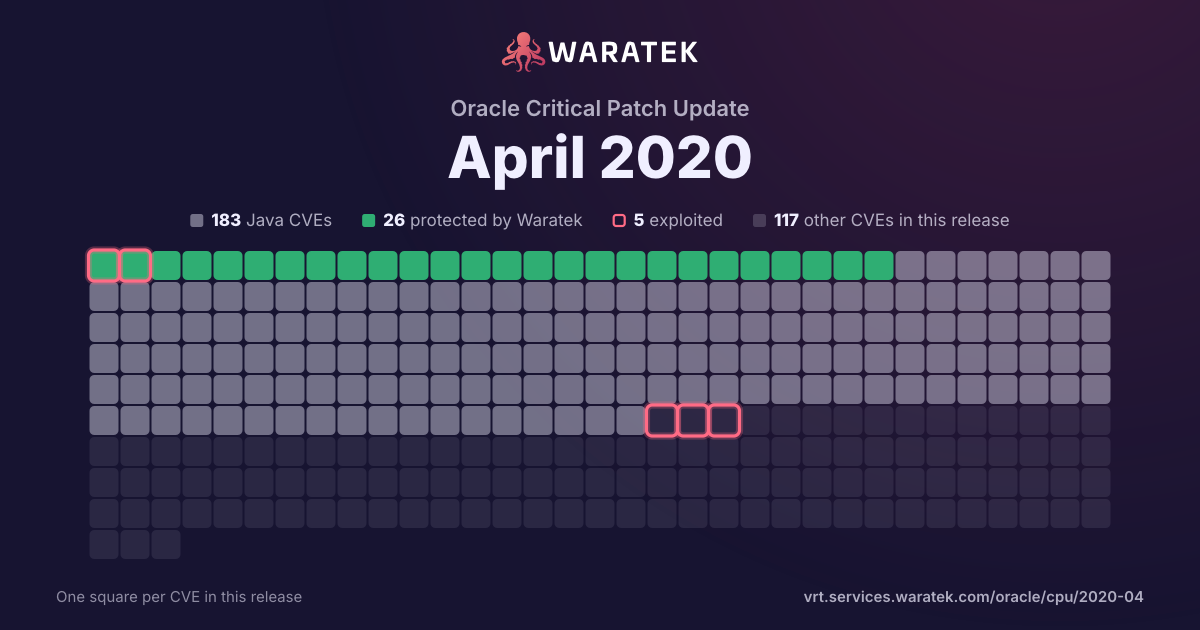
By status
26Protected by Waratek1Mitigation candidate156No exploit published60Outside Waratek scope56Not applicable1Withdrawn CVE
5Exploited, marked by the ring
No exploit published. For 141 of them, Oracle's security advisory is the source of public detail.
Protected by Waratek. Waratek RASP can block exploitation of these on systems that have not applied the patch yet.
Overview 34 matches · 21 in Waratek scope · 9 protected · 2 exploited · 1 CISA KEV · 6 public PoC · 6 EPSS ≥ 0.5
34matches
21in Waratek scope61.8%
9protected26.5%
2exploited5.9%
1CISA KEV2.9%
6public PoC17.6%
6EPSS ≥ 0.517.6%
Protected by Waratek
9
26.5%
Rule in development
0
0.0%
Mitigation candidate
1
2.9%
No exploit published
11
32.4%
Outside Waratek scope
11
32.4%
Not applicable
2
5.9%
Withdrawn CVE
0
0.0%
blocked by ARMR today
9
26.5%
partly blocked
0
0.0%
not blocked
25
73.5%
not established
0
0.0%
unrecorded
0
0.0%
split by
peak 10 / quarter
Q3 151
Outside Waratek scope1
Critical1
not blocked1
No public exploit1
Q4 150
Q1 160
Q2 160
Q3 160
Q4 162
Protected by Waratek1
Outside Waratek scope1
Critical2
blocked by ARMR today1
not blocked1
No public exploit2
Q1 170
Q2 172
Protected by Waratek1
Not applicable1
Critical2
blocked by ARMR today1
not blocked1
Working exploit published1
No public exploit1
Q3 171
Protected by Waratek1
Critical1
blocked by ARMR today1
No public exploit1
Q4 171
Not applicable1
Critical1
not blocked1
No public exploit1
Q1 180
Q2 180
Q3 181
Outside Waratek scope1
Critical1
not blocked1
No public exploit1
Q4 181
Outside Waratek scope1
Critical1
not blocked1
No public exploit1
Q1 190
Q2 191
Protected by Waratek1
Critical1
blocked by ARMR today1
Exploited1
Q3 196
Protected by Waratek2
Outside Waratek scope4
Critical6
blocked by ARMR today2
not blocked4
Forecast only1
No public exploit5
Q4 196
Protected by Waratek1
No exploit published3
Outside Waratek scope2
Critical6
blocked by ARMR today1
not blocked5
Proof of concept only2
No public exploit4
Q1 202
No exploit published1
Outside Waratek scope1
Critical2
not blocked2
No public exploit2
Q2 2010
Protected by Waratek2
Mitigation candidate1
No exploit published7
Critical10
blocked by ARMR today2
not blocked8
Exploited1
Working exploit published1
Forecast only1
No public exploit7
Q4 15Q2 16Q4 16Q2 17Q4 17Q2 18Q4 18Q2 19Q4 19Q2 20
| CVE | Severity | Published▾ | Status | Exploitation | Description |
|---|---|---|---|---|---|
| CVE-2020-2961 | Critical | 2020-04-15 | No exploit published | No public exploit | Vulnerability in the Enterprise Manager Base Platform product of Oracle Enterprise Manager (component: Discovery Framework (Oracle OHS)). Supported versions that are affected are 13.2.0.0 and 13.3.0.0. Easily exploitable vulnerability allows unauthenticated attacker with network access via HTTP to compromise Enterprise Manager Base Platform. Successful attacks of this vulnerability can result in takeover of Enterprise Manager Base Platform. CVSS 3.0 Base Score 9.8 (Confidentiality, Integrity and Availability impacts). CVSS Vector: (CVSS:3.0/AV:N/AC:L/PR:N/UI:N/S:U/C:H/I:H/A:H). |
| CVE-2020-2953 | Critical | 2020-04-15 | No exploit published | No public exploit | Vulnerability in the Oracle Retail Customer Management and Segmentation Foundation product of Oracle Retail Applications (component: Promotions). The supported version that is affected is 18.0. Easily exploitable vulnerability allows unauthenticated attacker with network access via HTTP to compromise Oracle Retail Customer Management and Segmentation Foundation. Successful attacks of this vulnerability can result in takeover of Oracle Retail Customer Management and Segmentation Foundation. CVSS 3.0 Base Score 9.8 (Confidentiality, Integrity and Availability impacts). CVSS Vector: (CVSS:3.0/AV:N/AC:L/PR:N/UI:N/S:U/C:H/I:H/A:H). |
| CVE-2020-2950 | Critical | 2020-04-15 | No exploit published | Forecast only | Vulnerability in the Oracle Business Intelligence Enterprise Edition product of Oracle Fusion Middleware (component: Analytics Web General). Supported versions that are affected are 5.5.0.0.0, 11.1.1.9.0, 12.2.1.3.0 and 12.2.1.4.0. Easily exploitable vulnerability allows unauthenticated attacker with network access via HTTP to compromise Oracle Business Intelligence Enterprise Edition. Successful attacks of this vulnerability can result in takeover of Oracle Business Intelligence Enterprise Edition. CVSS 3.0 Base Score 9.8 (Confidentiality, Integrity and Availability impacts). CVSS Vector: (CVSS:3.0/AV:N/AC:L/PR:N/UI:N/S:U/C:H/I:H/A:H). |
| CVE-2020-2931 | Critical | 2020-04-15 | No exploit published | No public exploit | Vulnerability in the Oracle Knowledge product of Oracle Knowledge (component: Web Applications - InfoCenter). Supported versions that are affected are 8.6.0-8.6.3. Easily exploitable vulnerability allows unauthenticated attacker with network access via HTTP to compromise Oracle Knowledge. Successful attacks of this vulnerability can result in takeover of Oracle Knowledge. CVSS 3.0 Base Score 9.8 (Confidentiality, Integrity and Availability impacts). CVSS Vector: (CVSS:3.0/AV:N/AC:L/PR:N/UI:N/S:U/C:H/I:H/A:H). |
| CVE-2020-2915 | Critical | 2020-04-15 | Protected by Waratek | No public exploit | Vulnerability in the Oracle Coherence product of Oracle Fusion Middleware (component: Caching, CacheStore, Invocation). Supported versions that are affected are 3.7.1.0, 12.1.3.0.0, 12.2.1.3.0 and 12.2.1.4.0. Easily exploitable vulnerability allows unauthenticated attacker with network access via IIOP, T3 to compromise Oracle Coherence. Successful attacks of this vulnerability can result in takeover of Oracle Coherence. CVSS 3.0 Base Score 9.8 (Confidentiality, Integrity and Availability impacts). CVSS Vector: (CVSS:3.0/AV:N/AC:L/PR:N/UI:N/S:U/C:H/I:H/A:H). |
| CVE-2020-2884 | Critical | 2020-04-15 | No exploit published | No public exploit | Vulnerability in the Oracle WebLogic Server product of Oracle Fusion Middleware (component: Core). Supported versions that are affected are 10.3.6.0.0, 12.1.3.0.0, 12.2.1.3.0 and 12.2.1.4.0. Easily exploitable vulnerability allows unauthenticated attacker with network access via IIOP, T3 to compromise Oracle WebLogic Server. Successful attacks of this vulnerability can result in takeover of Oracle WebLogic Server. CVSS 3.0 Base Score 9.8 (Confidentiality, Integrity and Availability impacts). CVSS Vector: (CVSS:3.0/AV:N/AC:L/PR:N/UI:N/S:U/C:H/I:H/A:H). |
| CVE-2020-2883 | Critical | 2020-04-15 | Protected by Waratek | Exploited | Vulnerability in the Oracle WebLogic Server product of Oracle Fusion Middleware (component: Core). Supported versions that are affected are 10.3.6.0.0, 12.1.3.0.0, 12.2.1.3.0 and 12.2.1.4.0. Easily exploitable vulnerability allows unauthenticated attacker with network access via IIOP, T3 to compromise Oracle WebLogic Server. Successful attacks of this vulnerability can result in takeover of Oracle WebLogic Server. CVSS 3.0 Base Score 9.8 (Confidentiality, Integrity and Availability impacts). CVSS Vector: (CVSS:3.0/AV:N/AC:L/PR:N/UI:N/S:U/C:H/I:H/A:H). |
| CVE-2020-2801 | Critical | 2020-04-15 | No exploit published | No public exploit | Vulnerability in the Oracle WebLogic Server product of Oracle Fusion Middleware (component: Core). Supported versions that are affected are 10.3.6.0.0, 12.1.3.0.0, 12.2.1.3.0 and 12.2.1.4.0. Easily exploitable vulnerability allows unauthenticated attacker with network access via IIOP, T3 to compromise Oracle WebLogic Server. Successful attacks of this vulnerability can result in takeover of Oracle WebLogic Server. Note: The patch for this issue will address the vulnerability only if the WLS instance is using JDK 1.7.0_191 or later, or JDK 1.8.0_181 or later. CVSS 3.0 Base Score 9.8 (Confidentiality, Integrity and Availability impacts). CVSS Vector: (CVSS:3.0/AV:N/AC:L/PR:N/UI:N/S:U/C:H/I:H/A:H). |
| CVE-2020-2791 | Critical | 2020-04-15 | No exploit published | No public exploit | Vulnerability in the Oracle Knowledge product of Oracle Knowledge (component: Information Manager Console). Supported versions that are affected are 8.6.0-8.6.2. Easily exploitable vulnerability allows unauthenticated attacker with network access via HTTP to compromise Oracle Knowledge. Successful attacks of this vulnerability can result in takeover of Oracle Knowledge. CVSS 3.0 Base Score 9.8 (Confidentiality, Integrity and Availability impacts). CVSS Vector: (CVSS:3.0/AV:N/AC:L/PR:N/UI:N/S:U/C:H/I:H/A:H). |
| CVE-2020-2733 | Critical | 2020-04-15 | Mitigation candidate | Working exploit published | Vulnerability in the JD Edwards EnterpriseOne Tools product of Oracle JD Edwards (component: Monitoring and Diagnostics). The supported version that is affected is 9.2. Easily exploitable vulnerability allows unauthenticated attacker with network access via HTTP to compromise JD Edwards EnterpriseOne Tools. Successful attacks of this vulnerability can result in takeover of JD Edwards EnterpriseOne Tools. CVSS 3.0 Base Score 9.8 (Confidentiality, Integrity and Availability impacts). CVSS Vector: (CVSS:3.0/AV:N/AC:L/PR:N/UI:N/S:U/C:H/I:H/A:H). |
| CVE-2019-15606 | Critical | 2020-02-07 | Outside Waratek scope | No public exploit | Including trailing white space in HTTP header values in Nodejs 10, 12, and 13 causes bypass of authorization based on header value comparisons |
| CVE-2019-20330 | Critical | 2020-01-03 | No exploit published | No public exploit | FasterXML jackson-databind 2.x before 2.9.10.2 lacks certain net.sf.ehcache blocking. |
| CVE-2019-17571 | Critical | 2019-12-20 | Protected by Waratek | Proof of concept only | Included in Log4j 1.2 is a SocketServer class that is vulnerable to deserialization of untrusted data which can be exploited to remotely execute arbitrary code when combined with a deserialization gadget when listening to untrusted network traffic for log data. This affects Log4j versions up to 1.2 up to 1.2.17. |
| CVE-2019-19646 | Critical | 2019-12-09 | Outside Waratek scope | No public exploit | pragma.c in SQLite through 3.30.1 mishandles NOT NULL in an integrity_check PRAGMA command in certain cases of generated columns. |
| CVE-2019-12419 | Critical | 2019-11-06 | No exploit published | No public exploit | Apache CXF before 3.3.4 and 3.2.11 provides all of the components that are required to build a fully fledged OpenId Connect service. There is a vulnerability in the access token services, where it does not validate that the authenticated principal is equal to that of the supplied clientId parameter in the request. If a malicious client was able to somehow steal an authorization code issued to another client, then they could exploit this vulnerability to obtain an access token for the other client. |
| CVE-2019-2904 | Critical | 2019-10-16 | No exploit published | No public exploit | Vulnerability in the Oracle JDeveloper and ADF product of Oracle Fusion Middleware (component: ADF Faces). Supported versions that are affected are 11.1.1.9.0, 12.1.3.0.0 and 12.2.1.3.0. Easily exploitable vulnerability allows unauthenticated attacker with network access via HTTP to compromise Oracle JDeveloper and ADF. Successful attacks of this vulnerability can result in takeover of Oracle JDeveloper and ADF. CVSS 3.0 Base Score 9.8 (Confidentiality, Integrity and Availability impacts). CVSS Vector: (CVSS:3.0/AV:N/AC:L/PR:N/UI:N/S:U/C:H/I:H/A:H). |
| CVE-2019-17195 | Critical | 2019-10-15 | Outside Waratek scope | Proof of concept only | Connect2id Nimbus JOSE+JWT before v7.9 can throw various uncaught exceptions while parsing a JWT, which could result in an application crash (potential information disclosure) or a potential authentication bypass. |
| CVE-2019-16943 | Critical | 2019-10-01 | No exploit published | No public exploit | A Polymorphic Typing issue was discovered in FasterXML jackson-databind 2.0.0 through 2.9.10. When Default Typing is enabled (either globally or for a specific property) for an externally exposed JSON endpoint and the service has the p6spy (3.8.6) jar in the classpath, and an attacker can find an RMI service endpoint to access, it is possible to make the service execute a malicious payload. This issue exists because of com.p6spy.engine.spy.P6DataSource mishandling. |
| CVE-2019-10082 | Critical | 2019-09-26 | Outside Waratek scope | No public exploit | In Apache HTTP Server 2.4.18-2.4.39, using fuzzed network input, the http/2 session handling could be made to read memory after being freed, during connection shutdown. |
| CVE-2019-5482 | Critical | 2019-09-16 | Outside Waratek scope | No public exploit | Heap buffer overflow in the TFTP protocol handler in cURL 7.19.4 to 7.65.3. |
| CVE-2019-14379 | Critical | 2019-07-29 | Protected by Waratek | No public exploit | SubTypeValidator.java in FasterXML jackson-databind before 2.9.9.2 mishandles default typing when ehcache is used (because of net.sf.ehcache.transaction.manager.DefaultTransactionManagerLookup), leading to remote code execution. |
| CVE-2019-13990 | Critical | 2019-07-26 | Outside Waratek scope | No public exploit | initDocumentParser in xml/XMLSchedulingDataProcessor.java in Terracotta Quartz Scheduler through 2.3.0 allows XXE attacks via a job description. |
| CVE-2019-10173 | Critical | 2019-07-23 | Protected by Waratek | Forecast only | It was found that xstream API version 1.4.10 before 1.4.11 introduced a regression for a previous deserialization flaw. If the security framework has not been initialized, it may allow a remote attacker to run arbitrary shell commands when unmarshalling XML or any supported format. e.g. JSON. (regression of CVE-2013-7285) |
| CVE-2019-1010238 | Critical | 2019-07-19 | Outside Waratek scope | No public exploit | Gnome Pango 1.42 and later is affected by: Buffer Overflow. The impact is: The heap based buffer overflow can be used to get code execution. The component is: function name: pango_log2vis_get_embedding_levels, assignment of nchars and the loop condition. The attack vector is: Bug can be used when application pass invalid utf-8 strings to functions like pango_itemize. |
| CVE-2019-2729 | Critical | 2019-06-19 | Protected by Waratek | Exploited | Vulnerability in the Oracle WebLogic Server component of Oracle Fusion Middleware (subcomponent: Web Services). Supported versions that are affected are 10.3.6.0.0, 12.1.3.0.0 and 12.2.1.3.0. Easily exploitable vulnerability allows unauthenticated attacker with network access via HTTP to compromise Oracle WebLogic Server. Successful attacks of this vulnerability can result in takeover of Oracle WebLogic Server. CVSS 3.0 Base Score 9.8 (Confidentiality, Integrity and Availability impacts). CVSS Vector: (CVSS:3.0/AV:N/AC:L/PR:N/UI:N/S:U/C:H/I:H/A:H). |
| CVE-2018-18311 | Critical | 2018-12-07 | Outside Waratek scope | No public exploit | Perl before 5.26.3 and 5.28.x before 5.28.1 has a buffer overflow via a crafted regular expression that triggers invalid write operations. |
| CVE-2018-11058 | Critical | 2018-09-14 | Outside Waratek scope | No public exploit | RSA BSAFE Micro Edition Suite, versions prior to 4.0.11 (in 4.0.x) and prior to 4.1.6 (in 4.1.x), and RSA BSAFE Crypto-C Micro Edition, version prior to 4.0.5.3 (in 4.0.x) contain a Buffer Over-Read vulnerability when parsing ASN.1 data. A remote attacker could use maliciously constructed ASN.1 data that would result in such issue. |
| CVE-2017-5533 | Critical | 2017-11-15 | Not applicable | No public exploit | A vulnerability in the server content cache of TIBCO JasperReports Server, TIBCO JasperReports Server Community Edition, TIBCO JasperReports Server for ActiveMatrix BPM, TIBCO Jaspersoft for AWS with Multi-Tenancy, and TIBCO Jaspersoft Reporting and Analytics for AWS contains a vulnerability which fails to prevent remote access to all the contents of the web application, including key configuration files. Affected releases are TIBCO JasperReports Server 6.4.0, TIBCO JasperReports Server Community Edition 6.4.0, TIBCO JasperReports Server for ActiveMatrix BPM 6.4.0, TIBCO Jaspersoft for AWS with Multi-Tenancy 6.4.0, TIBCO Jaspersoft Reporting and Analytics for AWS 6.4.0. |
| CVE-2016-4000 | Critical | 2017-07-06 | Protected by Waratek | No public exploit | Jython before 2.7.1rc1 allows attackers to execute arbitrary code via a crafted serialized PyFunction object. |
| CVE-2017-5645 | Critical | 2017-04-17 | Protected by Waratek | Working exploit published | In Apache Log4j 2.x before 2.8.2, when using the TCP socket server or UDP socket server to receive serialized log events from another application, a specially crafted binary payload can be sent that, when deserialized, can execute arbitrary code. |
| CVE-2016-10328 | Critical | 2017-04-14 | Not applicable | No public exploit | FreeType 2 before 2016-12-16 has an out-of-bounds write caused by a heap-based buffer overflow related to the cff_parser_run function in cff/cffparse.c. |
| CVE-2016-1000031 | Critical | 2016-10-25 | Protected by Waratek | No public exploit | Apache Commons FileUpload before 1.3.3 DiskFileItem File Manipulation Remote Code Execution |
| CVE-2015-1832 | Critical | 2016-10-03 | Outside Waratek scope | No public exploit | XML external entity (XXE) vulnerability in the SqlXmlUtil code in Apache Derby before 10.12.1.1, when a Java Security Manager is not in place, allows context-dependent attackers to read arbitrary files or cause a denial of service (resource consumption) via vectors involving XmlVTI and the XML datatype. |
| CVE-2015-3253 | Critical | 2015-08-13 | Outside Waratek scope | No public exploit | The MethodClosure class in runtime/MethodClosure.java in Apache Groovy 1.7.0 through 2.4.3 allows remote attackers to execute arbitrary code or cause a denial of service via a crafted serialized object. |