
Oracle Critical Patch Update January 2020
Released January 2020 · Oracle's advisory ↗ · ← Critical Patch Update, October 2019 · Critical Patch Update, April 2020 →
255 CVEs in this release, one square each
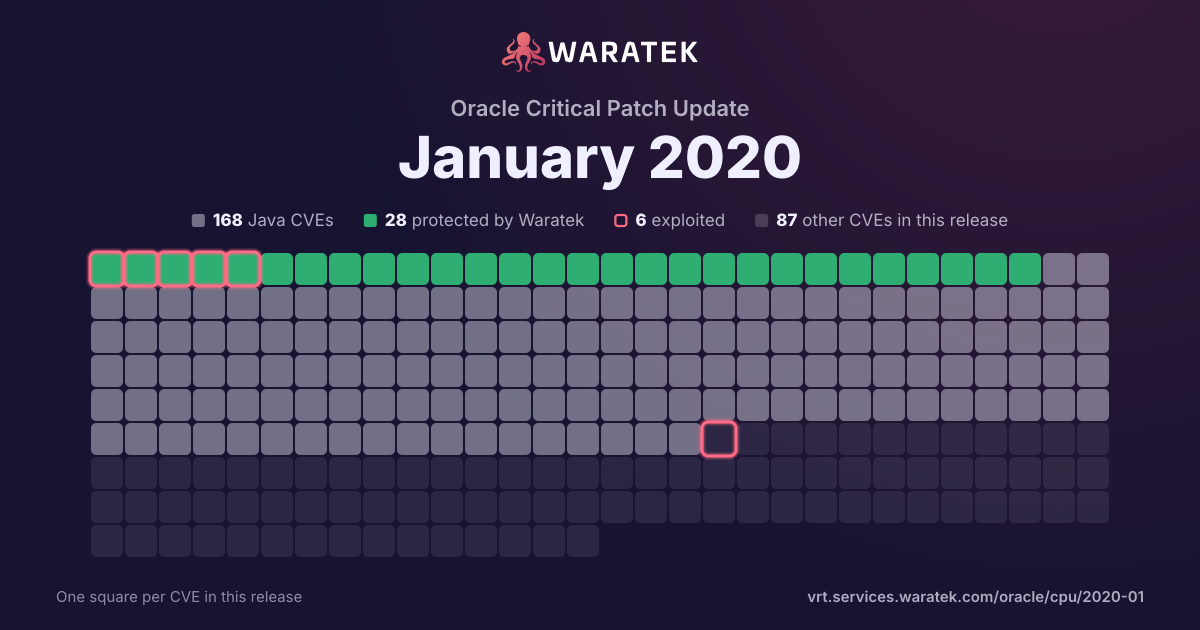
By status
29Protected by Waratek3Mitigation candidate145No exploit published9Outside Waratek scope69Not applicable
6Exploited, marked by the ring
No exploit published. For 135 of them, Oracle's security advisory is the source of public detail.
Protected by Waratek. Waratek RASP can block exploitation of these on systems that have not applied the patch yet.
Overview 8 matches · 0 protected · 0 exploited · 0 CISA KEV · 1 public PoC · 2 EPSS ≥ 0.5
Protected by Waratek
0
0.0%
Rule in development
0
0.0%
Mitigation candidate
1
12.5%
No exploit published
7
87.5%
blocked by ARMR today
0
0.0%
partly blocked
0
0.0%
not blocked
8
100.0%
not established
0
0.0%
unrecorded
0
0.0%
Exploited
0
0.0%
Working exploit published
1
12.5%
Proof of concept only
0
0.0%
Forecast only
1
12.5%
No public exploit
6
75.0%
split by
peak 2 / quarter
Q1 181
No exploit published1
High1
not blocked1
No public exploit1
Q2 181
No exploit published1
High1
not blocked1
No public exploit1
Q3 181
No exploit published1
High1
not blocked1
No public exploit1
Q4 181
No exploit published1
High1
not blocked1
No public exploit1
Q1 190
Q2 192
Mitigation candidate1
No exploit published1
High2
not blocked2
Working exploit published1
Forecast only1
Q3 191
No exploit published1
High1
not blocked1
No public exploit1
Q4 191
No exploit published1
High1
not blocked1
No public exploit1
Q1 18Q2 18Q3 18Q4 18Q1 19Q2 19Q3 19Q4 19
| CVE | Severity | Published▾ | Status | Exploitation | Description |
|---|---|---|---|---|---|
| CVE-2019-17359 | High | 2019-10-08 | No exploit published | No public exploit | The ASN.1 parser in Bouncy Castle Crypto (aka BC Java) 1.63 can trigger a large attempted memory allocation, and resultant OutOfMemoryError error, via crafted ASN.1 data. This is fixed in 1.64. |
| CVE-2019-10088 | High | 2019-08-02 | No exploit published | No public exploit | A carefully crafted or corrupt zip file can cause an OOM in Apache Tika's RecursiveParserWrapper in versions 1.7-1.21. Users should upgrade to 1.22 or later. |
| CVE-2019-10072 | High | 2019-06-21 | No exploit published | Forecast only | The fix for CVE-2019-0199 was incomplete and did not address HTTP/2 connection window exhaustion on write in Apache Tomcat versions 9.0.0.M1 to 9.0.19 and 8.5.0 to 8.5.40 . By not sending WINDOW_UPDATE messages for the connection window (stream 0) clients were able to cause server-side threads to block eventually leading to thread exhaustion and a DoS. |
| CVE-2019-0227 | High | 2019-05-01 | Mitigation candidate | Working exploit published | A Server Side Request Forgery (SSRF) vulnerability affected the Apache Axis 1.4 distribution that was last released in 2006. Security and bug commits commits continue in the projects Axis 1.x Subversion repository, legacy users are encouraged to build from source. The successor to Axis 1.x is Axis2, the latest version is 1.7.9 and is not vulnerable to this issue. |
| CVE-2018-15756 | High | 2018-10-18 | No exploit published | No public exploit | Spring Framework, version 5.1, versions 5.0.x prior to 5.0.10, versions 4.3.x prior to 4.3.20, and older unsupported versions on the 4.2.x branch provide support for range requests when serving static resources through the ResourceHttpRequestHandler, or starting in 5.0 when an annotated controller returns an org.springframework.core.io.Resource. A malicious user (or attacker) can add a range header with a high number of ranges, or with wide ranges that overlap, or both, for a denial of service attack. This vulnerability affects applications that depend on either spring-webmvc or spring-webflux. Such applications must also have a registration for serving static resources (e.g. JS, CSS, images, and others), or have an annotated controller that returns an org.springframework.core.io.Resource. Spring Boot applications that depend on spring-boot-starter-web or spring-boot-starter-webflux are ready to serve static resources out of the box and are therefore vulnerable. |
| CVE-2018-8039 | High | 2018-07-02 | No exploit published | No public exploit | It is possible to configure Apache CXF to use the com.sun.net.ssl implementation via 'System.setProperty("java.protocol.handler.pkgs", "com.sun.net.ssl.internal.www.protocol");'. When this system property is set, CXF uses some reflection to try to make the HostnameVerifier work with the old com.sun.net.ssl.HostnameVerifier interface. However, the default HostnameVerifier implementation in CXF does not implement the method in this interface, and an exception is thrown. However, in Apache CXF prior to 3.2.5 and 3.1.16 the exception is caught in the reflection code and not properly propagated. What this means is that if you are using the com.sun.net.ssl stack with CXF, an error with TLS hostname verification will not be thrown, leaving a CXF client subject to man-in-the-middle attacks. |
| CVE-2018-1258 | High | 2018-05-11 | No exploit published | No public exploit | Spring Framework version 5.0.5 when used in combination with any versions of Spring Security contains an authorization bypass when using method security. An unauthorized malicious user can gain unauthorized access to methods that should be restricted. |
| CVE-2017-12626 | High | 2018-01-29 | No exploit published | No public exploit | Apache POI in versions prior to release 3.17 are vulnerable to Denial of Service Attacks: 1) Infinite Loops while parsing crafted WMF, EMF, MSG and macros (POI bugs 61338 and 61294), and 2) Out of Memory Exceptions while parsing crafted DOC, PPT and XLS (POI bugs 52372 and 61295). |