
Oracle Critical Patch Update January 2020
Released January 2020 · Oracle's advisory ↗ · ← Critical Patch Update, October 2019 · Critical Patch Update, April 2020 →
255 CVEs in this release, one square each
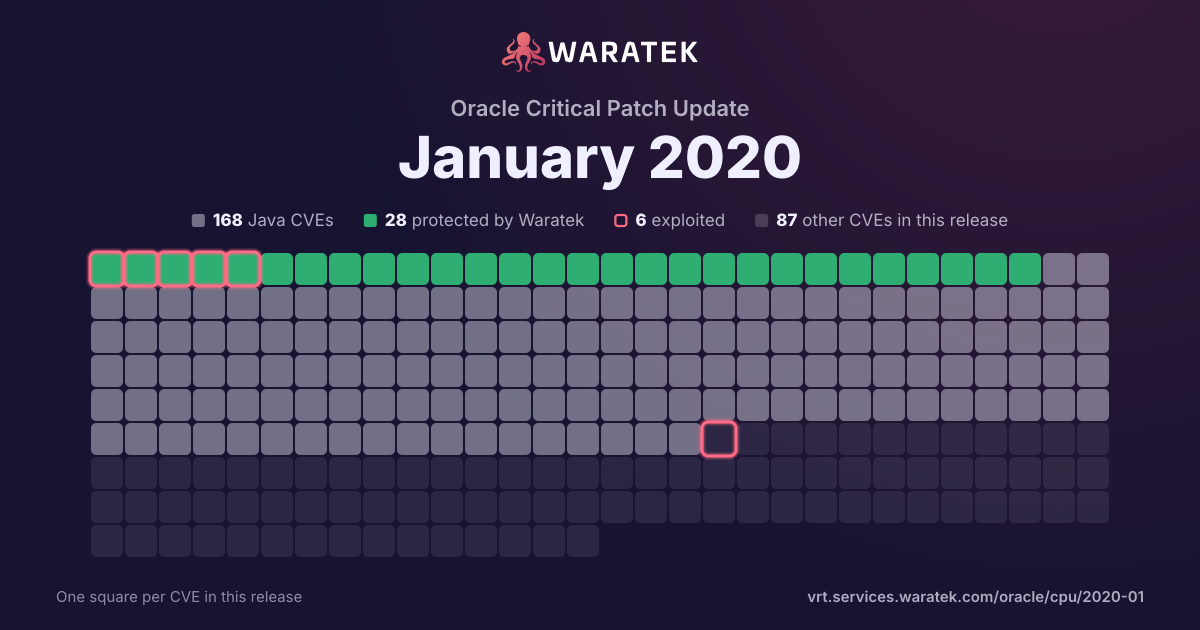
By status
28Protected by Waratek140No exploit published35Outside Waratek scope52Not applicable
6Exploited, marked by the ring
No exploit published. For 132 of them, Oracle's security advisory is the source of public detail.
Protected by Waratek. Waratek RASP can block exploitation of these on systems that have not applied the patch yet.
Overview 227 matches · 140 in Waratek scope · 0 protected · 1 exploited · 0 CISA KEV · 4 public PoC · 5 EPSS ≥ 0.5
227matches
140in Waratek scope61.7%
0protected0.0%
1exploited0.4%
0CISA KEV0.0%
4public PoC1.8%
5EPSS ≥ 0.52.2%
Protected by Waratek
0
0.0%
Rule in development
0
0.0%
Mitigation candidate
0
0.0%
No exploit published
140
61.7%
Outside Waratek scope
35
15.4%
Not applicable
52
22.9%
Withdrawn CVE
0
0.0%
blocked by ARMR today
0
0.0%
partly blocked
0
0.0%
not blocked
227
100.0%
not established
0
0.0%
unrecorded
0
0.0%
split by
peak 193 / year
20121
No exploit published1
Medium1
not blocked1
No public exploit1
20130
20140
20150
20160
20171
Not applicable1
High1
not blocked1
No public exploit1
20189
No exploit published3
Outside Waratek scope4
Not applicable2
Critical3
High5
Medium1
not blocked9
No public exploit9
201922
No exploit published7
Outside Waratek scope5
Not applicable10
Critical7
High6
Medium9
not blocked22
Exploited1
Working exploit published2
Proof of concept only1
Forecast only1
No public exploit17
2020193
No exploit published129
Outside Waratek scope26
Not applicable38
Critical2
High37
Medium143
Low11
not blocked193
No public exploit193
20210
20221
Not applicable1
High1
not blocked1
No public exploit1
20122013201420152016201720182019202020212022
| CVE | Severity | Published▾ | Status | Exploitation | Description |
|---|---|---|---|---|---|
| CVE-2019-10092 | Medium | 2019-09-26 | Outside Waratek scope | Working exploit published | In Apache HTTP Server 2.4.0-2.4.39, a limited cross-site scripting issue was reported affecting the mod_proxy error page. An attacker could cause the link on the error page to be malformed and instead point to a page of their choice. This would only be exploitable where a server was set up with proxying enabled but was misconfigured in such a way that the Proxy Error page was displayed. |
| CVE-2019-5482 | Critical | 2019-09-16 | Outside Waratek scope | No public exploit | Heap buffer overflow in the TFTP protocol handler in cURL 7.19.4 to 7.65.3. |
| CVE-2019-1547 | Medium | 2019-09-10 | Not applicable | No public exploit | Normally in OpenSSL EC groups always have a co-factor present and this is used in side channel resistant code paths. However, in some cases, it is possible to construct a group using explicit parameters (instead of using a named curve). In those cases it is possible that such a group does not have the cofactor present. This can occur even where all the parameters match a known named curve. If such a curve is used then OpenSSL falls back to non-side channel resistant code paths which may result in full key recovery during an ECDSA signature operation. In order to be vulnerable an attacker would have to have the ability to time the creation of a large number of signatures where explicit parameters with no co-factor present are in use by an application using libcrypto. For the avoidance of doubt libssl is not vulnerable because explicit parameters are never used. Fixed in OpenSSL 1.1.1d (Affected 1.1.1-1.1.1c). Fixed in OpenSSL 1.1.0l (Affected 1.1.0-1.1.0k). Fixed in OpenSSL 1.0.2t (Affected 1.0.2-1.0.2s). |
| CVE-2019-16168 | Medium | 2019-09-09 | Not applicable | No public exploit | In SQLite through 3.29.0, whereLoopAddBtreeIndex in sqlite3.c can crash a browser or other application because of missing validation of a sqlite_stat1 sz field, aka a "severe division by zero in the query planner." |
| CVE-2019-10088 | High | 2019-08-02 | No exploit published | No public exploit | A carefully crafted or corrupt zip file can cause an OOM in Apache Tika's RecursiveParserWrapper in versions 1.7-1.21. Users should upgrade to 1.22 or later. |
| CVE-2019-13118 | Medium | 2019-07-01 | Not applicable | No public exploit | In numbers.c in libxslt 1.1.33, a type holding grouping characters of an xsl:number instruction was too narrow and an invalid character/length combination could be passed to xsltNumberFormatDecimal, leading to a read of uninitialized stack data. |
| CVE-2019-13117 | Medium | 2019-07-01 | Not applicable | No public exploit | In numbers.c in libxslt 1.1.33, an xsl:number with certain format strings could lead to a uninitialized read in xsltNumberFormatInsertNumbers. This could allow an attacker to discern whether a byte on the stack contains the characters A, a, I, i, or 0, or any other character. |
| CVE-2019-10072 | High | 2019-06-21 | No exploit published | Forecast only | The fix for CVE-2019-0199 was incomplete and did not address HTTP/2 connection window exhaustion on write in Apache Tomcat versions 9.0.0.M1 to 9.0.19 and 8.5.0 to 8.5.40 . By not sending WINDOW_UPDATE messages for the connection window (stream 0) clients were able to cause server-side threads to block eventually leading to thread exhaustion and a DoS. |
| CVE-2019-11477 | High | 2019-06-19 | Not applicable | Proof of concept only | Jonathan Looney discovered that the TCP_SKB_CB(skb)->tcp_gso_segs value was subject to an integer overflow in the Linux kernel when handling TCP Selective Acknowledgments (SACKs). A remote attacker could use this to cause a denial of service. This has been fixed in stable kernel releases 4.4.182, 4.9.182, 4.14.127, 4.19.52, 5.1.11, and is fixed in commit 3b4929f65b0d8249f19a50245cd88ed1a2f78cff. |
| CVE-2019-8457 | Critical | 2019-05-30 | Not applicable | No public exploit | SQLite3 from 3.6.0 to and including 3.27.2 is vulnerable to heap out-of-bound read in the rtreenode() function when handling invalid rtree tables. |
| CVE-2019-0227 | High | 2019-05-01 | Outside Waratek scope | Working exploit published | A Server Side Request Forgery (SSRF) vulnerability affected the Apache Axis 1.4 distribution that was last released in 2006. Security and bug commits commits continue in the projects Axis 1.x Subversion repository, legacy users are encouraged to build from source. The successor to Axis 1.x is Axis2, the latest version is 1.7.9 and is not vulnerable to this issue. |
| CVE-2019-10247 | Medium | 2019-04-22 | No exploit published | No public exploit | In Eclipse Jetty version 7.x, 8.x, 9.2.27 and older, 9.3.26 and older, and 9.4.16 and older, the server running on any OS and Jetty version combination will reveal the configured fully qualified directory base resource location on the output of the 404 error for not finding a Context that matches the requested path. The default server behavior on jetty-distribution and jetty-home will include at the end of the Handler tree a DefaultHandler, which is responsible for reporting this 404 error, it presents the various configured contexts as HTML for users to click through to. This produced HTML includes output that contains the configured fully qualified directory base resource location for each context. |
| CVE-2019-11358 | Medium | 2019-04-20 | Outside Waratek scope | Exploited | jQuery before 3.4.0, as used in Drupal, Backdrop CMS, and other products, mishandles jQuery.extend(true, {}, ...) because of Object.prototype pollution. If an unsanitized source object contained an enumerable __proto__ property, it could extend the native Object.prototype. |
| CVE-2019-3862 | Critical | 2019-03-21 | Not applicable | No public exploit | An out of bounds read flaw was discovered in libssh2 before 1.8.1 in the way SSH_MSG_CHANNEL_REQUEST packets with an exit status message and no payload are parsed. A remote attacker who compromises a SSH server may be able to cause a Denial of Service or read data in the client memory. |
| CVE-2019-9636 | Critical | 2019-03-08 | Not applicable | No public exploit | Python 2.7.x through 2.7.16 and 3.x through 3.7.2 is affected by: Improper Handling of Unicode Encoding (with an incorrect netloc) during NFKC normalization. The impact is: Information disclosure (credentials, cookies, etc. that are cached against a given hostname). The components are: urllib.parse.urlsplit, urllib.parse.urlparse. The attack vector is: A specially crafted URL could be incorrectly parsed to locate cookies or authentication data and send that information to a different host than when parsed correctly. This is fixed in: v2.7.17, v2.7.17rc1, v2.7.18, v2.7.18rc1; v3.5.10, v3.5.10rc1, v3.5.7, v3.5.8, v3.5.8rc1, v3.5.8rc2, v3.5.9; v3.6.10, v3.6.10rc1, v3.6.11, v3.6.11rc1, v3.6.12, v3.6.9, v3.6.9rc1; v3.7.3, v3.7.3rc1, v3.7.4, v3.7.4rc1, v3.7.4rc2, v3.7.5, v3.7.5rc1, v3.7.6, v3.7.6rc1, v3.7.7, v3.7.7rc1, v3.7.8, v3.7.8rc1, v3.7.9. |
| CVE-2019-1559 | Medium | 2019-02-27 | Outside Waratek scope | No public exploit | If an application encounters a fatal protocol error and then calls SSL_shutdown() twice (once to send a close_notify, and once to receive one) then OpenSSL can respond differently to the calling application if a 0 byte record is received with invalid padding compared to if a 0 byte record is received with an invalid MAC. If the application then behaves differently based on that in a way that is detectable to the remote peer, then this amounts to a padding oracle that could be used to decrypt data. In order for this to be exploitable "non-stitched" ciphersuites must be in use. Stitched ciphersuites are optimised implementations of certain commonly used ciphersuites. Also the application must call SSL_shutdown() twice even if a protocol error has occurred (applications should not do this but some do anyway). Fixed in OpenSSL 1.0.2r (Affected 1.0.2-1.0.2q). |
| CVE-2018-16395 | Critical | 2018-11-16 | Not applicable | No public exploit | An issue was discovered in the OpenSSL library in Ruby before 2.3.8, 2.4.x before 2.4.5, 2.5.x before 2.5.2, and 2.6.x before 2.6.0-preview3. When two OpenSSL::X509::Name objects are compared using ==, depending on the ordering, non-equal objects may return true. When the first argument is one character longer than the second, or the second argument contains a character that is one less than a character in the same position of the first argument, the result of == will be true. This could be leveraged to create an illegitimate certificate that may be accepted as legitimate and then used in signing or encryption operations. |
| CVE-2018-0734 | Medium | 2018-10-30 | Outside Waratek scope | No public exploit | The OpenSSL DSA signature algorithm has been shown to be vulnerable to a timing side channel attack. An attacker could use variations in the signing algorithm to recover the private key. Fixed in OpenSSL 1.1.1a (Affected 1.1.1). Fixed in OpenSSL 1.1.0j (Affected 1.1.0-1.1.0i). Fixed in OpenSSL 1.0.2q (Affected 1.0.2-1.0.2p). |
| CVE-2018-15756 | High | 2018-10-18 | Outside Waratek scope | No public exploit | Spring Framework, version 5.1, versions 5.0.x prior to 5.0.10, versions 4.3.x prior to 4.3.20, and older unsupported versions on the 4.2.x branch provide support for range requests when serving static resources through the ResourceHttpRequestHandler, or starting in 5.0 when an annotated controller returns an org.springframework.core.io.Resource. A malicious user (or attacker) can add a range header with a high number of ranges, or with wide ranges that overlap, or both, for a denial of service attack. This vulnerability affects applications that depend on either spring-webmvc or spring-webflux. Such applications must also have a registration for serving static resources (e.g. JS, CSS, images, and others), or have an annotated controller that returns an org.springframework.core.io.Resource. Spring Boot applications that depend on spring-boot-starter-web or spring-boot-starter-webflux are ready to serve static resources out of the box and are therefore vulnerable. |
| CVE-2018-11058 | Critical | 2018-09-14 | Outside Waratek scope | No public exploit | RSA BSAFE Micro Edition Suite, versions prior to 4.0.11 (in 4.0.x) and prior to 4.1.6 (in 4.1.x), and RSA BSAFE Crypto-C Micro Edition, version prior to 4.0.5.3 (in 4.0.x) contain a Buffer Over-Read vulnerability when parsing ASN.1 data. A remote attacker could use maliciously constructed ASN.1 data that would result in such issue. |
| CVE-2018-8039 | High | 2018-07-02 | No exploit published | No public exploit | It is possible to configure Apache CXF to use the com.sun.net.ssl implementation via 'System.setProperty("java.protocol.handler.pkgs", "com.sun.net.ssl.internal.www.protocol");'. When this system property is set, CXF uses some reflection to try to make the HostnameVerifier work with the old com.sun.net.ssl.HostnameVerifier interface. However, the default HostnameVerifier implementation in CXF does not implement the method in this interface, and an exception is thrown. However, in Apache CXF prior to 3.2.5 and 3.1.16 the exception is caught in the reflection code and not properly propagated. What this means is that if you are using the com.sun.net.ssl stack with CXF, an error with TLS hostname verification will not be thrown, leaving a CXF client subject to man-in-the-middle attacks. |
| CVE-2018-1258 | High | 2018-05-11 | No exploit published | No public exploit | Spring Framework version 5.0.5 when used in combination with any versions of Spring Security contains an authorization bypass when using method security. An unauthorized malicious user can gain unauthorized access to methods that should be restricted. |
| CVE-2018-6829 | High | 2018-02-07 | Not applicable | No public exploit | cipher/elgamal.c in Libgcrypt through 1.8.2, when used to encrypt messages directly, improperly encodes plaintexts, which allows attackers to obtain sensitive information by reading ciphertext data (i.e., it does not have semantic security in face of a ciphertext-only attack). The Decisional Diffie-Hellman (DDH) assumption does not hold for Libgcrypt's ElGamal implementation. |
| CVE-2017-12626 | High | 2018-01-29 | No exploit published | No public exploit | Apache POI in versions prior to release 3.17 are vulnerable to Denial of Service Attacks: 1) Infinite Loops while parsing crafted WMF, EMF, MSG and macros (POI bugs 61338 and 61294), and 2) Out of Memory Exceptions while parsing crafted DOC, PPT and XLS (POI bugs 52372 and 61295). |
| CVE-2016-6814 | Critical | 2018-01-18 | Outside Waratek scope | No public exploit | When an application with unsupported Codehaus versions of Groovy from 1.7.0 to 2.4.3, Apache Groovy 2.4.4 to 2.4.7 on classpath uses standard Java serialization mechanisms, e.g. to communicate between servers or to store local data, it was possible for an attacker to bake a special serialized object that will execute code directly when deserialized. All applications which rely on serialization and do not isolate the code which deserializes objects were subject to this vulnerability. |
| CVE-2017-1000376 | High | 2017-06-19 | Not applicable | No public exploit | libffi requests an executable stack allowing attackers to more easily trigger arbitrary code execution by overwriting the stack. Please note that libffi is used by a number of other libraries. It was previously stated that this affects libffi version 3.2.1 but this appears to be incorrect. libffi prior to version 3.1 on 32 bit x86 systems was vulnerable, and upstream is believed to have fixed this issue in version 3.1. |
| CVE-2012-1695 | Medium | 2012-05-03 | No exploit published | No public exploit | Unspecified vulnerability in the Oracle JRockit component in Oracle Fusion Middleware 28.2.2 and earlier, and JDK/JRE 5 and 6 27.7.1 and earlier, allows remote attackers to affect confidentiality, integrity, and availability via unknown vectors. |