
Oracle Critical Patch Update January 2020
Released January 2020 · Oracle's advisory ↗ · ← Critical Patch Update, October 2019 · Critical Patch Update, April 2020 →
255 CVEs in this release, one square each
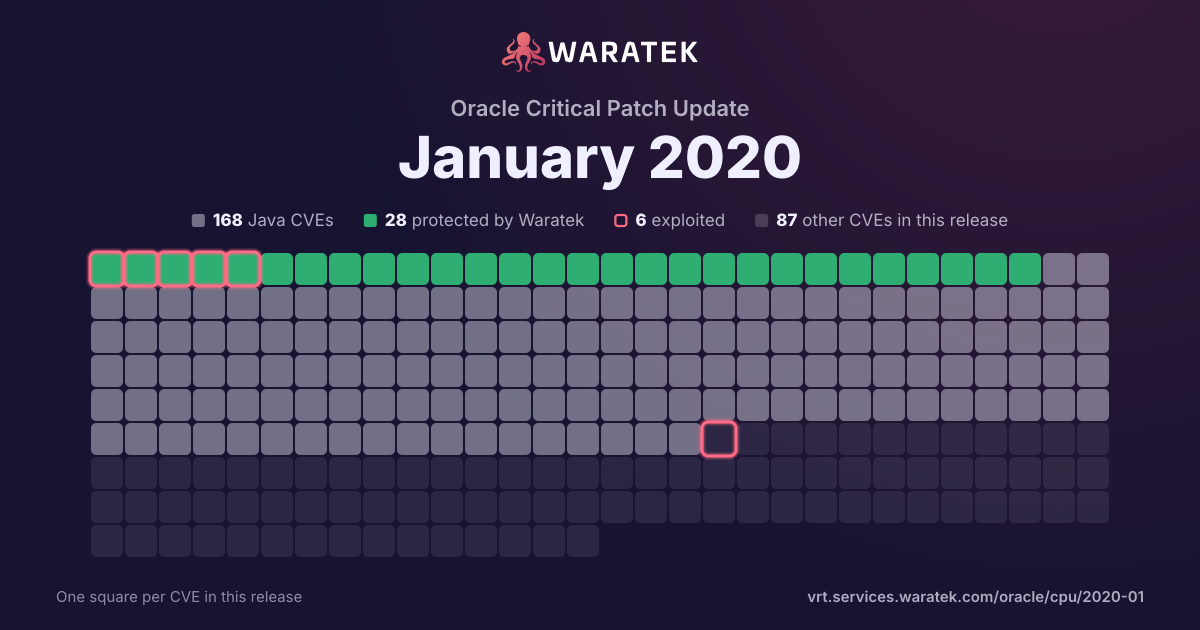
By status
28Protected by Waratek140No exploit published35Outside Waratek scope52Not applicable
6Exploited, marked by the ring
No exploit published. For 132 of them, Oracle's security advisory is the source of public detail.
Protected by Waratek. Waratek RASP can block exploitation of these on systems that have not applied the patch yet.
Overview 15 matches · 11 in Waratek scope · 11 protected · 6 exploited · 3 CISA KEV · 10 EPSS ≥ 0.5
Protected by Waratek
11
73.3%
Rule in development
0
0.0%
Mitigation candidate
0
0.0%
No exploit published
0
0.0%
Outside Waratek scope
3
20.0%
Not applicable
1
6.7%
Withdrawn CVE
0
0.0%
blocked by ARMR today
11
73.3%
partly blocked
0
0.0%
not blocked
4
26.7%
not established
0
0.0%
unrecorded
0
0.0%
Exploited
6
40.0%
Working exploit published
5
33.3%
Proof of concept only
4
26.7%
Forecast only
0
0.0%
No public exploit
0
0.0%
split by
peak 9 / year
20141
Protected by Waratek1
Medium1
blocked by ARMR today1
Working exploit published1
20150
20160
20171
Protected by Waratek1
Critical1
blocked by ARMR today1
Working exploit published1
20180
20199
Protected by Waratek5
Outside Waratek scope3
Not applicable1
Critical3
High3
Medium3
blocked by ARMR today5
not blocked4
Exploited4
Working exploit published2
Proof of concept only3
20203
Protected by Waratek3
Critical3
blocked by ARMR today3
Exploited2
Proof of concept only1
20211
Protected by Waratek1
Medium1
blocked by ARMR today1
Working exploit published1
20142015201620172018201920202021
| CVE | Severity | Published▾ | Status | Exploitation | Description |
|---|---|---|---|---|---|
| CVE-2020-6950 | Medium | 2021-06-02 | Protected by Waratek | Working exploit published | Directory traversal in Eclipse Mojarra before 2.3.14 allows attackers to read arbitrary files via the loc parameter or con parameter. |
| CVE-2020-2555 | Critical | 2020-01-15 | Protected by Waratek | Exploited | Vulnerability in the Oracle Coherence product of Oracle Fusion Middleware (component: Caching,CacheStore,Invocation). Supported versions that are affected are 3.7.1.0, 12.1.3.0.0, 12.2.1.3.0 and 12.2.1.4.0. Easily exploitable vulnerability allows unauthenticated attacker with network access via T3 to compromise Oracle Coherence. Successful attacks of this vulnerability can result in takeover of Oracle Coherence. CVSS 3.0 Base Score 9.8 (Confidentiality, Integrity and Availability impacts). CVSS Vector: (CVSS:3.0/AV:N/AC:L/PR:N/UI:N/S:U/C:H/I:H/A:H). |
| CVE-2020-2551 | Critical | 2020-01-15 | Protected by Waratek | Exploited | Vulnerability in the Oracle WebLogic Server product of Oracle Fusion Middleware (component: WLS Core Components). Supported versions that are affected are 10.3.6.0.0, 12.1.3.0.0, 12.2.1.3.0 and 12.2.1.4.0. Easily exploitable vulnerability allows unauthenticated attacker with network access via IIOP to compromise Oracle WebLogic Server. Successful attacks of this vulnerability can result in takeover of Oracle WebLogic Server. CVSS 3.0 Base Score 9.8 (Confidentiality, Integrity and Availability impacts). CVSS Vector: (CVSS:3.0/AV:N/AC:L/PR:N/UI:N/S:U/C:H/I:H/A:H). |
| CVE-2020-2546 | Critical | 2020-01-15 | Protected by Waratek | Proof of concept only | Vulnerability in the Oracle WebLogic Server product of Oracle Fusion Middleware (component: Application Container - JavaEE). Supported versions that are affected are 10.3.6.0.0 and 12.1.3.0.0. Easily exploitable vulnerability allows unauthenticated attacker with network access via T3 to compromise Oracle WebLogic Server. Successful attacks of this vulnerability can result in takeover of Oracle WebLogic Server. CVSS 3.0 Base Score 9.8 (Confidentiality, Integrity and Availability impacts). CVSS Vector: (CVSS:3.0/AV:N/AC:L/PR:N/UI:N/S:U/C:H/I:H/A:H). |
| CVE-2019-10092 | Medium | 2019-09-26 | Outside Waratek scope | Working exploit published | In Apache HTTP Server 2.4.0-2.4.39, a limited cross-site scripting issue was reported affecting the mod_proxy error page. An attacker could cause the link on the error page to be malformed and instead point to a page of their choice. This would only be exploitable where a server was set up with proxying enabled but was misconfigured in such a way that the Proxy Error page was displayed. |
| CVE-2019-14540 | Critical | 2019-09-15 | Protected by Waratek | Proof of concept only | A Polymorphic Typing issue was discovered in FasterXML jackson-databind before 2.9.10. It is related to com.zaxxer.hikari.HikariConfig. |
| CVE-2019-2729 | Critical | 2019-06-19 | Protected by Waratek | Exploited | Vulnerability in the Oracle WebLogic Server component of Oracle Fusion Middleware (subcomponent: Web Services). Supported versions that are affected are 10.3.6.0.0, 12.1.3.0.0 and 12.2.1.3.0. Easily exploitable vulnerability allows unauthenticated attacker with network access via HTTP to compromise Oracle WebLogic Server. Successful attacks of this vulnerability can result in takeover of Oracle WebLogic Server. CVSS 3.0 Base Score 9.8 (Confidentiality, Integrity and Availability impacts). CVSS Vector: (CVSS:3.0/AV:N/AC:L/PR:N/UI:N/S:U/C:H/I:H/A:H). |
| CVE-2019-12814 | Medium | 2019-06-19 | Protected by Waratek | Proof of concept only | A Polymorphic Typing issue was discovered in FasterXML jackson-databind 2.x through 2.9.9. When Default Typing is enabled (either globally or for a specific property) for an externally exposed JSON endpoint and the service has JDOM 1.x or 2.x jar in the classpath, an attacker can send a specifically crafted JSON message that allows them to read arbitrary local files on the server. |
| CVE-2019-11477 | High | 2019-06-19 | Not applicable | Proof of concept only | Jonathan Looney discovered that the TCP_SKB_CB(skb)->tcp_gso_segs value was subject to an integer overflow in the Linux kernel when handling TCP Selective Acknowledgments (SACKs). A remote attacker could use this to cause a denial of service. This has been fixed in stable kernel releases 4.4.182, 4.9.182, 4.14.127, 4.19.52, 5.1.11, and is fixed in commit 3b4929f65b0d8249f19a50245cd88ed1a2f78cff. |
| CVE-2019-0227 | High | 2019-05-01 | Outside Waratek scope | Working exploit published | A Server Side Request Forgery (SSRF) vulnerability affected the Apache Axis 1.4 distribution that was last released in 2006. Security and bug commits commits continue in the projects Axis 1.x Subversion repository, legacy users are encouraged to build from source. The successor to Axis 1.x is Axis2, the latest version is 1.7.9 and is not vulnerable to this issue. |
| CVE-2019-2725 | Critical | 2019-04-26 | Protected by Waratek | Exploited | Vulnerability in the Oracle WebLogic Server component of Oracle Fusion Middleware (subcomponent: Web Services). Supported versions that are affected are 10.3.6.0.0 and 12.1.3.0.0. Easily exploitable vulnerability allows unauthenticated attacker with network access via HTTP to compromise Oracle WebLogic Server. Successful attacks of this vulnerability can result in takeover of Oracle WebLogic Server. CVSS 3.0 Base Score 9.8 (Confidentiality, Integrity and Availability impacts). CVSS Vector: (CVSS:3.0/AV:N/AC:L/PR:N/UI:N/S:U/C:H/I:H/A:H). |
| CVE-2019-11358 | Medium | 2019-04-20 | Outside Waratek scope | Exploited | jQuery before 3.4.0, as used in Drupal, Backdrop CMS, and other products, mishandles jQuery.extend(true, {}, ...) because of Object.prototype pollution. If an unsanitized source object contained an enumerable __proto__ property, it could extend the native Object.prototype. |
| CVE-2019-0232 | High | 2019-04-15 | Protected by Waratek | Exploited | When running on Windows with enableCmdLineArguments enabled, the CGI Servlet in Apache Tomcat 9.0.0.M1 to 9.0.17, 8.5.0 to 8.5.39 and 7.0.0 to 7.0.93 is vulnerable to Remote Code Execution due to a bug in the way the JRE passes command line arguments to Windows. The CGI Servlet is disabled by default. The CGI option enableCmdLineArguments is disable by default in Tomcat 9.0.x (and will be disabled by default in all versions in response to this vulnerability). For a detailed explanation of the JRE behaviour, see Markus Wulftange's blog (https://codewhitesec.blogspot.com/2016/02/java-and-command-line-injections-in-windows.html) and this archived MSDN blog (https://web.archive.org/web/20161228144344/https://blogs.msdn.microsoft.com/twistylittlepassagesallalike/2011/04/23/everyone-quotes-command-line-arguments-the-wrong-way/). |
| CVE-2017-5645 | Critical | 2017-04-17 | Protected by Waratek | Working exploit published | In Apache Log4j 2.x before 2.8.2, when using the TCP socket server or UDP socket server to receive serialized log events from another application, a specially crafted binary payload can be sent that, when deserialized, can execute arbitrary code. |
| CVE-2014-3004 | Medium | 2014-06-11 | Protected by Waratek | Working exploit published | The default configuration for the Xerces SAX Parser in Castor before 1.3.3 allows context-dependent attackers to conduct XML External Entity (XXE) attacks via a crafted XML document. |