
Oracle Critical Patch Update October 2019
Released October 2019 · Oracle's advisory ↗ · ← Critical Patch Update, July 2019 · Critical Patch Update, January 2020 →
180 CVEs in this release, one square each
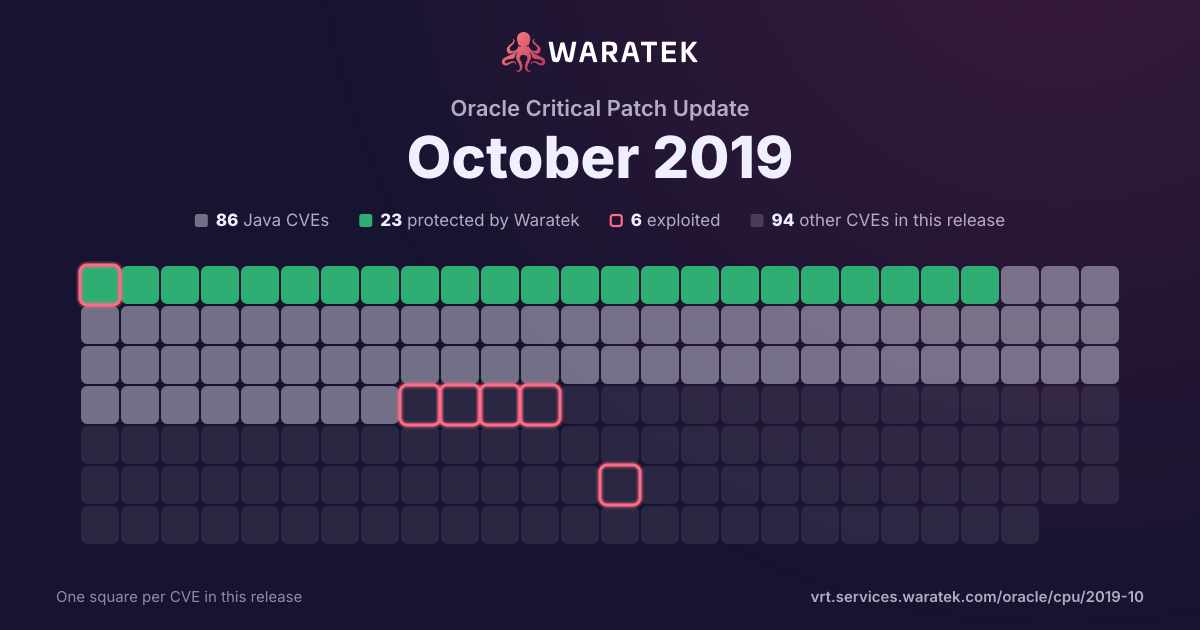
By status
24Protected by Waratek5Mitigation candidate65No exploit published17Outside Waratek scope69Not applicable
6Exploited, marked by the ring
No exploit published. For 56 of them, Oracle's security advisory is the source of public detail.
Protected by Waratek. Waratek RASP can block exploitation of these on systems that have not applied the patch yet.
Overview 17 matches · 8 in Waratek scope · 3 protected · 2 exploited · 1 CISA KEV · 3 public PoC · 5 EPSS ≥ 0.5
17matches
8in Waratek scope47.1%
3protected17.6%
2exploited11.8%
1CISA KEV5.9%
3public PoC17.6%
5EPSS ≥ 0.529.4%
Protected by Waratek
3
17.6%
Rule in development
0
0.0%
Mitigation candidate
2
11.8%
No exploit published
3
17.6%
Outside Waratek scope
2
11.8%
Not applicable
7
41.2%
Withdrawn CVE
0
0.0%
blocked by ARMR today
3
17.6%
partly blocked
0
0.0%
not blocked
14
82.4%
not established
0
0.0%
unrecorded
0
0.0%
split by
peak 6 / quarter
Q1 171
Not applicable1
High1
not blocked1
No public exploit1
Q2 171
Not applicable1
High1
not blocked1
No public exploit1
Q3 170
Q4 170
Q1 182
No exploit published1
Outside Waratek scope1
High2
not blocked2
No public exploit2
Q2 181
Not applicable1
High1
not blocked1
No public exploit1
Q3 180
Q4 182
No exploit published1
Outside Waratek scope1
High2
not blocked2
Proof of concept only1
No public exploit1
Q1 191
Not applicable1
High1
not blocked1
No public exploit1
Q2 196
Protected by Waratek3
Mitigation candidate2
No exploit published1
High6
blocked by ARMR today3
not blocked3
Exploited2
Working exploit published1
Forecast only1
No public exploit2
Q3 193
Not applicable3
High3
not blocked3
Forecast only1
No public exploit2
Q1 17Q2 17Q3 17Q4 17Q1 18Q2 18Q3 18Q4 18Q1 19Q2 19Q3 19
| CVE | Severity | Published▾ | Status | Exploitation | Description |
|---|---|---|---|---|---|
| CVE-2019-9517 | High | 2019-08-13 | Not applicable | No public exploit | Some HTTP/2 implementations are vulnerable to unconstrained interal data buffering, potentially leading to a denial of service. The attacker opens the HTTP/2 window so the peer can send without constraint; however, they leave the TCP window closed so the peer cannot actually write (many of) the bytes on the wire. The attacker then sends a stream of requests for a large response object. Depending on how the servers queue the responses, this can consume excess memory, CPU, or both. |
| CVE-2019-9511 | High | 2019-08-13 | Not applicable | Forecast only | Some HTTP/2 implementations are vulnerable to window size manipulation and stream prioritization manipulation, potentially leading to a denial of service. The attacker requests a large amount of data from a specified resource over multiple streams. They manipulate window size and stream priority to force the server to queue the data in 1-byte chunks. Depending on how efficiently this data is queued, this can consume excess CPU, memory, or both. |
| CVE-2019-5443 | High | 2019-07-02 | Not applicable | No public exploit | A non-privileged user or program can put code and a config file in a known non-privileged path (under C:/usr/local/) that will make curl <= 7.65.1 automatically run the code (as an openssl "engine") on invocation. If that curl is invoked by a privileged user it can do anything it wants. |
| CVE-2019-10072 | High | 2019-06-21 | No exploit published | Forecast only | The fix for CVE-2019-0199 was incomplete and did not address HTTP/2 connection window exhaustion on write in Apache Tomcat versions 9.0.0.M1 to 9.0.19 and 8.5.0 to 8.5.40 . By not sending WINDOW_UPDATE messages for the connection window (stream 0) clients were able to cause server-side threads to block eventually leading to thread exhaustion and a DoS. |
| CVE-2019-0188 | High | 2019-05-28 | Protected by Waratek | No public exploit | Apache Camel prior to 2.24.0 contains an XML external entity injection (XXE) vulnerability (CWE-611) due to using an outdated vulnerable JSON-lib library. This affects only the camel-xmljson component, which was removed. |
| CVE-2019-12086 | High | 2019-05-17 | Protected by Waratek | No public exploit | A Polymorphic Typing issue was discovered in FasterXML jackson-databind 2.x before 2.9.9. When Default Typing is enabled (either globally or for a specific property) for an externally exposed JSON endpoint, the service has the mysql-connector-java jar (8.0.14 or earlier) in the classpath, and an attacker can host a crafted MySQL server reachable by the victim, an attacker can send a crafted JSON message that allows them to read arbitrary local files on the server. This occurs because of missing com.mysql.cj.jdbc.admin.MiniAdmin validation. |
| CVE-2019-0227 | High | 2019-05-01 | Mitigation candidate | Working exploit published | A Server Side Request Forgery (SSRF) vulnerability affected the Apache Axis 1.4 distribution that was last released in 2006. Security and bug commits commits continue in the projects Axis 1.x Subversion repository, legacy users are encouraged to build from source. The successor to Axis 1.x is Axis2, the latest version is 1.7.9 and is not vulnerable to this issue. |
| CVE-2019-0232 | High | 2019-04-15 | Protected by Waratek | Exploited | When running on Windows with enableCmdLineArguments enabled, the CGI Servlet in Apache Tomcat 9.0.0.M1 to 9.0.17, 8.5.0 to 8.5.39 and 7.0.0 to 7.0.93 is vulnerable to Remote Code Execution due to a bug in the way the JRE passes command line arguments to Windows. The CGI Servlet is disabled by default. The CGI option enableCmdLineArguments is disable by default in Tomcat 9.0.x (and will be disabled by default in all versions in response to this vulnerability). For a detailed explanation of the JRE behaviour, see Markus Wulftange's blog (https://codewhitesec.blogspot.com/2016/02/java-and-command-line-injections-in-windows.html) and this archived MSDN blog (https://web.archive.org/web/20161228144344/https://blogs.msdn.microsoft.com/twistylittlepassagesallalike/2011/04/23/everyone-quotes-command-line-arguments-the-wrong-way/). |
| CVE-2019-0211 | High | 2019-04-08 | Mitigation candidate | Exploited | In Apache HTTP Server 2.4 releases 2.4.17 to 2.4.38, with MPM event, worker or prefork, code executing in less-privileged child processes or threads (including scripts executed by an in-process scripting interpreter) could execute arbitrary code with the privileges of the parent process (usually root) by manipulating the scoreboard. Non-Unix systems are not affected. |
| CVE-2019-1543 | High | 2019-03-06 | Not applicable | No public exploit | ChaCha20-Poly1305 is an AEAD cipher, and requires a unique nonce input for every encryption operation. RFC 7539 specifies that the nonce value (IV) should be 96 bits (12 bytes). OpenSSL allows a variable nonce length and front pads the nonce with 0 bytes if it is less than 12 bytes. However it also incorrectly allows a nonce to be set of up to 16 bytes. In this case only the last 12 bytes are significant and any additional leading bytes are ignored. It is a requirement of using this cipher that nonce values are unique. Messages encrypted using a reused nonce value are susceptible to serious confidentiality and integrity attacks. If an application changes the default nonce length to be longer than 12 bytes and then makes a change to the leading bytes of the nonce expecting the new value to be a new unique nonce then such an application could inadvertently encrypt messages with a reused nonce. Additionally the ignored bytes in a long nonce are not covered by the integrity guarantee of this cipher. Any application that relies on the integrity of these ignored leading bytes of a long nonce may be further affected. Any OpenSSL internal use of this cipher, including in SSL/TLS, is safe because no such use sets such a long nonce value. However user applications that use this cipher directly and set a non-default nonce length to be longer than 12 bytes may be vulnerable. OpenSSL versions 1.1.1 and 1.1.0 are affected by this issue. Due to the limited scope of affected deployments this has been assessed as low severity and therefore we are not creating new releases at this time. Fixed in OpenSSL 1.1.1c (Affected 1.1.1-1.1.1b). Fixed in OpenSSL 1.1.0k (Affected 1.1.0-1.1.0j). |
| CVE-2018-15756 | High | 2018-10-18 | No exploit published | No public exploit | Spring Framework, version 5.1, versions 5.0.x prior to 5.0.10, versions 4.3.x prior to 4.3.20, and older unsupported versions on the 4.2.x branch provide support for range requests when serving static resources through the ResourceHttpRequestHandler, or starting in 5.0 when an annotated controller returns an org.springframework.core.io.Resource. A malicious user (or attacker) can add a range header with a high number of ranges, or with wide ranges that overlap, or both, for a denial of service attack. This vulnerability affects applications that depend on either spring-webmvc or spring-webflux. Such applications must also have a registration for serving static resources (e.g. JS, CSS, images, and others), or have an annotated controller that returns an org.springframework.core.io.Resource. Spring Boot applications that depend on spring-boot-starter-web or spring-boot-starter-webflux are ready to serve static resources out of the box and are therefore vulnerable. |
| CVE-2018-18066 | High | 2018-10-08 | Outside Waratek scope | Proof of concept only | snmp_oid_compare in snmplib/snmp_api.c in Net-SNMP before 5.8 has a NULL Pointer Exception bug that can be used by an unauthenticated attacker to remotely cause the instance to crash via a crafted UDP packet, resulting in Denial of Service. |
| CVE-2018-0732 | High | 2018-06-12 | Not applicable | No public exploit | During key agreement in a TLS handshake using a DH(E) based ciphersuite a malicious server can send a very large prime value to the client. This will cause the client to spend an unreasonably long period of time generating a key for this prime resulting in a hang until the client has finished. This could be exploited in a Denial Of Service attack. Fixed in OpenSSL 1.1.0i-dev (Affected 1.1.0-1.1.0h). Fixed in OpenSSL 1.0.2p-dev (Affected 1.0.2-1.0.2o). |
| CVE-2018-7185 | High | 2018-03-06 | Outside Waratek scope | No public exploit | The protocol engine in ntp 4.2.6 before 4.2.8p11 allows a remote attackers to cause a denial of service (disruption) by continually sending a packet with a zero-origin timestamp and source IP address of the "other side" of an interleaved association causing the victim ntpd to reset its association. |
| CVE-2017-12626 | High | 2018-01-29 | No exploit published | No public exploit | Apache POI in versions prior to release 3.17 are vulnerable to Denial of Service Attacks: 1) Infinite Loops while parsing crafted WMF, EMF, MSG and macros (POI bugs 61338 and 61294), and 2) Out of Memory Exceptions while parsing crafted DOC, PPT and XLS (POI bugs 52372 and 61295). |
| CVE-2015-5180 | High | 2017-06-27 | Not applicable | No public exploit | res_query in libresolv in glibc before 2.25 allows remote attackers to cause a denial of service (NULL pointer dereference and process crash). |
| CVE-2017-6056 | High | 2017-02-17 | Not applicable | No public exploit | It was discovered that a programming error in the processing of HTTPS requests in the Apache Tomcat servlet and JSP engine may result in denial of service via an infinite loop. The denial of service is easily achievable as a consequence of backporting a CVE-2016-6816 fix but not backporting the fix for Tomcat bug 57544. Distributions affected by this backporting issue include Debian (before 7.0.56-3+deb8u8 and 8.0.14-1+deb8u7 in jessie) and Ubuntu. |