
Oracle Critical Patch Update October 2019
Released October 2019 · Oracle's advisory ↗ · ← Critical Patch Update, July 2019 · Critical Patch Update, January 2020 →
180 CVEs in this release, one square each
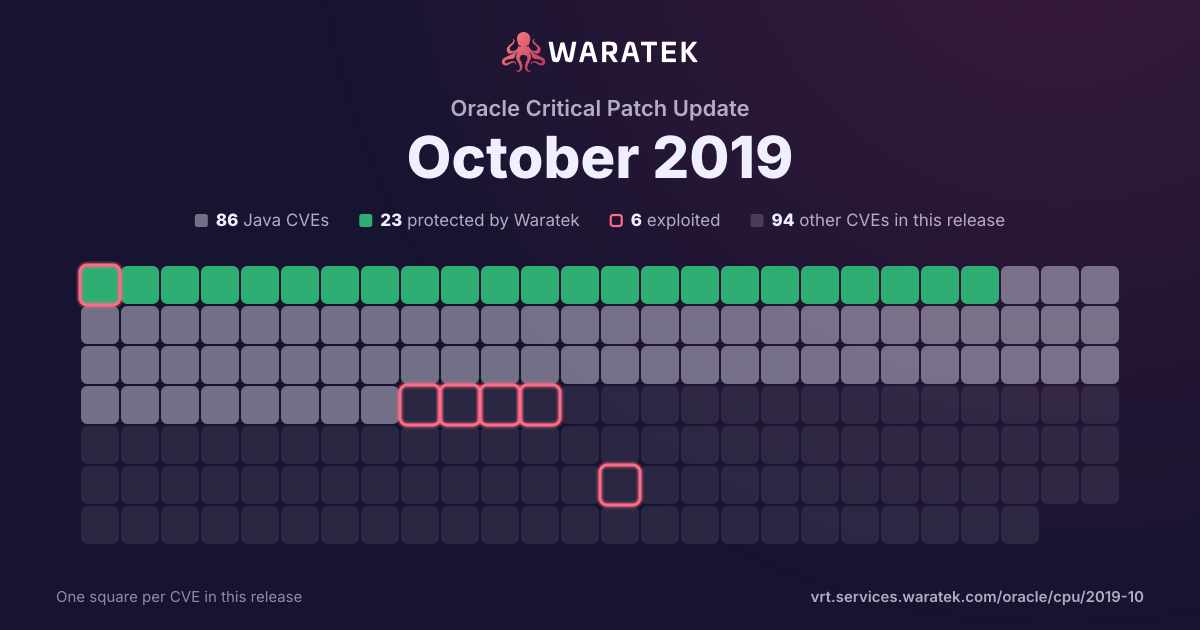
By status
24Protected by Waratek5Mitigation candidate65No exploit published17Outside Waratek scope69Not applicable
6Exploited, marked by the ring
No exploit published. For 56 of them, Oracle's security advisory is the source of public detail.
Protected by Waratek. Waratek RASP can block exploitation of these on systems that have not applied the patch yet.
Overview 18 matches · 0 protected · 2 exploited · 1 CISA KEV · 3 public PoC · 3 EPSS ≥ 0.5
Protected by Waratek
0
0.0%
Rule in development
0
0.0%
Mitigation candidate
3
16.7%
No exploit published
15
83.3%
blocked by ARMR today
0
0.0%
partly blocked
0
0.0%
not blocked
18
100.0%
not established
0
0.0%
unrecorded
0
0.0%
Exploited
2
11.1%
Working exploit published
1
5.6%
Proof of concept only
0
0.0%
Forecast only
0
0.0%
No public exploit
15
83.3%
split by
peak 14 / month
Apr 193
Mitigation candidate2
No exploit published1
High1
Medium2
not blocked3
Exploited2
No public exploit1
May 191
Mitigation candidate1
High1
not blocked1
Working exploit published1
Jun 190
Jul 190
Aug 190
Sep 190
Oct 1914
No exploit published14
Critical1
High5
Medium7
Low1
not blocked14
No public exploit14
Apr 19May 19Jun 19Jul 19Aug 19Sep 19Oct 19
| CVE | Severity | Published▾ | Status | Exploitation | Description |
|---|---|---|---|---|---|
| CVE-2019-3012 | Medium | 2019-10-16 | No exploit published | No public exploit | Vulnerability in the Oracle Business Intelligence Enterprise Edition product of Oracle Fusion Middleware (component: BI Platform Security). Supported versions that are affected are 11.1.1.9.0, 12.2.1.3.0 and 12.2.1.4.0. Easily exploitable vulnerability allows unauthenticated attacker with network access via HTTP to compromise Oracle Business Intelligence Enterprise Edition. Successful attacks of this vulnerability can result in unauthorized read access to a subset of Oracle Business Intelligence Enterprise Edition accessible data. CVSS 3.0 Base Score 5.3 (Confidentiality impacts). CVSS Vector: (CVSS:3.0/AV:N/AC:L/PR:N/UI:N/S:U/C:L/I:N/A:N). |
| CVE-2019-2943 | Medium | 2019-10-16 | No exploit published | No public exploit | Vulnerability in the Oracle Data Integrator product of Oracle Fusion Middleware (component: Studio). The supported version that is affected is 12.2.1.3.0. Easily exploitable vulnerability allows low privileged attacker with network access via HTTP to compromise Oracle Data Integrator. Successful attacks of this vulnerability can result in unauthorized access to critical data or complete access to all Oracle Data Integrator accessible data. CVSS 3.0 Base Score 6.5 (Confidentiality impacts). CVSS Vector: (CVSS:3.0/AV:N/AC:L/PR:L/UI:N/S:U/C:H/I:N/A:N). |
| CVE-2019-2907 | High | 2019-10-16 | No exploit published | No public exploit | Vulnerability in the Oracle Web Services product of Oracle Fusion Middleware (component: SOAP with Attachments API for Java). The supported version that is affected is 12.2.1.3.0. Easily exploitable vulnerability allows unauthenticated attacker with network access via HTTP to compromise Oracle Web Services. While the vulnerability is in Oracle Web Services, attacks may significantly impact additional products. Successful attacks of this vulnerability can result in unauthorized update, insert or delete access to some of Oracle Web Services accessible data as well as unauthorized read access to a subset of Oracle Web Services accessible data. CVSS 3.0 Base Score 7.2 (Confidentiality and Integrity impacts). CVSS Vector: (CVSS:3.0/AV:N/AC:L/PR:N/UI:N/S:C/C:L/I:L/A:N). |
| CVE-2019-2906 | High | 2019-10-16 | No exploit published | No public exploit | Vulnerability in the BI Publisher (formerly XML Publisher) product of Oracle Fusion Middleware (component: Mobile Service). Supported versions that are affected are 11.1.1.9.0, 12.2.1.3.0 and 12.2.1.4.0. Easily exploitable vulnerability allows unauthenticated attacker with network access via HTTP to compromise BI Publisher (formerly XML Publisher). Successful attacks require human interaction from a person other than the attacker and while the vulnerability is in BI Publisher (formerly XML Publisher), attacks may significantly impact additional products. Successful attacks of this vulnerability can result in unauthorized access to critical data or complete access to all BI Publisher (formerly XML Publisher) accessible data as well as unauthorized update, insert or delete access to some of BI Publisher (formerly XML Publisher) accessible data. CVSS 3.0 Base Score 8.2 (Confidentiality and Integrity impacts). CVSS Vector: (CVSS:3.0/AV:N/AC:L/PR:N/UI:R/S:C/C:H/I:L/A:N). |
| CVE-2019-2905 | High | 2019-10-16 | No exploit published | No public exploit | Vulnerability in the Oracle Business Intelligence Enterprise Edition product of Oracle Fusion Middleware (component: Installation). Supported versions that are affected are 12.2.1.3.0 and 12.2.1.4.0. Easily exploitable vulnerability allows unauthenticated attacker with network access via HTTP to compromise Oracle Business Intelligence Enterprise Edition. While the vulnerability is in Oracle Business Intelligence Enterprise Edition, attacks may significantly impact additional products. Successful attacks of this vulnerability can result in unauthorized access to critical data or complete access to all Oracle Business Intelligence Enterprise Edition accessible data. CVSS 3.0 Base Score 8.6 (Confidentiality impacts). CVSS Vector: (CVSS:3.0/AV:N/AC:L/PR:N/UI:N/S:C/C:H/I:N/A:N). |
| CVE-2019-2904 | Critical | 2019-10-16 | No exploit published | No public exploit | Vulnerability in the Oracle JDeveloper and ADF product of Oracle Fusion Middleware (component: ADF Faces). Supported versions that are affected are 11.1.1.9.0, 12.1.3.0.0 and 12.2.1.3.0. Easily exploitable vulnerability allows unauthenticated attacker with network access via HTTP to compromise Oracle JDeveloper and ADF. Successful attacks of this vulnerability can result in takeover of Oracle JDeveloper and ADF. CVSS 3.0 Base Score 9.8 (Confidentiality, Integrity and Availability impacts). CVSS Vector: (CVSS:3.0/AV:N/AC:L/PR:N/UI:N/S:U/C:H/I:H/A:H). |
| CVE-2019-2900 | High | 2019-10-16 | No exploit published | No public exploit | Vulnerability in the Oracle Business Intelligence Enterprise Edition product of Oracle Fusion Middleware (component: Analytics Actions). Supported versions that are affected are 12.2.1.3.0 and 12.2.1.4.0. Easily exploitable vulnerability allows unauthenticated attacker with network access via HTTP to compromise Oracle Business Intelligence Enterprise Edition. Successful attacks of this vulnerability can result in unauthorized access to critical data or complete access to all Oracle Business Intelligence Enterprise Edition accessible data. CVSS 3.0 Base Score 7.5 (Confidentiality impacts). CVSS Vector: (CVSS:3.0/AV:N/AC:L/PR:N/UI:N/S:U/C:H/I:N/A:N). |
| CVE-2019-2899 | Low | 2019-10-16 | No exploit published | No public exploit | Vulnerability in the Oracle JDeveloper and ADF product of Oracle Fusion Middleware (component: OAM). Supported versions that are affected are 11.1.1.9.0, 11.1.2.4.0, 12.1.3.0.0 and 12.2.1.3.0. Easily exploitable vulnerability allows high privileged attacker with network access via HTTP to compromise Oracle JDeveloper and ADF. Successful attacks require human interaction from a person other than the attacker. Successful attacks of this vulnerability can result in unauthorized read access to a subset of Oracle JDeveloper and ADF accessible data. CVSS 3.0 Base Score 2.4 (Confidentiality impacts). CVSS Vector: (CVSS:3.0/AV:N/AC:L/PR:H/UI:R/S:U/C:L/I:N/A:N). |
| CVE-2019-2898 | Medium | 2019-10-16 | No exploit published | No public exploit | Vulnerability in the BI Publisher (formerly XML Publisher) product of Oracle Fusion Middleware (component: BI Publisher Security). Supported versions that are affected are 11.1.1.9.0, 12.2.1.3.0 and 12.2.1.4.0. Easily exploitable vulnerability allows low privileged attacker with network access via HTTP to compromise BI Publisher (formerly XML Publisher). Successful attacks of this vulnerability can result in unauthorized read access to a subset of BI Publisher (formerly XML Publisher) accessible data. CVSS 3.0 Base Score 4.3 (Confidentiality impacts). CVSS Vector: (CVSS:3.0/AV:N/AC:L/PR:L/UI:N/S:U/C:L/I:N/A:N). |
| CVE-2019-2897 | Medium | 2019-10-16 | No exploit published | No public exploit | Vulnerability in the Oracle Business Intelligence Enterprise Edition product of Oracle Fusion Middleware (component: Analytics Actions). Supported versions that are affected are 12.2.1.3.0 and 12.2.1.4.0. Easily exploitable vulnerability allows low privileged attacker with network access via HTTP to compromise Oracle Business Intelligence Enterprise Edition. While the vulnerability is in Oracle Business Intelligence Enterprise Edition, attacks may significantly impact additional products. Successful attacks of this vulnerability can result in unauthorized update, insert or delete access to some of Oracle Business Intelligence Enterprise Edition accessible data as well as unauthorized read access to a subset of Oracle Business Intelligence Enterprise Edition accessible data. CVSS 3.0 Base Score 6.4 (Confidentiality and Integrity impacts). CVSS Vector: (CVSS:3.0/AV:N/AC:L/PR:L/UI:N/S:C/C:L/I:L/A:N). |
| CVE-2019-2891 | High | 2019-10-16 | No exploit published | No public exploit | Vulnerability in the Oracle WebLogic Server product of Oracle Fusion Middleware (component: Console). Supported versions that are affected are 10.3.6.0.0, 12.1.3.0.0 and 12.2.1.3.0. Difficult to exploit vulnerability allows unauthenticated attacker with network access via HTTP to compromise Oracle WebLogic Server. Successful attacks of this vulnerability can result in takeover of Oracle WebLogic Server. CVSS 3.0 Base Score 8.1 (Confidentiality, Integrity and Availability impacts). CVSS Vector: (CVSS:3.0/AV:N/AC:H/PR:N/UI:N/S:U/C:H/I:H/A:H). |
| CVE-2019-2889 | Medium | 2019-10-16 | No exploit published | No public exploit | Vulnerability in the Oracle WebLogic Server product of Oracle Fusion Middleware (component: Sample apps). The supported version that is affected is 12.2.1.3.0. Easily exploitable vulnerability allows unauthenticated attacker with network access via HTTP to compromise Oracle WebLogic Server. Successful attacks require human interaction from a person other than the attacker and while the vulnerability is in Oracle WebLogic Server, attacks may significantly impact additional products. Successful attacks of this vulnerability can result in unauthorized update, insert or delete access to some of Oracle WebLogic Server accessible data as well as unauthorized read access to a subset of Oracle WebLogic Server accessible data. CVSS 3.0 Base Score 6.1 (Confidentiality and Integrity impacts). CVSS Vector: (CVSS:3.0/AV:N/AC:L/PR:N/UI:R/S:C/C:L/I:L/A:N). |
| CVE-2019-2887 | Medium | 2019-10-16 | No exploit published | No public exploit | Vulnerability in the Oracle WebLogic Server product of Oracle Fusion Middleware (component: Web Services). Supported versions that are affected are 10.3.6.0.0, 12.1.3.0.0 and 12.2.1.3.0. Easily exploitable vulnerability allows low privileged attacker with network access via HTTP to compromise Oracle WebLogic Server. Successful attacks of this vulnerability can result in unauthorized read access to a subset of Oracle WebLogic Server accessible data. CVSS 3.0 Base Score 4.3 (Confidentiality impacts). CVSS Vector: (CVSS:3.0/AV:N/AC:L/PR:L/UI:N/S:U/C:L/I:N/A:N). |
| CVE-2019-2886 | Medium | 2019-10-16 | No exploit published | No public exploit | Vulnerability in the Oracle Forms product of Oracle Fusion Middleware (component: Services). The supported version that is affected is 12.2.1.3.0. Easily exploitable vulnerability allows unauthenticated attacker with network access via HTTP to compromise Oracle Forms. Successful attacks require human interaction from a person other than the attacker and while the vulnerability is in Oracle Forms, attacks may significantly impact additional products. Successful attacks of this vulnerability can result in unauthorized update, insert or delete access to some of Oracle Forms accessible data as well as unauthorized read access to a subset of Oracle Forms accessible data. CVSS 3.0 Base Score 6.1 (Confidentiality and Integrity impacts). CVSS Vector: (CVSS:3.0/AV:N/AC:L/PR:N/UI:R/S:C/C:L/I:L/A:N). |
| CVE-2019-0227 | High | 2019-05-01 | Mitigation candidate | Working exploit published | A Server Side Request Forgery (SSRF) vulnerability affected the Apache Axis 1.4 distribution that was last released in 2006. Security and bug commits commits continue in the projects Axis 1.x Subversion repository, legacy users are encouraged to build from source. The successor to Axis 1.x is Axis2, the latest version is 1.7.9 and is not vulnerable to this issue. |
| CVE-2019-10247 | Medium | 2019-04-22 | No exploit published | No public exploit | In Eclipse Jetty version 7.x, 8.x, 9.2.27 and older, 9.3.26 and older, and 9.4.16 and older, the server running on any OS and Jetty version combination will reveal the configured fully qualified directory base resource location on the output of the 404 error for not finding a Context that matches the requested path. The default server behavior on jetty-distribution and jetty-home will include at the end of the Handler tree a DefaultHandler, which is responsible for reporting this 404 error, it presents the various configured contexts as HTML for users to click through to. This produced HTML includes output that contains the configured fully qualified directory base resource location for each context. |
| CVE-2019-11358 | Medium | 2019-04-20 | Mitigation candidate | Exploited | jQuery before 3.4.0, as used in Drupal, Backdrop CMS, and other products, mishandles jQuery.extend(true, {}, ...) because of Object.prototype pollution. If an unsanitized source object contained an enumerable __proto__ property, it could extend the native Object.prototype. |
| CVE-2019-0211 | High | 2019-04-08 | Mitigation candidate | Exploited | In Apache HTTP Server 2.4 releases 2.4.17 to 2.4.38, with MPM event, worker or prefork, code executing in less-privileged child processes or threads (including scripts executed by an in-process scripting interpreter) could execute arbitrary code with the privileges of the parent process (usually root) by manipulating the scoreboard. Non-Unix systems are not affected. |