
Oracle Critical Patch Update October 2019
Released October 2019 · Oracle's advisory ↗ · ← Critical Patch Update, July 2019 · Critical Patch Update, January 2020 →
180 CVEs in this release, one square each
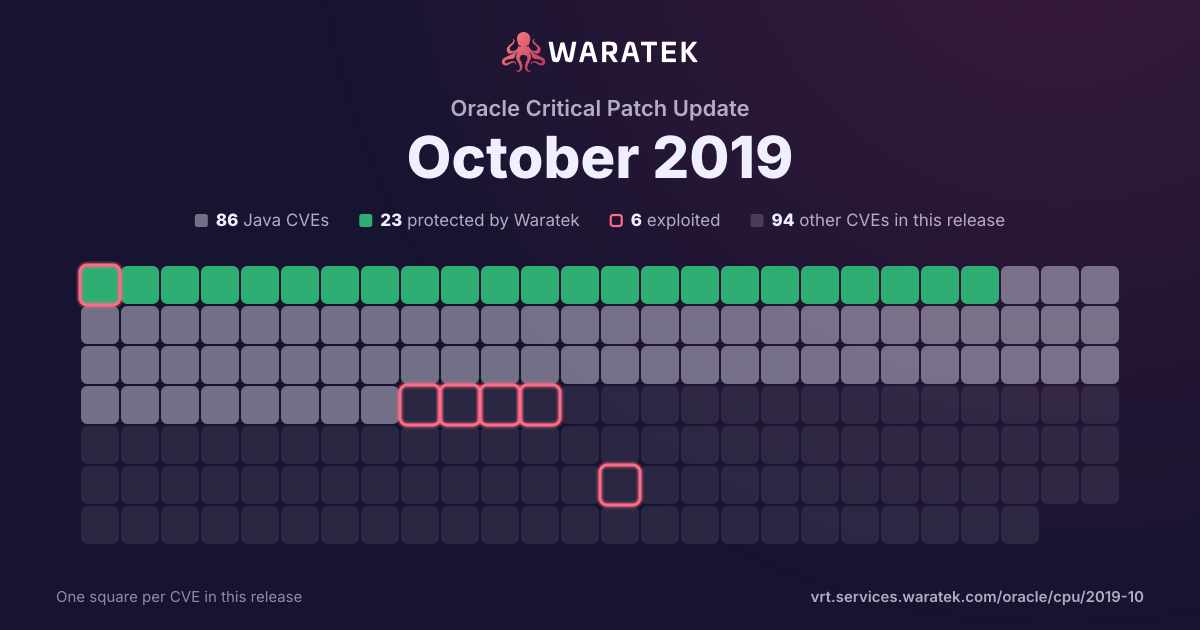
By status
24Protected by Waratek3Mitigation candidate64No exploit published17Outside Waratek scope72Not applicable
6Exploited, marked by the ring
No exploit published. For 56 of them, Oracle's security advisory is the source of public detail.
Protected by Waratek. Waratek RASP can block exploitation of these on systems that have not applied the patch yet.
Overview 3 matches · 1 protected · 0 exploited · 0 CISA KEV · 1 public PoC · 1 EPSS ≥ 0.5
Protected by Waratek
1
33.3%
Rule in development
0
0.0%
Mitigation candidate
1
33.3%
No exploit published
1
33.3%
blocked by ARMR today
1
33.3%
partly blocked
0
0.0%
not blocked
2
66.7%
not established
0
0.0%
unrecorded
0
0.0%
Exploited
0
0.0%
Working exploit published
1
33.3%
Proof of concept only
0
0.0%
Forecast only
0
0.0%
No public exploit
2
66.7%
split by
peak 2 / month
Oct 18Nov 18Dec 18Jan 19Feb 19Mar 19Apr 19May 19
| CVE | Severity | Published▾ | Status | Exploitation | Description |
|---|---|---|---|---|---|
| CVE-2019-0188 | High | 2019-05-28 | Protected by Waratek | No public exploit | Apache Camel prior to 2.24.0 contains an XML external entity injection (XXE) vulnerability (CWE-611) due to using an outdated vulnerable JSON-lib library. This affects only the camel-xmljson component, which was removed. |
| CVE-2019-0227 | High | 2019-05-01 | Mitigation candidate | Working exploit published | A Server Side Request Forgery (SSRF) vulnerability affected the Apache Axis 1.4 distribution that was last released in 2006. Security and bug commits commits continue in the projects Axis 1.x Subversion repository, legacy users are encouraged to build from source. The successor to Axis 1.x is Axis2, the latest version is 1.7.9 and is not vulnerable to this issue. |
| CVE-2018-15756 | High | 2018-10-18 | No exploit published | No public exploit | Spring Framework, version 5.1, versions 5.0.x prior to 5.0.10, versions 4.3.x prior to 4.3.20, and older unsupported versions on the 4.2.x branch provide support for range requests when serving static resources through the ResourceHttpRequestHandler, or starting in 5.0 when an annotated controller returns an org.springframework.core.io.Resource. A malicious user (or attacker) can add a range header with a high number of ranges, or with wide ranges that overlap, or both, for a denial of service attack. This vulnerability affects applications that depend on either spring-webmvc or spring-webflux. Such applications must also have a registration for serving static resources (e.g. JS, CSS, images, and others), or have an annotated controller that returns an org.springframework.core.io.Resource. Spring Boot applications that depend on spring-boot-starter-web or spring-boot-starter-webflux are ready to serve static resources out of the box and are therefore vulnerable. |