
Oracle Critical Patch Update October 2019
Released October 2019 · Oracle's advisory ↗ · ← Critical Patch Update, July 2019 · Critical Patch Update, January 2020 →
180 CVEs in this release, one square each
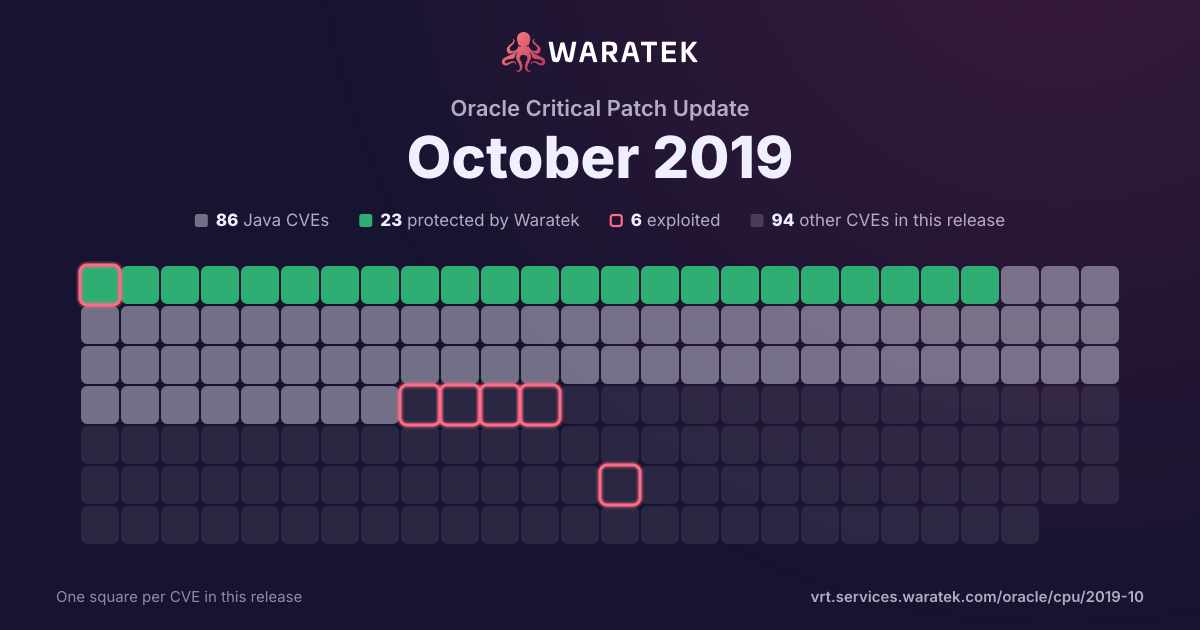
By status
24Protected by Waratek5Mitigation candidate65No exploit published17Outside Waratek scope69Not applicable
6Exploited, marked by the ring
No exploit published. For 56 of them, Oracle's security advisory is the source of public detail.
Protected by Waratek. Waratek RASP can block exploitation of these on systems that have not applied the patch yet.
Overview 12 matches · 4 protected · 0 exploited · 0 CISA KEV · 2 public PoC · 2 EPSS ≥ 0.5
Protected by Waratek
4
33.3%
Rule in development
0
0.0%
Mitigation candidate
1
8.3%
No exploit published
7
58.3%
blocked by ARMR today
4
33.3%
partly blocked
0
0.0%
not blocked
8
66.7%
not established
0
0.0%
unrecorded
0
0.0%
split by
peak 7 / month
May 192
Protected by Waratek1
Mitigation candidate1
High2
blocked by ARMR today1
not blocked1
Working exploit published1
No public exploit1
Jun 192
Protected by Waratek1
No exploit published1
High1
Medium1
blocked by ARMR today1
not blocked1
Proof of concept only1
Forecast only1
Jul 191
Protected by Waratek1
Critical1
blocked by ARMR today1
No public exploit1
Aug 190
Sep 190
Oct 197
Protected by Waratek1
No exploit published6
Critical1
Medium5
Low1
blocked by ARMR today1
not blocked6
No public exploit7
May 19Jun 19Jul 19Aug 19Sep 19Oct 19
| CVE | Severity | Published▾ | Status | Exploitation | Description |
|---|---|---|---|---|---|
| CVE-2019-2904 | Critical | 2019-10-16 | No exploit published | No public exploit | Vulnerability in the Oracle JDeveloper and ADF product of Oracle Fusion Middleware (component: ADF Faces). Supported versions that are affected are 11.1.1.9.0, 12.1.3.0.0 and 12.2.1.3.0. Easily exploitable vulnerability allows unauthenticated attacker with network access via HTTP to compromise Oracle JDeveloper and ADF. Successful attacks of this vulnerability can result in takeover of Oracle JDeveloper and ADF. CVSS 3.0 Base Score 9.8 (Confidentiality, Integrity and Availability impacts). CVSS Vector: (CVSS:3.0/AV:N/AC:L/PR:N/UI:N/S:U/C:H/I:H/A:H). |
| CVE-2019-2896 | Medium | 2019-10-16 | No exploit published | No public exploit | Vulnerability in the MICROS Relate CRM Software product of Oracle Retail Applications (component: Internal Operations). Supported versions that are affected are 7.1.0, 15.0.0, 16.0.0, 17.0.0, and 18.0.0. Difficult to exploit vulnerability allows unauthenticated attacker with network access via HTTP to compromise MICROS Relate CRM Software. Successful attacks of this vulnerability can result in unauthorized access to critical data or complete access to all MICROS Relate CRM Software accessible data. CVSS 3.0 Base Score 5.9 (Confidentiality impacts). CVSS Vector: (CVSS:3.0/AV:N/AC:H/PR:N/UI:N/S:U/C:H/I:N/A:N). |
| CVE-2019-2884 | Medium | 2019-10-16 | No exploit published | No public exploit | Vulnerability in the Oracle Retail Customer Management and Segmentation Foundation product of Oracle Retail Applications (component: Segment). The supported version that is affected is 17.0. Difficult to exploit vulnerability allows unauthenticated attacker with network access via HTTP to compromise Oracle Retail Customer Management and Segmentation Foundation. Successful attacks of this vulnerability can result in unauthorized access to critical data or complete access to all Oracle Retail Customer Management and Segmentation Foundation accessible data. CVSS 3.0 Base Score 5.9 (Confidentiality impacts). CVSS Vector: (CVSS:3.0/AV:N/AC:H/PR:N/UI:N/S:U/C:H/I:N/A:N). |
| CVE-2019-2883 | Medium | 2019-10-16 | No exploit published | No public exploit | Vulnerability in the Oracle Retail Customer Management and Segmentation Foundation product of Oracle Retail Applications (component: Segment). The supported version that is affected is 17.0. Easily exploitable vulnerability allows low privileged attacker with network access via HTTP to compromise Oracle Retail Customer Management and Segmentation Foundation. Successful attacks require human interaction from a person other than the attacker. Successful attacks of this vulnerability can result in unauthorized update, insert or delete access to some of Oracle Retail Customer Management and Segmentation Foundation accessible data as well as unauthorized read access to a subset of Oracle Retail Customer Management and Segmentation Foundation accessible data. CVSS 3.0 Base Score 4.6 (Confidentiality and Integrity impacts). CVSS Vector: (CVSS:3.0/AV:N/AC:L/PR:L/UI:R/S:U/C:L/I:L/A:N). |
| CVE-2019-2872 | Low | 2019-10-16 | No exploit published | No public exploit | Vulnerability in the Oracle Retail Xstore Point of Service product of Oracle Retail Applications (component: Point of Sale). Supported versions that are affected are 17.0.3, 18.0.1 and 19.0.0. Difficult to exploit vulnerability allows physical access to compromise Oracle Retail Xstore Point of Service. Successful attacks require human interaction from a person other than the attacker. Successful attacks of this vulnerability can result in unauthorized update, insert or delete access to some of Oracle Retail Xstore Point of Service accessible data as well as unauthorized read access to a subset of Oracle Retail Xstore Point of Service accessible data. CVSS 3.0 Base Score 2.7 (Confidentiality and Integrity impacts). CVSS Vector: (CVSS:3.0/AV:P/AC:H/PR:H/UI:R/S:U/C:L/I:L/A:N). |
| CVE-2018-3300 | Medium | 2019-10-16 | No exploit published | No public exploit | Vulnerability in the Oracle Retail Xstore Office product of Oracle Retail Applications (component: Internal Operations). The supported version that is affected is 7.1. Easily exploitable vulnerability allows low privileged attacker with network access via HTTP to compromise Oracle Retail Xstore Office. Successful attacks of this vulnerability can result in unauthorized update, insert or delete access to some of Oracle Retail Xstore Office accessible data as well as unauthorized read access to a subset of Oracle Retail Xstore Office accessible data. CVSS 3.0 Base Score 5.4 (Confidentiality and Integrity impacts). CVSS Vector: (CVSS:3.0/AV:N/AC:L/PR:L/UI:N/S:U/C:L/I:L/A:N). |
| CVE-2019-17091 | Medium | 2019-10-02 | Protected by Waratek | No public exploit | faces/context/PartialViewContextImpl.java in Eclipse Mojarra, as used in Mojarra for Eclipse EE4J before 2.3.10 and Mojarra JavaServer Faces before 2.2.20, allows Reflected XSS because a client window field is mishandled. |
| CVE-2019-14379 | Critical | 2019-07-29 | Protected by Waratek | No public exploit | SubTypeValidator.java in FasterXML jackson-databind before 2.9.9.2 mishandles default typing when ehcache is used (because of net.sf.ehcache.transaction.manager.DefaultTransactionManagerLookup), leading to remote code execution. |
| CVE-2019-10072 | High | 2019-06-21 | No exploit published | Forecast only | The fix for CVE-2019-0199 was incomplete and did not address HTTP/2 connection window exhaustion on write in Apache Tomcat versions 9.0.0.M1 to 9.0.19 and 8.5.0 to 8.5.40 . By not sending WINDOW_UPDATE messages for the connection window (stream 0) clients were able to cause server-side threads to block eventually leading to thread exhaustion and a DoS. |
| CVE-2019-12814 | Medium | 2019-06-19 | Protected by Waratek | Proof of concept only | A Polymorphic Typing issue was discovered in FasterXML jackson-databind 2.x through 2.9.9. When Default Typing is enabled (either globally or for a specific property) for an externally exposed JSON endpoint and the service has JDOM 1.x or 2.x jar in the classpath, an attacker can send a specifically crafted JSON message that allows them to read arbitrary local files on the server. |
| CVE-2019-12086 | High | 2019-05-17 | Protected by Waratek | No public exploit | A Polymorphic Typing issue was discovered in FasterXML jackson-databind 2.x before 2.9.9. When Default Typing is enabled (either globally or for a specific property) for an externally exposed JSON endpoint, the service has the mysql-connector-java jar (8.0.14 or earlier) in the classpath, and an attacker can host a crafted MySQL server reachable by the victim, an attacker can send a crafted JSON message that allows them to read arbitrary local files on the server. This occurs because of missing com.mysql.cj.jdbc.admin.MiniAdmin validation. |
| CVE-2019-0227 | High | 2019-05-01 | Mitigation candidate | Working exploit published | A Server Side Request Forgery (SSRF) vulnerability affected the Apache Axis 1.4 distribution that was last released in 2006. Security and bug commits commits continue in the projects Axis 1.x Subversion repository, legacy users are encouraged to build from source. The successor to Axis 1.x is Axis2, the latest version is 1.7.9 and is not vulnerable to this issue. |