
Oracle Critical Patch Update July 2019
Released July 2019 · Oracle's advisory ↗ · ← Critical Patch Update, April 2019 · Critical Patch Update, October 2019 →
207 CVEs in this release, one square each
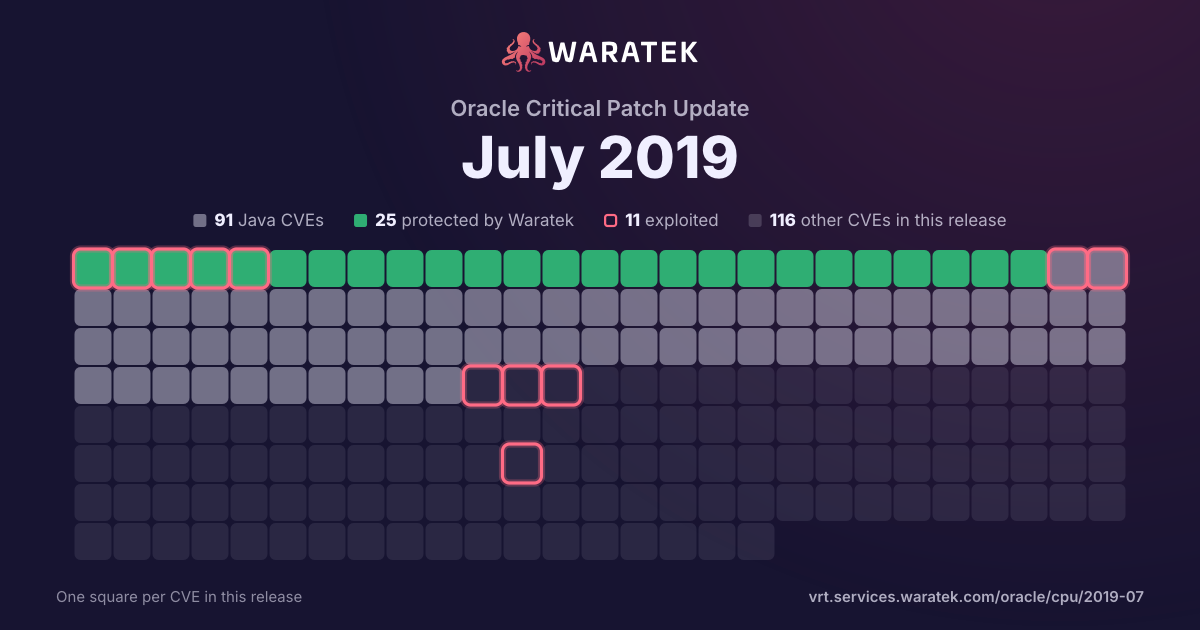
By status
26Protected by Waratek8Mitigation candidate69No exploit published9Outside Waratek scope95Not applicable
11Exploited, marked by the ring
No exploit published. For 59 of them, Oracle's security advisory is the source of public detail.
Protected by Waratek. Waratek RASP can block exploitation of these on systems that have not applied the patch yet.
Overview 12 matches · 5 protected · 1 exploited · 0 CISA KEV · 1 public PoC · 1 EPSS ≥ 0.5
Protected by Waratek
5
41.7%
Rule in development
0
0.0%
Mitigation candidate
0
0.0%
No exploit published
7
58.3%
blocked by ARMR today
5
41.7%
partly blocked
0
0.0%
not blocked
7
58.3%
not established
0
0.0%
unrecorded
0
0.0%
Exploited
1
8.3%
Working exploit published
0
0.0%
Proof of concept only
0
0.0%
Forecast only
0
0.0%
No public exploit
11
91.7%
split by
peak 3 / quarter
Q2 141
Protected by Waratek1
High1
blocked by ARMR today1
Exploited1
Q3 140
Q4 140
Q1 150
Q2 150
Q3 150
Q4 150
Q1 160
Q2 160
Q3 161
Protected by Waratek1
High1
blocked by ARMR today1
No public exploit1
Q4 160
Q1 170
Q2 171
No exploit published1
High1
not blocked1
No public exploit1
Q3 170
Q4 171
Protected by Waratek1
High1
blocked by ARMR today1
No public exploit1
Q1 180
Q2 182
No exploit published2
High2
not blocked2
No public exploit2
Q3 182
No exploit published2
High2
not blocked2
No public exploit2
Q4 181
No exploit published1
High1
not blocked1
No public exploit1
Q1 193
Protected by Waratek2
No exploit published1
High3
blocked by ARMR today2
not blocked1
No public exploit3
Q3 14Q1 15Q3 15Q1 16Q3 16Q1 17Q3 17Q1 18Q3 18Q1 19
| CVE | Severity | Published▾ | Status | Exploitation | Description |
|---|---|---|---|---|---|
| CVE-2019-0222 | High | 2019-03-28 | No exploit published | No public exploit | In Apache ActiveMQ 5.0.0 - 5.15.8, unmarshalling corrupt MQTT frame can lead to broker Out of Memory exception making it unresponsive. |
| CVE-2018-12023 | High | 2019-03-21 | Protected by Waratek | No public exploit | An issue was discovered in FasterXML jackson-databind prior to 2.7.9.4, 2.8.11.2, and 2.9.6. When Default Typing is enabled (either globally or for a specific property), the service has the Oracle JDBC jar in the classpath, and an attacker can provide an LDAP service to access, it is possible to make the service execute a malicious payload. |
| CVE-2018-12022 | High | 2019-03-21 | Protected by Waratek | No public exploit | An issue was discovered in FasterXML jackson-databind prior to 2.7.9.4, 2.8.11.2, and 2.9.6. When Default Typing is enabled (either globally or for a specific property), the service has the Jodd-db jar (for database access for the Jodd framework) in the classpath, and an attacker can provide an LDAP service to access, it is possible to make the service execute a malicious payload. |
| CVE-2018-15756 | High | 2018-10-18 | No exploit published | No public exploit | Spring Framework, version 5.1, versions 5.0.x prior to 5.0.10, versions 4.3.x prior to 4.3.20, and older unsupported versions on the 4.2.x branch provide support for range requests when serving static resources through the ResourceHttpRequestHandler, or starting in 5.0 when an annotated controller returns an org.springframework.core.io.Resource. A malicious user (or attacker) can add a range header with a high number of ranges, or with wide ranges that overlap, or both, for a denial of service attack. This vulnerability affects applications that depend on either spring-webmvc or spring-webflux. Such applications must also have a registration for serving static resources (e.g. JS, CSS, images, and others), or have an annotated controller that returns an org.springframework.core.io.Resource. Spring Boot applications that depend on spring-boot-starter-web or spring-boot-starter-webflux are ready to serve static resources out of the box and are therefore vulnerable. |
| CVE-2018-11775 | High | 2018-09-10 | No exploit published | No public exploit | TLS hostname verification when using the Apache ActiveMQ Client before 5.15.6 was missing which could make the client vulnerable to a MITM attack between a Java application using the ActiveMQ client and the ActiveMQ server. This is now enabled by default. |
| CVE-2018-8039 | High | 2018-07-02 | No exploit published | No public exploit | It is possible to configure Apache CXF to use the com.sun.net.ssl implementation via 'System.setProperty("java.protocol.handler.pkgs", "com.sun.net.ssl.internal.www.protocol");'. When this system property is set, CXF uses some reflection to try to make the HostnameVerifier work with the old com.sun.net.ssl.HostnameVerifier interface. However, the default HostnameVerifier implementation in CXF does not implement the method in this interface, and an exception is thrown. However, in Apache CXF prior to 3.2.5 and 3.1.16 the exception is caught in the reflection code and not properly propagated. What this means is that if you are using the com.sun.net.ssl stack with CXF, an error with TLS hostname verification will not be thrown, leaving a CXF client subject to man-in-the-middle attacks. |
| CVE-2018-1000180 | High | 2018-06-05 | No exploit published | No public exploit | Bouncy Castle BC 1.54 - 1.59, BC-FJA 1.0.0, BC-FJA 1.0.1 and earlier have a flaw in the Low-level interface to RSA key pair generator, specifically RSA Key Pairs generated in low-level API with added certainty may have less M-R tests than expected. This appears to be fixed in versions BC 1.60 beta 4 and later, BC-FJA 1.0.2 and later. |
| CVE-2018-1258 | High | 2018-05-11 | No exploit published | No public exploit | Spring Framework version 5.0.5 when used in combination with any versions of Spring Security contains an authorization bypass when using method security. An unauthorized malicious user can gain unauthorized access to methods that should be restricted. |
| CVE-2015-0226 | High | 2017-10-30 | Protected by Waratek | No public exploit | Apache WSS4J before 1.6.17 and 2.0.x before 2.0.2 improperly leaks information about decryption failures when decrypting an encrypted key or message data, which makes it easier for remote attackers to recover the plaintext form of a symmetric key via a series of crafted messages. NOTE: this vulnerability exists because of an incomplete fix for CVE-2011-2487. |
| CVE-2017-5664 | High | 2017-06-06 | No exploit published | No public exploit | The error page mechanism of the Java Servlet Specification requires that, when an error occurs and an error page is configured for the error that occurred, the original request and response are forwarded to the error page. This means that the request is presented to the error page with the original HTTP method. If the error page is a static file, expected behaviour is to serve content of the file as if processing a GET request, regardless of the actual HTTP method. The Default Servlet in Apache Tomcat 9.0.0.M1 to 9.0.0.M20, 8.5.0 to 8.5.14, 8.0.0.RC1 to 8.0.43 and 7.0.0 to 7.0.77 did not do this. Depending on the original request this could lead to unexpected and undesirable results for static error pages including, if the DefaultServlet is configured to permit writes, the replacement or removal of the custom error page. Notes for other user provided error pages: (1) Unless explicitly coded otherwise, JSPs ignore the HTTP method. JSPs used as error pages must must ensure that they handle any error dispatch as a GET request, regardless of the actual method. (2) By default, the response generated by a Servlet does depend on the HTTP method. Custom Servlets used as error pages must ensure that they handle any error dispatch as a GET request, regardless of the actual method. |
| CVE-2016-1181 | High | 2016-07-04 | Protected by Waratek | No public exploit | ActionServlet.java in Apache Struts 1 1.x through 1.3.10 mishandles multithreaded access to an ActionForm instance, which allows remote attackers to execute arbitrary code or cause a denial of service (unexpected memory access) via a multipart request, a related issue to CVE-2015-0899. |
| CVE-2014-0114 | High | 2014-04-30 | Protected by Waratek | Exploited | Apache Commons BeanUtils, as distributed in lib/commons-beanutils-1.8.0.jar in Apache Struts 1.x through 1.3.10 and in other products requiring commons-beanutils through 1.9.2, does not suppress the class property, which allows remote attackers to "manipulate" the ClassLoader and execute arbitrary code via the class parameter, as demonstrated by the passing of this parameter to the getClass method of the ActionForm object in Struts 1. |