
Oracle Critical Patch Update July 2019
Released July 2019 · Oracle's advisory ↗ · ← Critical Patch Update, April 2019 · Critical Patch Update, October 2019 →
207 CVEs in this release, one square each
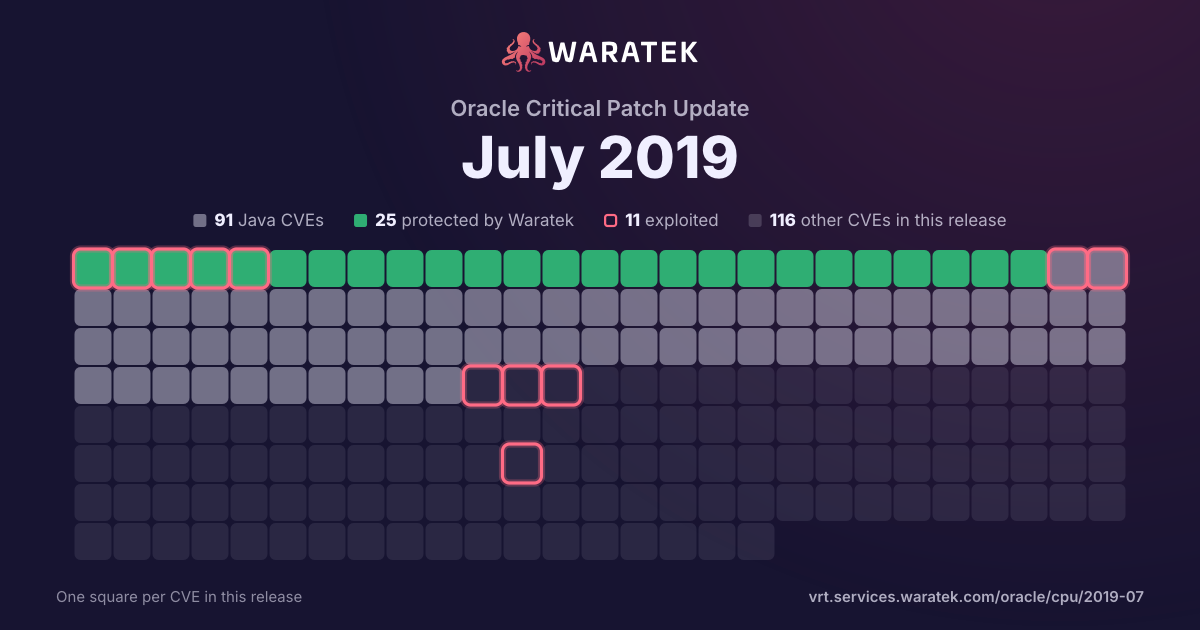
By status
25Protected by Waratek2Mitigation candidate64No exploit published55Outside Waratek scope61Not applicable
11Exploited, marked by the ring
No exploit published. For 58 of them, Oracle's security advisory is the source of public detail.
Protected by Waratek. Waratek RASP can block exploitation of these on systems that have not applied the patch yet.
Overview 189 matches · 80 in Waratek scope · 17 protected · 0 exploited · 0 CISA KEV · 0 public PoC · 0 EPSS ≥ 0.5
189matches
80in Waratek scope42.3%
17protected9.0%
0exploited0.0%
0CISA KEV0.0%
0public PoC0.0%
0EPSS ≥ 0.50.0%
Protected by Waratek
17
9.0%
Rule in development
0
0.0%
Mitigation candidate
0
0.0%
No exploit published
63
33.3%
Outside Waratek scope
49
25.9%
Not applicable
60
31.7%
Withdrawn CVE
0
0.0%
blocked by ARMR today
17
9.0%
partly blocked
0
0.0%
not blocked
172
91.0%
not established
0
0.0%
unrecorded
0
0.0%
Exploited
0
0.0%
Working exploit published
0
0.0%
Proof of concept only
0
0.0%
Forecast only
0
0.0%
No public exploit
189
100.0%
split by
peak 154 / quarter
Q3 161
Protected by Waratek1
High1
blocked by ARMR today1
No public exploit1
Q4 161
Protected by Waratek1
Critical1
blocked by ARMR today1
No public exploit1
Q1 171
Outside Waratek scope1
Medium1
not blocked1
No public exploit1
Q2 171
Outside Waratek scope1
High1
not blocked1
No public exploit1
Q3 171
Protected by Waratek1
Medium1
blocked by ARMR today1
No public exploit1
Q4 172
Protected by Waratek1
Not applicable1
High1
Medium1
blocked by ARMR today1
not blocked1
No public exploit2
Q1 183
Protected by Waratek1
Outside Waratek scope2
Critical3
blocked by ARMR today1
not blocked2
No public exploit3
Q2 184
Protected by Waratek1
No exploit published2
Not applicable1
Critical1
High3
blocked by ARMR today1
not blocked3
No public exploit4
Q3 184
No exploit published2
Outside Waratek scope1
Not applicable1
Critical1
High2
Medium1
not blocked4
No public exploit4
Q4 186
Protected by Waratek1
No exploit published1
Outside Waratek scope3
Not applicable1
Critical1
High1
Medium4
blocked by ARMR today1
not blocked5
No public exploit6
Q1 198
Protected by Waratek3
No exploit published1
Outside Waratek scope2
Not applicable2
Critical2
High4
Medium2
blocked by ARMR today3
not blocked5
No public exploit8
Q2 193
Protected by Waratek1
Not applicable2
Critical1
High2
blocked by ARMR today1
not blocked2
No public exploit3
Q3 19154
Protected by Waratek6
No exploit published57
Outside Waratek scope39
Not applicable52
Critical3
High49
Medium83
Low19
blocked by ARMR today6
not blocked148
No public exploit154
Q3 16Q1 17Q3 17Q1 18Q3 18Q1 19Q3 19
| CVE | Severity | Published▾ | Status | Exploitation | Description |
|---|---|---|---|---|---|
| CVE-2019-2774 | Medium | 2019-07-23 | Outside Waratek scope | No public exploit | Vulnerability in the MySQL Server component of Oracle MySQL (subcomponent: Server: Optimizer). Supported versions that are affected are 5.7.26 and prior and 8.0.16 and prior. Easily exploitable vulnerability allows high privileged attacker with network access via multiple protocols to compromise MySQL Server. Successful attacks of this vulnerability can result in unauthorized ability to cause a hang or frequently repeatable crash (complete DOS) of MySQL Server. CVSS 3.0 Base Score 4.9 (Availability impacts). CVSS Vector: (CVSS:3.0/AV:N/AC:L/PR:H/UI:N/S:U/C:N/I:N/A:H). |
| CVE-2019-2773 | Medium | 2019-07-23 | No exploit published | No public exploit | Vulnerability in the Oracle Payments component of Oracle E-Business Suite (subcomponent: File Transmission). Supported versions that are affected are 12.1.1 - 12.1.3 and 12.2.3 - 12.2.8. Easily exploitable vulnerability allows unauthenticated attacker with network access via HTTP to compromise Oracle Payments. While the vulnerability is in Oracle Payments, attacks may significantly impact additional products. Successful attacks of this vulnerability can result in unauthorized read access to a subset of Oracle Payments accessible data. CVSS 3.0 Base Score 5.8 (Confidentiality impacts). CVSS Vector: (CVSS:3.0/AV:N/AC:L/PR:N/UI:N/S:C/C:L/I:N/A:N). |
| CVE-2019-2772 | Medium | 2019-07-23 | No exploit published | No public exploit | Vulnerability in the PeopleSoft Enterprise PeopleTools component of Oracle PeopleSoft Products (subcomponent: Activity Guide). Supported versions that are affected are 8.55, 8.56 and 8.57. Easily exploitable vulnerability allows unauthenticated attacker with network access via HTTP to compromise PeopleSoft Enterprise PeopleTools. Successful attacks require human interaction from a person other than the attacker and while the vulnerability is in PeopleSoft Enterprise PeopleTools, attacks may significantly impact additional products. Successful attacks of this vulnerability can result in unauthorized update, insert or delete access to some of PeopleSoft Enterprise PeopleTools accessible data as well as unauthorized read access to a subset of PeopleSoft Enterprise PeopleTools accessible data. CVSS 3.0 Base Score 6.1 (Confidentiality and Integrity impacts). CVSS Vector: (CVSS:3.0/AV:N/AC:L/PR:N/UI:R/S:C/C:L/I:L/A:N). |
| CVE-2019-2771 | High | 2019-07-23 | No exploit published | No public exploit | Vulnerability in the BI Publisher (formerly XML Publisher) component of Oracle Fusion Middleware (subcomponent: BI Publisher Security). Supported versions that are affected are 11.1.1.9.0 and 12.2.1.3.0. Easily exploitable vulnerability allows low privileged attacker with network access via HTTP to compromise BI Publisher (formerly XML Publisher). Successful attacks require human interaction from a person other than the attacker and while the vulnerability is in BI Publisher (formerly XML Publisher), attacks may significantly impact additional products. Successful attacks of this vulnerability can result in unauthorized creation, deletion or modification access to critical data or all BI Publisher (formerly XML Publisher) accessible data as well as unauthorized read access to a subset of BI Publisher (formerly XML Publisher) accessible data and unauthorized ability to cause a partial denial of service (partial DOS) of BI Publisher (formerly XML Publisher). CVSS 3.0 Base Score 8.2 (Confidentiality, Integrity and Availability impacts). CVSS Vector: (CVSS:3.0/AV:N/AC:L/PR:L/UI:R/S:C/C:L/I:H/A:L). |
| CVE-2019-2770 | Medium | 2019-07-23 | No exploit published | No public exploit | Vulnerability in the Oracle Hyperion Planning component of Oracle Hyperion (subcomponent: Smart View). The supported version that is affected is 11.1.2.4. Easily exploitable vulnerability allows high privileged attacker with network access via HTTP to compromise Oracle Hyperion Planning. Successful attacks require human interaction from a person other than the attacker. Successful attacks of this vulnerability can result in unauthorized access to critical data or complete access to all Oracle Hyperion Planning accessible data. CVSS 3.0 Base Score 4.5 (Confidentiality impacts). CVSS Vector: (CVSS:3.0/AV:N/AC:L/PR:H/UI:R/S:U/C:H/I:N/A:N). |
| CVE-2019-2769 | Medium | 2019-07-23 | Protected by Waratek | No public exploit | Vulnerability in the Java SE, Java SE Embedded component of Oracle Java SE (subcomponent: Utilities). Supported versions that are affected are Java SE: 7u221, 8u212, 11.0.3 and 12.0.1; Java SE Embedded: 8u211. Easily exploitable vulnerability allows unauthenticated attacker with network access via multiple protocols to compromise Java SE, Java SE Embedded. Successful attacks of this vulnerability can result in unauthorized ability to cause a partial denial of service (partial DOS) of Java SE, Java SE Embedded. Note: This vulnerability applies to Java deployments, typically in clients running sandboxed Java Web Start applications or sandboxed Java applets (in Java SE 8), that load and run untrusted code (e.g., code that comes from the internet) and rely on the Java sandbox for security. This vulnerability can also be exploited by using APIs in the specified Component, e.g., through a web service which supplies data to the APIs. CVSS 3.0 Base Score 5.3 (Availability impacts). CVSS Vector: (CVSS:3.0/AV:N/AC:L/PR:N/UI:N/S:U/C:N/I:N/A:L). |
| CVE-2019-2766 | Low | 2019-07-23 | Protected by Waratek | No public exploit | Vulnerability in the Java SE, Java SE Embedded component of Oracle Java SE (subcomponent: Networking). Supported versions that are affected are Java SE: 7u221, 8u212, 11.0.3 and 12.0.1; Java SE Embedded: 8u211. Difficult to exploit vulnerability allows unauthenticated attacker with network access via multiple protocols to compromise Java SE, Java SE Embedded. Successful attacks require human interaction from a person other than the attacker. Successful attacks of this vulnerability can result in unauthorized read access to a subset of Java SE, Java SE Embedded accessible data. Note: This vulnerability applies to Java deployments, typically in clients running sandboxed Java Web Start applications or sandboxed Java applets (in Java SE 8), that load and run untrusted code (e.g., code that comes from the internet) and rely on the Java sandbox for security. This vulnerability can also be exploited by using APIs in the specified Component, e.g., through a web service which supplies data to the APIs. CVSS 3.0 Base Score 3.1 (Confidentiality impacts). CVSS Vector: (CVSS:3.0/AV:N/AC:H/PR:N/UI:R/S:U/C:L/I:N/A:N). |
| CVE-2019-2764 | High | 2019-07-23 | Not applicable | No public exploit | Vulnerability in the Oracle Outside In Technology component of Oracle Fusion Middleware (subcomponent: Outside In Filters). The supported version that is affected is 8.5.4. Easily exploitable vulnerability allows unauthenticated attacker with network access via HTTP to compromise Oracle Outside In Technology. Successful attacks of this vulnerability can result in unauthorized update, insert or delete access to some of Oracle Outside In Technology accessible data as well as unauthorized read access to a subset of Oracle Outside In Technology accessible data and unauthorized ability to cause a partial denial of service (partial DOS) of Oracle Outside In Technology. Note: Outside In Technology is a suite of software development kits (SDKs). The protocol and CVSS score depend on the software that uses the Outside In Technology code. The CVSS score assumes that the software passes data received over a network directly to Outside In Technology code, but if data is not received over a network the CVSS score may be lower. CVSS 3.0 Base Score 7.3 (Confidentiality, Integrity and Availability impacts). CVSS Vector: (CVSS:3.0/AV:N/AC:L/PR:N/UI:N/S:U/C:L/I:L/A:L). |
| CVE-2019-2763 | High | 2019-07-23 | No exploit published | No public exploit | Vulnerability in the Oracle Hospitality Gift and Loyalty component of Oracle Food and Beverage Applications. Supported versions that are affected are 9.0.0 and 9.1.0. Easily exploitable vulnerability allows unauthenticated attacker with network access via HTTP to compromise Oracle Hospitality Gift and Loyalty. Successful attacks of this vulnerability can result in unauthorized access to critical data or complete access to all Oracle Hospitality Gift and Loyalty accessible data as well as unauthorized update, insert or delete access to some of Oracle Hospitality Gift and Loyalty accessible data. CVSS 3.0 Base Score 8.2 (Confidentiality and Integrity impacts). CVSS Vector: (CVSS:3.0/AV:N/AC:L/PR:N/UI:N/S:U/C:H/I:L/A:N). |
| CVE-2019-2762 | Medium | 2019-07-23 | Protected by Waratek | No public exploit | Vulnerability in the Java SE, Java SE Embedded component of Oracle Java SE (subcomponent: Utilities). Supported versions that are affected are Java SE: 7u221, 8u212, 11.0.3 and 12.0.1; Java SE Embedded: 8u211. Easily exploitable vulnerability allows unauthenticated attacker with network access via multiple protocols to compromise Java SE, Java SE Embedded. Successful attacks of this vulnerability can result in unauthorized ability to cause a partial denial of service (partial DOS) of Java SE, Java SE Embedded. Note: This vulnerability applies to Java deployments, typically in clients running sandboxed Java Web Start applications or sandboxed Java applets (in Java SE 8), that load and run untrusted code (e.g., code that comes from the internet) and rely on the Java sandbox for security. This vulnerability can also be exploited by using APIs in the specified Component, e.g., through a web service which supplies data to the APIs. CVSS 3.0 Base Score 5.3 (Availability impacts). CVSS Vector: (CVSS:3.0/AV:N/AC:L/PR:N/UI:N/S:U/C:N/I:N/A:L). |
| CVE-2019-2761 | Low | 2019-07-23 | No exploit published | No public exploit | Vulnerability in the Oracle Application Object Library component of Oracle E-Business Suite (subcomponent: Attachments / File Upload). Supported versions that are affected are 12.1.3 and 12.2.3 - 12.2.8. Difficult to exploit vulnerability allows unauthenticated attacker with network access via HTTP to compromise Oracle Application Object Library. Successful attacks of this vulnerability can result in unauthorized read access to a subset of Oracle Application Object Library accessible data. CVSS 3.0 Base Score 3.7 (Confidentiality impacts). CVSS Vector: (CVSS:3.0/AV:N/AC:H/PR:N/UI:N/S:U/C:L/I:N/A:N). |
| CVE-2019-2760 | High | 2019-07-23 | Not applicable | No public exploit | Vulnerability in the Data Store component of Oracle Berkeley DB. Supported versions that are affected are 12.1.6.1.23, 12.1.6.1.26, 12.1.6.1.29, 12.1.6.1.36, 12.1.6.2.23 and 12.1.6.2.32. Difficult to exploit vulnerability allows unauthenticated attacker with logon to the infrastructure where Data Store executes to compromise Data Store. Successful attacks require human interaction from a person other than the attacker. Successful attacks of this vulnerability can result in takeover of Data Store. CVSS 3.0 Base Score 7.0 (Confidentiality, Integrity and Availability impacts). CVSS Vector: (CVSS:3.0/AV:L/AC:H/PR:N/UI:R/S:U/C:H/I:H/A:H). |
| CVE-2019-2759 | High | 2019-07-23 | Not applicable | No public exploit | Vulnerability in the Oracle Outside In Technology component of Oracle Fusion Middleware (subcomponent: Outside In Filters). The supported version that is affected is 8.5.4. Easily exploitable vulnerability allows unauthenticated attacker with network access via HTTP to compromise Oracle Outside In Technology. Successful attacks of this vulnerability can result in unauthorized update, insert or delete access to some of Oracle Outside In Technology accessible data as well as unauthorized read access to a subset of Oracle Outside In Technology accessible data and unauthorized ability to cause a partial denial of service (partial DOS) of Oracle Outside In Technology. Note: Outside In Technology is a suite of software development kits (SDKs). The protocol and CVSS score depend on the software that uses the Outside In Technology code. The CVSS score assumes that the software passes data received over a network directly to Outside In Technology code, but if data is not received over a network the CVSS score may be lower. CVSS 3.0 Base Score 7.3 (Confidentiality, Integrity and Availability impacts). CVSS Vector: (CVSS:3.0/AV:N/AC:L/PR:N/UI:N/S:U/C:L/I:L/A:L). |
| CVE-2019-2758 | Medium | 2019-07-23 | Not applicable | No public exploit | Vulnerability in the MySQL Server component of Oracle MySQL (subcomponent: InnoDB). Supported versions that are affected are 5.7.26 and prior and 8.0.16 and prior. Easily exploitable vulnerability allows high privileged attacker with network access via multiple protocols to compromise MySQL Server. Successful attacks of this vulnerability can result in unauthorized ability to cause a hang or frequently repeatable crash (complete DOS) of MySQL Server as well as unauthorized update, insert or delete access to some of MySQL Server accessible data. CVSS 3.0 Base Score 5.5 (Integrity and Availability impacts). CVSS Vector: (CVSS:3.0/AV:N/AC:L/PR:H/UI:N/S:U/C:N/I:L/A:H). |
| CVE-2019-2757 | Medium | 2019-07-23 | Outside Waratek scope | No public exploit | Vulnerability in the MySQL Server component of Oracle MySQL (subcomponent: Server: Optimizer). Supported versions that are affected are 5.7.26 and prior and 8.0.16 and prior. Easily exploitable vulnerability allows high privileged attacker with network access via multiple protocols to compromise MySQL Server. Successful attacks of this vulnerability can result in unauthorized ability to cause a hang or frequently repeatable crash (complete DOS) of MySQL Server. CVSS 3.0 Base Score 4.9 (Availability impacts). CVSS Vector: (CVSS:3.0/AV:N/AC:L/PR:H/UI:N/S:U/C:N/I:N/A:H). |
| CVE-2019-2756 | High | 2019-07-23 | Not applicable | No public exploit | Vulnerability in the Oracle Outside In Technology component of Oracle Fusion Middleware (subcomponent: Outside In Filters). The supported version that is affected is 8.5.4. Easily exploitable vulnerability allows unauthenticated attacker with network access via HTTP to compromise Oracle Outside In Technology. Successful attacks of this vulnerability can result in unauthorized update, insert or delete access to some of Oracle Outside In Technology accessible data as well as unauthorized read access to a subset of Oracle Outside In Technology accessible data and unauthorized ability to cause a partial denial of service (partial DOS) of Oracle Outside In Technology. Note: Outside In Technology is a suite of software development kits (SDKs). The protocol and CVSS score depend on the software that uses the Outside In Technology code. The CVSS score assumes that the software passes data received over a network directly to Outside In Technology code, but if data is not received over a network the CVSS score may be lower. CVSS 3.0 Base Score 7.3 (Confidentiality, Integrity and Availability impacts). CVSS Vector: (CVSS:3.0/AV:N/AC:L/PR:N/UI:N/S:U/C:L/I:L/A:L). |
| CVE-2019-2755 | Medium | 2019-07-23 | Outside Waratek scope | No public exploit | Vulnerability in the MySQL Server component of Oracle MySQL (subcomponent: Server: Replication). Supported versions that are affected are 5.7.25 and prior and 8.0.15 and prior. Easily exploitable vulnerability allows high privileged attacker with network access via multiple protocols to compromise MySQL Server. Successful attacks of this vulnerability can result in unauthorized ability to cause a hang or frequently repeatable crash (complete DOS) of MySQL Server. CVSS 3.0 Base Score 4.9 (Availability impacts). CVSS Vector: (CVSS:3.0/AV:N/AC:L/PR:H/UI:N/S:U/C:N/I:N/A:H). |
| CVE-2019-2754 | High | 2019-07-23 | No exploit published | No public exploit | Vulnerability in the Oracle FLEXCUBE Universal Banking component of Oracle Financial Services Applications (subcomponent: Infrastructure). Supported versions that are affected are 12.0.1-12.0.3, 12.1.0-12.4.0 and 14.0.0-14.2.0. Easily exploitable vulnerability allows low privileged attacker with network access via HTTP to compromise Oracle FLEXCUBE Universal Banking. Successful attacks of this vulnerability can result in unauthorized creation, deletion or modification access to critical data or all Oracle FLEXCUBE Universal Banking accessible data as well as unauthorized access to critical data or complete access to all Oracle FLEXCUBE Universal Banking accessible data. CVSS 3.0 Base Score 8.1 (Confidentiality and Integrity impacts). CVSS Vector: (CVSS:3.0/AV:N/AC:L/PR:L/UI:N/S:U/C:H/I:H/A:N). |
| CVE-2019-2753 | Medium | 2019-07-23 | Outside Waratek scope | No public exploit | Vulnerability in the Oracle Text component of Oracle Database Server. Supported versions that are affected are 11.2.0.4, 12.1.0.2, 12.2.0.1 and 18c. Easily exploitable vulnerability allows low privileged attacker having Create Session privilege with network access via OracleNet to compromise Oracle Text. Successful attacks require human interaction from a person other than the attacker. Successful attacks of this vulnerability can result in unauthorized read access to a subset of Oracle Text accessible data and unauthorized ability to cause a partial denial of service (partial DOS) of Oracle Text. CVSS 3.0 Base Score 4.6 (Confidentiality and Availability impacts). CVSS Vector: (CVSS:3.0/AV:N/AC:L/PR:L/UI:R/S:U/C:L/I:N/A:L). |
| CVE-2019-2752 | Medium | 2019-07-23 | Outside Waratek scope | No public exploit | Vulnerability in the MySQL Server component of Oracle MySQL (subcomponent: Server: Options). Supported versions that are affected are 8.0.16 and prior. Easily exploitable vulnerability allows high privileged attacker with network access via multiple protocols to compromise MySQL Server. Successful attacks of this vulnerability can result in unauthorized ability to cause a hang or frequently repeatable crash (complete DOS) of MySQL Server. CVSS 3.0 Base Score 4.9 (Availability impacts). CVSS Vector: (CVSS:3.0/AV:N/AC:L/PR:H/UI:N/S:U/C:N/I:N/A:H). |
| CVE-2019-2751 | Medium | 2019-07-23 | No exploit published | No public exploit | Vulnerability in the Oracle HTTP Server component of Oracle Fusion Middleware (subcomponent: OHS Config MBeans). Supported versions that are affected are 12.1.3.0.0 and 12.2.1.3.0. Difficult to exploit vulnerability allows unauthenticated attacker with network access via HTTPS to compromise Oracle HTTP Server. Successful attacks of this vulnerability can result in unauthorized access to critical data or complete access to all Oracle HTTP Server accessible data. CVSS 3.0 Base Score 5.9 (Confidentiality impacts). CVSS Vector: (CVSS:3.0/AV:N/AC:H/PR:N/UI:N/S:U/C:H/I:N/A:N). |
| CVE-2019-2750 | High | 2019-07-23 | No exploit published | No public exploit | Vulnerability in the MICROS Retail-J component of Oracle Retail Applications (subcomponent: Internal Operations). Supported versions that are affected are 12.1.0, 12.1.1, 12.1.2 and 13.1. Easily exploitable vulnerability allows unauthenticated attacker with network access via HTTP to compromise MICROS Retail-J. Successful attacks of this vulnerability can result in unauthorized access to critical data or complete access to all MICROS Retail-J accessible data as well as unauthorized update, insert or delete access to some of MICROS Retail-J accessible data and unauthorized ability to cause a partial denial of service (partial DOS) of MICROS Retail-J. CVSS 3.0 Base Score 8.6 (Confidentiality, Integrity and Availability impacts). CVSS Vector: (CVSS:3.0/AV:N/AC:L/PR:N/UI:N/S:U/C:H/I:L/A:L). |
| CVE-2019-2749 | Medium | 2019-07-23 | Outside Waratek scope | No public exploit | Vulnerability in the Java VM component of Oracle Database Server. Supported versions that are affected are 11.2.0.4, 12.1.0.2, 12.2.0.1, 18c and 19c. Difficult to exploit vulnerability allows low privileged attacker having Create Session, Create Procedure privilege with network access via multiple protocols to compromise Java VM. Successful attacks of this vulnerability can result in unauthorized creation, deletion or modification access to critical data or all Java VM accessible data and unauthorized ability to cause a hang or frequently repeatable crash (complete DOS) of Java VM. CVSS 3.0 Base Score 6.8 (Integrity and Availability impacts). CVSS Vector: (CVSS:3.0/AV:N/AC:H/PR:L/UI:N/S:U/C:N/I:H/A:H). |
| CVE-2019-2748 | High | 2019-07-23 | No exploit published | No public exploit | Vulnerability in the PeopleSoft Enterprise PT PeopleTools component of Oracle PeopleSoft Products (subcomponent: Application Server). Supported versions that are affected are 8.55, 8.56 and 8.57. Difficult to exploit vulnerability allows low privileged attacker with network access via HTTP to compromise PeopleSoft Enterprise PT PeopleTools. While the vulnerability is in PeopleSoft Enterprise PT PeopleTools, attacks may significantly impact additional products. Successful attacks of this vulnerability can result in unauthorized creation, deletion or modification access to critical data or all PeopleSoft Enterprise PT PeopleTools accessible data as well as unauthorized read access to a subset of PeopleSoft Enterprise PT PeopleTools accessible data. CVSS 3.0 Base Score 7.1 (Confidentiality and Integrity impacts). CVSS Vector: (CVSS:3.0/AV:N/AC:H/PR:L/UI:N/S:C/C:L/I:H/A:N). |
| CVE-2019-2747 | Medium | 2019-07-23 | Not applicable | No public exploit | Vulnerability in the MySQL Server component of Oracle MySQL (subcomponent: Server: GIS). Supported versions that are affected are 8.0.12 and prior. Easily exploitable vulnerability allows high privileged attacker with network access via multiple protocols to compromise MySQL Server. Successful attacks of this vulnerability can result in unauthorized ability to cause a hang or frequently repeatable crash (complete DOS) of MySQL Server. CVSS 3.0 Base Score 4.9 (Availability impacts). CVSS Vector: (CVSS:3.0/AV:N/AC:L/PR:H/UI:N/S:U/C:N/I:N/A:H). |
| CVE-2019-2746 | Medium | 2019-07-23 | Not applicable | No public exploit | Vulnerability in the MySQL Server component of Oracle MySQL (subcomponent: Server: Data Dictionary). Supported versions that are affected are 8.0.12 and prior. Easily exploitable vulnerability allows low privileged attacker with network access via multiple protocols to compromise MySQL Server. Successful attacks of this vulnerability can result in unauthorized ability to cause a hang or frequently repeatable crash (complete DOS) of MySQL Server. CVSS 3.0 Base Score 6.5 (Availability impacts). CVSS Vector: (CVSS:3.0/AV:N/AC:L/PR:L/UI:N/S:U/C:N/I:N/A:H). |
| CVE-2019-2745 | Medium | 2019-07-23 | Outside Waratek scope | No public exploit | Vulnerability in the Java SE component of Oracle Java SE (subcomponent: Security). Supported versions that are affected are Java SE: 7u221, 8u212 and 11.0.3. Difficult to exploit vulnerability allows unauthenticated attacker with logon to the infrastructure where Java SE executes to compromise Java SE. Successful attacks of this vulnerability can result in unauthorized access to critical data or complete access to all Java SE accessible data. Note: This vulnerability applies to Java deployments, typically in clients running sandboxed Java Web Start applications or sandboxed Java applets (in Java SE 8), that load and run untrusted code (e.g., code that comes from the internet) and rely on the Java sandbox for security. This vulnerability can also be exploited by using APIs in the specified Component, e.g., through a web service which supplies data to the APIs. CVSS 3.0 Base Score 5.1 (Confidentiality impacts). CVSS Vector: (CVSS:3.0/AV:L/AC:H/PR:N/UI:N/S:U/C:H/I:N/A:N). |
| CVE-2019-2744 | Medium | 2019-07-23 | No exploit published | No public exploit | Vulnerability in the Oracle FLEXCUBE Universal Banking component of Oracle Financial Services Applications (subcomponent: Infrastructure). Supported versions that are affected are 12.0.1-12.0.3, 12.1.0-12.4.0 and 14.0.0-14.2.0. Easily exploitable vulnerability allows unauthenticated attacker with network access via HTTP to compromise Oracle FLEXCUBE Universal Banking. Successful attacks require human interaction from a person other than the attacker and while the vulnerability is in Oracle FLEXCUBE Universal Banking, attacks may significantly impact additional products. Successful attacks of this vulnerability can result in unauthorized update, insert or delete access to some of Oracle FLEXCUBE Universal Banking accessible data as well as unauthorized read access to a subset of Oracle FLEXCUBE Universal Banking accessible data. CVSS 3.0 Base Score 6.1 (Confidentiality and Integrity impacts). CVSS Vector: (CVSS:3.0/AV:N/AC:L/PR:N/UI:R/S:C/C:L/I:L/A:N). |
| CVE-2019-2743 | Medium | 2019-07-23 | Not applicable | No public exploit | Vulnerability in the MySQL Server component of Oracle MySQL (subcomponent: Server: Security: Roles). Supported versions that are affected are 8.0.12 and prior. Difficult to exploit vulnerability allows low privileged attacker with network access via multiple protocols to compromise MySQL Server. Successful attacks of this vulnerability can result in unauthorized ability to cause a hang or frequently repeatable crash (complete DOS) of MySQL Server. CVSS 3.0 Base Score 5.3 (Availability impacts). CVSS Vector: (CVSS:3.0/AV:N/AC:H/PR:L/UI:N/S:U/C:N/I:N/A:H). |
| CVE-2019-2742 | High | 2019-07-23 | No exploit published | No public exploit | Vulnerability in the Oracle BI Publisher component of Oracle Fusion Middleware (subcomponent: Web Service API). The supported version that is affected is 11.1.1.9.0. Easily exploitable vulnerability allows unauthenticated attacker with network access via HTTP to compromise Oracle BI Publisher. While the vulnerability is in Oracle BI Publisher, attacks may significantly impact additional products. Successful attacks of this vulnerability can result in unauthorized update, insert or delete access to some of Oracle BI Publisher accessible data as well as unauthorized read access to a subset of Oracle BI Publisher accessible data. CVSS 3.0 Base Score 7.2 (Confidentiality and Integrity impacts). CVSS Vector: (CVSS:3.0/AV:N/AC:L/PR:N/UI:N/S:C/C:L/I:L/A:N). |
| CVE-2019-2741 | Medium | 2019-07-23 | Not applicable | No public exploit | Vulnerability in the MySQL Server component of Oracle MySQL (subcomponent: Server: Audit Log). Supported versions that are affected are 5.7.26 and prior and 8.0.16 and prior. Difficult to exploit vulnerability allows low privileged attacker with network access via multiple protocols to compromise MySQL Server. Successful attacks of this vulnerability can result in unauthorized ability to cause a hang or frequently repeatable crash (complete DOS) of MySQL Server. CVSS 3.0 Base Score 5.3 (Availability impacts). CVSS Vector: (CVSS:3.0/AV:N/AC:H/PR:L/UI:N/S:U/C:N/I:N/A:H). |
| CVE-2019-2740 | Medium | 2019-07-23 | Not applicable | No public exploit | Vulnerability in the MySQL Server component of Oracle MySQL (subcomponent: Server: XML). Supported versions that are affected are 5.6.44 and prior, 5.7.26 and prior and 8.0.16 and prior. Easily exploitable vulnerability allows low privileged attacker with network access via multiple protocols to compromise MySQL Server. Successful attacks of this vulnerability can result in unauthorized ability to cause a hang or frequently repeatable crash (complete DOS) of MySQL Server. CVSS 3.0 Base Score 6.5 (Availability impacts). CVSS Vector: (CVSS:3.0/AV:N/AC:L/PR:L/UI:N/S:U/C:N/I:N/A:H). |
| CVE-2019-2739 | Medium | 2019-07-23 | Not applicable | No public exploit | Vulnerability in the MySQL Server component of Oracle MySQL (subcomponent: Server: Security: Privileges). Supported versions that are affected are 5.6.44 and prior, 5.7.26 and prior and 8.0.16 and prior. Easily exploitable vulnerability allows high privileged attacker with logon to the infrastructure where MySQL Server executes to compromise MySQL Server. Successful attacks of this vulnerability can result in unauthorized ability to cause a hang or frequently repeatable crash (complete DOS) of MySQL Server as well as unauthorized update, insert or delete access to some of MySQL Server accessible data. CVSS 3.0 Base Score 5.1 (Integrity and Availability impacts). CVSS Vector: (CVSS:3.0/AV:L/AC:L/PR:H/UI:N/S:U/C:N/I:L/A:H). |
| CVE-2019-2738 | Low | 2019-07-23 | Outside Waratek scope | No public exploit | Vulnerability in the MySQL Server component of Oracle MySQL (subcomponent: Server : Compiling). Supported versions that are affected are 5.6.44 and prior, 5.7.26 and prior and 8.0.16 and prior. Difficult to exploit vulnerability allows low privileged attacker with network access via multiple protocols to compromise MySQL Server. Successful attacks of this vulnerability can result in unauthorized read access to a subset of MySQL Server accessible data. CVSS 3.0 Base Score 3.1 (Confidentiality impacts). CVSS Vector: (CVSS:3.0/AV:N/AC:H/PR:L/UI:N/S:U/C:L/I:N/A:N). |
| CVE-2019-2737 | Medium | 2019-07-23 | Not applicable | No public exploit | Vulnerability in the MySQL Server component of Oracle MySQL (subcomponent: Server : Pluggable Auth). Supported versions that are affected are 5.6.44 and prior, 5.7.26 and prior and 8.0.16 and prior. Easily exploitable vulnerability allows high privileged attacker with network access via multiple protocols to compromise MySQL Server. Successful attacks of this vulnerability can result in unauthorized ability to cause a hang or frequently repeatable crash (complete DOS) of MySQL Server. CVSS 3.0 Base Score 4.9 (Availability impacts). CVSS Vector: (CVSS:3.0/AV:N/AC:L/PR:H/UI:N/S:U/C:N/I:N/A:H). |
| CVE-2019-2736 | Medium | 2019-07-23 | No exploit published | No public exploit | Vulnerability in the Oracle FLEXCUBE Investor Servicing component of Oracle Financial Services Applications (subcomponent: Infrastructure). Supported versions that are affected are 12.0.1, 12.0.3, 12.0.4, 12.1.0, 12.3.0, 12.4.0, 14.0.0 and 14.1.0. Easily exploitable vulnerability allows unauthenticated attacker with network access via HTTP to compromise Oracle FLEXCUBE Investor Servicing. Successful attacks require human interaction from a person other than the attacker and while the vulnerability is in Oracle FLEXCUBE Investor Servicing, attacks may significantly impact additional products. Successful attacks of this vulnerability can result in unauthorized update, insert or delete access to some of Oracle FLEXCUBE Investor Servicing accessible data as well as unauthorized read access to a subset of Oracle FLEXCUBE Investor Servicing accessible data. CVSS 3.0 Base Score 6.1 (Confidentiality and Integrity impacts). CVSS Vector: (CVSS:3.0/AV:N/AC:L/PR:N/UI:R/S:C/C:L/I:L/A:N). |
| CVE-2019-2735 | Low | 2019-07-23 | No exploit published | No public exploit | Vulnerability in the Oracle Hyperion Workspace component of Oracle Hyperion (subcomponent: UI and Visualization). The supported version that is affected is 11.1.2.4. Easily exploitable vulnerability allows high privileged attacker with network access via HTTP to compromise Oracle Hyperion Workspace. Successful attacks require human interaction from a person other than the attacker. Successful attacks of this vulnerability can result in unauthorized read access to a subset of Oracle Hyperion Workspace accessible data. CVSS 3.0 Base Score 2.4 (Confidentiality impacts). CVSS Vector: (CVSS:3.0/AV:N/AC:L/PR:H/UI:R/S:U/C:L/I:N/A:N). |
| CVE-2019-2733 | Medium | 2019-07-23 | No exploit published | No public exploit | Vulnerability in the Oracle Demantra Demand Management component of Oracle Supply Chain Products Suite (subcomponent: Product Security). The supported version that is affected is 7.3.1.5.2. Easily exploitable vulnerability allows low privileged attacker with network access via HTTP to compromise Oracle Demantra Demand Management. Successful attacks of this vulnerability can result in unauthorized update, insert or delete access to some of Oracle Demantra Demand Management accessible data. CVSS 3.0 Base Score 4.3 (Integrity impacts). CVSS Vector: (CVSS:3.0/AV:N/AC:L/PR:L/UI:N/S:U/C:N/I:L/A:N). |
| CVE-2019-2732 | Medium | 2019-07-23 | No exploit published | No public exploit | Vulnerability in the Oracle Demantra Demand Management component of Oracle Supply Chain Products Suite (subcomponent: Product Security). The supported version that is affected is 7.3.1.5.2. Easily exploitable vulnerability allows unauthenticated attacker with network access via HTTP to compromise Oracle Demantra Demand Management. Successful attacks of this vulnerability can result in unauthorized read access to a subset of Oracle Demantra Demand Management accessible data. CVSS 3.0 Base Score 5.3 (Confidentiality impacts). CVSS Vector: (CVSS:3.0/AV:N/AC:L/PR:N/UI:N/S:U/C:L/I:N/A:N). |
| CVE-2019-2731 | Medium | 2019-07-23 | Not applicable | No public exploit | Vulnerability in the MySQL Server component of Oracle MySQL (subcomponent: Server: Replication). Supported versions that are affected are 5.7.23 and prior. Easily exploitable vulnerability allows low privileged attacker with network access via multiple protocols to compromise MySQL Server. Successful attacks of this vulnerability can result in unauthorized update, insert or delete access to some of MySQL Server accessible data and unauthorized ability to cause a partial denial of service (partial DOS) of MySQL Server. CVSS 3.0 Base Score 5.4 (Integrity and Availability impacts). CVSS Vector: (CVSS:3.0/AV:N/AC:L/PR:L/UI:N/S:U/C:N/I:L/A:L). |
| CVE-2019-2730 | Low | 2019-07-23 | Not applicable | No public exploit | Vulnerability in the MySQL Server component of Oracle MySQL (subcomponent: Server: Security: Privileges). Supported versions that are affected are 5.6.44 and prior and 5.7.18 and prior. Easily exploitable vulnerability allows high privileged attacker with network access via multiple protocols to compromise MySQL Server. Successful attacks of this vulnerability can result in unauthorized update, insert or delete access to some of MySQL Server accessible data. CVSS 3.0 Base Score 2.7 (Integrity impacts). CVSS Vector: (CVSS:3.0/AV:N/AC:L/PR:H/UI:N/S:U/C:N/I:L/A:N). |
| CVE-2019-2728 | Medium | 2019-07-23 | No exploit published | No public exploit | Vulnerability in the Enterprise Manager Ops Center component of Oracle Enterprise Manager Products Suite (subcomponent: Networking). Supported versions that are affected are 12.3.3 and 12.4.0. Easily exploitable vulnerability allows low privileged attacker with network access via HTTP to compromise Enterprise Manager Ops Center. Successful attacks of this vulnerability can result in unauthorized update, insert or delete access to some of Enterprise Manager Ops Center accessible data. CVSS 3.0 Base Score 4.3 (Integrity impacts). CVSS Vector: (CVSS:3.0/AV:N/AC:L/PR:L/UI:N/S:U/C:N/I:L/A:N). |
| CVE-2019-2727 | High | 2019-07-23 | No exploit published | No public exploit | Vulnerability in the Oracle Application Testing Suite component of Oracle Enterprise Manager Products Suite (subcomponent: Load Testing for Web Apps). The supported version that is affected is 13.3. Easily exploitable vulnerability allows unauthenticated attacker with network access via HTTP to compromise Oracle Application Testing Suite. Successful attacks of this vulnerability can result in unauthorized update, insert or delete access to some of Oracle Application Testing Suite accessible data as well as unauthorized read access to a subset of Oracle Application Testing Suite accessible data and unauthorized ability to cause a partial denial of service (partial DOS) of Oracle Application Testing Suite. CVSS 3.0 Base Score 7.3 (Confidentiality, Integrity and Availability impacts). CVSS Vector: (CVSS:3.0/AV:N/AC:L/PR:N/UI:N/S:U/C:L/I:L/A:L). |
| CVE-2019-2672 | High | 2019-07-23 | No exploit published | No public exploit | Vulnerability in the Oracle One-to-One Fulfillment component of Oracle E-Business Suite (subcomponent: Print Server). Supported versions that are affected are 12.1.1 - 12.1.3 and 12.2.3 - 12.2.8. Easily exploitable vulnerability allows unauthenticated attacker with network access via HTTP to compromise Oracle One-to-One Fulfillment. Successful attacks require human interaction from a person other than the attacker and while the vulnerability is in Oracle One-to-One Fulfillment, attacks may significantly impact additional products. Successful attacks of this vulnerability can result in unauthorized access to critical data or complete access to all Oracle One-to-One Fulfillment accessible data as well as unauthorized update, insert or delete access to some of Oracle One-to-One Fulfillment accessible data. CVSS 3.0 Base Score 8.2 (Confidentiality and Integrity impacts). CVSS Vector: (CVSS:3.0/AV:N/AC:L/PR:N/UI:R/S:C/C:H/I:L/A:N). |
| CVE-2019-2668 | High | 2019-07-23 | No exploit published | No public exploit | Vulnerability in the Oracle One-to-One Fulfillment component of Oracle E-Business Suite (subcomponent: Print Server). Supported versions that are affected are 12.1.1 - 12.1.3 and 12.2.3 - 12.2.8. Easily exploitable vulnerability allows unauthenticated attacker with network access via HTTP to compromise Oracle One-to-One Fulfillment. Successful attacks require human interaction from a person other than the attacker and while the vulnerability is in Oracle One-to-One Fulfillment, attacks may significantly impact additional products. Successful attacks of this vulnerability can result in unauthorized access to critical data or complete access to all Oracle One-to-One Fulfillment accessible data as well as unauthorized update, insert or delete access to some of Oracle One-to-One Fulfillment accessible data. CVSS 3.0 Base Score 8.2 (Confidentiality and Integrity impacts). CVSS Vector: (CVSS:3.0/AV:N/AC:L/PR:N/UI:R/S:C/C:H/I:L/A:N). |
| CVE-2019-2666 | High | 2019-07-23 | No exploit published | No public exploit | Vulnerability in the Oracle One-to-One Fulfillment component of Oracle E-Business Suite (subcomponent: Print Server). Supported versions that are affected are 12.1.1 - 12.1.3 and 12.2.3 - 12.2.8. Easily exploitable vulnerability allows unauthenticated attacker with network access via HTTP to compromise Oracle One-to-One Fulfillment. Successful attacks require human interaction from a person other than the attacker and while the vulnerability is in Oracle One-to-One Fulfillment, attacks may significantly impact additional products. Successful attacks of this vulnerability can result in unauthorized access to critical data or complete access to all Oracle One-to-One Fulfillment accessible data as well as unauthorized update, insert or delete access to some of Oracle One-to-One Fulfillment accessible data. CVSS 3.0 Base Score 8.2 (Confidentiality and Integrity impacts). CVSS Vector: (CVSS:3.0/AV:N/AC:L/PR:N/UI:R/S:C/C:H/I:L/A:N). |
| CVE-2019-2599 | Medium | 2019-07-23 | No exploit published | No public exploit | Vulnerability in the PeopleSoft Enterprise PT PeopleTools component of Oracle PeopleSoft Products (subcomponent: Pagelet Wizard). Supported versions that are affected are 8.55, 8.56 and 8.57. Easily exploitable vulnerability allows low privileged attacker with network access via HTTP to compromise PeopleSoft Enterprise PT PeopleTools. Successful attacks of this vulnerability can result in unauthorized access to critical data or complete access to all PeopleSoft Enterprise PT PeopleTools accessible data. CVSS 3.0 Base Score 6.5 (Confidentiality impacts). CVSS Vector: (CVSS:3.0/AV:N/AC:L/PR:L/UI:N/S:U/C:H/I:N/A:N). |
| CVE-2019-2569 | Medium | 2019-07-23 | Outside Waratek scope | No public exploit | Vulnerability in the Core RDBMS component of Oracle Database Server. Supported versions that are affected are 11.2.0.4, 12.1.0.2 and 12.2.0.1. Difficult to exploit vulnerability allows high privileged attacker having Local Logon privilege with logon to the infrastructure where Core RDBMS executes to compromise Core RDBMS. Successful attacks require human interaction from a person other than the attacker. Successful attacks of this vulnerability can result in unauthorized access to critical data or complete access to all Core RDBMS accessible data. CVSS 3.0 Base Score 4.0 (Confidentiality impacts). CVSS Vector: (CVSS:3.0/AV:L/AC:H/PR:H/UI:R/S:U/C:H/I:N/A:N). |
| CVE-2019-2561 | High | 2019-07-23 | No exploit published | No public exploit | Vulnerability in the Oracle Retail Xstore Office component of Oracle Retail Applications (subcomponent: Internal Operations). Supported versions that are affected are 7.0 and 7.1. Easily exploitable vulnerability allows unauthenticated attacker with network access via HTTP to compromise Oracle Retail Xstore Office. Successful attacks of this vulnerability can result in unauthorized access to critical data or complete access to all Oracle Retail Xstore Office accessible data as well as unauthorized update, insert or delete access to some of Oracle Retail Xstore Office accessible data. CVSS 3.0 Base Score 8.2 (Confidentiality and Integrity impacts). CVSS Vector: (CVSS:3.0/AV:N/AC:L/PR:N/UI:N/S:U/C:H/I:L/A:N). |
| CVE-2019-2484 | Medium | 2019-07-23 | Outside Waratek scope | No public exploit | Vulnerability in the Application Express component of Oracle Database Server. Supported versions that are affected are 5.1 and 18.2. Easily exploitable vulnerability allows low privileged attacker having Valid Account privilege with network access via HTTP to compromise Application Express. Successful attacks require human interaction from a person other than the attacker and while the vulnerability is in Application Express, attacks may significantly impact additional products. Successful attacks of this vulnerability can result in unauthorized update, insert or delete access to some of Application Express accessible data as well as unauthorized read access to a subset of Application Express accessible data. CVSS 3.0 Base Score 5.4 (Confidentiality and Integrity impacts). CVSS Vector: (CVSS:3.0/AV:N/AC:L/PR:L/UI:R/S:C/C:L/I:L/A:N). |
| CVE-2018-3316 | High | 2019-07-23 | No exploit published | No public exploit | Vulnerability in the Oracle Retail Customer Management and Segmentation Foundation component of Oracle Retail Applications (subcomponent: Segment). Supported versions that are affected are 16.0 and 17.0. Easily exploitable vulnerability allows low privileged attacker with network access via HTTP to compromise Oracle Retail Customer Management and Segmentation Foundation. Successful attacks of this vulnerability can result in unauthorized access to critical data or complete access to all Oracle Retail Customer Management and Segmentation Foundation accessible data as well as unauthorized update, insert or delete access to some of Oracle Retail Customer Management and Segmentation Foundation accessible data and unauthorized ability to cause a partial denial of service (partial DOS) of Oracle Retail Customer Management and Segmentation Foundation. CVSS 3.0 Base Score 7.6 (Confidentiality, Integrity and Availability impacts). CVSS Vector: (CVSS:3.0/AV:N/AC:L/PR:L/UI:N/S:U/C:H/I:L/A:L). |
| CVE-2018-3315 | High | 2019-07-23 | No exploit published | No public exploit | Vulnerability in the Oracle Retail Customer Management and Segmentation Foundation component of Oracle Retail Applications (subcomponent: Customer). Supported versions that are affected are 16.0 and 17.0. Difficult to exploit vulnerability allows low privileged attacker with network access via HTTP to compromise Oracle Retail Customer Management and Segmentation Foundation. While the vulnerability is in Oracle Retail Customer Management and Segmentation Foundation, attacks may significantly impact additional products. Successful attacks of this vulnerability can result in unauthorized creation, deletion or modification access to critical data or all Oracle Retail Customer Management and Segmentation Foundation accessible data as well as unauthorized access to critical data or complete access to all Oracle Retail Customer Management and Segmentation Foundation accessible data. CVSS 3.0 Base Score 8.2 (Confidentiality and Integrity impacts). CVSS Vector: (CVSS:3.0/AV:N/AC:H/PR:L/UI:N/S:C/C:H/I:H/A:N). |
| CVE-2018-3111 | High | 2019-07-23 | No exploit published | No public exploit | Vulnerability in the Oracle Retail Xstore Office component of Oracle Retail Applications (subcomponent: Internal Operations). The supported version that is affected is 7.1. Easily exploitable vulnerability allows unauthenticated attacker with network access via HTTP to compromise Oracle Retail Xstore Office. Successful attacks require human interaction from a person other than the attacker. Successful attacks of this vulnerability can result in unauthorized access to critical data or complete access to all Oracle Retail Xstore Office accessible data as well as unauthorized update, insert or delete access to some of Oracle Retail Xstore Office accessible data and unauthorized ability to cause a partial denial of service (partial DOS) of Oracle Retail Xstore Office. CVSS 3.0 Base Score 7.6 (Confidentiality, Integrity and Availability impacts). CVSS Vector: (CVSS:3.0/AV:N/AC:L/PR:N/UI:R/S:U/C:H/I:L/A:L). |
| CVE-2018-2883 | Medium | 2019-07-23 | No exploit published | No public exploit | Vulnerability in the Oracle Retail Xstore Office component of Oracle Retail Applications (subcomponent: Internal Operations). Supported versions that are affected are 7.0 and 7.1. Easily exploitable vulnerability allows low privileged attacker with network access via HTTP to compromise Oracle Retail Xstore Office. Successful attacks require human interaction from a person other than the attacker. Successful attacks of this vulnerability can result in unauthorized update, insert or delete access to some of Oracle Retail Xstore Office accessible data as well as unauthorized read access to a subset of Oracle Retail Xstore Office accessible data and unauthorized ability to cause a partial denial of service (partial DOS) of Oracle Retail Xstore Office. CVSS 3.0 Base Score 5.5 (Confidentiality, Integrity and Availability impacts). CVSS Vector: (CVSS:3.0/AV:N/AC:L/PR:L/UI:R/S:U/C:L/I:L/A:L). |
| CVE-2019-12086 | High | 2019-05-17 | Protected by Waratek | No public exploit | A Polymorphic Typing issue was discovered in FasterXML jackson-databind 2.x before 2.9.9. When Default Typing is enabled (either globally or for a specific property) for an externally exposed JSON endpoint, the service has the mysql-connector-java jar (8.0.14 or earlier) in the classpath, and an attacker can host a crafted MySQL server reachable by the victim, an attacker can send a crafted JSON message that allows them to read arbitrary local files on the server. This occurs because of missing com.mysql.cj.jdbc.admin.MiniAdmin validation. |
| CVE-2019-5598 | High | 2019-05-15 | Not applicable | No public exploit | In FreeBSD 11.3-PRERELEASE before r345378, 12.0-STABLE before r345377, 11.2-RELEASE before 11.2-RELEASE-p10, and 12.0-RELEASE before 12.0-RELEASE-p4, a bug in pf does not check if the outer ICMP or ICMP6 packet has the same destination IP as the source IP of the inner protocol packet allowing a maliciously crafted ICMP/ICMP6 packet could bypass the packet filter rules and be passed to a host that would otherwise be unavailable. |
| CVE-2019-5597 | Critical | 2019-05-15 | Not applicable | No public exploit | In FreeBSD 11.3-PRERELEASE and 12.0-STABLE before r347591, 11.2-RELEASE before 11.2-RELEASE-p10, and 12.0-RELEASE before 12.0-RELEASE-p4, a bug in the pf IPv6 fragment reassembly logic incorrectly uses the last extension header offset from the last received packet instead of the first packet allowing maliciously crafted IPv6 packets to cause a crash or potentially bypass the packet filter. |
| CVE-2019-0222 | High | 2019-03-28 | No exploit published | No public exploit | In Apache ActiveMQ 5.0.0 - 5.15.8, unmarshalling corrupt MQTT frame can lead to broker Out of Memory exception making it unresponsive. |
| CVE-2018-12023 | High | 2019-03-21 | Protected by Waratek | No public exploit | An issue was discovered in FasterXML jackson-databind prior to 2.7.9.4, 2.8.11.2, and 2.9.6. When Default Typing is enabled (either globally or for a specific property), the service has the Oracle JDBC jar in the classpath, and an attacker can provide an LDAP service to access, it is possible to make the service execute a malicious payload. |
| CVE-2018-12022 | High | 2019-03-21 | Protected by Waratek | No public exploit | An issue was discovered in FasterXML jackson-databind prior to 2.7.9.4, 2.8.11.2, and 2.9.6. When Default Typing is enabled (either globally or for a specific property), the service has the Jodd-db jar (for database access for the Jodd framework) in the classpath, and an attacker can provide an LDAP service to access, it is possible to make the service execute a malicious payload. |
| CVE-2019-1543 | High | 2019-03-06 | Not applicable | No public exploit | ChaCha20-Poly1305 is an AEAD cipher, and requires a unique nonce input for every encryption operation. RFC 7539 specifies that the nonce value (IV) should be 96 bits (12 bytes). OpenSSL allows a variable nonce length and front pads the nonce with 0 bytes if it is less than 12 bytes. However it also incorrectly allows a nonce to be set of up to 16 bytes. In this case only the last 12 bytes are significant and any additional leading bytes are ignored. It is a requirement of using this cipher that nonce values are unique. Messages encrypted using a reused nonce value are susceptible to serious confidentiality and integrity attacks. If an application changes the default nonce length to be longer than 12 bytes and then makes a change to the leading bytes of the nonce expecting the new value to be a new unique nonce then such an application could inadvertently encrypt messages with a reused nonce. Additionally the ignored bytes in a long nonce are not covered by the integrity guarantee of this cipher. Any application that relies on the integrity of these ignored leading bytes of a long nonce may be further affected. Any OpenSSL internal use of this cipher, including in SSL/TLS, is safe because no such use sets such a long nonce value. However user applications that use this cipher directly and set a non-default nonce length to be longer than 12 bytes may be vulnerable. OpenSSL versions 1.1.1 and 1.1.0 are affected by this issue. Due to the limited scope of affected deployments this has been assessed as low severity and therefore we are not creating new releases at this time. Fixed in OpenSSL 1.1.1c (Affected 1.1.1-1.1.1b). Fixed in OpenSSL 1.1.0k (Affected 1.1.0-1.1.0j). |
| CVE-2019-1559 | Medium | 2019-02-27 | Outside Waratek scope | No public exploit | If an application encounters a fatal protocol error and then calls SSL_shutdown() twice (once to send a close_notify, and once to receive one) then OpenSSL can respond differently to the calling application if a 0 byte record is received with invalid padding compared to if a 0 byte record is received with an invalid MAC. If the application then behaves differently based on that in a way that is detectable to the remote peer, then this amounts to a padding oracle that could be used to decrypt data. In order for this to be exploitable "non-stitched" ciphersuites must be in use. Stitched ciphersuites are optimised implementations of certain commonly used ciphersuites. Also the application must call SSL_shutdown() twice even if a protocol error has occurred (applications should not do this but some do anyway). Fixed in OpenSSL 1.0.2r (Affected 1.0.2-1.0.2q). |
| CVE-2019-3822 | Critical | 2019-02-06 | Outside Waratek scope | No public exploit | libcurl versions from 7.36.0 to before 7.64.0 are vulnerable to a stack-based buffer overflow. The function creating an outgoing NTLM type-3 header (`lib/vauth/ntlm.c:Curl_auth_create_ntlm_type3_message()`), generates the request HTTP header contents based on previously received data. The check that exists to prevent the local buffer from getting overflowed is implemented wrongly (using unsigned math) and as such it does not prevent the overflow from happening. This output data can grow larger than the local buffer if very large 'nt response' data is extracted from a previous NTLMv2 header provided by the malicious or broken HTTP server. Such a 'large value' needs to be around 1000 bytes or more. The actual payload data copied to the target buffer comes from the NTLMv2 type-2 response header. |
| CVE-2019-7317 | Medium | 2019-02-04 | Not applicable | No public exploit | png_image_free in png.c in libpng 1.6.x before 1.6.37 has a use-after-free because png_image_free_function is called under png_safe_execute. |
| CVE-2018-19362 | Critical | 2019-01-02 | Protected by Waratek | No public exploit | FasterXML jackson-databind 2.x before 2.9.8 might allow attackers to have unspecified impact by leveraging failure to block the jboss-common-core class from polymorphic deserialization. |
| CVE-2018-17197 | Medium | 2018-12-24 | No exploit published | No public exploit | A carefully crafted or corrupt sqlite file can cause an infinite loop in Apache Tika's SQLite3Parser in versions 1.8-1.19.1 of Apache Tika. |
| CVE-2018-1000873 | Medium | 2018-12-20 | Protected by Waratek | No public exploit | Fasterxml Jackson version Before 2.9.8 contains a CWE-20: Improper Input Validation vulnerability in Jackson-Modules-Java8 that can result in Causes a denial-of-service (DoS). This attack appear to be exploitable via The victim deserializes malicious input, specifically very large values in the nanoseconds field of a time value. This vulnerability appears to have been fixed in 2.9.8. |
| CVE-2018-18311 | Critical | 2018-12-07 | Outside Waratek scope | No public exploit | Perl before 5.26.3 and 5.28.x before 5.28.1 has a buffer overflow via a crafted regular expression that triggers invalid write operations. |
| CVE-2018-17960 | Medium | 2018-11-14 | Not applicable | No public exploit | CKEditor 4.x before 4.11.0 allows user-assisted XSS involving a source-mode paste. |
| CVE-2018-0734 | Medium | 2018-10-30 | Outside Waratek scope | No public exploit | The OpenSSL DSA signature algorithm has been shown to be vulnerable to a timing side channel attack. An attacker could use variations in the signing algorithm to recover the private key. Fixed in OpenSSL 1.1.1a (Affected 1.1.1). Fixed in OpenSSL 1.1.0j (Affected 1.1.0-1.1.0i). Fixed in OpenSSL 1.0.2q (Affected 1.0.2-1.0.2p). |
| CVE-2018-15756 | High | 2018-10-18 | Outside Waratek scope | No public exploit | Spring Framework, version 5.1, versions 5.0.x prior to 5.0.10, versions 4.3.x prior to 4.3.20, and older unsupported versions on the 4.2.x branch provide support for range requests when serving static resources through the ResourceHttpRequestHandler, or starting in 5.0 when an annotated controller returns an org.springframework.core.io.Resource. A malicious user (or attacker) can add a range header with a high number of ranges, or with wide ranges that overlap, or both, for a denial of service attack. This vulnerability affects applications that depend on either spring-webmvc or spring-webflux. Such applications must also have a registration for serving static resources (e.g. JS, CSS, images, and others), or have an annotated controller that returns an org.springframework.core.io.Resource. Spring Boot applications that depend on spring-boot-starter-web or spring-boot-starter-webflux are ready to serve static resources out of the box and are therefore vulnerable. |
| CVE-2018-11058 | Critical | 2018-09-14 | Outside Waratek scope | No public exploit | RSA BSAFE Micro Edition Suite, versions prior to 4.0.11 (in 4.0.x) and prior to 4.1.6 (in 4.1.x), and RSA BSAFE Crypto-C Micro Edition, version prior to 4.0.5.3 (in 4.0.x) contain a Buffer Over-Read vulnerability when parsing ASN.1 data. A remote attacker could use maliciously constructed ASN.1 data that would result in such issue. |
| CVE-2018-11775 | High | 2018-09-10 | No exploit published | No public exploit | TLS hostname verification when using the Apache ActiveMQ Client before 5.15.6 was missing which could make the client vulnerable to a MITM attack between a Java application using the ActiveMQ client and the ActiveMQ server. This is now enabled by default. |
| CVE-2016-9572 | Medium | 2018-08-01 | Not applicable | No public exploit | A NULL pointer dereference flaw was found in the way openjpeg 2.1.2 decoded certain input images. Due to a logic error in the code responsible for decoding the input image, an application using openjpeg to process image data could crash when processing a crafted image. |
| CVE-2018-8039 | High | 2018-07-02 | No exploit published | No public exploit | It is possible to configure Apache CXF to use the com.sun.net.ssl implementation via 'System.setProperty("java.protocol.handler.pkgs", "com.sun.net.ssl.internal.www.protocol");'. When this system property is set, CXF uses some reflection to try to make the HostnameVerifier work with the old com.sun.net.ssl.HostnameVerifier interface. However, the default HostnameVerifier implementation in CXF does not implement the method in this interface, and an exception is thrown. However, in Apache CXF prior to 3.2.5 and 3.1.16 the exception is caught in the reflection code and not properly propagated. What this means is that if you are using the com.sun.net.ssl stack with CXF, an error with TLS hostname verification will not be thrown, leaving a CXF client subject to man-in-the-middle attacks. |
| CVE-2018-0732 | High | 2018-06-12 | Not applicable | No public exploit | During key agreement in a TLS handshake using a DH(E) based ciphersuite a malicious server can send a very large prime value to the client. This will cause the client to spend an unreasonably long period of time generating a key for this prime resulting in a hang until the client has finished. This could be exploited in a Denial Of Service attack. Fixed in OpenSSL 1.1.0i-dev (Affected 1.1.0-1.1.0h). Fixed in OpenSSL 1.0.2p-dev (Affected 1.0.2-1.0.2o). |
| CVE-2018-1000180 | High | 2018-06-05 | No exploit published | No public exploit | Bouncy Castle BC 1.54 - 1.59, BC-FJA 1.0.0, BC-FJA 1.0.1 and earlier have a flaw in the Low-level interface to RSA key pair generator, specifically RSA Key Pairs generated in low-level API with added certainty may have less M-R tests than expected. This appears to be fixed in versions BC 1.60 beta 4 and later, BC-FJA 1.0.2 and later. |
| CVE-2018-8013 | Critical | 2018-05-24 | Protected by Waratek | No public exploit | In Apache Batik 1.x before 1.10, when deserializing subclass of `AbstractDocument`, the class takes a string from the inputStream as the class name which then use it to call the no-arg constructor of the class. Fix was to check the class type before calling newInstance in deserialization. |
| CVE-2018-1258 | High | 2018-05-11 | No exploit published | No public exploit | Spring Framework version 5.0.5 when used in combination with any versions of Spring Security contains an authorization bypass when using method security. An unauthorized malicious user can gain unauthorized access to methods that should be restricted. |
| CVE-2018-1000120 | Critical | 2018-03-14 | Outside Waratek scope | No public exploit | A buffer overflow exists in curl 7.12.3 to and including curl 7.58.0 in the FTP URL handling that allows an attacker to cause a denial of service or worse. |
| CVE-2018-7489 | Critical | 2018-02-26 | Protected by Waratek | No public exploit | FasterXML jackson-databind before 2.7.9.3, 2.8.x before 2.8.11.1 and 2.9.x before 2.9.5 allows unauthenticated remote code execution because of an incomplete fix for the CVE-2017-7525 deserialization flaw. This is exploitable by sending maliciously crafted JSON input to the readValue method of the ObjectMapper, bypassing a blacklist that is ineffective if the c3p0 libraries are available in the classpath. |
| CVE-2016-6814 | Critical | 2018-01-18 | Outside Waratek scope | No public exploit | When an application with unsupported Codehaus versions of Groovy from 1.7.0 to 2.4.3, Apache Groovy 2.4.4 to 2.4.7 on classpath uses standard Java serialization mechanisms, e.g. to communicate between servers or to store local data, it was possible for an attacker to bake a special serialized object that will execute code directly when deserialized. All applications which rely on serialization and do not isolate the code which deserializes objects were subject to this vulnerability. |
| CVE-2017-3736 | Medium | 2017-11-02 | Not applicable | No public exploit | There is a carry propagating bug in the x86_64 Montgomery squaring procedure in OpenSSL before 1.0.2m and 1.1.0 before 1.1.0g. No EC algorithms are affected. Analysis suggests that attacks against RSA and DSA as a result of this defect would be very difficult to perform and are not believed likely. Attacks against DH are considered just feasible (although very difficult) because most of the work necessary to deduce information about a private key may be performed offline. The amount of resources required for such an attack would be very significant and likely only accessible to a limited number of attackers. An attacker would additionally need online access to an unpatched system using the target private key in a scenario with persistent DH parameters and a private key that is shared between multiple clients. This only affects processors that support the BMI1, BMI2 and ADX extensions like Intel Broadwell (5th generation) and later or AMD Ryzen. |
| CVE-2015-0226 | High | 2017-10-30 | Protected by Waratek | No public exploit | Apache WSS4J before 1.6.17 and 2.0.x before 2.0.2 improperly leaks information about decryption failures when decrypting an encrypted key or message data, which makes it easier for remote attackers to recover the plaintext form of a symmetric key via a series of crafted messages. NOTE: this vulnerability exists because of an incomplete fix for CVE-2011-2487. |
| CVE-2017-14735 | Medium | 2017-09-25 | Protected by Waratek | No public exploit | OWASP AntiSamy before 1.5.7 allows XSS via HTML5 entities, as demonstrated by use of : to construct a javascript: URL. |
| CVE-2017-5664 | High | 2017-06-06 | Outside Waratek scope | No public exploit | The error page mechanism of the Java Servlet Specification requires that, when an error occurs and an error page is configured for the error that occurred, the original request and response are forwarded to the error page. This means that the request is presented to the error page with the original HTTP method. If the error page is a static file, expected behaviour is to serve content of the file as if processing a GET request, regardless of the actual HTTP method. The Default Servlet in Apache Tomcat 9.0.0.M1 to 9.0.0.M20, 8.5.0 to 8.5.14, 8.0.0.RC1 to 8.0.43 and 7.0.0 to 7.0.77 did not do this. Depending on the original request this could lead to unexpected and undesirable results for static error pages including, if the DefaultServlet is configured to permit writes, the replacement or removal of the custom error page. Notes for other user provided error pages: (1) Unless explicitly coded otherwise, JSPs ignore the HTTP method. JSPs used as error pages must must ensure that they handle any error dispatch as a GET request, regardless of the actual method. (2) By default, the response generated by a Servlet does depend on the HTTP method. Custom Servlets used as error pages must ensure that they handle any error dispatch as a GET request, regardless of the actual method. |
| CVE-2016-7103 | Medium | 2017-03-15 | Outside Waratek scope | No public exploit | Cross-site scripting (XSS) vulnerability in jQuery UI before 1.12.0 might allow remote attackers to inject arbitrary web script or HTML via the closeText parameter of the dialog function. |
| CVE-2016-1000031 | Critical | 2016-10-25 | Protected by Waratek | No public exploit | Apache Commons FileUpload before 1.3.3 DiskFileItem File Manipulation Remote Code Execution |
| CVE-2016-1181 | High | 2016-07-04 | Protected by Waratek | No public exploit | ActionServlet.java in Apache Struts 1 1.x through 1.3.10 mishandles multithreaded access to an ActionForm instance, which allows remote attackers to execute arbitrary code or cause a denial of service (unexpected memory access) via a multipart request, a related issue to CVE-2015-0899. |