
Oracle Critical Patch Update April 2019
Released April 2019 · Oracle's advisory ↗ · ← Critical Patch Update, January 2019 · Critical Patch Update, July 2019 →
207 CVEs in this release, one square each
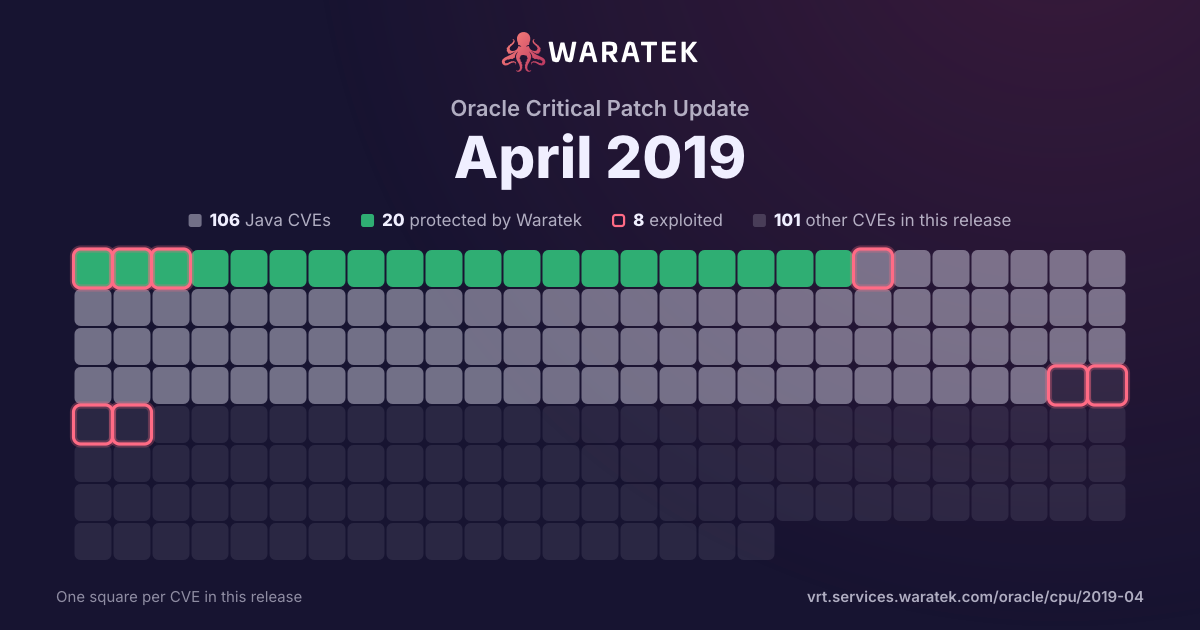
By status
21Protected by Waratek6Mitigation candidate89No exploit published8Outside Waratek scope83Not applicable
8Exploited, marked by the ring
No exploit published. For 81 of them, Oracle's security advisory is the source of public detail.
Protected by Waratek. Waratek RASP can block exploitation of these on systems that have not applied the patch yet.
Overview 18 matches · 0 in Waratek scope · 0 protected · 3 exploited · 0 CISA KEV · 2 public PoC · 3 EPSS ≥ 0.5
18matches
0in Waratek scope0.0%
0protected0.0%
3exploited16.7%
0CISA KEV0.0%
2public PoC11.1%
3EPSS ≥ 0.516.7%
Protected by Waratek
0
0.0%
Rule in development
0
0.0%
Mitigation candidate
0
0.0%
No exploit published
0
0.0%
Outside Waratek scope
0
0.0%
Not applicable
18
100.0%
Withdrawn CVE
0
0.0%
blocked by ARMR today
0
0.0%
partly blocked
0
0.0%
not blocked
18
100.0%
not established
0
0.0%
unrecorded
0
0.0%
Exploited
3
16.7%
Working exploit published
0
0.0%
Proof of concept only
2
11.1%
Forecast only
0
0.0%
No public exploit
13
72.2%
split by
peak 4 / quarter
Q2 172
Not applicable2
Critical2
not blocked2
No public exploit2
Q3 170
Q4 174
Not applicable4
Critical3
High1
not blocked4
Proof of concept only1
No public exploit3
Q1 182
Not applicable2
Medium2
not blocked2
Exploited1
Proof of concept only1
Q2 184
Not applicable4
Critical2
High1
Medium1
not blocked4
No public exploit4
Q3 181
Not applicable1
Medium1
not blocked1
Exploited1
Q4 181
Not applicable1
Medium1
not blocked1
No public exploit1
Q1 194
Not applicable4
Critical1
High1
Medium2
not blocked4
Exploited1
No public exploit3
Q2 17Q3 17Q4 17Q1 18Q2 18Q3 18Q4 18Q1 19
| CVE | Severity | Published▾ | Status | Exploitation | Description |
|---|---|---|---|---|---|
| CVE-2019-1559 | Medium | 2019-02-27 | Not applicable | No public exploit | If an application encounters a fatal protocol error and then calls SSL_shutdown() twice (once to send a close_notify, and once to receive one) then OpenSSL can respond differently to the calling application if a 0 byte record is received with invalid padding compared to if a 0 byte record is received with an invalid MAC. If the application then behaves differently based on that in a way that is detectable to the remote peer, then this amounts to a padding oracle that could be used to decrypt data. In order for this to be exploitable "non-stitched" ciphersuites must be in use. Stitched ciphersuites are optimised implementations of certain commonly used ciphersuites. Also the application must call SSL_shutdown() twice even if a protocol error has occurred (applications should not do this but some do anyway). Fixed in OpenSSL 1.0.2r (Affected 1.0.2-1.0.2q). |
| CVE-2019-3822 | Critical | 2019-02-06 | Not applicable | No public exploit | libcurl versions from 7.36.0 to before 7.64.0 are vulnerable to a stack-based buffer overflow. The function creating an outgoing NTLM type-3 header (`lib/vauth/ntlm.c:Curl_auth_create_ntlm_type3_message()`), generates the request HTTP header contents based on previously received data. The check that exists to prevent the local buffer from getting overflowed is implemented wrongly (using unsigned math) and as such it does not prevent the overflow from happening. This output data can grow larger than the local buffer if very large 'nt response' data is extracted from a previous NTLMv2 header provided by the malicious or broken HTTP server. Such a 'large value' needs to be around 1000 bytes or more. The actual payload data copied to the target buffer comes from the NTLMv2 type-2 response header. |
| CVE-2018-16864 | High | 2019-01-11 | Not applicable | No public exploit | An allocation of memory without limits, that could result in the stack clashing with another memory region, was discovered in systemd-journald when a program with long command line arguments calls syslog. A local attacker may use this flaw to crash systemd-journald or escalate his privileges. Versions through v240 are vulnerable. |
| CVE-2018-20685 | Medium | 2019-01-10 | Not applicable | Exploited | In OpenSSH 7.9, scp.c in the scp client allows remote SSH servers to bypass intended access restrictions via the filename of . or an empty filename. The impact is modifying the permissions of the target directory on the client side. |
| CVE-2018-0734 | Medium | 2018-10-30 | Not applicable | No public exploit | The OpenSSL DSA signature algorithm has been shown to be vulnerable to a timing side channel attack. An attacker could use variations in the signing algorithm to recover the private key. Fixed in OpenSSL 1.1.1a (Affected 1.1.1). Fixed in OpenSSL 1.1.0j (Affected 1.1.0-1.1.0i). Fixed in OpenSSL 1.0.2q (Affected 1.0.2-1.0.2p). |
| CVE-2018-11763 | Medium | 2018-09-25 | Not applicable | Exploited | In Apache HTTP Server 2.4.17 to 2.4.34, by sending continuous, large SETTINGS frames a client can occupy a connection, server thread and CPU time without any connection timeout coming to effect. This affects only HTTP/2 connections. A possible mitigation is to not enable the h2 protocol. |
| CVE-2018-11219 | Critical | 2018-06-17 | Not applicable | No public exploit | An Integer Overflow issue was discovered in the struct library in the Lua subsystem in Redis before 3.2.12, 4.x before 4.0.10, and 5.x before 5.0 RC2, leading to a failure of bounds checking. |
| CVE-2018-0495 | Medium | 2018-06-13 | Not applicable | No public exploit | Libgcrypt before 1.7.10 and 1.8.x before 1.8.3 allows a memory-cache side-channel attack on ECDSA signatures that can be mitigated through the use of blinding during the signing process in the _gcry_ecc_ecdsa_sign function in cipher/ecc-ecdsa.c, aka the Return Of the Hidden Number Problem or ROHNP. To discover an ECDSA key, the attacker needs access to either the local machine or a different virtual machine on the same physical host. |
| CVE-2018-0732 | High | 2018-06-12 | Not applicable | No public exploit | During key agreement in a TLS handshake using a DH(E) based ciphersuite a malicious server can send a very large prime value to the client. This will cause the client to spend an unreasonably long period of time generating a key for this prime resulting in a hang until the client has finished. This could be exploited in a Denial Of Service attack. Fixed in OpenSSL 1.1.0i-dev (Affected 1.1.0-1.1.0h). Fixed in OpenSSL 1.0.2p-dev (Affected 1.0.2-1.0.2o). |
| CVE-2018-11236 | Critical | 2018-05-18 | Not applicable | No public exploit | stdlib/canonicalize.c in the GNU C Library (aka glibc or libc6) 2.27 and earlier, when processing very long pathname arguments to the realpath function, could encounter an integer overflow on 32-bit architectures, leading to a stack-based buffer overflow and, potentially, arbitrary code execution. |
| CVE-2017-5754 | Medium | 2018-01-04 | Not applicable | Proof of concept only | Systems with microprocessors utilizing speculative execution and indirect branch prediction may allow unauthorized disclosure of information to an attacker with local user access via a side-channel analysis of the data cache. |
| CVE-2017-5753 | Medium | 2018-01-04 | Not applicable | Exploited | Systems with microprocessors utilizing speculative execution and branch prediction may allow unauthorized disclosure of information to an attacker with local user access via a side-channel analysis. |
| CVE-2014-9515 | Critical | 2017-12-29 | Not applicable | Proof of concept only | Dozer improperly uses a reflection-based approach to type conversion, which might allow remote attackers to execute arbitrary code via a crafted serialized object. |
| CVE-2017-0861 | High | 2017-11-16 | Not applicable | No public exploit | Use-after-free vulnerability in the snd_pcm_info function in the ALSA subsystem in the Linux kernel allows attackers to gain privileges via unspecified vectors. |
| CVE-2017-5533 | Critical | 2017-11-15 | Not applicable | No public exploit | A vulnerability in the server content cache of TIBCO JasperReports Server, TIBCO JasperReports Server Community Edition, TIBCO JasperReports Server for ActiveMatrix BPM, TIBCO Jaspersoft for AWS with Multi-Tenancy, and TIBCO Jaspersoft Reporting and Analytics for AWS contains a vulnerability which fails to prevent remote access to all the contents of the web application, including key configuration files. Affected releases are TIBCO JasperReports Server 6.4.0, TIBCO JasperReports Server Community Edition 6.4.0, TIBCO JasperReports Server for ActiveMatrix BPM 6.4.0, TIBCO Jaspersoft for AWS with Multi-Tenancy 6.4.0, TIBCO Jaspersoft Reporting and Analytics for AWS 6.4.0. |
| CVE-2017-14952 | Critical | 2017-10-16 | Not applicable | No public exploit | Double free in i18n/zonemeta.cpp in International Components for Unicode (ICU) for C/C++ through 59.1 allows remote attackers to execute arbitrary code via a crafted string, aka a "redundant UVector entry clean up function call" issue. |
| CVE-2017-8287 | Critical | 2017-04-27 | Not applicable | No public exploit | FreeType 2 before 2017-03-26 has an out-of-bounds write caused by a heap-based buffer overflow related to the t1_builder_close_contour function in psaux/psobjs.c. |
| CVE-2017-8105 | Critical | 2017-04-24 | Not applicable | No public exploit | FreeType 2 before 2017-03-24 has an out-of-bounds write caused by a heap-based buffer overflow related to the t1_decoder_parse_charstrings function in psaux/t1decode.c. |