
Oracle Critical Patch Update April 2019
Released April 2019 · Oracle's advisory ↗ · ← Critical Patch Update, January 2019 · Critical Patch Update, July 2019 →
207 CVEs in this release, one square each
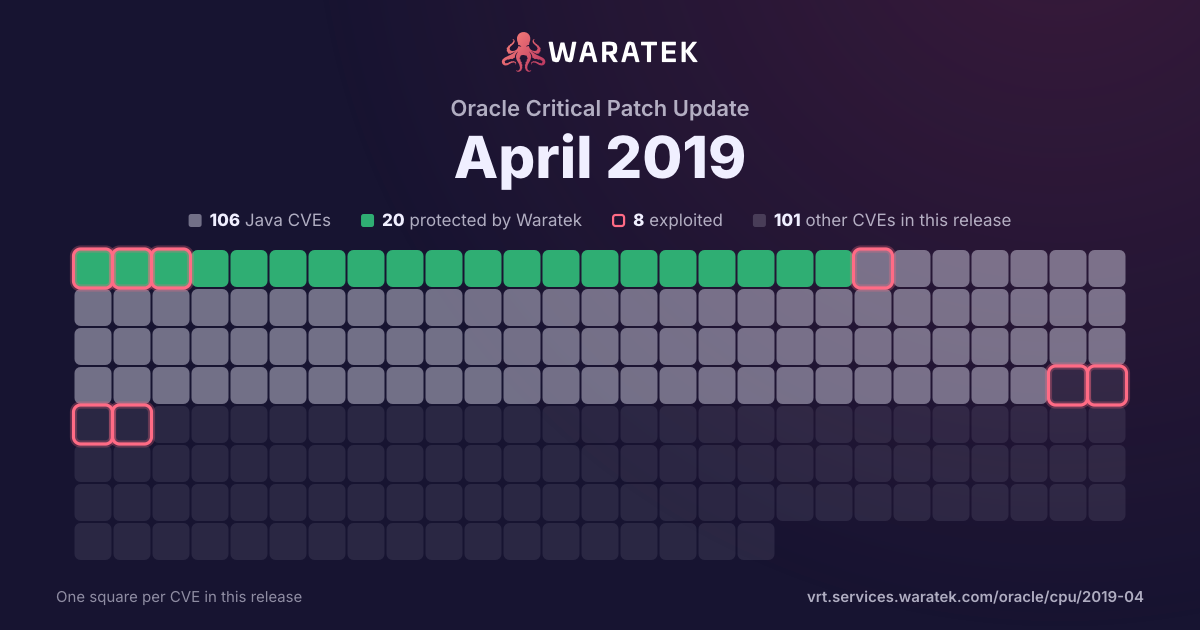
By status
21Protected by Waratek6Mitigation candidate89No exploit published8Outside Waratek scope83Not applicable
8Exploited, marked by the ring
No exploit published. For 81 of them, Oracle's security advisory is the source of public detail.
Protected by Waratek. Waratek RASP can block exploitation of these on systems that have not applied the patch yet.
Overview 2 matches · 0 in Waratek scope · 0 protected · 0 exploited · 0 CISA KEV · 0 public PoC · 0 EPSS ≥ 0.5
2matches
0in Waratek scope0.0%
0protected0.0%
0exploited0.0%
0CISA KEV0.0%
0public PoC0.0%
0EPSS ≥ 0.50.0%
Protected by Waratek
0
0.0%
Rule in development
0
0.0%
Mitigation candidate
0
0.0%
No exploit published
0
0.0%
Outside Waratek scope
0
0.0%
Not applicable
2
100.0%
Withdrawn CVE
0
0.0%
blocked by ARMR today
0
0.0%
partly blocked
0
0.0%
not blocked
2
100.0%
not established
0
0.0%
unrecorded
0
0.0%
Exploited
0
0.0%
Working exploit published
0
0.0%
Proof of concept only
0
0.0%
Forecast only
0
0.0%
No public exploit
2
100.0%
split by
peak 2 / month
Feb 19
| CVE | Severity | Published▾ | Status | Exploitation | Description |
|---|---|---|---|---|---|
| CVE-2019-1559 | Medium | 2019-02-27 | Not applicable | No public exploit | If an application encounters a fatal protocol error and then calls SSL_shutdown() twice (once to send a close_notify, and once to receive one) then OpenSSL can respond differently to the calling application if a 0 byte record is received with invalid padding compared to if a 0 byte record is received with an invalid MAC. If the application then behaves differently based on that in a way that is detectable to the remote peer, then this amounts to a padding oracle that could be used to decrypt data. In order for this to be exploitable "non-stitched" ciphersuites must be in use. Stitched ciphersuites are optimised implementations of certain commonly used ciphersuites. Also the application must call SSL_shutdown() twice even if a protocol error has occurred (applications should not do this but some do anyway). Fixed in OpenSSL 1.0.2r (Affected 1.0.2-1.0.2q). |
| CVE-2019-3822 | Critical | 2019-02-06 | Not applicable | No public exploit | libcurl versions from 7.36.0 to before 7.64.0 are vulnerable to a stack-based buffer overflow. The function creating an outgoing NTLM type-3 header (`lib/vauth/ntlm.c:Curl_auth_create_ntlm_type3_message()`), generates the request HTTP header contents based on previously received data. The check that exists to prevent the local buffer from getting overflowed is implemented wrongly (using unsigned math) and as such it does not prevent the overflow from happening. This output data can grow larger than the local buffer if very large 'nt response' data is extracted from a previous NTLMv2 header provided by the malicious or broken HTTP server. Such a 'large value' needs to be around 1000 bytes or more. The actual payload data copied to the target buffer comes from the NTLMv2 type-2 response header. |