
Oracle Critical Patch Update April 2019
Released April 2019 · Oracle's advisory ↗ · ← Critical Patch Update, January 2019 · Critical Patch Update, July 2019 →
207 CVEs in this release, one square each
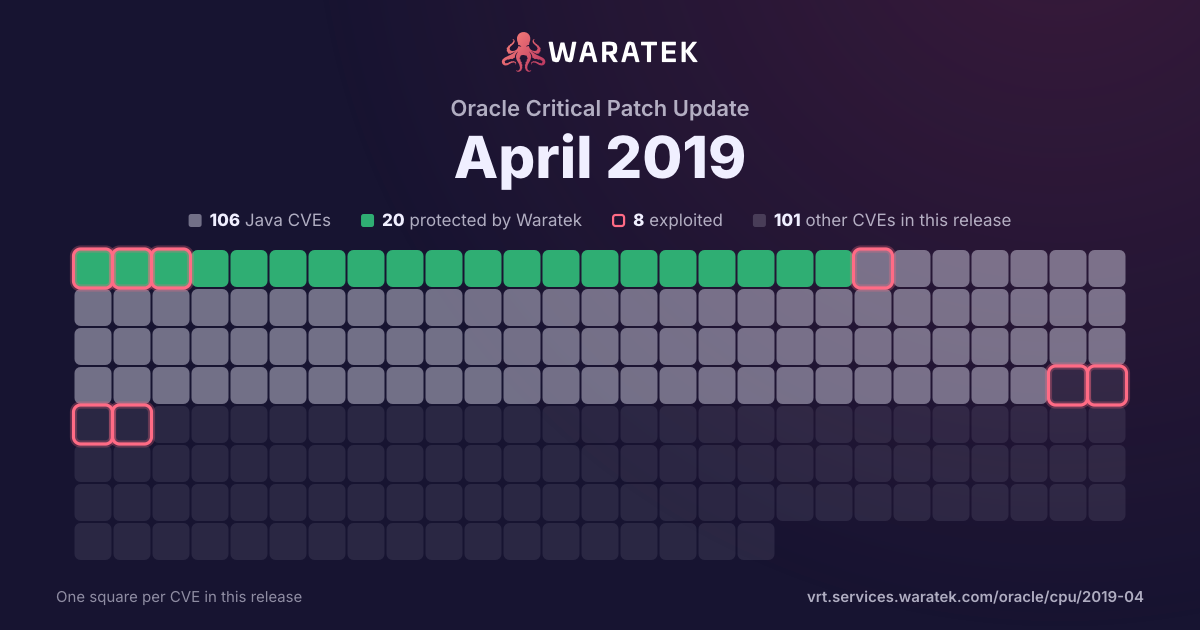
By status
20Protected by Waratek3Mitigation candidate83No exploit published58Outside Waratek scope43Not applicable
8Exploited, marked by the ring
No exploit published. For 80 of them, Oracle's security advisory is the source of public detail.
Protected by Waratek. Waratek RASP can block exploitation of these on systems that have not applied the patch yet.
Overview 4 matches · 1 in Waratek scope · 0 protected · 0 exploited · 0 CISA KEV · 0 public PoC · 0 EPSS ≥ 0.5
4matches
1in Waratek scope25.0%
0protected0.0%
0exploited0.0%
0CISA KEV0.0%
0public PoC0.0%
0EPSS ≥ 0.50.0%
Protected by Waratek
0
0.0%
Rule in development
0
0.0%
Mitigation candidate
0
0.0%
No exploit published
1
25.0%
Outside Waratek scope
0
0.0%
Not applicable
3
75.0%
Withdrawn CVE
0
0.0%
blocked by ARMR today
0
0.0%
partly blocked
0
0.0%
not blocked
4
100.0%
not established
0
0.0%
unrecorded
0
0.0%
Exploited
0
0.0%
Working exploit published
0
0.0%
Proof of concept only
0
0.0%
Forecast only
0
0.0%
No public exploit
4
100.0%
split by
peak 4 / month
Jun 18
| CVE | Severity | Published▾ | Status | Exploitation | Description |
|---|---|---|---|---|---|
| CVE-2018-11219 | Critical | 2018-06-17 | Not applicable | No public exploit | An Integer Overflow issue was discovered in the struct library in the Lua subsystem in Redis before 3.2.12, 4.x before 4.0.10, and 5.x before 5.0 RC2, leading to a failure of bounds checking. |
| CVE-2018-0495 | Medium | 2018-06-13 | Not applicable | No public exploit | Libgcrypt before 1.7.10 and 1.8.x before 1.8.3 allows a memory-cache side-channel attack on ECDSA signatures that can be mitigated through the use of blinding during the signing process in the _gcry_ecc_ecdsa_sign function in cipher/ecc-ecdsa.c, aka the Return Of the Hidden Number Problem or ROHNP. To discover an ECDSA key, the attacker needs access to either the local machine or a different virtual machine on the same physical host. |
| CVE-2018-0732 | High | 2018-06-12 | Not applicable | No public exploit | During key agreement in a TLS handshake using a DH(E) based ciphersuite a malicious server can send a very large prime value to the client. This will cause the client to spend an unreasonably long period of time generating a key for this prime resulting in a hang until the client has finished. This could be exploited in a Denial Of Service attack. Fixed in OpenSSL 1.1.0i-dev (Affected 1.1.0-1.1.0h). Fixed in OpenSSL 1.0.2p-dev (Affected 1.0.2-1.0.2o). |
| CVE-2018-1000180 | High | 2018-06-05 | No exploit published | No public exploit | Bouncy Castle BC 1.54 - 1.59, BC-FJA 1.0.0, BC-FJA 1.0.1 and earlier have a flaw in the Low-level interface to RSA key pair generator, specifically RSA Key Pairs generated in low-level API with added certainty may have less M-R tests than expected. This appears to be fixed in versions BC 1.60 beta 4 and later, BC-FJA 1.0.2 and later. |