
Oracle Critical Patch Update April 2019
Released April 2019 · Oracle's advisory ↗ · ← Critical Patch Update, January 2019 · Critical Patch Update, July 2019 →
207 CVEs in this release, one square each
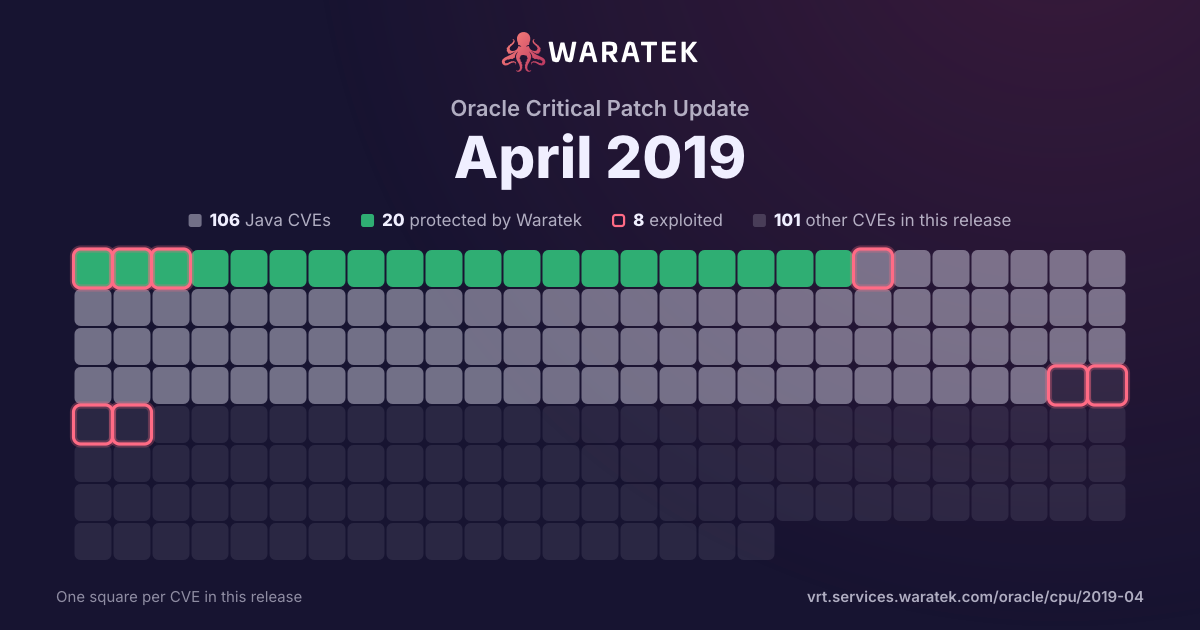
By status
20Protected by Waratek3Mitigation candidate83No exploit published58Outside Waratek scope43Not applicable
8Exploited, marked by the ring
No exploit published. For 80 of them, Oracle's security advisory is the source of public detail.
Protected by Waratek. Waratek RASP can block exploitation of these on systems that have not applied the patch yet.
Overview 6 matches · 2 in Waratek scope · 0 protected · 0 exploited · 0 CISA KEV · 2 EPSS ≥ 0.5
Protected by Waratek
0
0.0%
Rule in development
0
0.0%
Mitigation candidate
2
33.3%
No exploit published
0
0.0%
Outside Waratek scope
3
50.0%
Not applicable
1
16.7%
Withdrawn CVE
0
0.0%
blocked by ARMR today
0
0.0%
partly blocked
0
0.0%
not blocked
6
100.0%
not established
0
0.0%
unrecorded
0
0.0%
Exploited
0
0.0%
Working exploit published
6
100.0%
Proof of concept only
0
0.0%
Forecast only
0
0.0%
No public exploit
0
0.0%
split by
peak 5 / month
Oct 18Nov 18Dec 18Jan 19Feb 19Mar 19Apr 19
| CVE | Severity | Published▾ | Status | Exploitation | Description |
|---|---|---|---|---|---|
| CVE-2019-2721 | High | 2019-04-23 | Not applicable | Working exploit published | Vulnerability in the Oracle VM VirtualBox component of Oracle Virtualization (subcomponent: Core). Supported versions that are affected are Prior to 5.2.28 and prior to 6.0.6. Easily exploitable vulnerability allows low privileged attacker with logon to the infrastructure where Oracle VM VirtualBox executes to compromise Oracle VM VirtualBox. While the vulnerability is in Oracle VM VirtualBox, attacks may significantly impact additional products. Successful attacks of this vulnerability can result in takeover of Oracle VM VirtualBox. CVSS 3.0 Base Score 8.8 (Confidentiality, Integrity and Availability impacts). CVSS Vector: (CVSS:3.0/AV:L/AC:L/PR:L/UI:N/S:C/C:H/I:H/A:H). |
| CVE-2019-2698 | High | 2019-04-23 | Outside Waratek scope | Working exploit published | Vulnerability in the Java SE component of Oracle Java SE (subcomponent: 2D). Supported versions that are affected are Java SE: 7u211 and 8u202. Difficult to exploit vulnerability allows unauthenticated attacker with network access via multiple protocols to compromise Java SE. Successful attacks of this vulnerability can result in takeover of Java SE. Note: This vulnerability applies to Java deployments, typically in clients running sandboxed Java Web Start applications or sandboxed Java applets (in Java SE 8), that load and run untrusted code (e.g., code that comes from the internet) and rely on the Java sandbox for security. This vulnerability does not apply to Java deployments, typically in servers, that load and run only trusted code (e.g., code installed by an administrator). CVSS 3.0 Base Score 8.1 (Confidentiality, Integrity and Availability impacts). CVSS Vector: (CVSS:3.0/AV:N/AC:H/PR:N/UI:N/S:U/C:H/I:H/A:H). |
| CVE-2019-2697 | High | 2019-04-23 | Outside Waratek scope | Working exploit published | Vulnerability in the Java SE component of Oracle Java SE (subcomponent: 2D). Supported versions that are affected are Java SE: 7u211 and 8u202. Difficult to exploit vulnerability allows unauthenticated attacker with network access via multiple protocols to compromise Java SE. Successful attacks of this vulnerability can result in takeover of Java SE. Note: This vulnerability applies to Java deployments, typically in clients running sandboxed Java Web Start applications or sandboxed Java applets (in Java SE 8), that load and run untrusted code (e.g., code that comes from the internet) and rely on the Java sandbox for security. This vulnerability does not apply to Java deployments, typically in servers, that load and run only trusted code (e.g., code installed by an administrator). CVSS 3.0 Base Score 8.1 (Confidentiality, Integrity and Availability impacts). CVSS Vector: (CVSS:3.0/AV:N/AC:H/PR:N/UI:N/S:U/C:H/I:H/A:H). |
| CVE-2019-2579 | Medium | 2019-04-23 | Mitigation candidate | Working exploit published | Vulnerability in the Oracle WebCenter Sites component of Oracle Fusion Middleware (subcomponent: Advanced UI). The supported version that is affected is 12.2.1.3.0. Easily exploitable vulnerability allows low privileged attacker with network access via HTTP to compromise Oracle WebCenter Sites. Successful attacks of this vulnerability can result in unauthorized read access to a subset of Oracle WebCenter Sites accessible data. CVSS 3.0 Base Score 4.3 (Confidentiality impacts). CVSS Vector: (CVSS:3.0/AV:N/AC:L/PR:L/UI:N/S:U/C:L/I:N/A:N). |
| CVE-2019-2578 | High | 2019-04-23 | Mitigation candidate | Working exploit published | Vulnerability in the Oracle WebCenter Sites component of Oracle Fusion Middleware (subcomponent: Advanced UI). The supported version that is affected is 12.2.1.3.0. Easily exploitable vulnerability allows unauthenticated attacker with network access via HTTP to compromise Oracle WebCenter Sites. While the vulnerability is in Oracle WebCenter Sites, attacks may significantly impact additional products. Successful attacks of this vulnerability can result in unauthorized access to critical data or complete access to all Oracle WebCenter Sites accessible data. CVSS 3.0 Base Score 8.6 (Confidentiality impacts). CVSS Vector: (CVSS:3.0/AV:N/AC:L/PR:N/UI:N/S:C/C:H/I:N/A:N). |
| CVE-2018-11784 | Medium | 2018-10-04 | Outside Waratek scope | Working exploit published | When the default servlet in Apache Tomcat versions 9.0.0.M1 to 9.0.11, 8.5.0 to 8.5.33 and 7.0.23 to 7.0.90 returned a redirect to a directory (e.g. redirecting to '/foo/' when the user requested '/foo') a specially crafted URL could be used to cause the redirect to be generated to any URI of the attackers choice. |