
Oracle Critical Patch Update April 2019
Released April 2019 · Oracle's advisory ↗ · ← Critical Patch Update, January 2019 · Critical Patch Update, July 2019 →
207 CVEs in this release, one square each
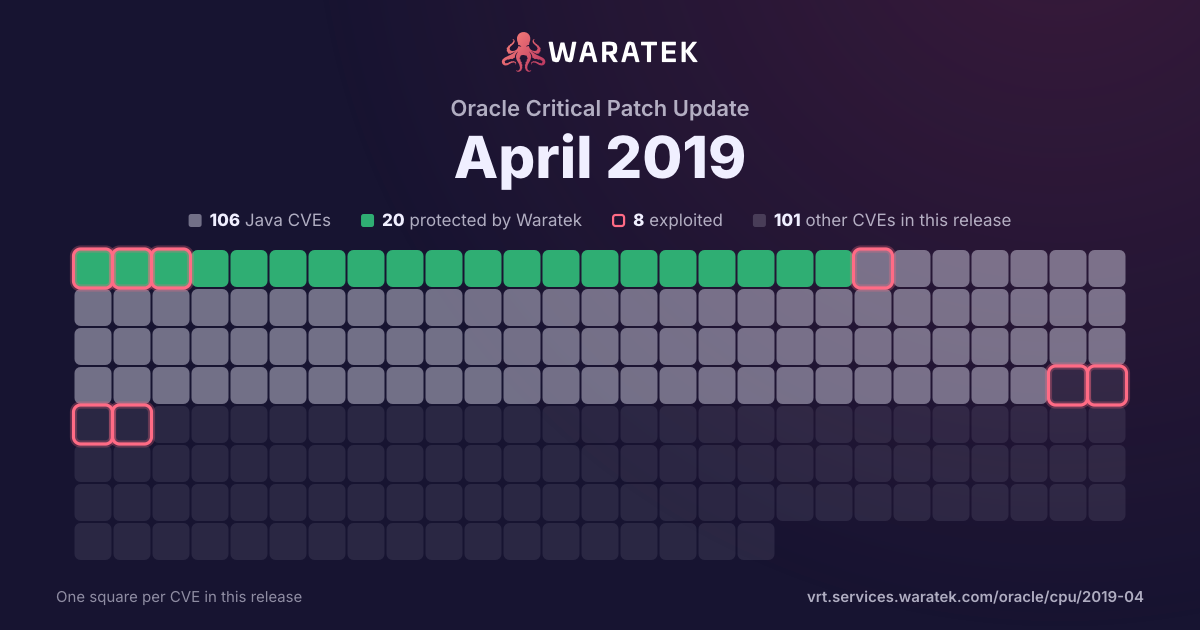
By status
20Protected by Waratek3Mitigation candidate83No exploit published58Outside Waratek scope43Not applicable
8Exploited, marked by the ring
No exploit published. For 80 of them, Oracle's security advisory is the source of public detail.
Protected by Waratek. Waratek RASP can block exploitation of these on systems that have not applied the patch yet.
Overview 16 matches · 9 protected · 0 exploited · 0 CISA KEV · 1 public PoC · 1 EPSS ≥ 0.5
Protected by Waratek
9
56.2%
Rule in development
0
0.0%
Mitigation candidate
0
0.0%
No exploit published
7
43.8%
blocked by ARMR today
9
56.2%
partly blocked
0
0.0%
not blocked
7
43.8%
not established
0
0.0%
unrecorded
0
0.0%
Exploited
0
0.0%
Working exploit published
1
6.2%
Proof of concept only
0
0.0%
Forecast only
0
0.0%
No public exploit
15
93.8%
split by
peak 6 / quarter
Q2 161
No exploit published1
Critical1
not blocked1
No public exploit1
Q3 160
Q4 161
Protected by Waratek1
Critical1
blocked by ARMR today1
No public exploit1
Q1 170
Q2 171
Protected by Waratek1
Critical1
blocked by ARMR today1
Working exploit published1
Q3 171
Protected by Waratek1
Critical1
blocked by ARMR today1
No public exploit1
Q4 170
Q1 182
Protected by Waratek2
Critical2
blocked by ARMR today2
No public exploit2
Q2 181
Protected by Waratek1
Critical1
blocked by ARMR today1
No public exploit1
Q3 180
Q4 180
Q1 193
Protected by Waratek3
Critical3
blocked by ARMR today3
No public exploit3
Q2 196
No exploit published6
Critical6
not blocked6
No public exploit6
Q2 16Q4 16Q2 17Q4 17Q2 18Q4 18Q2 19
| CVE | Severity | Published▾ | Status | Exploitation | Description |
|---|---|---|---|---|---|
| CVE-2019-2699 | Critical | 2019-04-23 | No exploit published | No public exploit | Vulnerability in the Java SE component of Oracle Java SE (subcomponent: Windows DLL). The supported version that is affected is Java SE: 8u202. Difficult to exploit vulnerability allows unauthenticated attacker with network access via multiple protocols to compromise Java SE. While the vulnerability is in Java SE, attacks may significantly impact additional products. Successful attacks of this vulnerability can result in takeover of Java SE. Note: This vulnerability applies to Java deployments, typically in clients running sandboxed Java Web Start applications or sandboxed Java applets (in Java SE 8), that load and run untrusted code (e.g., code that comes from the internet) and rely on the Java sandbox for security. This vulnerability can also be exploited by using APIs in the specified Component, e.g., through a web service which supplies data to the APIs. CVSS 3.0 Base Score 9.0 (Confidentiality, Integrity and Availability impacts). CVSS Vector: (CVSS:3.0/AV:N/AC:H/PR:N/UI:N/S:C/C:H/I:H/A:H). |
| CVE-2019-2658 | Critical | 2019-04-23 | No exploit published | No public exploit | Vulnerability in the Oracle WebLogic Server component of Oracle Fusion Middleware (subcomponent: WLS Core Components). Supported versions that are affected are 10.3.6.0.0 and 12.1.3.0.0. Easily exploitable vulnerability allows unauthenticated attacker with network access via HTTP to compromise Oracle WebLogic Server. Successful attacks of this vulnerability can result in takeover of Oracle WebLogic Server. CVSS 3.0 Base Score 9.8 (Confidentiality, Integrity and Availability impacts). CVSS Vector: (CVSS:3.0/AV:N/AC:L/PR:N/UI:N/S:U/C:H/I:H/A:H). |
| CVE-2019-2646 | Critical | 2019-04-23 | No exploit published | No public exploit | Vulnerability in the Oracle WebLogic Server component of Oracle Fusion Middleware (subcomponent: EJB Container). Supported versions that are affected are 10.3.6.0.0, 12.1.3.0.0 and 12.2.1.3.0. Easily exploitable vulnerability allows unauthenticated attacker with network access via T3 to compromise Oracle WebLogic Server. Successful attacks of this vulnerability can result in takeover of Oracle WebLogic Server. CVSS 3.0 Base Score 9.8 (Confidentiality, Integrity and Availability impacts). CVSS Vector: (CVSS:3.0/AV:N/AC:L/PR:N/UI:N/S:U/C:H/I:H/A:H). |
| CVE-2019-2645 | Critical | 2019-04-23 | No exploit published | No public exploit | Vulnerability in the Oracle WebLogic Server component of Oracle Fusion Middleware (subcomponent: WLS Core Components). Supported versions that are affected are 10.3.6.0.0, 12.1.3.0.0 and 12.2.1.3.0. Easily exploitable vulnerability allows unauthenticated attacker with network access via T3 to compromise Oracle WebLogic Server. Successful attacks of this vulnerability can result in takeover of Oracle WebLogic Server. CVSS 3.0 Base Score 9.8 (Confidentiality, Integrity and Availability impacts). CVSS Vector: (CVSS:3.0/AV:N/AC:L/PR:N/UI:N/S:U/C:H/I:H/A:H). |
| CVE-2019-2638 | Critical | 2019-04-23 | No exploit published | No public exploit | Vulnerability in the Oracle General Ledger component of Oracle E-Business Suite (subcomponent: Consolidation Hierarchy Viewer). Supported versions that are affected are 12.1.1, 12.1.2, 12.1.3, 12.2.3, 12.2.4, 12.2.5, 12.2.6, 12.2.7 and 12.2.8. Easily exploitable vulnerability allows low privileged attacker with network access via HTTP to compromise Oracle General Ledger. Successful attacks of this vulnerability can result in unauthorized creation, deletion or modification access to critical data or all Oracle General Ledger accessible data as well as unauthorized access to critical data or complete access to all Oracle General Ledger accessible data. CVSS 3.0 Base Score 9.9 (Confidentiality, Integrity and Availability impacts). CVSS Vector: (CVSS:3.0/AV:N/AC:L/PR:L/UI:N/S:C/C:H/I:H/A:L). |
| CVE-2019-2633 | Critical | 2019-04-23 | No exploit published | No public exploit | Vulnerability in the Oracle Work in Process component of Oracle E-Business Suite (subcomponent: Messages). Supported versions that are affected are 12.1.1, 12.1.2, 12.1.3, 12.2.3, 12.2.4, 12.2.5, 12.2.6, 12.2.7 and 12.2.8. Easily exploitable vulnerability allows low privileged attacker with network access via HTTP to compromise Oracle Work in Process. Successful attacks of this vulnerability can result in unauthorized creation, deletion or modification access to critical data or all Oracle Work in Process accessible data as well as unauthorized access to critical data or complete access to all Oracle Work in Process accessible data. CVSS 3.0 Base Score 9.9 (Confidentiality, Integrity and Availability impacts). CVSS Vector: (CVSS:3.0/AV:N/AC:L/PR:L/UI:N/S:C/C:H/I:H/A:L). |
| CVE-2019-3772 | Critical | 2019-01-18 | Protected by Waratek | No public exploit | Spring Integration (spring-integration-xml and spring-integration-ws modules), versions 4.3.18, 5.0.10, 5.1.1, and older unsupported versions, were susceptible to XML External Entity Injection (XXE) when receiving XML data from untrusted sources. |
| CVE-2018-19362 | Critical | 2019-01-02 | Protected by Waratek | No public exploit | FasterXML jackson-databind 2.x before 2.9.8 might allow attackers to have unspecified impact by leveraging failure to block the jboss-common-core class from polymorphic deserialization. |
| CVE-2018-14718 | Critical | 2019-01-02 | Protected by Waratek | No public exploit | FasterXML jackson-databind 2.x before 2.9.7 might allow remote attackers to execute arbitrary code by leveraging failure to block the slf4j-ext class from polymorphic deserialization. |
| CVE-2018-8013 | Critical | 2018-05-24 | Protected by Waratek | No public exploit | In Apache Batik 1.x before 1.10, when deserializing subclass of `AbstractDocument`, the class takes a string from the inputStream as the class name which then use it to call the no-arg constructor of the class. Fix was to check the class type before calling newInstance in deserialization. |
| CVE-2018-8088 | Critical | 2018-03-20 | Protected by Waratek | No public exploit | org.slf4j.ext.EventData in the slf4j-ext module in QOS.CH SLF4J before 1.8.0-beta2 allows remote attackers to bypass intended access restrictions via crafted data. EventData in the slf4j-ext module in QOS.CH SLF4J, has been fixed in SLF4J versions 1.7.26 later and in the 2.0.x series. |
| CVE-2018-7489 | Critical | 2018-02-26 | Protected by Waratek | No public exploit | FasterXML jackson-databind before 2.7.9.3, 2.8.x before 2.8.11.1 and 2.9.x before 2.9.5 allows unauthenticated remote code execution because of an incomplete fix for the CVE-2017-7525 deserialization flaw. This is exploitable by sending maliciously crafted JSON input to the readValue method of the ObjectMapper, bypassing a blacklist that is ineffective if the c3p0 libraries are available in the classpath. |
| CVE-2016-4000 | Critical | 2017-07-06 | Protected by Waratek | No public exploit | Jython before 2.7.1rc1 allows attackers to execute arbitrary code via a crafted serialized PyFunction object. |
| CVE-2017-5645 | Critical | 2017-04-17 | Protected by Waratek | Working exploit published | In Apache Log4j 2.x before 2.8.2, when using the TCP socket server or UDP socket server to receive serialized log events from another application, a specially crafted binary payload can be sent that, when deserialized, can execute arbitrary code. |
| CVE-2016-1000031 | Critical | 2016-10-25 | Protected by Waratek | No public exploit | Apache Commons FileUpload before 1.3.3 DiskFileItem File Manipulation Remote Code Execution |
| CVE-2016-2141 | Critical | 2016-06-30 | No exploit published | No public exploit | It was found that JGroups did not require necessary headers for encrypt and auth protocols from new nodes joining the cluster. An attacker could use this flaw to bypass security restrictions, and use this vulnerability to send and receive messages within the cluster, leading to information disclosure, message spoofing, or further possible attacks. |