
Oracle Critical Patch Update October 2018
Released October 2018 · Oracle's advisory ↗ · ← Critical Patch Update, July 2018 · Critical Patch Update, January 2019 →
226 CVEs in this release, one square each
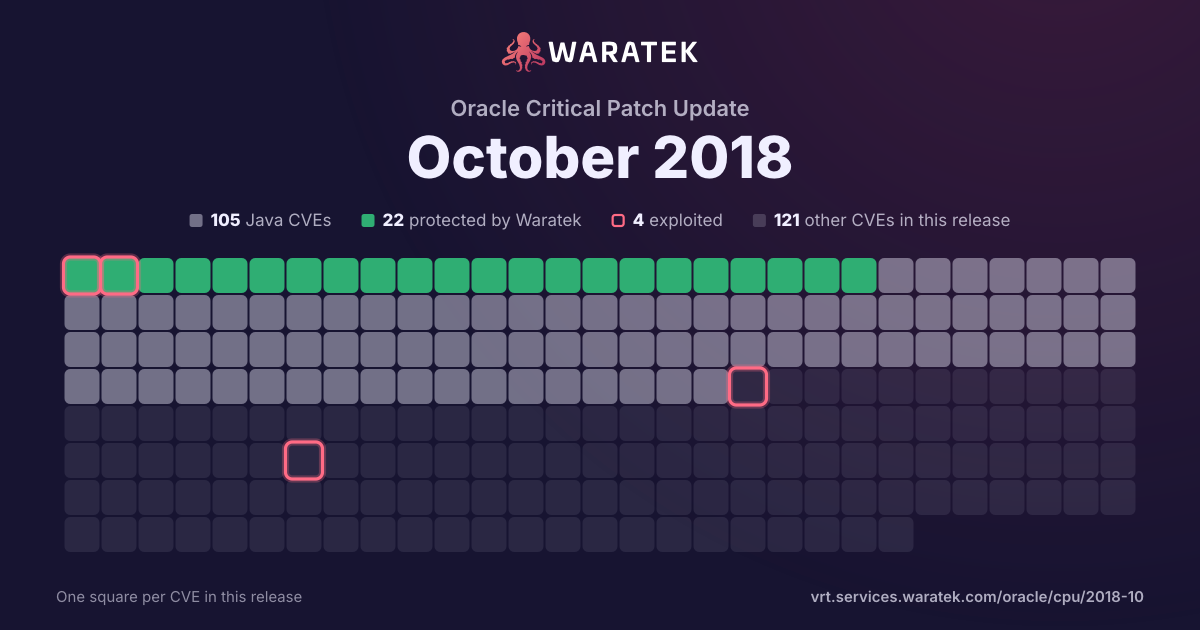
By status
22Protected by Waratek2Mitigation candidate81No exploit published46Outside Waratek scope75Not applicable
4Exploited, marked by the ring
No exploit published. For 81 of them, Oracle's security advisory is the source of public detail.
Protected by Waratek. Waratek RASP can block exploitation of these on systems that have not applied the patch yet.
Overview 77 matches · 28 in Waratek scope · 0 protected · 1 exploited · 0 CISA KEV · 2 public PoC · 2 EPSS ≥ 0.5
77matches
28in Waratek scope36.4%
0protected0.0%
1exploited1.3%
0CISA KEV0.0%
2public PoC2.6%
2EPSS ≥ 0.52.6%
Protected by Waratek
0
0.0%
Rule in development
0
0.0%
Mitigation candidate
0
0.0%
No exploit published
28
36.4%
Outside Waratek scope
5
6.5%
Not applicable
44
57.1%
Withdrawn CVE
0
0.0%
blocked by ARMR today
0
0.0%
partly blocked
0
0.0%
not blocked
77
100.0%
not established
0
0.0%
unrecorded
0
0.0%
Exploited
1
1.3%
Working exploit published
1
1.3%
Proof of concept only
0
0.0%
Forecast only
0
0.0%
No public exploit
75
97.4%
split by
peak 70 / quarter
Q1 151
Outside Waratek scope1
High1
not blocked1
Working exploit published1
Q2 150
Q3 150
Q4 150
Q1 160
Q2 161
Not applicable1
High1
not blocked1
No public exploit1
Q3 161
Outside Waratek scope1
High1
not blocked1
No public exploit1
Q4 160
Q1 170
Q2 170
Q3 171
Not applicable1
High1
not blocked1
Exploited1
Q4 170
Q1 180
Q2 183
No exploit published1
Not applicable2
High3
not blocked3
No public exploit3
Q3 180
Q4 1870
No exploit published27
Outside Waratek scope3
Not applicable40
High70
not blocked70
No public exploit70
Q2 15Q4 15Q2 16Q4 16Q2 17Q4 17Q2 18Q4 18
| CVE | Severity | Published▾ | Status | Exploitation | Description |
|---|---|---|---|---|---|
| CVE-2018-18224 | High | 2018-10-19 | Not applicable | No public exploit | A vulnerability exists in the file reading procedure in Open Design Alliance Drawings SDK 2019Update1 on non-Windows platforms in which attackers could perform read operations past the end, or before the beginning, of the intended buffer. This can allow attackers to obtain sensitive information from process memory or cause a crash. |
| CVE-2018-18223 | High | 2018-10-19 | Not applicable | No public exploit | Open Design Alliance Drawings SDK 2019Update1 has a vulnerability during the reading of malformed files, allowing attackers to obtain sensitive information from process memory or cause a crash. |
| CVE-2018-3302 | High | 2018-10-17 | Not applicable | No public exploit | Vulnerability in the Oracle Outside In Technology component of Oracle Fusion Middleware (subcomponent: Outside In Filters). The supported version that is affected are 8.5.3 and 8.5.4. Easily exploitable vulnerability allows unauthenticated attacker with network access via HTTP to compromise Oracle Outside In Technology. Successful attacks require human interaction from a person other than the attacker. Successful attacks of this vulnerability can result in unauthorized ability to cause a hang or frequently repeatable crash (complete DOS) of Oracle Outside In Technology and unauthorized read access to a subset of Oracle Outside In Technology accessible data. Note: Outside In Technology is a suite of software development kits (SDKs). The protocol and CVSS score depend on the software that uses the Outside In Technology code. The CVSS score assumes that the software passes data received over a network directly to Outside In Technology code, but if data is not received over a network the CVSS score may be lower. CVSS 3.0 Base Score 7.1 (Confidentiality and Availability impacts). CVSS Vector: (CVSS:3.0/AV:N/AC:L/PR:N/UI:R/S:U/C:L/I:N/A:H). |
| CVE-2018-3299 | High | 2018-10-17 | Not applicable | No public exploit | Vulnerability in the Oracle Text component of Oracle Database Server. Supported versions that are affected are 11.2.0.4, 12.1.0.2 and 12.2.0.1. Easily exploitable vulnerability allows unauthenticated attacker with network access via multiple protocols to compromise Oracle Text. Successful attacks require human interaction from a person other than the attacker and while the vulnerability is in Oracle Text, attacks may significantly impact additional products. Successful attacks of this vulnerability can result in unauthorized ability to cause a hang or frequently repeatable crash (complete DOS) of Oracle Text as well as unauthorized update, insert or delete access to some of Oracle Text accessible data. CVSS 3.0 Base Score 8.2 (Integrity and Availability impacts). CVSS Vector: (CVSS:3.0/AV:N/AC:L/PR:N/UI:R/S:C/C:N/I:L/A:H). |
| CVE-2018-3298 | High | 2018-10-17 | Not applicable | No public exploit | Vulnerability in the Oracle VM VirtualBox component of Oracle Virtualization (subcomponent: Core). The supported version that is affected is Prior to 5.2.20. Easily exploitable vulnerability allows unauthenticated attacker with logon to the infrastructure where Oracle VM VirtualBox executes to compromise Oracle VM VirtualBox. Successful attacks require human interaction from a person other than the attacker and while the vulnerability is in Oracle VM VirtualBox, attacks may significantly impact additional products. Successful attacks of this vulnerability can result in takeover of Oracle VM VirtualBox. CVSS 3.0 Base Score 8.6 (Confidentiality, Integrity and Availability impacts). CVSS Vector: (CVSS:3.0/AV:L/AC:L/PR:N/UI:R/S:C/C:H/I:H/A:H). |
| CVE-2018-3297 | High | 2018-10-17 | Not applicable | No public exploit | Vulnerability in the Oracle VM VirtualBox component of Oracle Virtualization (subcomponent: Core). The supported version that is affected is Prior to 5.2.20. Easily exploitable vulnerability allows unauthenticated attacker with logon to the infrastructure where Oracle VM VirtualBox executes to compromise Oracle VM VirtualBox. Successful attacks require human interaction from a person other than the attacker and while the vulnerability is in Oracle VM VirtualBox, attacks may significantly impact additional products. Successful attacks of this vulnerability can result in takeover of Oracle VM VirtualBox. CVSS 3.0 Base Score 8.6 (Confidentiality, Integrity and Availability impacts). CVSS Vector: (CVSS:3.0/AV:L/AC:L/PR:N/UI:R/S:C/C:H/I:H/A:H). |
| CVE-2018-3296 | High | 2018-10-17 | Not applicable | No public exploit | Vulnerability in the Oracle VM VirtualBox component of Oracle Virtualization (subcomponent: Core). The supported version that is affected is Prior to 5.2.20. Easily exploitable vulnerability allows unauthenticated attacker with logon to the infrastructure where Oracle VM VirtualBox executes to compromise Oracle VM VirtualBox. Successful attacks require human interaction from a person other than the attacker and while the vulnerability is in Oracle VM VirtualBox, attacks may significantly impact additional products. Successful attacks of this vulnerability can result in takeover of Oracle VM VirtualBox. CVSS 3.0 Base Score 8.6 (Confidentiality, Integrity and Availability impacts). CVSS Vector: (CVSS:3.0/AV:L/AC:L/PR:N/UI:R/S:C/C:H/I:H/A:H). |
| CVE-2018-3295 | High | 2018-10-17 | Not applicable | No public exploit | Vulnerability in the Oracle VM VirtualBox component of Oracle Virtualization (subcomponent: Core). The supported version that is affected is Prior to 5.2.20. Easily exploitable vulnerability allows unauthenticated attacker with logon to the infrastructure where Oracle VM VirtualBox executes to compromise Oracle VM VirtualBox. Successful attacks require human interaction from a person other than the attacker and while the vulnerability is in Oracle VM VirtualBox, attacks may significantly impact additional products. Successful attacks of this vulnerability can result in takeover of Oracle VM VirtualBox. CVSS 3.0 Base Score 8.6 (Confidentiality, Integrity and Availability impacts). CVSS Vector: (CVSS:3.0/AV:L/AC:L/PR:N/UI:R/S:C/C:H/I:H/A:H). |
| CVE-2018-3293 | High | 2018-10-17 | Not applicable | No public exploit | Vulnerability in the Oracle VM VirtualBox component of Oracle Virtualization (subcomponent: Core). The supported version that is affected is Prior to 5.2.20. Easily exploitable vulnerability allows unauthenticated attacker with logon to the infrastructure where Oracle VM VirtualBox executes to compromise Oracle VM VirtualBox. Successful attacks require human interaction from a person other than the attacker and while the vulnerability is in Oracle VM VirtualBox, attacks may significantly impact additional products. Successful attacks of this vulnerability can result in takeover of Oracle VM VirtualBox. CVSS 3.0 Base Score 8.6 (Confidentiality, Integrity and Availability impacts). CVSS Vector: (CVSS:3.0/AV:L/AC:L/PR:N/UI:R/S:C/C:H/I:H/A:H). |
| CVE-2018-3292 | High | 2018-10-17 | Not applicable | No public exploit | Vulnerability in the Oracle VM VirtualBox component of Oracle Virtualization (subcomponent: Core). The supported version that is affected is Prior to 5.2.20. Easily exploitable vulnerability allows unauthenticated attacker with logon to the infrastructure where Oracle VM VirtualBox executes to compromise Oracle VM VirtualBox. Successful attacks require human interaction from a person other than the attacker and while the vulnerability is in Oracle VM VirtualBox, attacks may significantly impact additional products. Successful attacks of this vulnerability can result in takeover of Oracle VM VirtualBox. CVSS 3.0 Base Score 8.6 (Confidentiality, Integrity and Availability impacts). CVSS Vector: (CVSS:3.0/AV:L/AC:L/PR:N/UI:R/S:C/C:H/I:H/A:H). |
| CVE-2018-3291 | High | 2018-10-17 | Not applicable | No public exploit | Vulnerability in the Oracle VM VirtualBox component of Oracle Virtualization (subcomponent: Core). The supported version that is affected is Prior to 5.2.20. Easily exploitable vulnerability allows unauthenticated attacker with logon to the infrastructure where Oracle VM VirtualBox executes to compromise Oracle VM VirtualBox. Successful attacks require human interaction from a person other than the attacker and while the vulnerability is in Oracle VM VirtualBox, attacks may significantly impact additional products. Successful attacks of this vulnerability can result in takeover of Oracle VM VirtualBox. CVSS 3.0 Base Score 8.6 (Confidentiality, Integrity and Availability impacts). CVSS Vector: (CVSS:3.0/AV:L/AC:L/PR:N/UI:R/S:C/C:H/I:H/A:H). |
| CVE-2018-3290 | High | 2018-10-17 | Not applicable | No public exploit | Vulnerability in the Oracle VM VirtualBox component of Oracle Virtualization (subcomponent: Core). The supported version that is affected is Prior to 5.2.20. Easily exploitable vulnerability allows unauthenticated attacker with logon to the infrastructure where Oracle VM VirtualBox executes to compromise Oracle VM VirtualBox. Successful attacks require human interaction from a person other than the attacker and while the vulnerability is in Oracle VM VirtualBox, attacks may significantly impact additional products. Successful attacks of this vulnerability can result in takeover of Oracle VM VirtualBox. CVSS 3.0 Base Score 8.6 (Confidentiality, Integrity and Availability impacts). CVSS Vector: (CVSS:3.0/AV:L/AC:L/PR:N/UI:R/S:C/C:H/I:H/A:H). |
| CVE-2018-3289 | High | 2018-10-17 | Not applicable | No public exploit | Vulnerability in the Oracle VM VirtualBox component of Oracle Virtualization (subcomponent: Core). The supported version that is affected is Prior to 5.2.20. Easily exploitable vulnerability allows unauthenticated attacker with logon to the infrastructure where Oracle VM VirtualBox executes to compromise Oracle VM VirtualBox. Successful attacks require human interaction from a person other than the attacker and while the vulnerability is in Oracle VM VirtualBox, attacks may significantly impact additional products. Successful attacks of this vulnerability can result in takeover of Oracle VM VirtualBox. CVSS 3.0 Base Score 8.6 (Confidentiality, Integrity and Availability impacts). CVSS Vector: (CVSS:3.0/AV:L/AC:L/PR:N/UI:R/S:C/C:H/I:H/A:H). |
| CVE-2018-3288 | High | 2018-10-17 | Not applicable | No public exploit | Vulnerability in the Oracle VM VirtualBox component of Oracle Virtualization (subcomponent: Core). The supported version that is affected is Prior to 5.2.20. Easily exploitable vulnerability allows unauthenticated attacker with logon to the infrastructure where Oracle VM VirtualBox executes to compromise Oracle VM VirtualBox. Successful attacks require human interaction from a person other than the attacker and while the vulnerability is in Oracle VM VirtualBox, attacks may significantly impact additional products. Successful attacks of this vulnerability can result in takeover of Oracle VM VirtualBox. CVSS 3.0 Base Score 8.6 (Confidentiality, Integrity and Availability impacts). CVSS Vector: (CVSS:3.0/AV:L/AC:L/PR:N/UI:R/S:C/C:H/I:H/A:H). |
| CVE-2018-3287 | High | 2018-10-17 | Not applicable | No public exploit | Vulnerability in the Oracle VM VirtualBox component of Oracle Virtualization (subcomponent: Core). The supported version that is affected is Prior to 5.2.20. Easily exploitable vulnerability allows unauthenticated attacker with logon to the infrastructure where Oracle VM VirtualBox executes to compromise Oracle VM VirtualBox. Successful attacks require human interaction from a person other than the attacker and while the vulnerability is in Oracle VM VirtualBox, attacks may significantly impact additional products. Successful attacks of this vulnerability can result in takeover of Oracle VM VirtualBox. CVSS 3.0 Base Score 8.6 (Confidentiality, Integrity and Availability impacts). CVSS Vector: (CVSS:3.0/AV:L/AC:L/PR:N/UI:R/S:C/C:H/I:H/A:H). |
| CVE-2018-3275 | High | 2018-10-17 | Not applicable | No public exploit | Vulnerability in the Solaris component of Oracle Sun Systems Products Suite (subcomponent: LibKMIP). The supported version that is affected is 11.3. Difficult to exploit vulnerability allows unauthenticated attacker with network access via multiple protocols to compromise Solaris. Successful attacks of this vulnerability can result in unauthorized creation, deletion or modification access to critical data or all Solaris accessible data as well as unauthorized access to critical data or complete access to all Solaris accessible data. CVSS 3.0 Base Score 7.4 (Confidentiality and Integrity impacts). CVSS Vector: (CVSS:3.0/AV:N/AC:H/PR:N/UI:N/S:U/C:H/I:H/A:N). |
| CVE-2018-3273 | High | 2018-10-17 | Not applicable | No public exploit | Vulnerability in the Solaris component of Oracle Sun Systems Products Suite (subcomponent: Remote Administration Daemon (RAD)). The supported version that is affected is 11.3. Easily exploitable vulnerability allows unauthenticated attacker with network access via multiple protocols to compromise Solaris. Successful attacks require human interaction from a person other than the attacker. Successful attacks of this vulnerability can result in unauthorized creation, deletion or modification access to critical data or all Solaris accessible data as well as unauthorized access to critical data or complete access to all Solaris accessible data. CVSS 3.0 Base Score 8.1 (Confidentiality and Integrity impacts). CVSS Vector: (CVSS:3.0/AV:N/AC:L/PR:N/UI:R/S:U/C:H/I:H/A:N). |
| CVE-2018-3258 | High | 2018-10-17 | Not applicable | No public exploit | Vulnerability in the MySQL Connectors component of Oracle MySQL (subcomponent: Connector/J). Supported versions that are affected are 8.0.12 and prior. Easily exploitable vulnerability allows low privileged attacker with network access via multiple protocols to compromise MySQL Connectors. Successful attacks of this vulnerability can result in takeover of MySQL Connectors. CVSS 3.0 Base Score 8.8 (Confidentiality, Integrity and Availability impacts). CVSS Vector: (CVSS:3.0/AV:N/AC:L/PR:L/UI:N/S:U/C:H/I:H/A:H). |
| CVE-2018-3253 | High | 2018-10-17 | No exploit published | No public exploit | Vulnerability in the Oracle Virtual Directory component of Oracle Fusion Middleware (subcomponent: Virtual Directory Manager). Supported versions that are affected are 11.1.1.7.0 and 11.1.1.9.0. Difficult to exploit vulnerability allows low privileged attacker with network access via HTTP to compromise Oracle Virtual Directory. Successful attacks of this vulnerability can result in unauthorized update, insert or delete access to some of Oracle Virtual Directory accessible data as well as unauthorized read access to a subset of Oracle Virtual Directory accessible data and unauthorized ability to cause a partial denial of service (partial DOS) of Oracle Virtual Directory. CVSS 3.0 Base Score 8.5 (Confidentiality, Integrity and Availability impacts). CVSS Vector: (CVSS:3.0/AV:N/AC:H/PR:L/UI:N/S:C/C:H/I:H/A:H). |
| CVE-2018-3246 | High | 2018-10-17 | No exploit published | No public exploit | Vulnerability in the Oracle WebLogic Server component of Oracle Fusion Middleware (subcomponent: WLS - Web Services). Supported versions that are affected are 12.1.3.0 and 12.2.1.3. Easily exploitable vulnerability allows unauthenticated attacker with network access via HTTP to compromise Oracle WebLogic Server. Successful attacks of this vulnerability can result in unauthorized access to critical data or complete access to all Oracle WebLogic Server accessible data. CVSS 3.0 Base Score 7.5 (Confidentiality impacts). CVSS Vector: (CVSS:3.0/AV:N/AC:L/PR:N/UI:N/S:U/C:H/I:N/A:N). |
| CVE-2018-3243 | High | 2018-10-17 | No exploit published | No public exploit | Vulnerability in the Oracle Applications Framework component of Oracle E-Business Suite (subcomponent: None). Supported versions that are affected are 12.1.3, 12.2.3, 12.2.4, 12.2.5 and 12.2.6. Easily exploitable vulnerability allows unauthenticated attacker with network access via HTTP to compromise Oracle Applications Framework. Successful attacks require human interaction from a person other than the attacker and while the vulnerability is in Oracle Applications Framework, attacks may significantly impact additional products. Successful attacks of this vulnerability can result in unauthorized access to critical data or complete access to all Oracle Applications Framework accessible data as well as unauthorized update, insert or delete access to some of Oracle Applications Framework accessible data. CVSS 3.0 Base Score 8.2 (Confidentiality and Integrity impacts). CVSS Vector: (CVSS:3.0/AV:N/AC:L/PR:N/UI:R/S:C/C:H/I:L/A:N). |
| CVE-2018-3242 | High | 2018-10-17 | No exploit published | No public exploit | Vulnerability in the Oracle Marketing component of Oracle E-Business Suite (subcomponent: Marketing Administration). Supported versions that are affected are 12.1.1, 12.1.2, 12.1.3, 12.2.3, 12.2.4, 12.2.5, 12.2.6 and 12.2.7. Easily exploitable vulnerability allows unauthenticated attacker with network access via HTTP to compromise Oracle Marketing. Successful attacks require human interaction from a person other than the attacker and while the vulnerability is in Oracle Marketing, attacks may significantly impact additional products. Successful attacks of this vulnerability can result in unauthorized access to critical data or complete access to all Oracle Marketing accessible data as well as unauthorized update, insert or delete access to some of Oracle Marketing accessible data. CVSS 3.0 Base Score 8.2 (Confidentiality and Integrity impacts). CVSS Vector: (CVSS:3.0/AV:N/AC:L/PR:N/UI:R/S:C/C:H/I:L/A:N). |
| CVE-2018-3235 | High | 2018-10-17 | No exploit published | No public exploit | Vulnerability in the Oracle Applications Manager component of Oracle E-Business Suite (subcomponent: None). Supported versions that are affected are 12.1.3, 12.2.3, 12.2.4, 12.2.5, 12.2.6 and 12.2.7. Easily exploitable vulnerability allows unauthenticated attacker with network access via HTTP to compromise Oracle Applications Manager. Successful attacks require human interaction from a person other than the attacker and while the vulnerability is in Oracle Applications Manager, attacks may significantly impact additional products. Successful attacks of this vulnerability can result in unauthorized access to critical data or complete access to all Oracle Applications Manager accessible data as well as unauthorized update, insert or delete access to some of Oracle Applications Manager accessible data. CVSS 3.0 Base Score 8.2 (Confidentiality and Integrity impacts). CVSS Vector: (CVSS:3.0/AV:N/AC:L/PR:N/UI:R/S:C/C:H/I:L/A:N). |
| CVE-2018-3234 | High | 2018-10-17 | Not applicable | No public exploit | Vulnerability in the Oracle Outside In Technology component of Oracle Fusion Middleware (subcomponent: Outside In Filters). The supported version that is affected are 8.5.3 and 8.5.4. Easily exploitable vulnerability allows unauthenticated attacker with network access via HTTP to compromise Oracle Outside In Technology. Successful attacks require human interaction from a person other than the attacker. Successful attacks of this vulnerability can result in unauthorized ability to cause a hang or frequently repeatable crash (complete DOS) of Oracle Outside In Technology and unauthorized read access to a subset of Oracle Outside In Technology accessible data. Note: Outside In Technology is a suite of software development kits (SDKs). The protocol and CVSS score depend on the software that uses the Outside In Technology code. The CVSS score assumes that the software passes data received over a network directly to Outside In Technology code, but if data is not received over a network the CVSS score may be lower. CVSS 3.0 Base Score 7.1 (Confidentiality and Availability impacts). CVSS Vector: (CVSS:3.0/AV:N/AC:L/PR:N/UI:R/S:U/C:L/I:N/A:H). |
| CVE-2018-3233 | High | 2018-10-17 | Not applicable | No public exploit | Vulnerability in the Oracle Outside In Technology component of Oracle Fusion Middleware (subcomponent: Outside In Filters). The supported version that is affected are 8.5.3 and 8.5.4. Easily exploitable vulnerability allows unauthenticated attacker with network access via HTTP to compromise Oracle Outside In Technology. Successful attacks require human interaction from a person other than the attacker. Successful attacks of this vulnerability can result in unauthorized ability to cause a hang or frequently repeatable crash (complete DOS) of Oracle Outside In Technology and unauthorized read access to a subset of Oracle Outside In Technology accessible data. Note: Outside In Technology is a suite of software development kits (SDKs). The protocol and CVSS score depend on the software that uses the Outside In Technology code. The CVSS score assumes that the software passes data received over a network directly to Outside In Technology code, but if data is not received over a network the CVSS score may be lower. CVSS 3.0 Base Score 7.1 (Confidentiality and Availability impacts). CVSS Vector: (CVSS:3.0/AV:N/AC:L/PR:N/UI:R/S:U/C:L/I:N/A:H). |
| CVE-2018-3232 | High | 2018-10-17 | Not applicable | No public exploit | Vulnerability in the Oracle Outside In Technology component of Oracle Fusion Middleware (subcomponent: Outside In Filters). The supported version that is affected are 8.5.3 and 8.5.4. Easily exploitable vulnerability allows unauthenticated attacker with network access via HTTP to compromise Oracle Outside In Technology. Successful attacks require human interaction from a person other than the attacker. Successful attacks of this vulnerability can result in unauthorized ability to cause a hang or frequently repeatable crash (complete DOS) of Oracle Outside In Technology and unauthorized read access to a subset of Oracle Outside In Technology accessible data. Note: Outside In Technology is a suite of software development kits (SDKs). The protocol and CVSS score depend on the software that uses the Outside In Technology code. The CVSS score assumes that the software passes data received over a network directly to Outside In Technology code, but if data is not received over a network the CVSS score may be lower. CVSS 3.0 Base Score 7.1 (Confidentiality and Availability impacts). CVSS Vector: (CVSS:3.0/AV:N/AC:L/PR:N/UI:R/S:U/C:L/I:N/A:H). |
| CVE-2018-3231 | High | 2018-10-17 | Not applicable | No public exploit | Vulnerability in the Oracle Outside In Technology component of Oracle Fusion Middleware (subcomponent: Outside In Filters). The supported version that is affected are 8.5.3 and 8.5.4. Easily exploitable vulnerability allows unauthenticated attacker with network access via HTTP to compromise Oracle Outside In Technology. Successful attacks require human interaction from a person other than the attacker. Successful attacks of this vulnerability can result in unauthorized ability to cause a hang or frequently repeatable crash (complete DOS) of Oracle Outside In Technology and unauthorized read access to a subset of Oracle Outside In Technology accessible data. Note: Outside In Technology is a suite of software development kits (SDKs). The protocol and CVSS score depend on the software that uses the Outside In Technology code. The CVSS score assumes that the software passes data received over a network directly to Outside In Technology code, but if data is not received over a network the CVSS score may be lower. CVSS 3.0 Base Score 7.1 (Confidentiality and Availability impacts). CVSS Vector: (CVSS:3.0/AV:N/AC:L/PR:N/UI:R/S:U/C:L/I:N/A:H). |
| CVE-2018-3230 | High | 2018-10-17 | Not applicable | No public exploit | Vulnerability in the Oracle Outside In Technology component of Oracle Fusion Middleware (subcomponent: Outside In Filters). The supported version that is affected are 8.5.3 and 8.5.4. Easily exploitable vulnerability allows unauthenticated attacker with network access via HTTP to compromise Oracle Outside In Technology. Successful attacks require human interaction from a person other than the attacker. Successful attacks of this vulnerability can result in unauthorized ability to cause a hang or frequently repeatable crash (complete DOS) of Oracle Outside In Technology and unauthorized read access to a subset of Oracle Outside In Technology accessible data. Note: Outside In Technology is a suite of software development kits (SDKs). The protocol and CVSS score depend on the software that uses the Outside In Technology code. The CVSS score assumes that the software passes data received over a network directly to Outside In Technology code, but if data is not received over a network the CVSS score may be lower. CVSS 3.0 Base Score 7.1 (Confidentiality and Availability impacts). CVSS Vector: (CVSS:3.0/AV:N/AC:L/PR:N/UI:R/S:U/C:L/I:N/A:H). |
| CVE-2018-3229 | High | 2018-10-17 | Not applicable | No public exploit | Vulnerability in the Oracle Outside In Technology component of Oracle Fusion Middleware (subcomponent: Outside In Filters). The supported version that is affected are 8.5.3 and 8.5.4. Easily exploitable vulnerability allows unauthenticated attacker with network access via HTTP to compromise Oracle Outside In Technology. Successful attacks require human interaction from a person other than the attacker. Successful attacks of this vulnerability can result in unauthorized ability to cause a hang or frequently repeatable crash (complete DOS) of Oracle Outside In Technology and unauthorized read access to a subset of Oracle Outside In Technology accessible data. Note: Outside In Technology is a suite of software development kits (SDKs). The protocol and CVSS score depend on the software that uses the Outside In Technology code. The CVSS score assumes that the software passes data received over a network directly to Outside In Technology code, but if data is not received over a network the CVSS score may be lower. CVSS 3.0 Base Score 7.1 (Confidentiality and Availability impacts). CVSS Vector: (CVSS:3.0/AV:N/AC:L/PR:N/UI:R/S:U/C:L/I:N/A:H). |
| CVE-2018-3228 | High | 2018-10-17 | Not applicable | No public exploit | Vulnerability in the Oracle Outside In Technology component of Oracle Fusion Middleware (subcomponent: Outside In Filters). The supported version that is affected are 8.5.3 and 8.5.4. Easily exploitable vulnerability allows unauthenticated attacker with network access via HTTP to compromise Oracle Outside In Technology. Successful attacks require human interaction from a person other than the attacker. Successful attacks of this vulnerability can result in unauthorized ability to cause a hang or frequently repeatable crash (complete DOS) of Oracle Outside In Technology and unauthorized read access to a subset of Oracle Outside In Technology accessible data. Note: Outside In Technology is a suite of software development kits (SDKs). The protocol and CVSS score depend on the software that uses the Outside In Technology code. The CVSS score assumes that the software passes data received over a network directly to Outside In Technology code, but if data is not received over a network the CVSS score may be lower. CVSS 3.0 Base Score 7.1 (Confidentiality and Availability impacts). CVSS Vector: (CVSS:3.0/AV:N/AC:L/PR:N/UI:R/S:U/C:L/I:N/A:H). |
| CVE-2018-3227 | High | 2018-10-17 | Not applicable | No public exploit | Vulnerability in the Oracle Outside In Technology component of Oracle Fusion Middleware (subcomponent: Outside In Filters). The supported version that is affected are 8.5.3 and 8.5.4. Easily exploitable vulnerability allows unauthenticated attacker with network access via HTTP to compromise Oracle Outside In Technology. Successful attacks require human interaction from a person other than the attacker. Successful attacks of this vulnerability can result in unauthorized ability to cause a hang or frequently repeatable crash (complete DOS) of Oracle Outside In Technology and unauthorized read access to a subset of Oracle Outside In Technology accessible data. Note: Outside In Technology is a suite of software development kits (SDKs). The protocol and CVSS score depend on the software that uses the Outside In Technology code. The CVSS score assumes that the software passes data received over a network directly to Outside In Technology code, but if data is not received over a network the CVSS score may be lower. CVSS 3.0 Base Score 7.1 (Confidentiality and Availability impacts). CVSS Vector: (CVSS:3.0/AV:N/AC:L/PR:N/UI:R/S:U/C:L/I:N/A:H). |
| CVE-2018-3226 | High | 2018-10-17 | Not applicable | No public exploit | Vulnerability in the Oracle Outside In Technology component of Oracle Fusion Middleware (subcomponent: Outside In Filters). The supported version that is affected are 8.5.3 and 8.5.4. Easily exploitable vulnerability allows unauthenticated attacker with network access via HTTP to compromise Oracle Outside In Technology. Successful attacks require human interaction from a person other than the attacker. Successful attacks of this vulnerability can result in unauthorized ability to cause a hang or frequently repeatable crash (complete DOS) of Oracle Outside In Technology and unauthorized read access to a subset of Oracle Outside In Technology accessible data. Note: Outside In Technology is a suite of software development kits (SDKs). The protocol and CVSS score depend on the software that uses the Outside In Technology code. The CVSS score assumes that the software passes data received over a network directly to Outside In Technology code, but if data is not received over a network the CVSS score may be lower. CVSS 3.0 Base Score 7.1 (Confidentiality and Availability impacts). CVSS Vector: (CVSS:3.0/AV:N/AC:L/PR:N/UI:R/S:U/C:L/I:N/A:H). |
| CVE-2018-3225 | High | 2018-10-17 | Not applicable | No public exploit | Vulnerability in the Oracle Outside In Technology component of Oracle Fusion Middleware (subcomponent: Outside In Filters). The supported version that is affected are 8.5.3 and 8.5.4. Easily exploitable vulnerability allows unauthenticated attacker with network access via HTTP to compromise Oracle Outside In Technology. Successful attacks require human interaction from a person other than the attacker. Successful attacks of this vulnerability can result in unauthorized ability to cause a hang or frequently repeatable crash (complete DOS) of Oracle Outside In Technology and unauthorized read access to a subset of Oracle Outside In Technology accessible data. Note: Outside In Technology is a suite of software development kits (SDKs). The protocol and CVSS score depend on the software that uses the Outside In Technology code. The CVSS score assumes that the software passes data received over a network directly to Outside In Technology code, but if data is not received over a network the CVSS score may be lower. CVSS 3.0 Base Score 7.1 (Confidentiality and Availability impacts). CVSS Vector: (CVSS:3.0/AV:N/AC:L/PR:N/UI:R/S:U/C:L/I:N/A:H). |
| CVE-2018-3224 | High | 2018-10-17 | Not applicable | No public exploit | Vulnerability in the Oracle Outside In Technology component of Oracle Fusion Middleware (subcomponent: Outside In Filters). The supported version that is affected are 8.5.3 and 8.5.4. Easily exploitable vulnerability allows unauthenticated attacker with network access via HTTP to compromise Oracle Outside In Technology. Successful attacks require human interaction from a person other than the attacker. Successful attacks of this vulnerability can result in unauthorized ability to cause a hang or frequently repeatable crash (complete DOS) of Oracle Outside In Technology and unauthorized read access to a subset of Oracle Outside In Technology accessible data. Note: Outside In Technology is a suite of software development kits (SDKs). The protocol and CVSS score depend on the software that uses the Outside In Technology code. The CVSS score assumes that the software passes data received over a network directly to Outside In Technology code, but if data is not received over a network the CVSS score may be lower. CVSS 3.0 Base Score 7.1 (Confidentiality and Availability impacts). CVSS Vector: (CVSS:3.0/AV:N/AC:L/PR:N/UI:R/S:U/C:L/I:N/A:H). |
| CVE-2018-3223 | High | 2018-10-17 | Not applicable | No public exploit | Vulnerability in the Oracle Outside In Technology component of Oracle Fusion Middleware (subcomponent: Outside In Filters). The supported version that is affected are 8.5.3 and 8.5.4. Easily exploitable vulnerability allows unauthenticated attacker with network access via HTTP to compromise Oracle Outside In Technology. Successful attacks require human interaction from a person other than the attacker. Successful attacks of this vulnerability can result in unauthorized ability to cause a hang or frequently repeatable crash (complete DOS) of Oracle Outside In Technology and unauthorized read access to a subset of Oracle Outside In Technology accessible data. Note: Outside In Technology is a suite of software development kits (SDKs). The protocol and CVSS score depend on the software that uses the Outside In Technology code. The CVSS score assumes that the software passes data received over a network directly to Outside In Technology code, but if data is not received over a network the CVSS score may be lower. CVSS 3.0 Base Score 7.1 (Confidentiality and Availability impacts). CVSS Vector: (CVSS:3.0/AV:N/AC:L/PR:N/UI:R/S:U/C:L/I:N/A:H). |
| CVE-2018-3222 | High | 2018-10-17 | Not applicable | No public exploit | Vulnerability in the Oracle Outside In Technology component of Oracle Fusion Middleware (subcomponent: Outside In Filters). The supported version that is affected are 8.5.3 and 8.5.4. Easily exploitable vulnerability allows unauthenticated attacker with network access via HTTP to compromise Oracle Outside In Technology. Successful attacks require human interaction from a person other than the attacker. Successful attacks of this vulnerability can result in unauthorized ability to cause a hang or frequently repeatable crash (complete DOS) of Oracle Outside In Technology and unauthorized read access to a subset of Oracle Outside In Technology accessible data. Note: Outside In Technology is a suite of software development kits (SDKs). The protocol and CVSS score depend on the software that uses the Outside In Technology code. The CVSS score assumes that the software passes data received over a network directly to Outside In Technology code, but if data is not received over a network the CVSS score may be lower. CVSS 3.0 Base Score 7.1 (Confidentiality and Availability impacts). CVSS Vector: (CVSS:3.0/AV:N/AC:L/PR:N/UI:R/S:U/C:L/I:N/A:H). |
| CVE-2018-3221 | High | 2018-10-17 | Not applicable | No public exploit | Vulnerability in the Oracle Outside In Technology component of Oracle Fusion Middleware (subcomponent: Outside In Filters). The supported version that is affected are 8.5.3 and 8.5.4. Easily exploitable vulnerability allows unauthenticated attacker with network access via HTTP to compromise Oracle Outside In Technology. Successful attacks require human interaction from a person other than the attacker. Successful attacks of this vulnerability can result in unauthorized ability to cause a hang or frequently repeatable crash (complete DOS) of Oracle Outside In Technology and unauthorized read access to a subset of Oracle Outside In Technology accessible data. Note: Outside In Technology is a suite of software development kits (SDKs). The protocol and CVSS score depend on the software that uses the Outside In Technology code. The CVSS score assumes that the software passes data received over a network directly to Outside In Technology code, but if data is not received over a network the CVSS score may be lower. CVSS 3.0 Base Score 7.1 (Confidentiality and Availability impacts). CVSS Vector: (CVSS:3.0/AV:N/AC:L/PR:N/UI:R/S:U/C:L/I:N/A:H). |
| CVE-2018-3220 | High | 2018-10-17 | Not applicable | No public exploit | Vulnerability in the Oracle Outside In Technology component of Oracle Fusion Middleware (subcomponent: Outside In Filters). The supported version that is affected are 8.5.3 and 8.5.4. Easily exploitable vulnerability allows unauthenticated attacker with network access via HTTP to compromise Oracle Outside In Technology. Successful attacks require human interaction from a person other than the attacker. Successful attacks of this vulnerability can result in unauthorized access to critical data or complete access to all Oracle Outside In Technology accessible data and unauthorized ability to cause a partial denial of service (partial DOS) of Oracle Outside In Technology. Note: Outside In Technology is a suite of software development kits (SDKs). The protocol and CVSS score depend on the software that uses the Outside In Technology code. The CVSS score assumes that the software passes data received over a network directly to Outside In Technology code, but if data is not received over a network the CVSS score may be lower. CVSS 3.0 Base Score 7.1 (Confidentiality and Availability impacts). CVSS Vector: (CVSS:3.0/AV:N/AC:L/PR:N/UI:R/S:U/C:H/I:N/A:L). |
| CVE-2018-3219 | High | 2018-10-17 | Not applicable | No public exploit | Vulnerability in the Oracle Outside In Technology component of Oracle Fusion Middleware (subcomponent: Outside In Filters). The supported version that is affected are 8.5.3 and 8.5.4. Easily exploitable vulnerability allows unauthenticated attacker with network access via HTTP to compromise Oracle Outside In Technology. Successful attacks require human interaction from a person other than the attacker. Successful attacks of this vulnerability can result in unauthorized access to critical data or complete access to all Oracle Outside In Technology accessible data and unauthorized ability to cause a partial denial of service (partial DOS) of Oracle Outside In Technology. Note: Outside In Technology is a suite of software development kits (SDKs). The protocol and CVSS score depend on the software that uses the Outside In Technology code. The CVSS score assumes that the software passes data received over a network directly to Outside In Technology code, but if data is not received over a network the CVSS score may be lower. CVSS 3.0 Base Score 7.1 (Confidentiality and Availability impacts). CVSS Vector: (CVSS:3.0/AV:N/AC:L/PR:N/UI:R/S:U/C:H/I:N/A:L). |
| CVE-2018-3218 | High | 2018-10-17 | Not applicable | No public exploit | Vulnerability in the Oracle Outside In Technology component of Oracle Fusion Middleware (subcomponent: Outside In Filters). The supported version that is affected are 8.5.3 and 8.5.4. Easily exploitable vulnerability allows unauthenticated attacker with network access via HTTP to compromise Oracle Outside In Technology. Successful attacks require human interaction from a person other than the attacker. Successful attacks of this vulnerability can result in unauthorized access to critical data or complete access to all Oracle Outside In Technology accessible data as well as unauthorized update, insert or delete access to some of Oracle Outside In Technology accessible data. Note: Outside In Technology is a suite of software development kits (SDKs). The protocol and CVSS score depend on the software that uses the Outside In Technology code. The CVSS score assumes that the software passes data received over a network directly to Outside In Technology code, but if data is not received over a network the CVSS score may be lower. CVSS 3.0 Base Score 7.1 (Confidentiality and Integrity impacts). CVSS Vector: (CVSS:3.0/AV:N/AC:L/PR:N/UI:R/S:U/C:H/I:L/A:N). |
| CVE-2018-3217 | High | 2018-10-17 | Not applicable | No public exploit | Vulnerability in the Oracle Outside In Technology component of Oracle Fusion Middleware (subcomponent: Outside In Filters). The supported version that is affected are 8.5.3 and 8.5.4. Easily exploitable vulnerability allows unauthenticated attacker with network access via HTTP to compromise Oracle Outside In Technology. Successful attacks require human interaction from a person other than the attacker. Successful attacks of this vulnerability can result in unauthorized access to critical data or complete access to all Oracle Outside In Technology accessible data as well as unauthorized update, insert or delete access to some of Oracle Outside In Technology accessible data. Note: Outside In Technology is a suite of software development kits (SDKs). The protocol and CVSS score depend on the software that uses the Outside In Technology code. The CVSS score assumes that the software passes data received over a network directly to Outside In Technology code, but if data is not received over a network the CVSS score may be lower. CVSS 3.0 Base Score 7.1 (Confidentiality and Integrity impacts). CVSS Vector: (CVSS:3.0/AV:N/AC:L/PR:N/UI:R/S:U/C:H/I:L/A:N). |
| CVE-2018-3213 | High | 2018-10-17 | No exploit published | No public exploit | Vulnerability in the Oracle WebLogic Server component of Oracle Fusion Middleware (subcomponent: Docker Images). The supported version that is affected is prior to Docker 12.2.1.3.20180913. Easily exploitable vulnerability allows unauthenticated attacker with network access via T3 to compromise Oracle WebLogic Server. Successful attacks of this vulnerability can result in unauthorized access to critical data or complete access to all Oracle WebLogic Server accessible data. CVSS 3.0 Base Score 7.5 (Confidentiality impacts). CVSS Vector: (CVSS:3.0/AV:N/AC:L/PR:N/UI:N/S:U/C:H/I:N/A:N). |
| CVE-2018-3209 | High | 2018-10-17 | Outside Waratek scope | No public exploit | Vulnerability in the Java SE component of Oracle Java SE (subcomponent: JavaFX). The supported version that is affected is Java SE: 8u182. Difficult to exploit vulnerability allows unauthenticated attacker with network access via multiple protocols to compromise Java SE. Successful attacks require human interaction from a person other than the attacker and while the vulnerability is in Java SE, attacks may significantly impact additional products. Successful attacks of this vulnerability can result in takeover of Java SE. Note: This vulnerability applies to Java deployments, typically in clients running sandboxed Java Web Start applications or sandboxed Java applets (in Java SE 8), that load and run untrusted code (e.g. code that comes from the internet) and rely on the Java sandbox for security. This vulnerability does not apply to Java deployments, typically in servers, that load and run only trusted code (e.g. code installed by an administrator). CVSS 3.0 Base Score 8.3 (Confidentiality, Integrity and Availability impacts). CVSS Vector: (CVSS:3.0/AV:N/AC:H/PR:N/UI:R/S:C/C:H/I:H/A:H). |
| CVE-2018-3208 | High | 2018-10-17 | No exploit published | No public exploit | Vulnerability in the Hyperion Data Relationship Management component of Oracle Hyperion (subcomponent: Access and Security). The supported version that is affected is 11.1.2.4.345. Easily exploitable vulnerability allows low privileged attacker with network access via HTTP to compromise Hyperion Data Relationship Management. While the vulnerability is in Hyperion Data Relationship Management, attacks may significantly impact additional products. Successful attacks of this vulnerability can result in unauthorized access to critical data or complete access to all Hyperion Data Relationship Management accessible data. CVSS 3.0 Base Score 7.7 (Confidentiality impacts). CVSS Vector: (CVSS:3.0/AV:N/AC:L/PR:L/UI:N/S:C/C:H/I:N/A:N). |
| CVE-2018-3204 | High | 2018-10-17 | No exploit published | No public exploit | Vulnerability in the Oracle Business Intelligence Enterprise Edition component of Oracle Fusion Middleware (subcomponent: Analytics Server). The supported version that is affected is 12.2.1.3.0. Easily exploitable vulnerability allows unauthenticated attacker with network access via HTTP to compromise Oracle Business Intelligence Enterprise Edition. Successful attacks require human interaction from a person other than the attacker and while the vulnerability is in Oracle Business Intelligence Enterprise Edition, attacks may significantly impact additional products. Successful attacks of this vulnerability can result in unauthorized access to critical data or complete access to all Oracle Business Intelligence Enterprise Edition accessible data as well as unauthorized update, insert or delete access to some of Oracle Business Intelligence Enterprise Edition accessible data. CVSS 3.0 Base Score 8.2 (Confidentiality and Integrity impacts). CVSS Vector: (CVSS:3.0/AV:N/AC:L/PR:N/UI:R/S:C/C:H/I:L/A:N). |
| CVE-2018-3196 | High | 2018-10-17 | No exploit published | No public exploit | Vulnerability in the Oracle Partner Management component of Oracle E-Business Suite (subcomponent: Partner Dashboard). Supported versions that are affected are 12.1.1, 12.1.2, 12.1.3, 12.2.3, 12.2.4, 12.2.5, 12.2.6 and 12.2.7. Easily exploitable vulnerability allows unauthenticated attacker with network access via HTTP to compromise Oracle Partner Management. Successful attacks require human interaction from a person other than the attacker and while the vulnerability is in Oracle Partner Management, attacks may significantly impact additional products. Successful attacks of this vulnerability can result in unauthorized access to critical data or complete access to all Oracle Partner Management accessible data as well as unauthorized update, insert or delete access to some of Oracle Partner Management accessible data. CVSS 3.0 Base Score 8.2 (Confidentiality and Integrity impacts). CVSS Vector: (CVSS:3.0/AV:N/AC:L/PR:N/UI:R/S:C/C:H/I:L/A:N). |
| CVE-2018-3192 | High | 2018-10-17 | No exploit published | No public exploit | Vulnerability in the PeopleSoft Enterprise PeopleTools component of Oracle PeopleSoft Products (subcomponent: Query). Supported versions that are affected are 8.55 and 8.56. Easily exploitable vulnerability allows high privileged attacker with network access via HTTP to compromise PeopleSoft Enterprise PeopleTools. Successful attacks of this vulnerability can result in takeover of PeopleSoft Enterprise PeopleTools. CVSS 3.0 Base Score 7.2 (Confidentiality, Integrity and Availability impacts). CVSS Vector: (CVSS:3.0/AV:N/AC:L/PR:H/UI:N/S:U/C:H/I:H/A:H). |
| CVE-2018-3190 | High | 2018-10-17 | No exploit published | No public exploit | Vulnerability in the Oracle E-Business Intelligence component of Oracle E-Business Suite (subcomponent: Overview Page/Report Rendering). Supported versions that are affected are 12.1.1, 12.1.2 and 12.1.3. Easily exploitable vulnerability allows unauthenticated attacker with network access via HTTP to compromise Oracle E-Business Intelligence. Successful attacks require human interaction from a person other than the attacker and while the vulnerability is in Oracle E-Business Intelligence, attacks may significantly impact additional products. Successful attacks of this vulnerability can result in unauthorized access to critical data or complete access to all Oracle E-Business Intelligence accessible data as well as unauthorized update, insert or delete access to some of Oracle E-Business Intelligence accessible data. CVSS 3.0 Base Score 8.2 (Confidentiality and Integrity impacts). CVSS Vector: (CVSS:3.0/AV:N/AC:L/PR:N/UI:R/S:C/C:H/I:L/A:N). |
| CVE-2018-3189 | High | 2018-10-17 | No exploit published | No public exploit | Vulnerability in the Oracle Customer Interaction History component of Oracle E-Business Suite (subcomponent: Outcome-Result). Supported versions that are affected are 12.1.1, 12.1.2 and 12.1.3. Easily exploitable vulnerability allows unauthenticated attacker with network access via HTTP to compromise Oracle Customer Interaction History. Successful attacks require human interaction from a person other than the attacker and while the vulnerability is in Oracle Customer Interaction History, attacks may significantly impact additional products. Successful attacks of this vulnerability can result in unauthorized access to critical data or complete access to all Oracle Customer Interaction History accessible data as well as unauthorized update, insert or delete access to some of Oracle Customer Interaction History accessible data. CVSS 3.0 Base Score 8.2 (Confidentiality and Integrity impacts). CVSS Vector: (CVSS:3.0/AV:N/AC:L/PR:N/UI:R/S:C/C:H/I:L/A:N). |
| CVE-2018-3188 | High | 2018-10-17 | No exploit published | No public exploit | Vulnerability in the Oracle iStore component of Oracle E-Business Suite (subcomponent: Web interface). Supported versions that are affected are 12.1.1, 12.1.2, 12.1.3, 12.2.3, 12.2.4, 12.2.5, 12.2.6 and 12.2.7. Easily exploitable vulnerability allows unauthenticated attacker with network access via HTTP to compromise Oracle iStore. Successful attacks require human interaction from a person other than the attacker and while the vulnerability is in Oracle iStore, attacks may significantly impact additional products. Successful attacks of this vulnerability can result in unauthorized access to critical data or complete access to all Oracle iStore accessible data as well as unauthorized update, insert or delete access to some of Oracle iStore accessible data. CVSS 3.0 Base Score 8.2 (Confidentiality and Integrity impacts). CVSS Vector: (CVSS:3.0/AV:N/AC:L/PR:N/UI:R/S:C/C:H/I:L/A:N). |
| CVE-2018-3179 | High | 2018-10-17 | No exploit published | No public exploit | Vulnerability in the Oracle Identity Manager component of Oracle Fusion Middleware (subcomponent: Advanced Console). Supported versions that are affected are 11.1.2.3.0 and 12.2.1.3.0. Easily exploitable vulnerability allows unauthenticated attacker with network access via HTTP to compromise Oracle Identity Manager. While the vulnerability is in Oracle Identity Manager, attacks may significantly impact additional products. Successful attacks of this vulnerability can result in unauthorized read access to a subset of Oracle Identity Manager accessible data and unauthorized ability to cause a partial denial of service (partial DOS) of Oracle Identity Manager. CVSS 3.0 Base Score 7.2 (Confidentiality and Availability impacts). CVSS Vector: (CVSS:3.0/AV:N/AC:L/PR:N/UI:N/S:C/C:L/I:N/A:L). |
| CVE-2018-3169 | High | 2018-10-17 | Outside Waratek scope | No public exploit | Vulnerability in the Java SE, Java SE Embedded component of Oracle Java SE (subcomponent: Hotspot). Supported versions that are affected are Java SE: 7u191, 8u182 and 11; Java SE Embedded: 8u181. Difficult to exploit vulnerability allows unauthenticated attacker with network access via multiple protocols to compromise Java SE, Java SE Embedded. Successful attacks require human interaction from a person other than the attacker and while the vulnerability is in Java SE, Java SE Embedded, attacks may significantly impact additional products. Successful attacks of this vulnerability can result in takeover of Java SE, Java SE Embedded. Note: This vulnerability applies to Java deployments, typically in clients running sandboxed Java Web Start applications or sandboxed Java applets (in Java SE 8), that load and run untrusted code (e.g. code that comes from the internet) and rely on the Java sandbox for security. This vulnerability does not apply to Java deployments, typically in servers, that load and run only trusted code (e.g. code installed by an administrator). CVSS 3.0 Base Score 8.3 (Confidentiality, Integrity and Availability impacts). CVSS Vector: (CVSS:3.0/AV:N/AC:H/PR:N/UI:R/S:C/C:H/I:H/A:H). |
| CVE-2018-3168 | High | 2018-10-17 | No exploit published | No public exploit | Vulnerability in the Oracle Identity Analytics component of Oracle Fusion Middleware (subcomponent: Core Components). The supported version that is affected is 11.1.1.5.8. Easily exploitable vulnerability allows low privileged attacker with network access via HTTP to compromise Oracle Identity Analytics. Successful attacks of this vulnerability can result in unauthorized creation, deletion or modification access to critical data or all Oracle Identity Analytics accessible data as well as unauthorized read access to a subset of Oracle Identity Analytics accessible data. CVSS 3.0 Base Score 7.1 (Confidentiality and Integrity impacts). CVSS Vector: (CVSS:3.0/AV:N/AC:L/PR:L/UI:N/S:U/C:L/I:H/A:N). |
| CVE-2018-3165 | High | 2018-10-17 | No exploit published | No public exploit | Vulnerability in the PeopleSoft Enterprise PeopleTools component of Oracle PeopleSoft Products (subcomponent: SQR). Supported versions that are affected are 8.55 and 8.56. Easily exploitable vulnerability allows high privileged attacker with network access via HTTP to compromise PeopleSoft Enterprise PeopleTools. Successful attacks of this vulnerability can result in takeover of PeopleSoft Enterprise PeopleTools. CVSS 3.0 Base Score 7.2 (Confidentiality, Integrity and Availability impacts). CVSS Vector: (CVSS:3.0/AV:N/AC:L/PR:H/UI:N/S:U/C:H/I:H/A:H). |
| CVE-2018-3160 | High | 2018-10-17 | No exploit published | No public exploit | Vulnerability in the Oracle Hospitality Cruise Shipboard Property Management System component of Oracle Hospitality Applications (subcomponent: OHC Admin, OHC Management). The supported version that is affected is 8.0. Easily exploitable vulnerability allows high privileged attacker with logon to the infrastructure where Oracle Hospitality Cruise Shipboard Property Management System executes to compromise Oracle Hospitality Cruise Shipboard Property Management System. Successful attacks require human interaction from a person other than the attacker and while the vulnerability is in Oracle Hospitality Cruise Shipboard Property Management System, attacks may significantly impact additional products. Successful attacks of this vulnerability can result in takeover of Oracle Hospitality Cruise Shipboard Property Management System. CVSS 3.0 Base Score 7.7 (Confidentiality, Integrity and Availability impacts). CVSS Vector: (CVSS:3.0/AV:L/AC:L/PR:H/UI:R/S:C/C:H/I:H/A:H). |
| CVE-2018-3158 | High | 2018-10-17 | Not applicable | No public exploit | Vulnerability in the Oracle Hospitality Cruise Fleet Management component of Oracle Hospitality Applications (subcomponent: Emergency Response System). The supported version that is affected is 9.0. Easily exploitable vulnerability allows low privileged attacker with network access via HTTP to compromise Oracle Hospitality Cruise Fleet Management. Successful attacks of this vulnerability can result in unauthorized access to critical data or complete access to all Oracle Hospitality Cruise Fleet Management accessible data as well as unauthorized update, insert or delete access to some of Oracle Hospitality Cruise Fleet Management accessible data. CVSS 3.0 Base Score 7.1 (Confidentiality and Integrity impacts). CVSS Vector: (CVSS:3.0/AV:N/AC:L/PR:L/UI:N/S:U/C:H/I:L/A:N). |
| CVE-2018-3155 | High | 2018-10-17 | Outside Waratek scope | No public exploit | Vulnerability in the MySQL Server component of Oracle MySQL (subcomponent: Server: Parser). Supported versions that are affected are 5.7.23 and prior and 8.0.12 and prior. Easily exploitable vulnerability allows low privileged attacker with network access via multiple protocols to compromise MySQL Server. While the vulnerability is in MySQL Server, attacks may significantly impact additional products. Successful attacks of this vulnerability can result in unauthorized ability to cause a hang or frequently repeatable crash (complete DOS) of MySQL Server. CVSS 3.0 Base Score 7.7 (Availability impacts). CVSS Vector: (CVSS:3.0/AV:N/AC:L/PR:L/UI:N/S:C/C:N/I:N/A:H). |
| CVE-2018-3152 | High | 2018-10-17 | No exploit published | No public exploit | Vulnerability in the Oracle GlassFish Server component of Oracle Fusion Middleware (subcomponent: Administration). The supported version that is affected is 3.1.2. Easily exploitable vulnerability allows unauthenticated attacker with network access via HTTP to compromise Oracle GlassFish Server. Successful attacks of this vulnerability can result in unauthorized ability to cause a hang or frequently repeatable crash (complete DOS) of Oracle GlassFish Server. CVSS 3.0 Base Score 7.5 (Availability impacts). CVSS Vector: (CVSS:3.0/AV:N/AC:L/PR:N/UI:N/S:U/C:N/I:N/A:H). |
| CVE-2018-3151 | High | 2018-10-17 | No exploit published | No public exploit | Vulnerability in the Oracle iProcurement component of Oracle E-Business Suite (subcomponent: E-Content Manager Catalog). Supported versions that are affected are 12.1.1, 12.1.2, 12.1.3, 12.2.3, 12.2.4, 12.2.5, 12.2.6 and 12.2.7. Easily exploitable vulnerability allows unauthenticated attacker with network access via HTTP to compromise Oracle iProcurement. Successful attacks of this vulnerability can result in unauthorized access to critical data or complete access to all Oracle iProcurement accessible data. CVSS 3.0 Base Score 7.5 (Confidentiality impacts). CVSS Vector: (CVSS:3.0/AV:N/AC:L/PR:N/UI:N/S:U/C:H/I:N/A:N). |
| CVE-2018-3146 | High | 2018-10-17 | No exploit published | No public exploit | Vulnerability in the Oracle iLearning component of Oracle iLearning (subcomponent: Learner Administration). Supported versions that are affected are 6.1 and 6.2. Easily exploitable vulnerability allows unauthenticated attacker with network access via HTTP to compromise Oracle iLearning. Successful attacks require human interaction from a person other than the attacker and while the vulnerability is in Oracle iLearning, attacks may significantly impact additional products. Successful attacks of this vulnerability can result in unauthorized access to critical data or complete access to all Oracle iLearning accessible data as well as unauthorized update, insert or delete access to some of Oracle iLearning accessible data. CVSS 3.0 Base Score 8.2 (Confidentiality and Integrity impacts). CVSS Vector: (CVSS:3.0/AV:N/AC:L/PR:N/UI:R/S:C/C:H/I:L/A:N). |
| CVE-2018-3142 | High | 2018-10-17 | No exploit published | No public exploit | Vulnerability in the Hyperion Essbase Administration Services component of Oracle Hyperion (subcomponent: EAS Console). The supported version that is affected is 11.1.2.4. Easily exploitable vulnerability allows low privileged attacker with network access via HTTP to compromise Hyperion Essbase Administration Services. While the vulnerability is in Hyperion Essbase Administration Services, attacks may significantly impact additional products. Successful attacks of this vulnerability can result in unauthorized access to critical data or complete access to all Hyperion Essbase Administration Services accessible data. CVSS 3.0 Base Score 7.7 (Confidentiality impacts). CVSS Vector: (CVSS:3.0/AV:N/AC:L/PR:L/UI:N/S:C/C:H/I:N/A:N). |
| CVE-2018-3138 | High | 2018-10-17 | No exploit published | No public exploit | Vulnerability in the Oracle Application Object Library component of Oracle E-Business Suite (subcomponent: Attachments / File Upload). Supported versions that are affected are 12.1.3, 12.2.3, 12.2.4, 12.2.5, 12.2.6 and 12.2.7. Easily exploitable vulnerability allows unauthenticated attacker with network access via HTTP to compromise Oracle Application Object Library. Successful attacks require human interaction from a person other than the attacker and while the vulnerability is in Oracle Application Object Library, attacks may significantly impact additional products. Successful attacks of this vulnerability can result in unauthorized access to critical data or complete access to all Oracle Application Object Library accessible data as well as unauthorized update, insert or delete access to some of Oracle Application Object Library accessible data. CVSS 3.0 Base Score 8.2 (Confidentiality and Integrity impacts). CVSS Vector: (CVSS:3.0/AV:N/AC:L/PR:N/UI:R/S:C/C:H/I:L/A:N). |
| CVE-2018-3128 | High | 2018-10-17 | No exploit published | No public exploit | Vulnerability in the Oracle Hospitality Reporting and Analytics component of Oracle Food and Beverage Applications. The supported version that is affected is 9.0. Easily exploitable vulnerability allows low privileged attacker having Report privilege with network access via HTTP to compromise Oracle Hospitality Reporting and Analytics. Successful attacks of this vulnerability can result in unauthorized creation, deletion, or modification access to critical data or all Oracle Hospitality Reporting and Analytics accessible data as well as unauthorized access to critical data or complete access to all Oracle Hospitality Reporting and Analytics accessible data. CVSS 3.0 Base Score 8.1 (Confidentiality and Integrity impacts). CVSS Vector: (CVSS:3.0/AV:N/AC:L/PR:L/UI:N/S:U/C:H/I:H/A:N). |
| CVE-2018-3115 | High | 2018-10-17 | No exploit published | No public exploit | Vulnerability in the Oracle Retail Sales Audit component of Oracle Retail Applications (subcomponent: Operational Insights). Supported versions that are affected are 15.0 and 16.0. Difficult to exploit vulnerability allows low privileged attacker with network access via HTTP to compromise Oracle Retail Sales Audit. While the vulnerability is in Oracle Retail Sales Audit, attacks may significantly impact additional products. Successful attacks of this vulnerability can result in unauthorized access to critical data or complete access to all Oracle Retail Sales Audit accessible data as well as unauthorized update, insert or delete access to some of Oracle Retail Sales Audit accessible data and unauthorized ability to cause a partial denial of service (partial DOS) of Oracle Retail Sales Audit. CVSS 3.0 Base Score 7.7 (Confidentiality, Integrity and Availability impacts). CVSS Vector: (CVSS:3.0/AV:N/AC:H/PR:L/UI:N/S:C/C:H/I:L/A:L). |
| CVE-2018-3011 | High | 2018-10-17 | No exploit published | No public exploit | Vulnerability in the Oracle Trade Management component of Oracle E-Business Suite (subcomponent: User Interface). Supported versions that are affected are 12.1.1, 12.1.2, 12.1.3, 12.2.3, 12.2.4, 12.2.5, 12.2.6 and 12.2.7. Easily exploitable vulnerability allows unauthenticated attacker with network access via HTTP to compromise Oracle Trade Management. Successful attacks require human interaction from a person other than the attacker and while the vulnerability is in Oracle Trade Management, attacks may significantly impact additional products. Successful attacks of this vulnerability can result in unauthorized access to critical data or complete access to all Oracle Trade Management accessible data as well as unauthorized update, insert or delete access to some of Oracle Trade Management accessible data. CVSS 3.0 Base Score 8.2 (Confidentiality and Integrity impacts). CVSS Vector: (CVSS:3.0/AV:N/AC:L/PR:N/UI:R/S:C/C:H/I:L/A:N). |
| CVE-2018-2914 | High | 2018-10-17 | Not applicable | No public exploit | Vulnerability in the Oracle GoldenGate component of Oracle GoldenGate (subcomponent: Manager). Supported versions that are affected are 12.1.2.1.0, 12.2.0.2.0 and 12.3.0.1.0. Easily exploitable vulnerability allows unauthenticated attacker with network access via TCP to compromise Oracle GoldenGate. Successful attacks of this vulnerability can result in unauthorized ability to cause a hang or frequently repeatable crash (complete DOS) of Oracle GoldenGate. CVSS 3.0 Base Score 7.5 (Availability impacts). CVSS Vector: (CVSS:3.0/AV:N/AC:L/PR:N/UI:N/S:U/C:N/I:N/A:H). |
| CVE-2018-2912 | High | 2018-10-17 | Not applicable | No public exploit | Vulnerability in the Oracle GoldenGate component of Oracle GoldenGate (subcomponent: Manager). Supported versions that are affected are 12.1.2.1.0, 12.2.0.2.0 and 12.3.0.1.0. Easily exploitable vulnerability allows unauthenticated attacker with network access via TCP to compromise Oracle GoldenGate. Successful attacks of this vulnerability can result in unauthorized ability to cause a hang or frequently repeatable crash (complete DOS) of Oracle GoldenGate. CVSS 3.0 Base Score 7.5 (Availability impacts). CVSS Vector: (CVSS:3.0/AV:N/AC:L/PR:N/UI:N/S:U/C:N/I:N/A:H). |
| CVE-2018-2911 | High | 2018-10-17 | No exploit published | No public exploit | Vulnerability in the Oracle GlassFish Server component of Oracle Fusion Middleware (subcomponent: Java Server Faces). The supported version that is affected is 3.1.2. Easily exploitable vulnerability allows unauthenticated attacker with network access via HTTP to compromise Oracle GlassFish Server. Successful attacks require human interaction from a person other than the attacker. Successful attacks of this vulnerability can result in unauthorized creation, deletion or modification access to critical data or all Oracle GlassFish Server accessible data as well as unauthorized access to critical data or complete access to all Oracle GlassFish Server accessible data and unauthorized ability to cause a partial denial of service (partial DOS) of Oracle GlassFish Server. CVSS 3.0 Base Score 8.3 (Confidentiality, Integrity and Availability impacts). CVSS Vector: (CVSS:3.0/AV:N/AC:L/PR:N/UI:R/S:U/C:H/I:H/A:L). |
| CVE-2018-2909 | High | 2018-10-17 | Not applicable | No public exploit | Vulnerability in the Oracle VM VirtualBox component of Oracle Virtualization (subcomponent: Core). The supported version that is affected is Prior to 5.2.20. Easily exploitable vulnerability allows unauthenticated attacker with logon to the infrastructure where Oracle VM VirtualBox executes to compromise Oracle VM VirtualBox. Successful attacks require human interaction from a person other than the attacker and while the vulnerability is in Oracle VM VirtualBox, attacks may significantly impact additional products. Successful attacks of this vulnerability can result in takeover of Oracle VM VirtualBox. CVSS 3.0 Base Score 8.6 (Confidentiality, Integrity and Availability impacts). CVSS Vector: (CVSS:3.0/AV:L/AC:L/PR:N/UI:R/S:C/C:H/I:H/A:H). |
| CVE-2018-2889 | High | 2018-10-17 | No exploit published | No public exploit | Vulnerability in the MICROS Retail-J component of Oracle Retail Applications (subcomponent: Internal Operations). The supported version that is affected is 12.1.2. Easily exploitable vulnerability allows unauthenticated attacker with network access via HTTP to compromise MICROS Retail-J. Successful attacks of this vulnerability can result in unauthorized access to critical data or complete access to all MICROS Retail-J accessible data. CVSS 3.0 Base Score 7.5 (Confidentiality impacts). CVSS Vector: (CVSS:3.0/AV:N/AC:L/PR:N/UI:N/S:U/C:H/I:N/A:N). |
| CVE-2018-0732 | High | 2018-06-12 | Not applicable | No public exploit | During key agreement in a TLS handshake using a DH(E) based ciphersuite a malicious server can send a very large prime value to the client. This will cause the client to spend an unreasonably long period of time generating a key for this prime resulting in a hang until the client has finished. This could be exploited in a Denial Of Service attack. Fixed in OpenSSL 1.1.0i-dev (Affected 1.1.0-1.1.0h). Fixed in OpenSSL 1.0.2p-dev (Affected 1.0.2-1.0.2o). |
| CVE-2017-7805 | High | 2018-06-11 | Not applicable | No public exploit | During TLS 1.2 exchanges, handshake hashes are generated which point to a message buffer. This saved data is used for later messages but in some cases, the handshake transcript can exceed the space available in the current buffer, causing the allocation of a new buffer. This leaves a pointer pointing to the old, freed buffer, resulting in a use-after-free when handshake hashes are then calculated afterwards. This can result in a potentially exploitable crash. This vulnerability affects Firefox < 56, Firefox ESR < 52.4, and Thunderbird < 52.4. |
| CVE-2018-1258 | High | 2018-05-11 | No exploit published | No public exploit | Spring Framework version 5.0.5 when used in combination with any versions of Spring Security contains an authorization bypass when using method security. An unauthorized malicious user can gain unauthorized access to methods that should be restricted. |
| CVE-2017-9798 | High | 2017-09-18 | Not applicable | Exploited | Apache httpd allows remote attackers to read secret data from process memory if the Limit directive can be set in a user's .htaccess file, or if httpd.conf has certain misconfigurations, aka Optionsbleed. This affects the Apache HTTP Server through 2.2.34 and 2.4.x through 2.4.27. The attacker sends an unauthenticated OPTIONS HTTP request when attempting to read secret data. This is a use-after-free issue and thus secret data is not always sent, and the specific data depends on many factors including configuration. Exploitation with .htaccess can be blocked with a patch to the ap_limit_section function in server/core.c. |
| CVE-2016-0635 | High | 2016-07-21 | Outside Waratek scope | No public exploit | Unspecified vulnerability in the Enterprise Manager Ops Center component in Oracle Enterprise Manager Grid Control 12.1.4, 12.2.2, and 12.3.2; the Oracle Health Sciences Information Manager component in Oracle Health Sciences Applications 1.2.8.3, 2.0.2.3, and 3.0.1.0; the Oracle Healthcare Master Person Index component in Oracle Health Sciences Applications 2.0.12, 3.0.0, and 4.0.1; the Oracle Documaker component in Oracle Insurance Applications before 12.5; the Oracle Insurance Calculation Engine component in Oracle Insurance Applications 9.7.1, 10.1.2, and 10.2.2; the Oracle Insurance Policy Administration J2EE and Oracle Insurance Rules Palette components in Oracle Insurance Applications 9.6.1, 9.7.1, 10.0.1, 10.1.2, 10.2.0, and 10.2.2; the Oracle Retail Integration Bus component in Oracle Retail Applications 15.0; the Oracle Retail Order Broker component in Oracle Retail Applications 5.1, 5.2, and 15.0; the Primavera Contract Management component in Oracle Primavera Products Suite 14.2; the Primavera P6 Enterprise Project Portfolio Management component in Oracle Primavera Products Suite 8.2, 8.3, 8.4, 15.1, 15.2, and 16.1; the Oracle Financial Services Analytical Applications Infrastructure component in Oracle Financial Services Applications 8.0.0, 8.0.1, 8.0.2, and 8.0.3; the Oracle Commerce Guided Search / Oracle Commerce Experience Manager component in Oracle Commerce 3.1.1, 3.1.2, 11.0, 11.1, and 11.2; the Oracle Agile PLM component in Oracle Supply Chain Products Suite 9.3.4 and 9.3.5; the Oracle Communications BRM - Elastic Charging Engine 11.2.0.0.0 and 11.3.0.0.0; the Oracle Enterprise Repository Enterprise Repository 12.1.3.0.0; the Oracle Financial Services Behavior Detection Platform 8.0.1 and 8.0.2; the Oracle Hyperion Essbase 12.2.1.1; the Oracle Tuxedo System and Applications Monitor (TSAM) 11.1.1.2.0, 11.1.1.2.1, 11.1.1.2.1, 12.1.1.1.0, 12.1.3.0.0, and 12.2.2.0.0; the Oracle Communications WebRTC Session Controller component of Oracle Communications Applications (subcomponent: Security (Spring)) 7.0, 7.1 and 7.2; the Oracle Endeca Information Discovery Integrator 3.2; the Converged Commerce component of Oracle Retail Applications 16.0.1; the Oracle Identity Manager 11.1.2.3.0; Oracle Enterprise Manager for MySQL Database 12.1.0.4; Oracle Retail Invoice Matching 12.0, 13.0, 13.1, 13.2, 14.0, and 14.1; Oracle Communications Performance Intelligence Center (PIC) Software Prior to 10.2.1 and the Oracle Knowledge component of Oracle Siebel CRM (subcomponent: AnswerFlow (Spring Framework)) version 8.5.1.0 - 8.5.1.7 and 8.6.0 allows remote authenticated users to affect confidentiality, integrity, and availability via unknown vectors. |
| CVE-2016-5244 | High | 2016-06-27 | Not applicable | No public exploit | The rds_inc_info_copy function in net/rds/recv.c in the Linux kernel through 4.6.3 does not initialize a certain structure member, which allows remote attackers to obtain sensitive information from kernel stack memory by reading an RDS message. |
| CVE-2015-0235 | High | 2015-01-28 | Outside Waratek scope | Working exploit published | Heap-based buffer overflow in the __nss_hostname_digits_dots function in glibc 2.2, and other 2.x versions before 2.18, allows context-dependent attackers to execute arbitrary code via vectors related to the (1) gethostbyname or (2) gethostbyname2 function, aka "GHOST." |