
Oracle Critical Patch Update October 2018
Released October 2018 · Oracle's advisory ↗ · ← Critical Patch Update, July 2018 · Critical Patch Update, January 2019 →
226 CVEs in this release, one square each
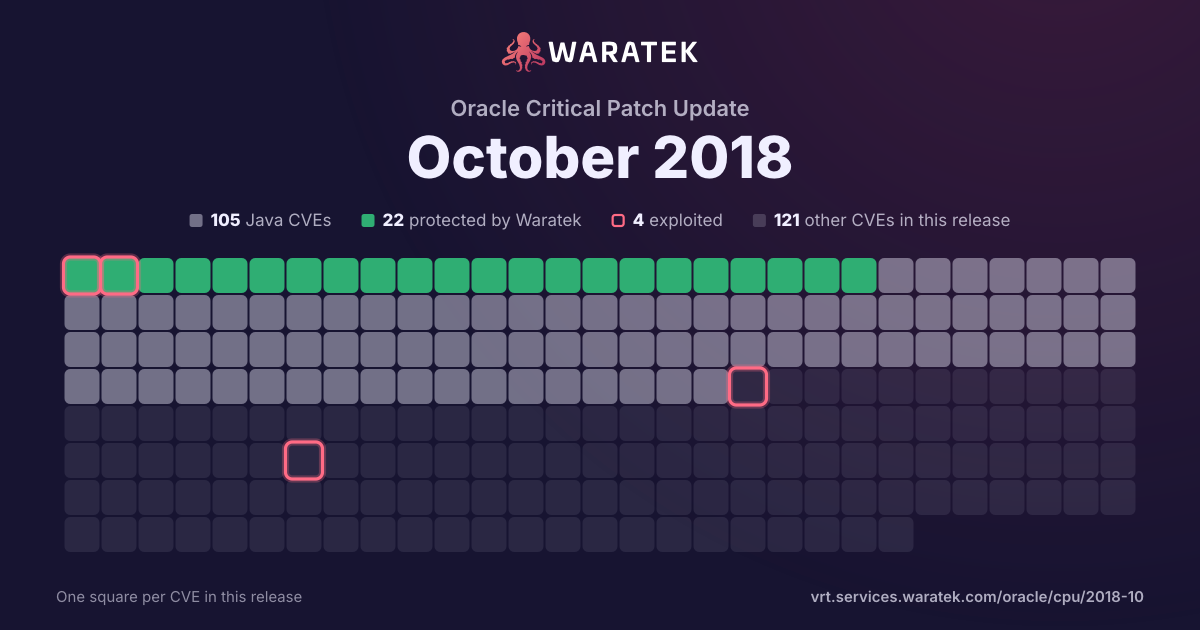
By status
22Protected by Waratek2Mitigation candidate81No exploit published46Outside Waratek scope75Not applicable
4Exploited, marked by the ring
No exploit published. For 81 of them, Oracle's security advisory is the source of public detail.
Protected by Waratek. Waratek RASP can block exploitation of these on systems that have not applied the patch yet.
Overview 8 matches · 2 in Waratek scope · 0 protected · 2 exploited · 0 CISA KEV · 4 EPSS ≥ 0.5
Protected by Waratek
0
0.0%
Rule in development
0
0.0%
Mitigation candidate
2
25.0%
No exploit published
0
0.0%
Outside Waratek scope
4
50.0%
Not applicable
2
25.0%
Withdrawn CVE
0
0.0%
blocked by ARMR today
0
0.0%
partly blocked
0
0.0%
not blocked
8
100.0%
not established
0
0.0%
unrecorded
0
0.0%
Exploited
2
25.0%
Working exploit published
5
62.5%
Proof of concept only
1
12.5%
Forecast only
0
0.0%
No public exploit
0
0.0%
split by
peak 3 / quarter
Q1 151
Outside Waratek scope1
High1
not blocked1
Working exploit published1
Q2 150
Q3 150
Q4 150
Q1 160
Q2 161
Not applicable1
Medium1
not blocked1
Working exploit published1
Q3 160
Q4 160
Q1 170
Q2 170
Q3 171
Not applicable1
High1
not blocked1
Exploited1
Q4 170
Q1 183
Outside Waratek scope3
Medium3
not blocked3
Exploited1
Working exploit published1
Proof of concept only1
Q2 180
Q3 180
Q4 182
Mitigation candidate2
Medium2
not blocked2
Working exploit published2
Q2 15Q4 15Q2 16Q4 16Q2 17Q4 17Q2 18Q4 18
| CVE | Severity | Published▾ | Status | Exploitation | Description |
|---|---|---|---|---|---|
| CVE-2018-3238 | Medium | 2018-10-17 | Mitigation candidate | Working exploit published | Vulnerability in the Oracle WebCenter Sites component of Oracle Fusion Middleware (subcomponent: Advanced UI). The supported version that is affected is 11.1.1.8.0. Easily exploitable vulnerability allows high privileged attacker with network access via HTTP to compromise Oracle WebCenter Sites. Successful attacks require human interaction from a person other than the attacker and while the vulnerability is in Oracle WebCenter Sites, attacks may significantly impact additional products. Successful attacks of this vulnerability can result in unauthorized access to critical data or complete access to all Oracle WebCenter Sites accessible data as well as unauthorized update, insert or delete access to some of Oracle WebCenter Sites accessible data. CVSS 3.0 Base Score 6.9 (Confidentiality and Integrity impacts). CVSS Vector: (CVSS:3.0/AV:N/AC:L/PR:H/UI:R/S:C/C:H/I:L/A:N). |
| CVE-2018-3167 | Medium | 2018-10-17 | Mitigation candidate | Working exploit published | Vulnerability in the Application Management Pack for Oracle E-Business Suite component of Oracle E-Business Suite (subcomponent: User Monitoring). Supported versions that are affected are 12.1.3, 12.2.3, 12.2.4, 12.2.5, 12.2.6 and 12.2.7. Easily exploitable vulnerability allows unauthenticated attacker with network access via HTTP to compromise Application Management Pack for Oracle E-Business Suite. Successful attacks of this vulnerability can result in unauthorized read access to a subset of Application Management Pack for Oracle E-Business Suite accessible data. CVSS 3.0 Base Score 5.3 (Confidentiality impacts). CVSS Vector: (CVSS:3.0/AV:N/AC:L/PR:N/UI:N/S:U/C:L/I:N/A:N). |
| CVE-2018-1305 | Medium | 2018-02-23 | Outside Waratek scope | Proof of concept only | Security constraints defined by annotations of Servlets in Apache Tomcat 9.0.0.M1 to 9.0.4, 8.5.0 to 8.5.27, 8.0.0.RC1 to 8.0.49 and 7.0.0 to 7.0.84 were only applied once a Servlet had been loaded. Because security constraints defined in this way apply to the URL pattern and any URLs below that point, it was possible - depending on the order Servlets were loaded - for some security constraints not to be applied. This could have exposed resources to users who were not authorised to access them. |
| CVE-2015-9251 | Medium | 2018-01-18 | Outside Waratek scope | Exploited | jQuery before 3.0.0 is vulnerable to Cross-site Scripting (XSS) attacks when a cross-domain Ajax request is performed without the dataType option, causing text/javascript responses to be executed. |
| CVE-2017-5715 | Medium | 2018-01-04 | Outside Waratek scope | Working exploit published | Systems with microprocessors utilizing speculative execution and indirect branch prediction may allow unauthorized disclosure of information to an attacker with local user access via a side-channel analysis. |
| CVE-2017-9798 | High | 2017-09-18 | Not applicable | Exploited | Apache httpd allows remote attackers to read secret data from process memory if the Limit directive can be set in a user's .htaccess file, or if httpd.conf has certain misconfigurations, aka Optionsbleed. This affects the Apache HTTP Server through 2.2.34 and 2.4.x through 2.4.27. The attacker sends an unauthenticated OPTIONS HTTP request when attempting to read secret data. This is a use-after-free issue and thus secret data is not always sent, and the specific data depends on many factors including configuration. Exploitation with .htaccess can be blocked with a patch to the ap_limit_section function in server/core.c. |
| CVE-2016-2107 | Medium | 2016-05-05 | Not applicable | Working exploit published | The AES-NI implementation in OpenSSL before 1.0.1t and 1.0.2 before 1.0.2h does not consider memory allocation during a certain padding check, which allows remote attackers to obtain sensitive cleartext information via a padding-oracle attack against an AES CBC session. NOTE: this vulnerability exists because of an incorrect fix for CVE-2013-0169. |
| CVE-2015-0235 | High | 2015-01-28 | Outside Waratek scope | Working exploit published | Heap-based buffer overflow in the __nss_hostname_digits_dots function in glibc 2.2, and other 2.x versions before 2.18, allows context-dependent attackers to execute arbitrary code via vectors related to the (1) gethostbyname or (2) gethostbyname2 function, aka "GHOST." |