
Oracle Critical Patch Update October 2018
Released October 2018 · Oracle's advisory ↗ · ← Critical Patch Update, July 2018 · Critical Patch Update, January 2019 →
226 CVEs in this release, one square each
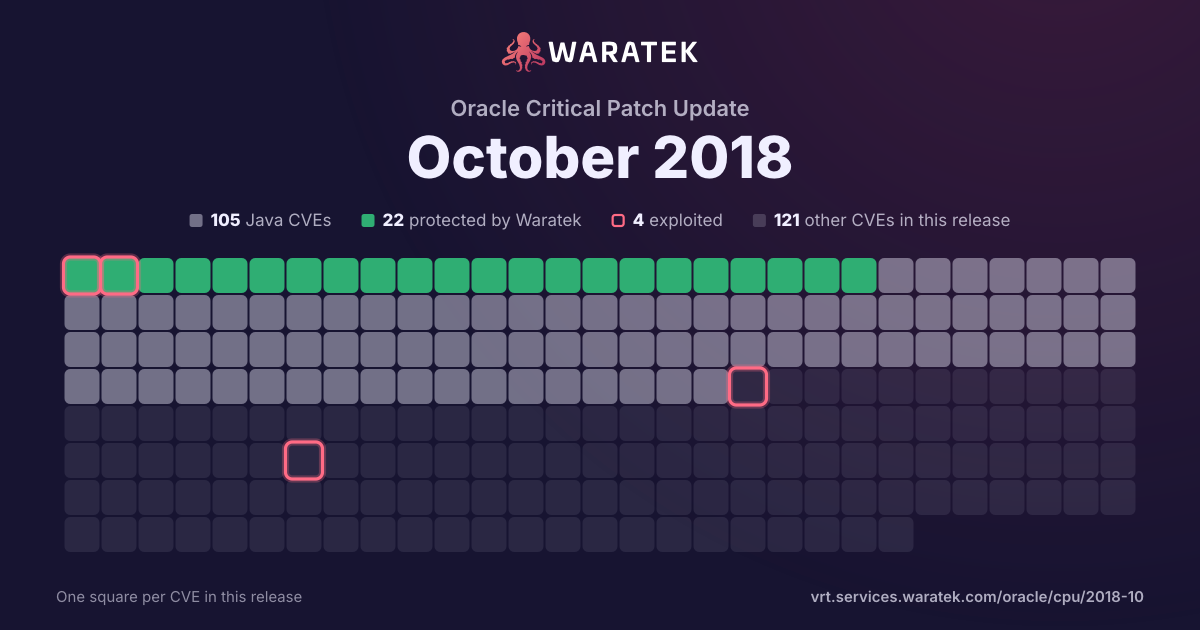
By status
22Protected by Waratek2Mitigation candidate81No exploit published46Outside Waratek scope75Not applicable
4Exploited, marked by the ring
No exploit published. For 81 of them, Oracle's security advisory is the source of public detail.
Protected by Waratek. Waratek RASP can block exploitation of these on systems that have not applied the patch yet.
Overview 110 matches · 55 in Waratek scope · 3 protected · 1 exploited · 0 CISA KEV · 6 public PoC · 2 EPSS ≥ 0.5
110matches
55in Waratek scope50.0%
3protected2.7%
1exploited0.9%
0CISA KEV0.0%
6public PoC5.5%
2EPSS ≥ 0.51.8%
Protected by Waratek
3
2.7%
Rule in development
0
0.0%
Mitigation candidate
2
1.8%
No exploit published
50
45.5%
Outside Waratek scope
34
30.9%
Not applicable
21
19.1%
Withdrawn CVE
0
0.0%
blocked by ARMR today
3
2.7%
partly blocked
0
0.0%
not blocked
107
97.3%
not established
0
0.0%
unrecorded
0
0.0%
split by
peak 100 / quarter
Q4 151
Not applicable1
Medium1
not blocked1
No public exploit1
Q1 160
Q2 161
Not applicable1
Medium1
not blocked1
Working exploit published1
Q3 160
Q4 160
Q1 170
Q2 170
Q3 171
Protected by Waratek1
Medium1
blocked by ARMR today1
No public exploit1
Q4 171
Not applicable1
Medium1
not blocked1
No public exploit1
Q1 184
Outside Waratek scope3
Not applicable1
Medium4
not blocked4
Exploited1
Working exploit published1
Proof of concept only1
No public exploit1
Q2 181
No exploit published1
Medium1
not blocked1
No public exploit1
Q3 181
Not applicable1
Medium1
not blocked1
No public exploit1
Q4 18100
Protected by Waratek2
Mitigation candidate2
No exploit published49
Outside Waratek scope31
Not applicable16
Medium100
blocked by ARMR today2
not blocked98
Working exploit published2
No public exploit98
Q4 15Q2 16Q4 16Q2 17Q4 17Q2 18Q4 18
| CVE | Severity | Published▾ | Status | Exploitation | Description |
|---|---|---|---|---|---|
| CVE-2018-13785 | Medium | 2018-07-09 | Not applicable | No public exploit | In libpng 1.6.34, a wrong calculation of row_factor in the png_check_chunk_length function (pngrutil.c) may trigger an integer overflow and resultant divide-by-zero while processing a crafted PNG file, leading to a denial of service. |
| CVE-2018-11039 | Medium | 2018-06-25 | No exploit published | No public exploit | Spring Framework (versions 5.0.x prior to 5.0.7, versions 4.3.x prior to 4.3.18, and older unsupported versions) allow web applications to change the HTTP request method to any HTTP method (including TRACE) using the HiddenHttpMethodFilter in Spring MVC. If an application has a pre-existing XSS vulnerability, a malicious user (or attacker) can use this filter to escalate to an XST (Cross Site Tracing) attack. |
| CVE-2018-0739 | Medium | 2018-03-27 | Not applicable | No public exploit | Constructed ASN.1 types with a recursive definition (such as can be found in PKCS7) could eventually exceed the stack given malicious input with excessive recursion. This could result in a Denial Of Service attack. There are no such structures used within SSL/TLS that come from untrusted sources so this is considered safe. Fixed in OpenSSL 1.1.0h (Affected 1.1.0-1.1.0g). Fixed in OpenSSL 1.0.2o (Affected 1.0.2b-1.0.2n). |
| CVE-2018-1305 | Medium | 2018-02-23 | Outside Waratek scope | Proof of concept only | Security constraints defined by annotations of Servlets in Apache Tomcat 9.0.0.M1 to 9.0.4, 8.5.0 to 8.5.27, 8.0.0.RC1 to 8.0.49 and 7.0.0 to 7.0.84 were only applied once a Servlet had been loaded. Because security constraints defined in this way apply to the URL pattern and any URLs below that point, it was possible - depending on the order Servlets were loaded - for some security constraints not to be applied. This could have exposed resources to users who were not authorised to access them. |
| CVE-2015-9251 | Medium | 2018-01-18 | Outside Waratek scope | Exploited | jQuery before 3.0.0 is vulnerable to Cross-site Scripting (XSS) attacks when a cross-domain Ajax request is performed without the dataType option, causing text/javascript responses to be executed. |
| CVE-2017-5715 | Medium | 2018-01-04 | Outside Waratek scope | Working exploit published | Systems with microprocessors utilizing speculative execution and indirect branch prediction may allow unauthorized disclosure of information to an attacker with local user access via a side-channel analysis. |
| CVE-2017-3736 | Medium | 2017-11-02 | Not applicable | No public exploit | There is a carry propagating bug in the x86_64 Montgomery squaring procedure in OpenSSL before 1.0.2m and 1.1.0 before 1.1.0g. No EC algorithms are affected. Analysis suggests that attacks against RSA and DSA as a result of this defect would be very difficult to perform and are not believed likely. Attacks against DH are considered just feasible (although very difficult) because most of the work necessary to deduce information about a private key may be performed offline. The amount of resources required for such an attack would be very significant and likely only accessible to a limited number of attackers. An attacker would additionally need online access to an unpatched system using the target private key in a scenario with persistent DH parameters and a private key that is shared between multiple clients. This only affects processors that support the BMI1, BMI2 and ADX extensions like Intel Broadwell (5th generation) and later or AMD Ryzen. |
| CVE-2017-14735 | Medium | 2017-09-25 | Protected by Waratek | No public exploit | OWASP AntiSamy before 1.5.7 allows XSS via HTML5 entities, as demonstrated by use of : to construct a javascript: URL. |
| CVE-2016-2107 | Medium | 2016-05-05 | Not applicable | Working exploit published | The AES-NI implementation in OpenSSL before 1.0.1t and 1.0.2 before 1.0.2h does not consider memory allocation during a certain padding check, which allows remote attackers to obtain sensitive cleartext information via a padding-oracle attack against an AES CBC session. NOTE: this vulnerability exists because of an incorrect fix for CVE-2013-0169. |
| CVE-2015-6937 | Medium | 2015-10-19 | Not applicable | No public exploit | The __rds_conn_create function in net/rds/connection.c in the Linux kernel through 4.2.3 allows local users to cause a denial of service (NULL pointer dereference and system crash) or possibly have unspecified other impact by using a socket that was not properly bound. |