
Oracle Critical Patch Update July 2018
Released July 2018 · Oracle's advisory ↗ · ← Critical Patch Update, April 2018 · Critical Patch Update, October 2018 →
247 CVEs in this release, one square each
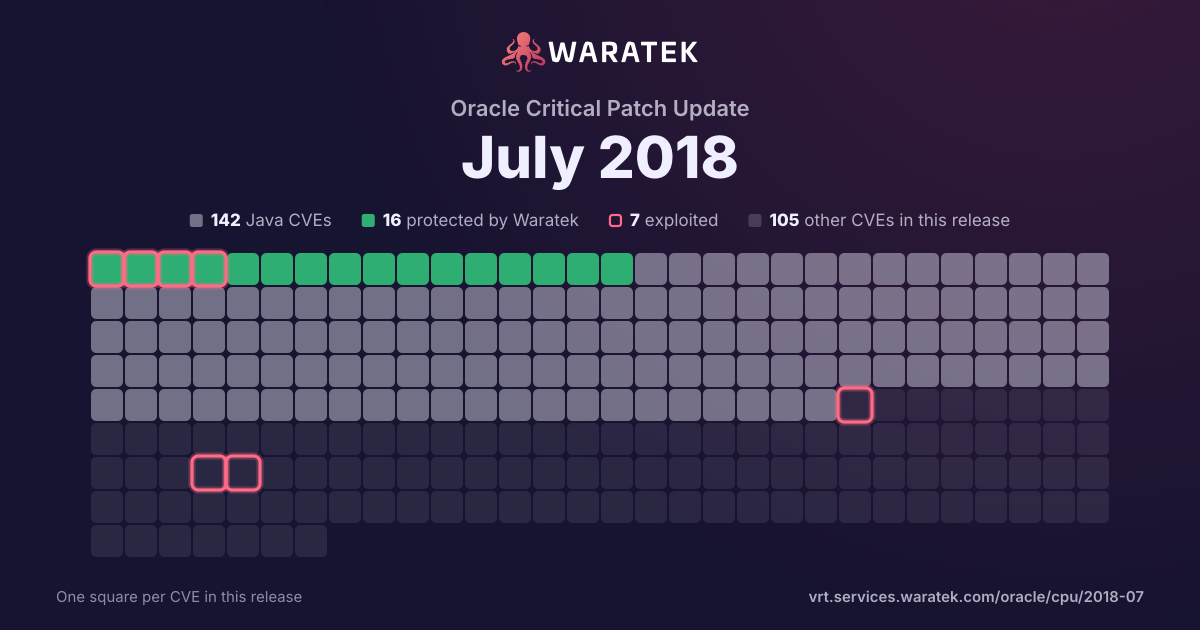
By status
16Protected by Waratek126No exploit published41Outside Waratek scope64Not applicable
7Exploited, marked by the ring
No exploit published. For 125 of them, Oracle's security advisory is the source of public detail.
Protected by Waratek. Waratek RASP can block exploitation of these on systems that have not applied the patch yet.
Overview 135 matches · 93 in Waratek scope · 1 protected · 1 exploited · 0 CISA KEV · 4 public PoC · 2 EPSS ≥ 0.5
135matches
93in Waratek scope68.9%
1protected0.7%
1exploited0.7%
0CISA KEV0.0%
4public PoC3.0%
2EPSS ≥ 0.51.5%
Protected by Waratek
1
0.7%
Rule in development
0
0.0%
Mitigation candidate
0
0.0%
No exploit published
92
68.1%
Outside Waratek scope
27
20.0%
Not applicable
15
11.1%
Withdrawn CVE
0
0.0%
blocked by ARMR today
1
0.7%
partly blocked
0
0.0%
not blocked
134
99.3%
not established
0
0.0%
unrecorded
0
0.0%
split by
peak 126 / year
20111
No exploit published1
Medium1
not blocked1
No public exploit1
20120
20130
20141
Protected by Waratek1
Medium1
blocked by ARMR today1
No public exploit1
20152
Outside Waratek scope1
Not applicable1
Medium2
not blocked2
Exploited1
No public exploit1
20160
20175
Outside Waratek scope2
Not applicable3
Medium5
not blocked5
Working exploit published1
No public exploit4
2018126
No exploit published91
Outside Waratek scope24
Not applicable11
Medium126
not blocked126
Working exploit published1
Proof of concept only1
No public exploit124
20112012201320142015201620172018
| CVE | Severity | Published▾ | Status | Exploitation | Description |
|---|---|---|---|---|---|
| CVE-2018-2940 | Medium | 2018-07-18 | Outside Waratek scope | No public exploit | Vulnerability in the Java SE, Java SE Embedded component of Oracle Java SE (subcomponent: Libraries). Supported versions that are affected are Java SE: 6u191, 7u181, 8u172 and 10.0.1; Java SE Embedded: 8u171. Easily exploitable vulnerability allows unauthenticated attacker with network access via multiple protocols to compromise Java SE, Java SE Embedded. Successful attacks require human interaction from a person other than the attacker. Successful attacks of this vulnerability can result in unauthorized read access to a subset of Java SE, Java SE Embedded accessible data. Note: This vulnerability applies to Java deployments, typically in clients running sandboxed Java Web Start applications or sandboxed Java applets, that load and run untrusted code (e.g., code that comes from the internet) and rely on the Java sandbox for security. This vulnerability does not apply to Java deployments, typically in servers, that load and run only trusted code (e.g., code installed by an administrator). CVSS 3.0 Base Score 4.3 (Confidentiality impacts). CVSS Vector: (CVSS:3.0/AV:N/AC:L/PR:N/UI:R/S:U/C:L/I:N/A:N). |
| CVE-2018-2937 | Medium | 2018-07-18 | Not applicable | No public exploit | Vulnerability in the Sun ZFS Storage Appliance Kit (AK) component of Oracle Sun Systems Products Suite (subcomponent: User Interface). The supported version that is affected is Prior to 8.7.19. Easily exploitable vulnerability allows unauthenticated attacker with network access via HTTP to compromise Sun ZFS Storage Appliance Kit (AK). Successful attacks of this vulnerability can result in unauthorized update, insert or delete access to some of Sun ZFS Storage Appliance Kit (AK) accessible data. CVSS 3.0 Base Score 5.3 (Integrity impacts). CVSS Vector: (CVSS:3.0/AV:N/AC:L/PR:N/UI:N/S:U/C:N/I:L/A:N). |
| CVE-2018-2936 | Medium | 2018-07-18 | No exploit published | No public exploit | Vulnerability in the Oracle Communications Messaging Server component of Oracle Communications Applications (subcomponent: Web Client). The supported version that is affected is 3.x. Easily exploitable vulnerability allows unauthenticated attacker with network access via HTTP to compromise Oracle Communications Messaging Server. Successful attacks require human interaction from a person other than the attacker and while the vulnerability is in Oracle Communications Messaging Server, attacks may significantly impact additional products. Successful attacks of this vulnerability can result in unauthorized update, insert or delete access to some of Oracle Communications Messaging Server accessible data as well as unauthorized read access to a subset of Oracle Communications Messaging Server accessible data. CVSS 3.0 Base Score 6.1 (Confidentiality and Integrity impacts). CVSS Vector: (CVSS:3.0/AV:N/AC:L/PR:N/UI:R/S:C/C:L/I:L/A:N). |
| CVE-2018-2934 | Medium | 2018-07-18 | No exploit published | No public exploit | Vulnerability in the Oracle Application Object Library component of Oracle E-Business Suite (subcomponent: Attachments / File Upload). The supported version that is affected is 12.1.3. Easily exploitable vulnerability allows unauthenticated attacker with network access via HTTP to compromise Oracle Application Object Library. Successful attacks of this vulnerability can result in unauthorized update, insert or delete access to some of Oracle Application Object Library accessible data. CVSS 3.0 Base Score 5.3 (Integrity impacts). CVSS Vector: (CVSS:3.0/AV:N/AC:L/PR:N/UI:N/S:U/C:N/I:L/A:N). |
| CVE-2018-2929 | Medium | 2018-07-18 | No exploit published | No public exploit | Vulnerability in the PeopleSoft Enterprise PeopleTools component of Oracle PeopleSoft Products (subcomponent: PIA Core Technology). Supported versions that are affected are 8.55 and 8.56. Easily exploitable vulnerability allows unauthenticated attacker with network access via HTTP to compromise PeopleSoft Enterprise PeopleTools. Successful attacks require human interaction from a person other than the attacker and while the vulnerability is in PeopleSoft Enterprise PeopleTools, attacks may significantly impact additional products. Successful attacks of this vulnerability can result in unauthorized update, insert or delete access to some of PeopleSoft Enterprise PeopleTools accessible data as well as unauthorized read access to a subset of PeopleSoft Enterprise PeopleTools accessible data. CVSS 3.0 Base Score 6.1 (Confidentiality and Integrity impacts). CVSS Vector: (CVSS:3.0/AV:N/AC:L/PR:N/UI:R/S:C/C:L/I:L/A:N). |
| CVE-2018-2927 | Medium | 2018-07-18 | Not applicable | No public exploit | Vulnerability in the Sun ZFS Storage Appliance Kit (AK) component of Oracle Sun Systems Products Suite (subcomponent: HTTP data path subsystems). The supported version that is affected is Prior to 8.7.18. Easily exploitable vulnerability allows low privileged attacker with network access via HTTP to compromise Sun ZFS Storage Appliance Kit (AK). Successful attacks of this vulnerability can result in unauthorized read access to a subset of Sun ZFS Storage Appliance Kit (AK) accessible data. CVSS 3.0 Base Score 4.3 (Confidentiality impacts). CVSS Vector: (CVSS:3.0/AV:N/AC:L/PR:L/UI:N/S:U/C:L/I:N/A:N). |
| CVE-2018-2925 | Medium | 2018-07-18 | No exploit published | No public exploit | Vulnerability in the BI Publisher component of Oracle Fusion Middleware (subcomponent: Web Server). Supported versions that are affected are 11.1.1.7.0, 11.1.1.9.0, 12.2.1.2.0 and 12.2.1.3.0. Easily exploitable vulnerability allows low privileged attacker with network access via HTTP to compromise BI Publisher. Successful attacks of this vulnerability can result in unauthorized access to critical data or complete access to all BI Publisher accessible data. CVSS 3.0 Base Score 6.5 (Confidentiality impacts). CVSS Vector: (CVSS:3.0/AV:N/AC:L/PR:L/UI:N/S:U/C:H/I:N/A:N). |
| CVE-2018-2924 | Medium | 2018-07-18 | Not applicable | No public exploit | Vulnerability in the Sun ZFS Storage Appliance Kit (AK) component of Oracle Sun Systems Products Suite (subcomponent: API frameworks). The supported version that is affected is Prior to 8.7.18. Easily exploitable vulnerability allows high privileged attacker with logon to the infrastructure where Sun ZFS Storage Appliance Kit (AK) executes to compromise Sun ZFS Storage Appliance Kit (AK). While the vulnerability is in Sun ZFS Storage Appliance Kit (AK), attacks may significantly impact additional products. Successful attacks of this vulnerability can result in unauthorized update, insert or delete access to some of Sun ZFS Storage Appliance Kit (AK) accessible data as well as unauthorized read access to a subset of Sun ZFS Storage Appliance Kit (AK) accessible data and unauthorized ability to cause a partial denial of service (partial DOS) of Sun ZFS Storage Appliance Kit (AK). CVSS 3.0 Base Score 5.7 (Confidentiality, Integrity and Availability impacts). CVSS Vector: (CVSS:3.0/AV:L/AC:L/PR:H/UI:N/S:C/C:L/I:L/A:L). |
| CVE-2018-2921 | Medium | 2018-07-18 | Not applicable | No public exploit | Vulnerability in the Sun ZFS Storage Appliance Kit (AK) component of Oracle Sun Systems Products Suite (subcomponent: User Interface). The supported version that is affected is Prior to 8.7.18. Easily exploitable vulnerability allows unauthenticated attacker with network access via HTTP to compromise Sun ZFS Storage Appliance Kit (AK). While the vulnerability is in Sun ZFS Storage Appliance Kit (AK), attacks may significantly impact additional products. Successful attacks of this vulnerability can result in unauthorized read access to a subset of Sun ZFS Storage Appliance Kit (AK) accessible data. CVSS 3.0 Base Score 5.8 (Confidentiality impacts). CVSS Vector: (CVSS:3.0/AV:N/AC:L/PR:N/UI:N/S:C/C:L/I:N/A:N). |
| CVE-2018-2919 | Medium | 2018-07-18 | No exploit published | No public exploit | Vulnerability in the PeopleSoft Enterprise PeopleTools component of Oracle PeopleSoft Products (subcomponent: Unified Navigation). Supported versions that are affected are 8.55 and 8.56. Easily exploitable vulnerability allows unauthenticated attacker with network access via HTTP to compromise PeopleSoft Enterprise PeopleTools. Successful attacks require human interaction from a person other than the attacker and while the vulnerability is in PeopleSoft Enterprise PeopleTools, attacks may significantly impact additional products. Successful attacks of this vulnerability can result in unauthorized update, insert or delete access to some of PeopleSoft Enterprise PeopleTools accessible data as well as unauthorized read access to a subset of PeopleSoft Enterprise PeopleTools accessible data. CVSS 3.0 Base Score 6.1 (Confidentiality and Integrity impacts). CVSS Vector: (CVSS:3.0/AV:N/AC:L/PR:N/UI:R/S:C/C:L/I:L/A:N). |
| CVE-2018-2917 | Medium | 2018-07-18 | Not applicable | No public exploit | Vulnerability in the Sun ZFS Storage Appliance Kit (AK) component of Oracle Sun Systems Products Suite (subcomponent: API frameworks). The supported version that is affected is Prior to 8.7.18. Easily exploitable vulnerability allows unauthenticated attacker with network access via multiple protocols to compromise Sun ZFS Storage Appliance Kit (AK). Successful attacks of this vulnerability can result in unauthorized ability to cause a partial denial of service (partial DOS) of Sun ZFS Storage Appliance Kit (AK). CVSS 3.0 Base Score 5.3 (Availability impacts). CVSS Vector: (CVSS:3.0/AV:N/AC:L/PR:N/UI:N/S:U/C:N/I:N/A:L). |
| CVE-2018-2915 | Medium | 2018-07-18 | No exploit published | No public exploit | Vulnerability in the Hyperion Data Relationship Management component of Oracle Hyperion (subcomponent: Access and security). The supported version that is affected is 11.1.2.4.330. Easily exploitable vulnerability allows unauthenticated attacker with network access via HTTPS to compromise Hyperion Data Relationship Management. While the vulnerability is in Hyperion Data Relationship Management, attacks may significantly impact additional products. Successful attacks of this vulnerability can result in unauthorized read access to a subset of Hyperion Data Relationship Management accessible data. CVSS 3.0 Base Score 5.8 (Confidentiality impacts). CVSS Vector: (CVSS:3.0/AV:N/AC:L/PR:N/UI:N/S:C/C:L/I:N/A:N). |
| CVE-2018-2905 | Medium | 2018-07-18 | Not applicable | No public exploit | Vulnerability in the Sun ZFS Storage Appliance Kit (AK) component of Oracle Sun Systems Products Suite (subcomponent: Core Services). The supported version that is affected is Prior to 8.7.20. Easily exploitable vulnerability allows unauthenticated attacker with network access via SSL/TLS to compromise Sun ZFS Storage Appliance Kit (AK). Successful attacks of this vulnerability can result in unauthorized read access to a subset of Sun ZFS Storage Appliance Kit (AK) accessible data. CVSS 3.0 Base Score 5.3 (Confidentiality impacts). CVSS Vector: (CVSS:3.0/AV:N/AC:L/PR:N/UI:N/S:U/C:L/I:N/A:N). |
| CVE-2018-2904 | Medium | 2018-07-18 | No exploit published | No public exploit | Vulnerability in the Oracle Communications EAGLE LNP Application Processor component of Oracle Communications Applications (subcomponent: GUI). The supported version that is affected is 10.x. Easily exploitable vulnerability allows unauthenticated attacker with network access via HTTP to compromise Oracle Communications EAGLE LNP Application Processor. Successful attacks of this vulnerability can result in unauthorized update, insert or delete access to some of Oracle Communications EAGLE LNP Application Processor accessible data as well as unauthorized read access to a subset of Oracle Communications EAGLE LNP Application Processor accessible data. CVSS 3.0 Base Score 6.5 (Confidentiality and Integrity impacts). CVSS Vector: (CVSS:3.0/AV:N/AC:L/PR:N/UI:N/S:U/C:L/I:L/A:N). |
| CVE-2018-2903 | Medium | 2018-07-18 | Not applicable | No public exploit | Vulnerability in the Solaris component of Oracle Sun Systems Products Suite (subcomponent: Kernel). Supported versions that are affected are 10 and 11.3. Easily exploitable vulnerability allows high privileged attacker with logon to the infrastructure where Solaris executes to compromise Solaris. Successful attacks of this vulnerability can result in unauthorized access to critical data or complete access to all Solaris accessible data. CVSS 3.0 Base Score 4.4 (Confidentiality impacts). CVSS Vector: (CVSS:3.0/AV:L/AC:L/PR:H/UI:N/S:U/C:H/I:N/A:N). |
| CVE-2018-2899 | Medium | 2018-07-18 | No exploit published | No public exploit | Vulnerability in the Oracle FLEXCUBE Universal Banking component of Oracle Financial Services Applications (subcomponent: Infrastructure). Supported versions that are affected are 11.3.0, 11.4.0, 12.0.1, 12.0.2, 12.0.3, 12.1.0, 12.2.0, 12.3.0, 12.4.0, 14.0.0 and 14.1.0. Easily exploitable vulnerability allows unauthenticated attacker with network access via HTTP to compromise Oracle FLEXCUBE Universal Banking. Successful attacks require human interaction from a person other than the attacker and while the vulnerability is in Oracle FLEXCUBE Universal Banking, attacks may significantly impact additional products. Successful attacks of this vulnerability can result in unauthorized update, insert or delete access to some of Oracle FLEXCUBE Universal Banking accessible data as well as unauthorized read access to a subset of Oracle FLEXCUBE Universal Banking accessible data. CVSS 3.0 Base Score 6.1 (Confidentiality and Integrity impacts). CVSS Vector: (CVSS:3.0/AV:N/AC:L/PR:N/UI:R/S:C/C:L/I:L/A:N). |
| CVE-2018-2898 | Medium | 2018-07-18 | No exploit published | No public exploit | Vulnerability in the Oracle FLEXCUBE Investor Servicing component of Oracle Financial Services Applications (subcomponent: Infrastructure). Supported versions that are affected are 12.0.4, 12.1.0, 12.3.0 and 12.4.0. Easily exploitable vulnerability allows unauthenticated attacker with network access via HTTP to compromise Oracle FLEXCUBE Investor Servicing. Successful attacks require human interaction from a person other than the attacker and while the vulnerability is in Oracle FLEXCUBE Investor Servicing, attacks may significantly impact additional products. Successful attacks of this vulnerability can result in unauthorized update, insert or delete access to some of Oracle FLEXCUBE Investor Servicing accessible data as well as unauthorized read access to a subset of Oracle FLEXCUBE Investor Servicing accessible data. CVSS 3.0 Base Score 6.1 (Confidentiality and Integrity impacts). CVSS Vector: (CVSS:3.0/AV:N/AC:L/PR:N/UI:R/S:C/C:L/I:L/A:N). |
| CVE-2018-2897 | Medium | 2018-07-18 | No exploit published | No public exploit | Vulnerability in the Oracle FLEXCUBE Enterprise Limits and Collateral Management component of Oracle Financial Services Applications (subcomponent: Infrastructure). Supported versions that are affected are 12.3.0, 14.0.0 and 14.1.0. Easily exploitable vulnerability allows unauthenticated attacker with network access via HTTP to compromise Oracle FLEXCUBE Enterprise Limits and Collateral Management. Successful attacks require human interaction from a person other than the attacker and while the vulnerability is in Oracle FLEXCUBE Enterprise Limits and Collateral Management, attacks may significantly impact additional products. Successful attacks of this vulnerability can result in unauthorized update, insert or delete access to some of Oracle FLEXCUBE Enterprise Limits and Collateral Management accessible data as well as unauthorized read access to a subset of Oracle FLEXCUBE Enterprise Limits and Collateral Management accessible data. CVSS 3.0 Base Score 6.1 (Confidentiality and Integrity impacts). CVSS Vector: (CVSS:3.0/AV:N/AC:L/PR:N/UI:R/S:C/C:L/I:L/A:N). |
| CVE-2018-2896 | Medium | 2018-07-18 | No exploit published | No public exploit | Vulnerability in the Oracle Banking Payments component of Oracle Financial Services Applications (subcomponent: Payments Core). Supported versions that are affected are 12.2.0, 12.3.0, 12.4.0, 12.5.0 and 14.1.0. Easily exploitable vulnerability allows unauthenticated attacker with network access via HTTP to compromise Oracle Banking Payments. Successful attacks require human interaction from a person other than the attacker and while the vulnerability is in Oracle Banking Payments, attacks may significantly impact additional products. Successful attacks of this vulnerability can result in unauthorized update, insert or delete access to some of Oracle Banking Payments accessible data as well as unauthorized read access to a subset of Oracle Banking Payments accessible data. CVSS 3.0 Base Score 6.1 (Confidentiality and Integrity impacts). CVSS Vector: (CVSS:3.0/AV:N/AC:L/PR:N/UI:R/S:C/C:L/I:L/A:N). |
| CVE-2018-2895 | Medium | 2018-07-18 | No exploit published | No public exploit | Vulnerability in the Oracle Banking Corporate Lending component of Oracle Financial Services Applications (subcomponent: Core module). Supported versions that are affected are 12.3.0, 12.4.0, 12.5.0, 14.0.0 and 14.1.0. Easily exploitable vulnerability allows unauthenticated attacker with network access via HTTP to compromise Oracle Banking Corporate Lending. Successful attacks require human interaction from a person other than the attacker and while the vulnerability is in Oracle Banking Corporate Lending, attacks may significantly impact additional products. Successful attacks of this vulnerability can result in unauthorized update, insert or delete access to some of Oracle Banking Corporate Lending accessible data as well as unauthorized read access to a subset of Oracle Banking Corporate Lending accessible data. CVSS 3.0 Base Score 6.1 (Confidentiality and Integrity impacts). CVSS Vector: (CVSS:3.0/AV:N/AC:L/PR:N/UI:R/S:C/C:L/I:L/A:N). |
| CVE-2018-2891 | Medium | 2018-07-18 | No exploit published | No public exploit | Vulnerability in the Oracle Retail Bulk Data Integration component of Oracle Retail Applications (subcomponent: BDI Job Scheduler). The supported version that is affected is 16.0. Easily exploitable vulnerability allows unauthenticated attacker with network access via HTTP to compromise Oracle Retail Bulk Data Integration. Successful attacks require human interaction from a person other than the attacker and while the vulnerability is in Oracle Retail Bulk Data Integration, attacks may significantly impact additional products. Successful attacks of this vulnerability can result in unauthorized update, insert or delete access to some of Oracle Retail Bulk Data Integration accessible data as well as unauthorized read access to a subset of Oracle Retail Bulk Data Integration accessible data. CVSS 3.0 Base Score 6.1 (Confidentiality and Integrity impacts). CVSS Vector: (CVSS:3.0/AV:N/AC:L/PR:N/UI:R/S:C/C:L/I:L/A:N). |
| CVE-2018-2888 | Medium | 2018-07-18 | No exploit published | No public exploit | Vulnerability in the MICROS Retail-J component of Oracle Retail Applications (subcomponent: Back Office). Supported versions that are affected are 10.2.x, 11.0.x, 12.0.x, 12.1.x, 12.1.1.x,12.1.2.x and 13.1.x. Difficult to exploit vulnerability allows physical access to compromise MICROS Retail-J. Successful attacks require human interaction from a person other than the attacker and while the vulnerability is in MICROS Retail-J, attacks may significantly impact additional products. Successful attacks of this vulnerability can result in unauthorized creation, deletion or modification access to critical data or all MICROS Retail-J accessible data as well as unauthorized access to critical data or complete access to all MICROS Retail-J accessible data and unauthorized ability to cause a partial denial of service (partial DOS) of MICROS Retail-J. CVSS 3.0 Base Score 6.7 (Confidentiality, Integrity and Availability impacts). CVSS Vector: (CVSS:3.0/AV:P/AC:H/PR:H/UI:R/S:C/C:H/I:H/A:L). |
| CVE-2018-2881 | Medium | 2018-07-18 | No exploit published | No public exploit | Vulnerability in the MICROS Retail-J component of Oracle Retail Applications (subcomponent: Database). Supported versions that are affected are 11.0.x, 12.0.x, 12.1.x, 12.1.1.x, 12.1.2.x and 13.1.x. Easily exploitable vulnerability allows low privileged attacker with network access via HTTP to compromise MICROS Retail-J. Successful attacks of this vulnerability can result in unauthorized update, insert or delete access to some of MICROS Retail-J accessible data as well as unauthorized read access to a subset of MICROS Retail-J accessible data and unauthorized ability to cause a partial denial of service (partial DOS) of MICROS Retail-J. CVSS 3.0 Base Score 6.3 (Confidentiality, Integrity and Availability impacts). CVSS Vector: (CVSS:3.0/AV:N/AC:L/PR:L/UI:N/S:U/C:L/I:L/A:L). |
| CVE-2018-0739 | Medium | 2018-03-27 | Not applicable | No public exploit | Constructed ASN.1 types with a recursive definition (such as can be found in PKCS7) could eventually exceed the stack given malicious input with excessive recursion. This could result in a Denial Of Service attack. There are no such structures used within SSL/TLS that come from untrusted sources so this is considered safe. Fixed in OpenSSL 1.1.0h (Affected 1.1.0-1.1.0g). Fixed in OpenSSL 1.0.2o (Affected 1.0.2b-1.0.2n). |
| CVE-2018-1305 | Medium | 2018-02-23 | Outside Waratek scope | Proof of concept only | Security constraints defined by annotations of Servlets in Apache Tomcat 9.0.0.M1 to 9.0.4, 8.5.0 to 8.5.27, 8.0.0.RC1 to 8.0.49 and 7.0.0 to 7.0.84 were only applied once a Servlet had been loaded. Because security constraints defined in this way apply to the URL pattern and any URLs below that point, it was possible - depending on the order Servlets were loaded - for some security constraints not to be applied. This could have exposed resources to users who were not authorised to access them. |
| CVE-2017-5715 | Medium | 2018-01-04 | Outside Waratek scope | Working exploit published | Systems with microprocessors utilizing speculative execution and indirect branch prediction may allow unauthorized disclosure of information to an attacker with local user access via a side-channel analysis. |
| CVE-2017-3736 | Medium | 2017-11-02 | Not applicable | No public exploit | There is a carry propagating bug in the x86_64 Montgomery squaring procedure in OpenSSL before 1.0.2m and 1.1.0 before 1.1.0g. No EC algorithms are affected. Analysis suggests that attacks against RSA and DSA as a result of this defect would be very difficult to perform and are not believed likely. Attacks against DH are considered just feasible (although very difficult) because most of the work necessary to deduce information about a private key may be performed offline. The amount of resources required for such an attack would be very significant and likely only accessible to a limited number of attackers. An attacker would additionally need online access to an unpatched system using the target private key in a scenario with persistent DH parameters and a private key that is shared between multiple clients. This only affects processors that support the BMI1, BMI2 and ADX extensions like Intel Broadwell (5th generation) and later or AMD Ryzen. |
| CVE-2017-0785 | Medium | 2017-09-14 | Not applicable | Working exploit published | A information disclosure vulnerability in the Android system (bluetooth). Product: Android. Versions: 4.4.4, 5.0.2, 5.1.1, 6.0, 6.0.1, 7.0, 7.1.1, 7.1.2, 8.0. Android ID: A-63146698. |
| CVE-2017-3633 | Medium | 2017-08-08 | Outside Waratek scope | No public exploit | Vulnerability in the MySQL Server component of Oracle MySQL (subcomponent: Server: Memcached). Supported versions that are affected are 5.6.36 and earlier and 5.7.18 and earlier. Difficult to exploit vulnerability allows unauthenticated attacker with network access via Memcached to compromise MySQL Server. Successful attacks of this vulnerability can result in unauthorized ability to cause a hang or frequently repeatable crash (complete DOS) of MySQL Server as well as unauthorized update, insert or delete access to some of MySQL Server accessible data. CVSS 3.0 Base Score 6.5 (Integrity and Availability impacts). CVSS Vector: (CVSS:3.0/AV:N/AC:H/PR:N/UI:N/S:U/C:N/I:L/A:H). |
| CVE-2016-7103 | Medium | 2017-03-15 | Outside Waratek scope | No public exploit | Cross-site scripting (XSS) vulnerability in jQuery UI before 1.12.0 might allow remote attackers to inject arbitrary web script or HTML via the closeText parameter of the dialog function. |
| CVE-2016-4055 | Medium | 2017-01-23 | Not applicable | No public exploit | The duration function in the moment package before 2.11.2 for Node.js allows remote attackers to cause a denial of service (CPU consumption) via a long string, aka a "regular expression Denial of Service (ReDoS)." |
| CVE-2015-7940 | Medium | 2015-11-09 | Outside Waratek scope | No public exploit | The Bouncy Castle Java library before 1.51 does not validate a point is withing the elliptic curve, which makes it easier for remote attackers to obtain private keys via a series of crafted elliptic curve Diffie Hellman (ECDH) key exchanges, aka an "invalid curve attack." |
| CVE-2015-0204 | Medium | 2015-01-09 | Not applicable | Exploited | The ssl3_get_key_exchange function in s3_clnt.c in OpenSSL before 0.9.8zd, 1.0.0 before 1.0.0p, and 1.0.1 before 1.0.1k allows remote SSL servers to conduct RSA-to-EXPORT_RSA downgrade attacks and facilitate brute-force decryption by offering a weak ephemeral RSA key in a noncompliant role, related to the "FREAK" issue. NOTE: the scope of this CVE is only client code based on OpenSSL, not EXPORT_RSA issues associated with servers or other TLS implementations. |
| CVE-2014-3577 | Medium | 2014-08-21 | Protected by Waratek | No public exploit | org.apache.http.conn.ssl.AbstractVerifier in Apache HttpComponents HttpClient before 4.3.5 and HttpAsyncClient before 4.0.2 does not properly verify that the server hostname matches a domain name in the subject's Common Name (CN) or subjectAltName field of the X.509 certificate, which allows man-in-the-middle attackers to spoof SSL servers via a "CN=" string in a field in the distinguished name (DN) of a certificate, as demonstrated by the "foo,CN=www.apache.org" string in the O field. |
| CVE-2011-4461 | Medium | 2011-12-30 | No exploit published | No public exploit | Jetty 8.1.0.RC2 and earlier computes hash values for form parameters without restricting the ability to trigger hash collisions predictably, which allows remote attackers to cause a denial of service (CPU consumption) by sending many crafted parameters. |