
Oracle Critical Patch Update April 2018
Released April 2018 · Oracle's advisory ↗ · ← Critical Patch Update, January 2018 · Critical Patch Update, July 2018 →
165 CVEs in this release, one square each
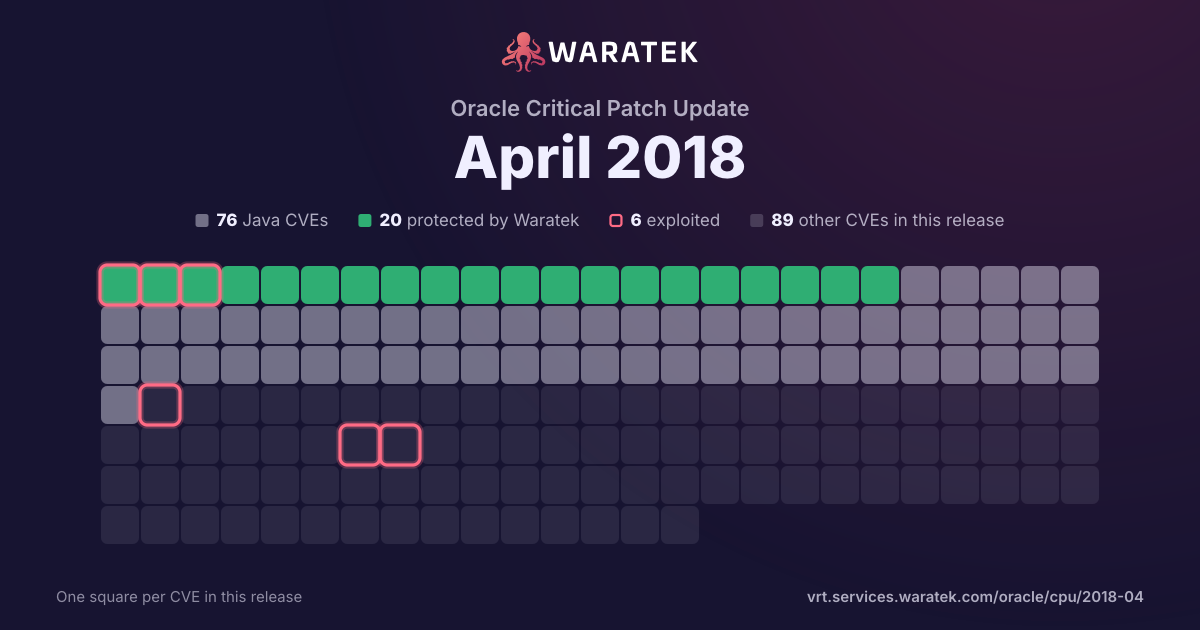
By status
20Protected by Waratek2Mitigation candidate54No exploit published30Outside Waratek scope59Not applicable
6Exploited, marked by the ring
No exploit published. For 52 of them, Oracle's security advisory is the source of public detail.
Protected by Waratek. Waratek RASP can block exploitation of these on systems that have not applied the patch yet.
Overview 3 matches · 0 in Waratek scope · 0 protected · 0 exploited · 0 CISA KEV · 0 public PoC · 1 EPSS ≥ 0.5
3matches
0in Waratek scope0.0%
0protected0.0%
0exploited0.0%
0CISA KEV0.0%
0public PoC0.0%
1EPSS ≥ 0.533.3%
Protected by Waratek
0
0.0%
Rule in development
0
0.0%
Mitigation candidate
0
0.0%
No exploit published
0
0.0%
Outside Waratek scope
1
33.3%
Not applicable
2
66.7%
Withdrawn CVE
0
0.0%
blocked by ARMR today
0
0.0%
partly blocked
0
0.0%
not blocked
3
100.0%
not established
0
0.0%
unrecorded
0
0.0%
Exploited
0
0.0%
Working exploit published
0
0.0%
Proof of concept only
0
0.0%
Forecast only
1
33.3%
No public exploit
2
66.7%
split by
peak 2 / quarter
Q4 15Q1 16Q2 16Q3 16Q4 16Q1 17Q2 17Q3 17Q4 17
| CVE | Severity | Published▾ | Status | Exploitation | Description |
|---|---|---|---|---|---|
| CVE-2017-3737 | Medium | 2017-12-07 | Not applicable | Forecast only | OpenSSL 1.0.2 (starting from version 1.0.2b) introduced an "error state" mechanism. The intent was that if a fatal error occurred during a handshake then OpenSSL would move into the error state and would immediately fail if you attempted to continue the handshake. This works as designed for the explicit handshake functions (SSL_do_handshake(), SSL_accept() and SSL_connect()), however due to a bug it does not work correctly if SSL_read() or SSL_write() is called directly. In that scenario, if the handshake fails then a fatal error will be returned in the initial function call. If SSL_read()/SSL_write() is subsequently called by the application for the same SSL object then it will succeed and the data is passed without being decrypted/encrypted directly from the SSL/TLS record layer. In order to exploit this issue an application bug would have to be present that resulted in a call to SSL_read()/SSL_write() being issued after having already received a fatal error. OpenSSL version 1.0.2b-1.0.2m are affected. Fixed in OpenSSL 1.0.2n. OpenSSL 1.1.0 is not affected. |
| CVE-2017-3736 | Medium | 2017-11-02 | Not applicable | No public exploit | There is a carry propagating bug in the x86_64 Montgomery squaring procedure in OpenSSL before 1.0.2m and 1.1.0 before 1.1.0g. No EC algorithms are affected. Analysis suggests that attacks against RSA and DSA as a result of this defect would be very difficult to perform and are not believed likely. Attacks against DH are considered just feasible (although very difficult) because most of the work necessary to deduce information about a private key may be performed offline. The amount of resources required for such an attack would be very significant and likely only accessible to a limited number of attackers. An attacker would additionally need online access to an unpatched system using the target private key in a scenario with persistent DH parameters and a private key that is shared between multiple clients. This only affects processors that support the BMI1, BMI2 and ADX extensions like Intel Broadwell (5th generation) and later or AMD Ryzen. |
| CVE-2015-7940 | Medium | 2015-11-09 | Outside Waratek scope | No public exploit | The Bouncy Castle Java library before 1.51 does not validate a point is withing the elliptic curve, which makes it easier for remote attackers to obtain private keys via a series of crafted elliptic curve Diffie Hellman (ECDH) key exchanges, aka an "invalid curve attack." |