
Oracle Critical Patch Update April 2018
Released April 2018 · Oracle's advisory ↗ · ← Critical Patch Update, January 2018 · Critical Patch Update, July 2018 →
165 CVEs in this release, one square each
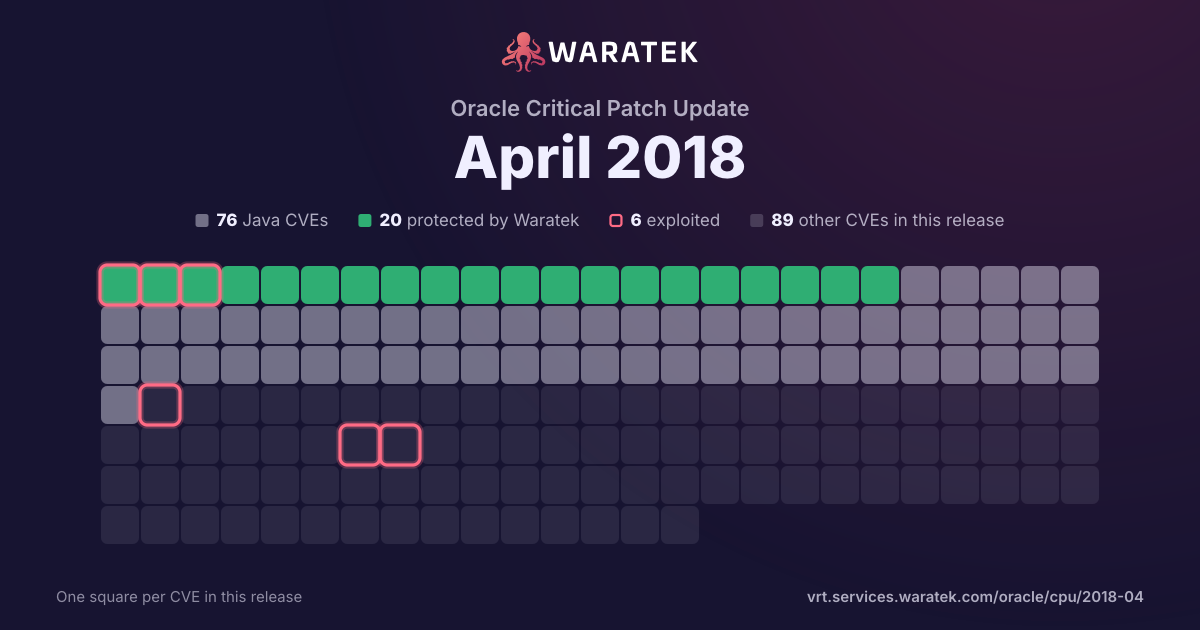
By status
20Protected by Waratek2Mitigation candidate54No exploit published30Outside Waratek scope59Not applicable
6Exploited, marked by the ring
No exploit published. For 52 of them, Oracle's security advisory is the source of public detail.
Protected by Waratek. Waratek RASP can block exploitation of these on systems that have not applied the patch yet.
Overview 2 matches · 1 in Waratek scope · 0 protected · 0 exploited · 0 CISA KEV · 0 public PoC · 0 EPSS ≥ 0.5
2matches
1in Waratek scope50.0%
0protected0.0%
0exploited0.0%
0CISA KEV0.0%
0public PoC0.0%
0EPSS ≥ 0.50.0%
Protected by Waratek
0
0.0%
Rule in development
0
0.0%
Mitigation candidate
1
50.0%
No exploit published
0
0.0%
Outside Waratek scope
1
50.0%
Not applicable
0
0.0%
Withdrawn CVE
0
0.0%
blocked by ARMR today
0
0.0%
partly blocked
0
0.0%
not blocked
2
100.0%
not established
0
0.0%
unrecorded
0
0.0%
Exploited
0
0.0%
Working exploit published
0
0.0%
Proof of concept only
0
0.0%
Forecast only
0
0.0%
No public exploit
2
100.0%
split by
peak 1 / quarter
Q3 13Q4 13Q1 14Q2 14Q3 14Q4 14Q1 15Q2 15Q3 15Q4 15
| CVE | Severity | Published▾ | Status | Exploitation | Description |
|---|---|---|---|---|---|
| CVE-2015-7940 | Medium | 2015-11-09 | Outside Waratek scope | No public exploit | The Bouncy Castle Java library before 1.51 does not validate a point is withing the elliptic curve, which makes it easier for remote attackers to obtain private keys via a series of crafted elliptic curve Diffie Hellman (ECDH) key exchanges, aka an "invalid curve attack." |
| CVE-2013-1768 | High | 2013-07-11 | Mitigation candidate | No public exploit | The BrokerFactory functionality in Apache OpenJPA 1.x before 1.2.3 and 2.x before 2.2.2 creates local executable JSP files containing logging trace data produced during deserialization of certain crafted OpenJPA objects, which makes it easier for remote attackers to execute arbitrary code by creating a serialized object and leveraging improperly secured server programs. |