
Oracle Critical Patch Update January 2018
Released January 2018 · Oracle's advisory ↗ · ← Critical Patch Update, October 2017 · Critical Patch Update, April 2018 →
197 CVEs in this release, one square each
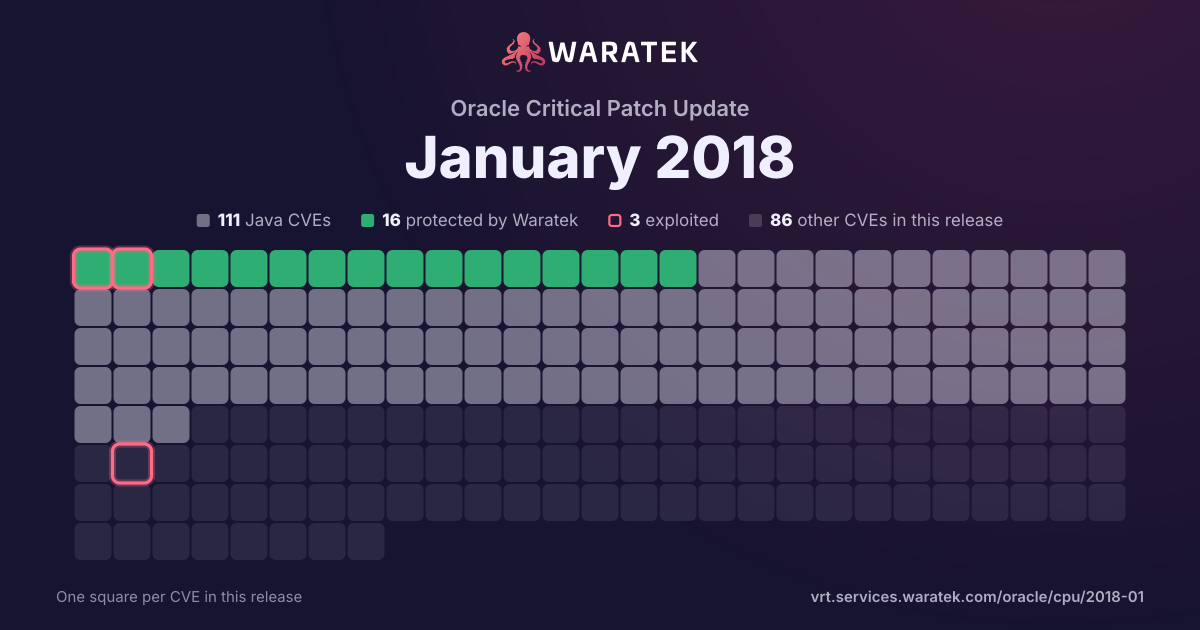
By status
16Protected by Waratek1Mitigation candidate94No exploit published25Outside Waratek scope61Not applicable
3Exploited, marked by the ring
No exploit published. For 94 of them, Oracle's security advisory is the source of public detail.
Protected by Waratek. Waratek RASP can block exploitation of these on systems that have not applied the patch yet.
Overview 8 matches · 1 protected · 1 exploited · 1 CISA KEV · 1 public PoC · 1 EPSS ≥ 0.5
Protected by Waratek
2
25.0%
Rule in development
0
0.0%
Mitigation candidate
0
0.0%
No exploit published
6
75.0%
blocked by ARMR today
1
12.5%
partly blocked
1
12.5%
not blocked
6
75.0%
not established
0
0.0%
unrecorded
0
0.0%
Exploited
1
12.5%
Working exploit published
0
0.0%
Proof of concept only
0
0.0%
Forecast only
0
0.0%
No public exploit
7
87.5%
split by
peak 6 / quarter
Q3 16Q4 16Q1 17Q2 17Q3 17Q4 17Q1 18
| CVE | Severity | Published▾ | Status | Exploitation | Description |
|---|---|---|---|---|---|
| CVE-2018-2713 | High | 2018-01-18 | No exploit published | No public exploit | Vulnerability in the Oracle WebCenter Portal component of Oracle Fusion Middleware (subcomponent: WebCenter Spaces Application). Supported versions that are affected are 11.1.1.9.0, 12.2.1.2.0 and 12.2.1.3.0. Easily exploitable vulnerability allows unauthenticated attacker with network access via HTTP to compromise Oracle WebCenter Portal. Successful attacks require human interaction from a person other than the attacker and while the vulnerability is in Oracle WebCenter Portal, attacks may significantly impact additional products. Successful attacks of this vulnerability can result in unauthorized creation, deletion or modification access to critical data or all Oracle WebCenter Portal accessible data as well as unauthorized read access to a subset of Oracle WebCenter Portal accessible data. CVSS 3.0 Base Score 8.2 (Confidentiality and Integrity impacts). CVSS Vector: (CVSS:3.0/AV:N/AC:L/PR:N/UI:R/S:C/C:L/I:H/A:N). |
| CVE-2018-2711 | High | 2018-01-18 | No exploit published | No public exploit | Vulnerability in the Oracle JDeveloper component of Oracle Fusion Middleware (subcomponent: Security Framework). Supported versions that are affected are 11.1.1.2.4, 11.1.1.7.0, 11.1.1.7.1, 11.1.1.9.0 and 12.1.3.0.0. Easily exploitable vulnerability allows unauthenticated attacker with network access via HTTP to compromise Oracle JDeveloper. Successful attacks require human interaction from a person other than the attacker and while the vulnerability is in Oracle JDeveloper, attacks may significantly impact additional products. Successful attacks of this vulnerability can result in unauthorized access to critical data or complete access to all Oracle JDeveloper accessible data as well as unauthorized update, insert or delete access to some of Oracle JDeveloper accessible data. CVSS 3.0 Base Score 8.2 (Confidentiality and Integrity impacts). CVSS Vector: (CVSS:3.0/AV:N/AC:L/PR:N/UI:R/S:C/C:H/I:L/A:N). |
| CVE-2018-2601 | High | 2018-01-18 | No exploit published | No public exploit | Vulnerability in the Oracle Internet Directory component of Oracle Fusion Middleware (subcomponent: Oracle Directory Services Manager). Supported versions that are affected are 11.1.1.7.0, 11.1.1.9.0 and 12.2.1.3.0. Difficult to exploit vulnerability allows high privileged attacker with network access via HTTP to compromise Oracle Internet Directory. While the vulnerability is in Oracle Internet Directory, attacks may significantly impact additional products. Successful attacks of this vulnerability can result in takeover of Oracle Internet Directory. CVSS 3.0 Base Score 8.0 (Confidentiality, Integrity and Availability impacts). CVSS Vector: (CVSS:3.0/AV:N/AC:H/PR:H/UI:N/S:C/C:H/I:H/A:H). |
| CVE-2018-2596 | High | 2018-01-18 | No exploit published | No public exploit | Vulnerability in the Oracle WebCenter Content component of Oracle Fusion Middleware (subcomponent: Content Server). Supported versions that are affected are 11.1.1.9.0, 12.2.1.2.0 and 12.2.1.3.0. Easily exploitable vulnerability allows unauthenticated attacker with network access via HTTP to compromise Oracle WebCenter Content. Successful attacks require human interaction from a person other than the attacker and while the vulnerability is in Oracle WebCenter Content, attacks may significantly impact additional products. Successful attacks of this vulnerability can result in unauthorized creation, deletion or modification access to critical data or all Oracle WebCenter Content accessible data as well as unauthorized read access to a subset of Oracle WebCenter Content accessible data. CVSS 3.0 Base Score 8.2 (Confidentiality and Integrity impacts). CVSS Vector: (CVSS:3.0/AV:N/AC:L/PR:N/UI:R/S:C/C:L/I:H/A:N). |
| CVE-2018-2564 | High | 2018-01-18 | No exploit published | No public exploit | Vulnerability in the Oracle WebCenter Content component of Oracle Fusion Middleware (subcomponent: Content Server). The supported version that is affected is 11.1.1.9.0. Easily exploitable vulnerability allows unauthenticated attacker with network access via HTTP to compromise Oracle WebCenter Content. Successful attacks require human interaction from a person other than the attacker and while the vulnerability is in Oracle WebCenter Content, attacks may significantly impact additional products. Successful attacks of this vulnerability can result in unauthorized creation, deletion or modification access to critical data or all Oracle WebCenter Content accessible data as well as unauthorized read access to a subset of Oracle WebCenter Content accessible data. CVSS 3.0 Base Score 8.2 (Confidentiality and Integrity impacts). CVSS Vector: (CVSS:3.0/AV:N/AC:L/PR:N/UI:R/S:C/C:L/I:H/A:N). |
| CVE-2017-10068 | High | 2018-01-18 | No exploit published | No public exploit | Vulnerability in the Oracle Business Intelligence Enterprise Edition component of Oracle Fusion Middleware (subcomponent: Analytics Web Dashboards). The supported version that is affected is 12.2.1.3.0. Easily exploitable vulnerability allows unauthenticated attacker with network access via HTTP to compromise Oracle Business Intelligence Enterprise Edition. Successful attacks require human interaction from a person other than the attacker and while the vulnerability is in Oracle Business Intelligence Enterprise Edition, attacks may significantly impact additional products. Successful attacks of this vulnerability can result in unauthorized access to critical data or complete access to all Oracle Business Intelligence Enterprise Edition accessible data as well as unauthorized update, insert or delete access to some of Oracle Business Intelligence Enterprise Edition accessible data. CVSS 3.0 Base Score 8.2 (Confidentiality and Integrity impacts). CVSS Vector: (CVSS:3.0/AV:N/AC:L/PR:N/UI:R/S:C/C:H/I:L/A:N). |
| CVE-2017-12617 | High | 2017-10-04 | Protected by Waratek | Exploited | When running Apache Tomcat versions 9.0.0.M1 to 9.0.0, 8.5.0 to 8.5.22, 8.0.0.RC1 to 8.0.46 and 7.0.0 to 7.0.81 with HTTP PUTs enabled (e.g. via setting the readonly initialisation parameter of the Default servlet to false) it was possible to upload a JSP file to the server via a specially crafted request. This JSP could then be requested and any code it contained would be executed by the server. |
| CVE-2016-1182 | High | 2016-07-04 | Protected by Waratek | No public exploit | ActionServlet.java in Apache Struts 1 1.x through 1.3.10 does not properly restrict the Validator configuration, which allows remote attackers to conduct cross-site scripting (XSS) attacks or cause a denial of service via crafted input, a related issue to CVE-2015-0899. |