
Oracle Critical Patch Update October 2017
Released October 2017 · Oracle's advisory ↗ · ← Critical Patch Update, July 2017 · Critical Patch Update, January 2018 →
225 CVEs in this release, one square each
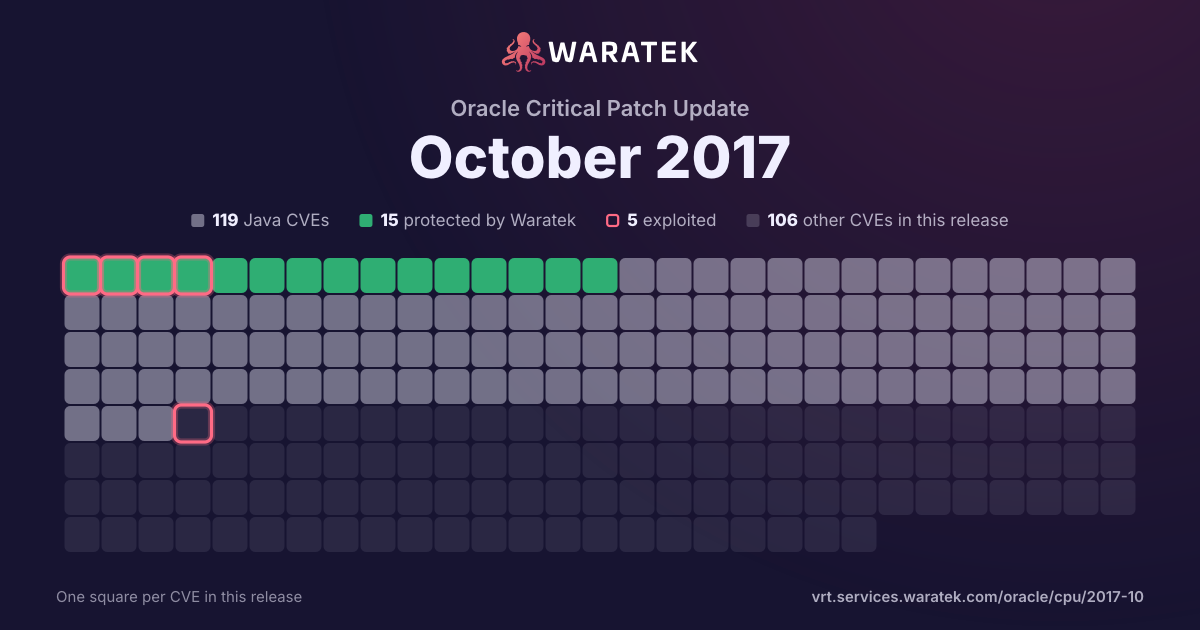
By status
15Protected by Waratek3Mitigation candidate101No exploit published34Outside Waratek scope72Not applicable
5Exploited, marked by the ring
No exploit published. For 100 of them, Oracle's security advisory is the source of public detail.
Protected by Waratek. Waratek RASP can block exploitation of these on systems that have not applied the patch yet.
Overview 13 matches · 0 in Waratek scope · 0 protected · 0 exploited · 0 CISA KEV · 1 public PoC · 2 EPSS ≥ 0.5
13matches
0in Waratek scope0.0%
0protected0.0%
0exploited0.0%
0CISA KEV0.0%
1public PoC7.7%
2EPSS ≥ 0.515.4%
Protected by Waratek
0
0.0%
Rule in development
0
0.0%
Mitigation candidate
0
0.0%
No exploit published
0
0.0%
Outside Waratek scope
0
0.0%
Not applicable
13
100.0%
Withdrawn CVE
0
0.0%
blocked by ARMR today
0
0.0%
partly blocked
0
0.0%
not blocked
13
100.0%
not established
0
0.0%
unrecorded
0
0.0%
Exploited
0
0.0%
Working exploit published
1
7.7%
Proof of concept only
0
0.0%
Forecast only
1
7.7%
No public exploit
11
84.6%
split by
peak 6 / year
20031
Not applicable1
Medium1
not blocked1
No public exploit1
20040
20050
20060
20070
20080
20090
20100
20110
20120
20131
Not applicable1
High1
not blocked1
No public exploit1
20145
Not applicable5
High1
Medium4
not blocked5
No public exploit5
20150
20166
Not applicable6
High5
Medium1
not blocked6
Working exploit published1
Forecast only1
No public exploit4
2004200620082010201220142016
| CVE | Severity | Published▾ | Status | Exploitation | Description |
|---|---|---|---|---|---|
| CVE-2016-7052 | High | 2016-09-26 | Not applicable | No public exploit | crypto/x509/x509_vfy.c in OpenSSL 1.0.2i allows remote attackers to cause a denial of service (NULL pointer dereference and application crash) by triggering a CRL operation. |
| CVE-2016-6304 | High | 2016-09-26 | Not applicable | Forecast only | Multiple memory leaks in t1_lib.c in OpenSSL before 1.0.1u, 1.0.2 before 1.0.2i, and 1.1.0 before 1.1.0a allow remote attackers to cause a denial of service (memory consumption) via large OCSP Status Request extensions. |
| CVE-2016-3506 | High | 2016-07-21 | Not applicable | No public exploit | Unspecified vulnerability in the JDBC component in Oracle Database Server 11.2.0.4, 12.1.0.1, and 12.1.0.2; the Oracle Retail Xstore Point of Service 5.5, 6.0, 6.5, 7.0, 7.1, 15.0, and 16.0; the Oracle Retail Warehouse Management System 14.04, 14.1.3, and 15.0.1; the Oracle Retail Workforce Management 1.60.7, and 1.64.0; the Oracle Retail Clearance Optimization Engine 13.4; the Oracle Retail Markdown Optimization 13.4 and 14.0; and Oracle Retail Merchandising System 16.0 allows remote attackers to affect confidentiality, integrity, and availability via unknown vectors. |
| CVE-2016-2834 | High | 2016-06-13 | Not applicable | No public exploit | Mozilla Network Security Services (NSS) before 3.23, as used in Mozilla Firefox before 47.0, allows remote attackers to cause a denial of service (memory corruption and application crash) or possibly have unspecified other impact via unknown vectors. |
| CVE-2016-2107 | Medium | 2016-05-05 | Not applicable | Working exploit published | The AES-NI implementation in OpenSSL before 1.0.1t and 1.0.2 before 1.0.2h does not consider memory allocation during a certain padding check, which allows remote attackers to obtain sensitive cleartext information via a padding-oracle attack against an AES CBC session. NOTE: this vulnerability exists because of an incorrect fix for CVE-2013-0169. |
| CVE-2016-2381 | High | 2016-04-08 | Not applicable | No public exploit | Perl might allow context-dependent attackers to bypass the taint protection mechanism in a child process via duplicate environment variables in envp. |
| CVE-2014-8714 | Medium | 2014-11-23 | Not applicable | No public exploit | The dissect_write_structured_field function in epan/dissectors/packet-tn5250.c in the TN5250 dissector in Wireshark 1.10.x before 1.10.11 and 1.12.x before 1.12.2 allows remote attackers to cause a denial of service (infinite loop) via a crafted packet. |
| CVE-2014-3707 | Medium | 2014-11-15 | Not applicable | No public exploit | The curl_easy_duphandle function in libcurl 7.17.1 through 7.38.0, when running with the CURLOPT_COPYPOSTFIELDS option, does not properly copy HTTP POST data for an easy handle, which triggers an out-of-bounds read that allows remote web servers to read sensitive memory information. |
| CVE-2014-4345 | High | 2014-08-14 | Not applicable | No public exploit | Off-by-one error in the krb5_encode_krbsecretkey function in plugins/kdb/ldap/libkdb_ldap/ldap_principal2.c in the LDAP KDB module in kadmind in MIT Kerberos 5 (aka krb5) 1.6.x through 1.11.x before 1.11.6 and 1.12.x before 1.12.2 allows remote authenticated users to cause a denial of service (buffer overflow) or possibly execute arbitrary code via a series of "cpw -keepold" commands. |
| CVE-2014-3538 | Medium | 2014-07-03 | Not applicable | No public exploit | file before 5.19 does not properly restrict the amount of data read during a regex search, which allows remote attackers to cause a denial of service (CPU consumption) via a crafted file that triggers backtracking during processing of an awk rule. NOTE: this vulnerability exists because of an incomplete fix for CVE-2013-7345. |
| CVE-2014-0062 | Medium | 2014-03-31 | Not applicable | No public exploit | Race condition in the (1) CREATE INDEX and (2) unspecified ALTER TABLE commands in PostgreSQL before 8.4.20, 9.0.x before 9.0.16, 9.1.x before 9.1.12, 9.2.x before 9.2.7, and 9.3.x before 9.3.3 allows remote authenticated users to create an unauthorized index or read portions of unauthorized tables by creating or deleting a table with the same name during the timing window. |
| CVE-2013-1903 | High | 2013-04-04 | Not applicable | No public exploit | PostgreSQL, possibly 9.2.x before 9.2.4, 9.1.x before 9.1.9, 9.0.x before 9.0.13, 8.4.x before 8.4.17, and 8.3.x before 8.3.23 incorrectly provides the superuser password to scripts related to "graphical installers for Linux and Mac OS X," which has unspecified impact and attack vectors. |
| CVE-2003-1418 | Medium | 2003-12-31 | Not applicable | No public exploit | Apache HTTP Server 1.3.22 through 1.3.27 on OpenBSD allows remote attackers to obtain sensitive information via (1) the ETag header, which reveals the inode number, or (2) multipart MIME boundary, which reveals child process IDs (PID). |