
Oracle Critical Patch Update October 2017
Released October 2017 · Oracle's advisory ↗ · ← Critical Patch Update, July 2017 · Critical Patch Update, January 2018 →
225 CVEs in this release, one square each
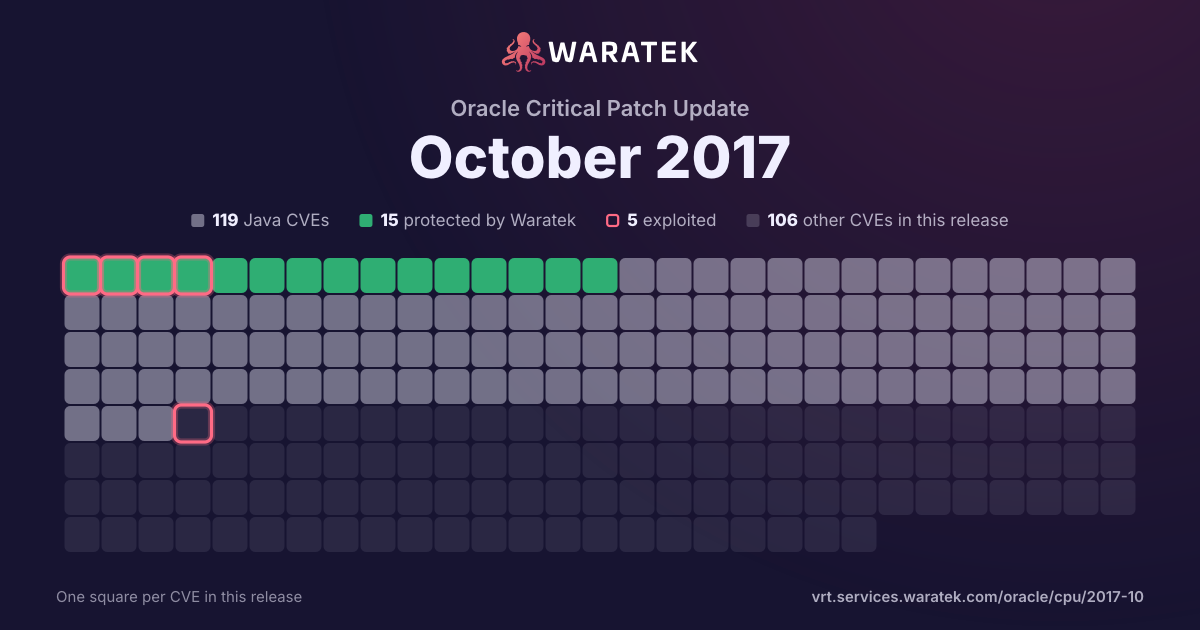
By status
15Protected by Waratek3Mitigation candidate101No exploit published34Outside Waratek scope72Not applicable
5Exploited, marked by the ring
No exploit published. For 100 of them, Oracle's security advisory is the source of public detail.
Protected by Waratek. Waratek RASP can block exploitation of these on systems that have not applied the patch yet.
Overview 9 matches · 1 in Waratek scope · 1 protected · 1 exploited · 1 CISA KEV · 1 public PoC · 2 EPSS ≥ 0.5
9matches
1in Waratek scope11.1%
1protected11.1%
1exploited11.1%
1CISA KEV11.1%
1public PoC11.1%
2EPSS ≥ 0.522.2%
Protected by Waratek
1
11.1%
Rule in development
0
0.0%
Mitigation candidate
0
0.0%
No exploit published
0
0.0%
Outside Waratek scope
2
22.2%
Not applicable
6
66.7%
Withdrawn CVE
0
0.0%
blocked by ARMR today
1
11.1%
partly blocked
0
0.0%
not blocked
8
88.9%
not established
0
0.0%
unrecorded
0
0.0%
Exploited
1
11.1%
Working exploit published
0
0.0%
Proof of concept only
0
0.0%
Forecast only
1
11.1%
No public exploit
7
77.8%
split by
peak 5 / month
Apr 172
Protected by Waratek1
Not applicable1
Critical1
High1
blocked by ARMR today1
not blocked1
Exploited1
No public exploit1
May 175
Not applicable5
Critical2
High2
Medium1
not blocked5
Forecast only1
No public exploit4
Jun 172
Outside Waratek scope2
Critical1
High1
not blocked2
No public exploit2
Apr 17May 17Jun 17
| CVE | Severity | Published▾ | Status | Exploitation | Description |
|---|---|---|---|---|---|
| CVE-2017-3167 | Critical | 2017-06-20 | Outside Waratek scope | No public exploit | In Apache httpd 2.2.x before 2.2.33 and 2.4.x before 2.4.26, use of the ap_get_basic_auth_pw() by third-party modules outside of the authentication phase may lead to authentication requirements being bypassed. |
| CVE-2017-5664 | High | 2017-06-06 | Outside Waratek scope | No public exploit | The error page mechanism of the Java Servlet Specification requires that, when an error occurs and an error page is configured for the error that occurred, the original request and response are forwarded to the error page. This means that the request is presented to the error page with the original HTTP method. If the error page is a static file, expected behaviour is to serve content of the file as if processing a GET request, regardless of the actual HTTP method. The Default Servlet in Apache Tomcat 9.0.0.M1 to 9.0.0.M20, 8.5.0 to 8.5.14, 8.0.0.RC1 to 8.0.43 and 7.0.0 to 7.0.77 did not do this. Depending on the original request this could lead to unexpected and undesirable results for static error pages including, if the DefaultServlet is configured to permit writes, the replacement or removal of the custom error page. Notes for other user provided error pages: (1) Unless explicitly coded otherwise, JSPs ignore the HTTP method. JSPs used as error pages must must ensure that they handle any error dispatch as a GET request, regardless of the actual method. (2) By default, the response generated by a Servlet does depend on the HTTP method. Custom Servlets used as error pages must ensure that they handle any error dispatch as a GET request, regardless of the actual method. |
| CVE-2016-9841 | Critical | 2017-05-23 | Not applicable | No public exploit | inffast.c in zlib 1.2.8 might allow context-dependent attackers to have unspecified impact by leveraging improper pointer arithmetic. |
| CVE-2017-5461 | Critical | 2017-05-11 | Not applicable | No public exploit | Mozilla Network Security Services (NSS) before 3.21.4, 3.22.x through 3.28.x before 3.28.4, 3.29.x before 3.29.5, and 3.30.x before 3.30.1 allows remote attackers to cause a denial of service (out-of-bounds write) or possibly have unspecified other impact by leveraging incorrect base64 operations. |
| CVE-2017-3733 | High | 2017-05-04 | Not applicable | No public exploit | During a renegotiation handshake if the Encrypt-Then-Mac extension is negotiated where it was not in the original handshake (or vice-versa) then this can cause OpenSSL 1.1.0 before 1.1.0e to crash (dependent on ciphersuite). Both clients and servers are affected. |
| CVE-2017-3732 | Medium | 2017-05-04 | Not applicable | No public exploit | There is a carry propagating bug in the x86_64 Montgomery squaring procedure in OpenSSL 1.0.2 before 1.0.2k and 1.1.0 before 1.1.0d. No EC algorithms are affected. Analysis suggests that attacks against RSA and DSA as a result of this defect would be very difficult to perform and are not believed likely. Attacks against DH are considered just feasible (although very difficult) because most of the work necessary to deduce information about a private key may be performed offline. The amount of resources required for such an attack would be very significant and likely only accessible to a limited number of attackers. An attacker would additionally need online access to an unpatched system using the target private key in a scenario with persistent DH parameters and a private key that is shared between multiple clients. For example this can occur by default in OpenSSL DHE based SSL/TLS ciphersuites. Note: This issue is very similar to CVE-2015-3193 but must be treated as a separate problem. |
| CVE-2017-3731 | High | 2017-05-04 | Not applicable | Forecast only | If an SSL/TLS server or client is running on a 32-bit host, and a specific cipher is being used, then a truncated packet can cause that server or client to perform an out-of-bounds read, usually resulting in a crash. For OpenSSL 1.1.0, the crash can be triggered when using CHACHA20/POLY1305; users should upgrade to 1.1.0d. For Openssl 1.0.2, the crash can be triggered when using RC4-MD5; users who have not disabled that algorithm should update to 1.0.2k. |
| CVE-2017-5662 | High | 2017-04-18 | Not applicable | No public exploit | In Apache Batik before 1.9, files lying on the filesystem of the server which uses batik can be revealed to arbitrary users who send maliciously formed SVG files. The file types that can be shown depend on the user context in which the exploitable application is running. If the user is root a full compromise of the server - including confidential or sensitive files - would be possible. XXE can also be used to attack the availability of the server via denial of service as the references within a xml document can trivially trigger an amplification attack. |
| CVE-2016-8735 | Critical | 2017-04-06 | Protected by Waratek | Exploited | Remote code execution is possible with Apache Tomcat before 6.0.48, 7.x before 7.0.73, 8.x before 8.0.39, 8.5.x before 8.5.7, and 9.x before 9.0.0.M12 if JmxRemoteLifecycleListener is used and an attacker can reach JMX ports. The issue exists because this listener wasn't updated for consistency with the CVE-2016-3427 Oracle patch that affected credential types. |