
Oracle Critical Patch Update October 2017
Released October 2017 · Oracle's advisory ↗ · ← Critical Patch Update, July 2017 · Critical Patch Update, January 2018 →
225 CVEs in this release, one square each
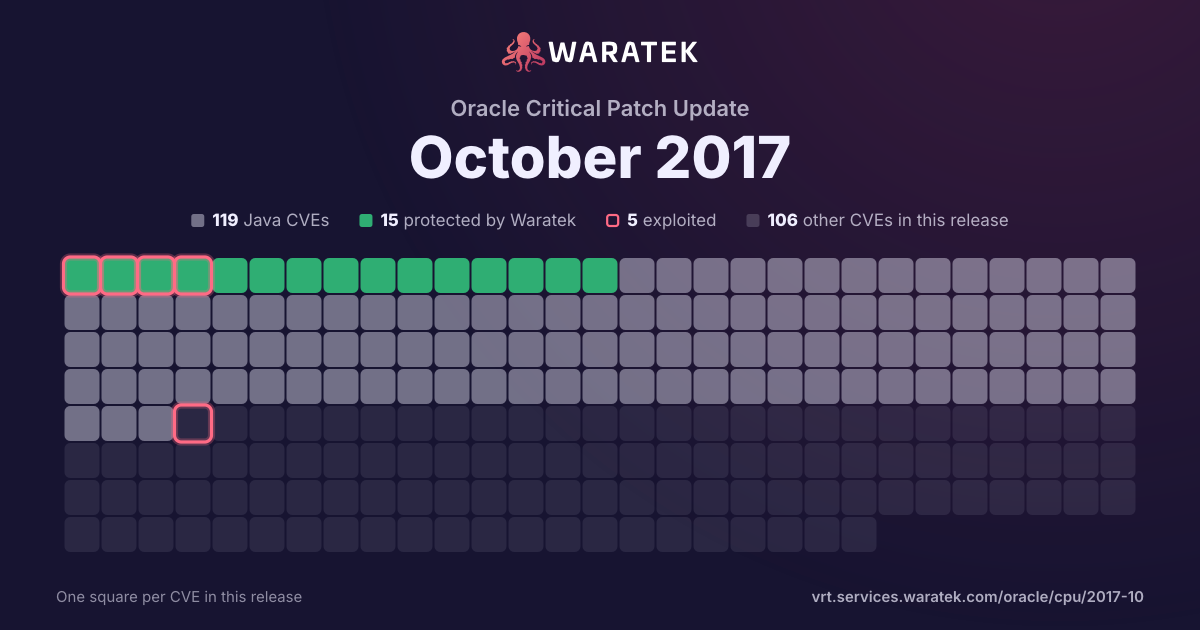
By status
15Protected by Waratek3Mitigation candidate101No exploit published34Outside Waratek scope72Not applicable
5Exploited, marked by the ring
No exploit published. For 100 of them, Oracle's security advisory is the source of public detail.
Protected by Waratek. Waratek RASP can block exploitation of these on systems that have not applied the patch yet.
Overview 210 matches · 104 in Waratek scope · 0 protected · 1 exploited · 0 CISA KEV · 7 public PoC · 7 EPSS ≥ 0.5
210matches
104in Waratek scope49.5%
0protected0.0%
1exploited0.5%
0CISA KEV0.0%
7public PoC3.3%
7EPSS ≥ 0.53.3%
Protected by Waratek
0
0.0%
Rule in development
0
0.0%
Mitigation candidate
3
1.4%
No exploit published
101
48.1%
Outside Waratek scope
34
16.2%
Not applicable
72
34.3%
Withdrawn CVE
0
0.0%
blocked by ARMR today
0
0.0%
partly blocked
0
0.0%
not blocked
210
100.0%
not established
0
0.0%
unrecorded
0
0.0%
split by
peak 187 / year
20031
Not applicable1
Medium1
not blocked1
No public exploit1
20040
20050
20060
20070
20080
20090
20100
20110
20120
20131
Not applicable1
High1
not blocked1
No public exploit1
20146
Outside Waratek scope1
Not applicable5
High2
Medium4
not blocked6
Exploited1
No public exploit5
20154
Outside Waratek scope4
Critical1
High1
Medium1
Low1
not blocked4
Working exploit published1
Forecast only1
No public exploit2
201610
No exploit published1
Outside Waratek scope3
Not applicable6
High9
Medium1
not blocked10
Working exploit published1
Proof of concept only1
Forecast only1
No public exploit7
2017187
Mitigation candidate3
No exploit published100
Outside Waratek scope25
Not applicable59
Critical12
High62
Medium104
Low9
not blocked187
Working exploit published3
Proof of concept only1
Forecast only1
No public exploit182
20181
Outside Waratek scope1
Critical1
not blocked1
No public exploit1
20042006200820102012201420162018
| CVE | Severity | Published▾ | Status | Exploitation | Description |
|---|---|---|---|---|---|
| CVE-2015-2808 | Low | 2015-04-01 | Outside Waratek scope | Forecast only | The RC4 algorithm, as used in the TLS protocol and SSL protocol, does not properly combine state data with key data during the initialization phase, which makes it easier for remote attackers to conduct plaintext-recovery attacks against the initial bytes of a stream by sniffing network traffic that occasionally relies on keys affected by the Invariance Weakness, and then using a brute-force approach involving LSB values, aka the "Bar Mitzvah" issue. |
| CVE-2015-0235 | High | 2015-01-28 | Outside Waratek scope | Working exploit published | Heap-based buffer overflow in the __nss_hostname_digits_dots function in glibc 2.2, and other 2.x versions before 2.18, allows context-dependent attackers to execute arbitrary code via vectors related to the (1) gethostbyname or (2) gethostbyname2 function, aka "GHOST." |
| CVE-2014-8714 | Medium | 2014-11-23 | Not applicable | No public exploit | The dissect_write_structured_field function in epan/dissectors/packet-tn5250.c in the TN5250 dissector in Wireshark 1.10.x before 1.10.11 and 1.12.x before 1.12.2 allows remote attackers to cause a denial of service (infinite loop) via a crafted packet. |
| CVE-2014-3707 | Medium | 2014-11-15 | Not applicable | No public exploit | The curl_easy_duphandle function in libcurl 7.17.1 through 7.38.0, when running with the CURLOPT_COPYPOSTFIELDS option, does not properly copy HTTP POST data for an easy handle, which triggers an out-of-bounds read that allows remote web servers to read sensitive memory information. |
| CVE-2014-4345 | High | 2014-08-14 | Not applicable | No public exploit | Off-by-one error in the krb5_encode_krbsecretkey function in plugins/kdb/ldap/libkdb_ldap/ldap_principal2.c in the LDAP KDB module in kadmind in MIT Kerberos 5 (aka krb5) 1.6.x through 1.11.x before 1.11.6 and 1.12.x before 1.12.2 allows remote authenticated users to cause a denial of service (buffer overflow) or possibly execute arbitrary code via a series of "cpw -keepold" commands. |
| CVE-2014-3538 | Medium | 2014-07-03 | Not applicable | No public exploit | file before 5.19 does not properly restrict the amount of data read during a regex search, which allows remote attackers to cause a denial of service (CPU consumption) via a crafted file that triggers backtracking during processing of an awk rule. NOTE: this vulnerability exists because of an incomplete fix for CVE-2013-7345. |
| CVE-2014-0224 | High | 2014-06-05 | Outside Waratek scope | Exploited | OpenSSL before 0.9.8za, 1.0.0 before 1.0.0m, and 1.0.1 before 1.0.1h does not properly restrict processing of ChangeCipherSpec messages, which allows man-in-the-middle attackers to trigger use of a zero-length master key in certain OpenSSL-to-OpenSSL communications, and consequently hijack sessions or obtain sensitive information, via a crafted TLS handshake, aka the "CCS Injection" vulnerability. |
| CVE-2014-0062 | Medium | 2014-03-31 | Not applicable | No public exploit | Race condition in the (1) CREATE INDEX and (2) unspecified ALTER TABLE commands in PostgreSQL before 8.4.20, 9.0.x before 9.0.16, 9.1.x before 9.1.12, 9.2.x before 9.2.7, and 9.3.x before 9.3.3 allows remote authenticated users to create an unauthorized index or read portions of unauthorized tables by creating or deleting a table with the same name during the timing window. |
| CVE-2013-1903 | High | 2013-04-04 | Not applicable | No public exploit | PostgreSQL, possibly 9.2.x before 9.2.4, 9.1.x before 9.1.9, 9.0.x before 9.0.13, 8.4.x before 8.4.17, and 8.3.x before 8.3.23 incorrectly provides the superuser password to scripts related to "graphical installers for Linux and Mac OS X," which has unspecified impact and attack vectors. |
| CVE-2003-1418 | Medium | 2003-12-31 | Not applicable | No public exploit | Apache HTTP Server 1.3.22 through 1.3.27 on OpenBSD allows remote attackers to obtain sensitive information via (1) the ETag header, which reveals the inode number, or (2) multipart MIME boundary, which reveals child process IDs (PID). |