
Oracle Critical Patch Update October 2017
Released October 2017 · Oracle's advisory ↗ · ← Critical Patch Update, July 2017 · Critical Patch Update, January 2018 →
225 CVEs in this release, one square each
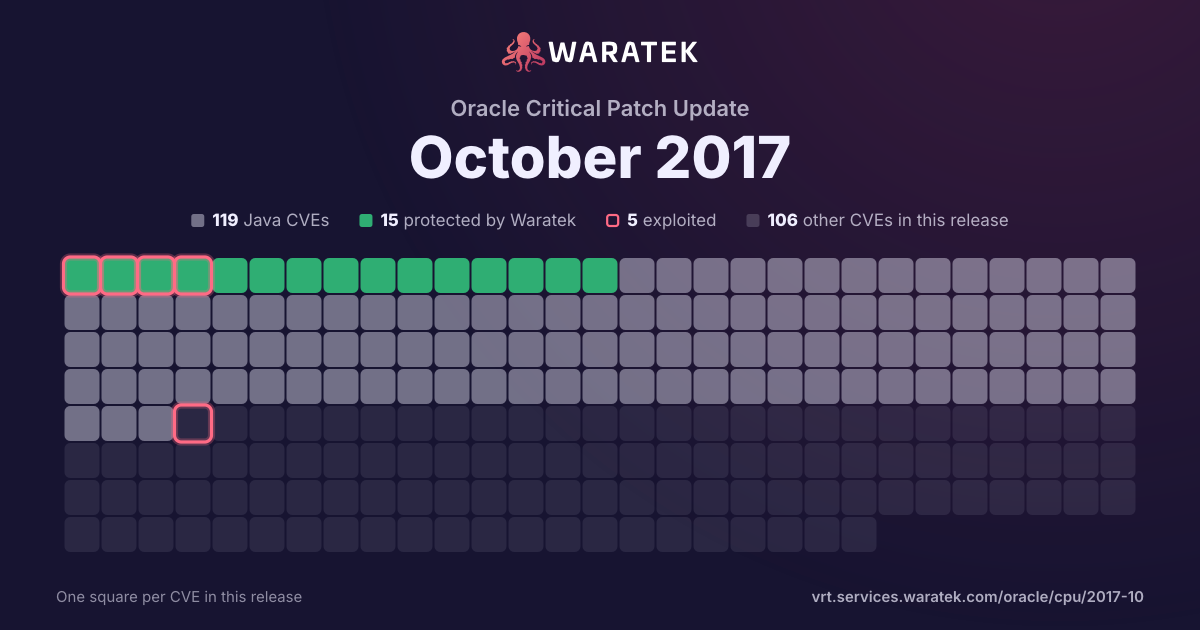
By status
18Protected by Waratek2Mitigation candidate109No exploit published17Outside Waratek scope79Not applicable
5Exploited, marked by the ring
No exploit published. For 103 of them, Oracle's security advisory is the source of public detail.
Protected by Waratek. Waratek RASP can block exploitation of these on systems that have not applied the patch yet.
Overview 4 matches · 2 protected · 1 exploited · 0 CISA KEV · 1 public PoC · 2 EPSS ≥ 0.5
Protected by Waratek
2
50.0%
Rule in development
0
0.0%
Mitigation candidate
0
0.0%
No exploit published
2
50.0%
blocked by ARMR today
2
50.0%
partly blocked
0
0.0%
not blocked
2
50.0%
not established
0
0.0%
unrecorded
0
0.0%
Exploited
1
25.0%
Working exploit published
0
0.0%
Proof of concept only
0
0.0%
Forecast only
1
25.0%
No public exploit
2
50.0%
split by
peak 2 / month
Apr 142
Protected by Waratek2
High2
blocked by ARMR today2
Exploited1
No public exploit1
May 140
Jun 140
Jul 140
Aug 140
Sep 140
Oct 140
Nov 140
Dec 140
Jan 150
Feb 150
Mar 150
Apr 151
No exploit published1
Low1
not blocked1
Forecast only1
May 150
Jun 150
Jul 150
Aug 151
No exploit published1
Critical1
not blocked1
No public exploit1
Apr 14Jun 14Aug 14Oct 14Dec 14Feb 15Apr 15Jun 15Aug 15
| CVE | Severity | Published▾ | Status | Exploitation | Description |
|---|---|---|---|---|---|
| CVE-2015-3253 | Critical | 2015-08-13 | No exploit published | No public exploit | The MethodClosure class in runtime/MethodClosure.java in Apache Groovy 1.7.0 through 2.4.3 allows remote attackers to execute arbitrary code or cause a denial of service via a crafted serialized object. |
| CVE-2015-2808 | Low | 2015-04-01 | No exploit published | Forecast only | The RC4 algorithm, as used in the TLS protocol and SSL protocol, does not properly combine state data with key data during the initialization phase, which makes it easier for remote attackers to conduct plaintext-recovery attacks against the initial bytes of a stream by sniffing network traffic that occasionally relies on keys affected by the Invariance Weakness, and then using a brute-force approach involving LSB values, aka the "Bar Mitzvah" issue. |
| CVE-2014-0114 | High | 2014-04-30 | Protected by Waratek | Exploited | Apache Commons BeanUtils, as distributed in lib/commons-beanutils-1.8.0.jar in Apache Struts 1.x through 1.3.10 and in other products requiring commons-beanutils through 1.9.2, does not suppress the class property, which allows remote attackers to "manipulate" the ClassLoader and execute arbitrary code via the class parameter, as demonstrated by the passing of this parameter to the getClass method of the ActionForm object in Struts 1. |
| CVE-2014-0107 | High | 2014-04-15 | Protected by Waratek | No public exploit | The TransformerFactory in Apache Xalan-Java before 2.7.2 does not properly restrict access to certain properties when FEATURE_SECURE_PROCESSING is enabled, which allows remote attackers to bypass expected restrictions and load arbitrary classes or access external resources via a crafted (1) xalan:content-header, (2) xalan:entities, (3) xslt:content-header, or (4) xslt:entities property, or a Java property that is bound to the XSLT 1.0 system-property function. |