
Oracle Critical Patch Update July 2017
Released July 2017 · Oracle's advisory ↗ · ← Critical Patch Update, April 2017 · Critical Patch Update, October 2017 →
272 CVEs in this release, one square each
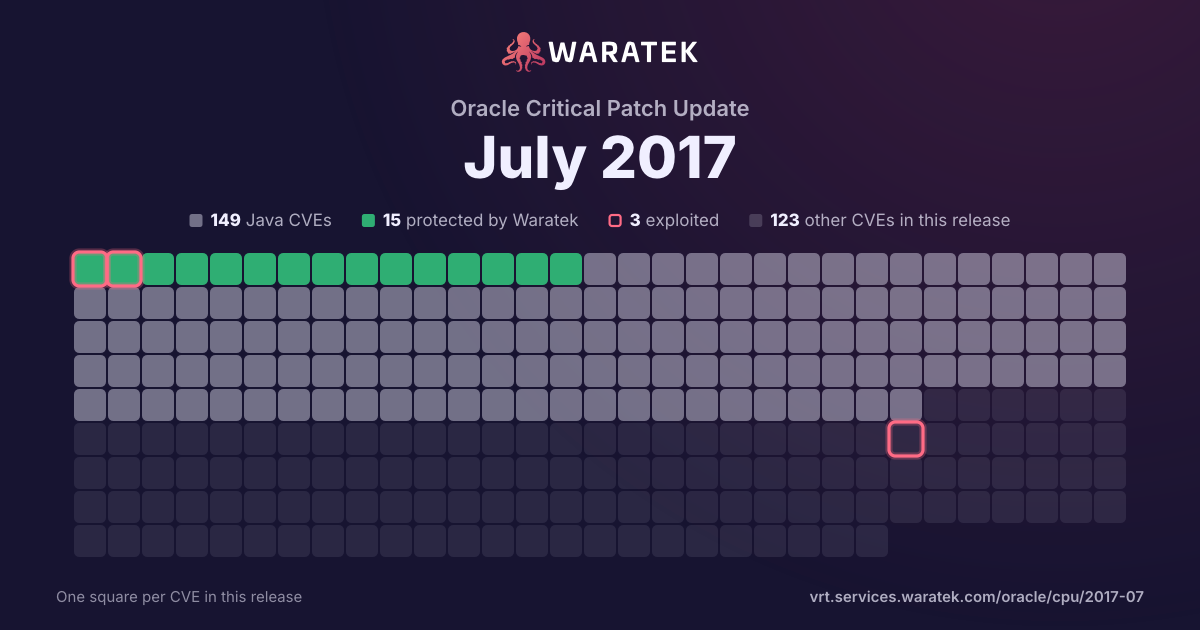
By status
15Protected by Waratek3Mitigation candidate131No exploit published30Outside Waratek scope93Not applicable
3Exploited, marked by the ring
No exploit published. For 126 of them, Oracle's security advisory is the source of public detail.
Protected by Waratek. Waratek RASP can block exploitation of these on systems that have not applied the patch yet.
Overview 7 matches · 0 in Waratek scope · 0 protected · 0 exploited · 0 CISA KEV · 0 public PoC · 0 EPSS ≥ 0.5
7matches
0in Waratek scope0.0%
0protected0.0%
0exploited0.0%
0CISA KEV0.0%
0public PoC0.0%
0EPSS ≥ 0.50.0%
Protected by Waratek
0
0.0%
Rule in development
0
0.0%
Mitigation candidate
0
0.0%
No exploit published
0
0.0%
Outside Waratek scope
7
100.0%
Not applicable
0
0.0%
Withdrawn CVE
0
0.0%
blocked by ARMR today
0
0.0%
partly blocked
0
0.0%
not blocked
7
100.0%
not established
0
0.0%
unrecorded
0
0.0%
Exploited
0
0.0%
Working exploit published
0
0.0%
Proof of concept only
0
0.0%
Forecast only
0
0.0%
No public exploit
7
100.0%
split by
peak 5 / quarter
Q1 15Q2 15Q3 15Q4 15Q1 16Q2 16Q3 16Q4 16Q1 17Q2 17Q3 17
| CVE | Severity | Published▾ | Status | Exploitation | Description |
|---|---|---|---|---|---|
| CVE-2017-3633 | Medium | 2017-08-08 | Outside Waratek scope | No public exploit | Vulnerability in the MySQL Server component of Oracle MySQL (subcomponent: Server: Memcached). Supported versions that are affected are 5.6.36 and earlier and 5.7.18 and earlier. Difficult to exploit vulnerability allows unauthenticated attacker with network access via Memcached to compromise MySQL Server. Successful attacks of this vulnerability can result in unauthorized ability to cause a hang or frequently repeatable crash (complete DOS) of MySQL Server as well as unauthorized update, insert or delete access to some of MySQL Server accessible data. CVSS 3.0 Base Score 6.5 (Integrity and Availability impacts). CVSS Vector: (CVSS:3.0/AV:N/AC:H/PR:N/UI:N/S:U/C:N/I:L/A:H). |
| CVE-2017-10109 | Medium | 2017-08-08 | Outside Waratek scope | No public exploit | Vulnerability in the Java SE, Java SE Embedded, JRockit component of Oracle Java SE (subcomponent: Serialization). Supported versions that are affected are Java SE: 6u151, 7u141 and 8u131; Java SE Embedded: 8u131; JRockit: R28.3.14. Easily exploitable vulnerability allows unauthenticated attacker with network access via multiple protocols to compromise Java SE, Java SE Embedded, JRockit. Successful attacks of this vulnerability can result in unauthorized ability to cause a partial denial of service (partial DOS) of Java SE, Java SE Embedded, JRockit. Note: This vulnerability applies to Java deployments, typically in clients running sandboxed Java Web Start applications or sandboxed Java applets, that load and run untrusted code (e.g., code that comes from the internet) and rely on the Java sandbox for security. This vulnerability does not apply to Java deployments, typically in servers, that load and run only trusted code (e.g., code installed by an administrator). CVSS 3.0 Base Score 5.3 (Availability impacts). CVSS Vector: (CVSS:3.0/AV:N/AC:L/PR:N/UI:N/S:U/C:N/I:N/A:L). |
| CVE-2017-10105 | Medium | 2017-08-08 | Outside Waratek scope | No public exploit | Vulnerability in the Java SE component of Oracle Java SE (subcomponent: Deployment). Supported versions that are affected are Java SE: 6u151, 7u141 and 8u131. Easily exploitable vulnerability allows unauthenticated attacker with network access via multiple protocols to compromise Java SE. Successful attacks require human interaction from a person other than the attacker. Successful attacks of this vulnerability can result in unauthorized update, insert or delete access to some of Java SE accessible data. Note: This vulnerability applies to Java deployments, typically in clients running sandboxed Java Web Start applications or sandboxed Java applets, that load and run untrusted code (e.g., code that comes from the internet) and rely on the Java sandbox for security. This vulnerability does not apply to Java deployments, typically in servers, that load and run only trusted code (e.g., code installed by an administrator). CVSS 3.0 Base Score 4.3 (Integrity impacts). CVSS Vector: (CVSS:3.0/AV:N/AC:L/PR:N/UI:R/S:U/C:N/I:L/A:N). |
| CVE-2017-10081 | Medium | 2017-08-08 | Outside Waratek scope | No public exploit | Vulnerability in the Java SE, Java SE Embedded component of Oracle Java SE (subcomponent: Hotspot). Supported versions that are affected are Java SE: 6u151, 7u141 and 8u131; Java SE Embedded: 8u131. Easily exploitable vulnerability allows unauthenticated attacker with network access via multiple protocols to compromise Java SE, Java SE Embedded. Successful attacks require human interaction from a person other than the attacker. Successful attacks of this vulnerability can result in unauthorized update, insert or delete access to some of Java SE, Java SE Embedded accessible data. Note: This vulnerability applies to Java deployments, typically in clients running sandboxed Java Web Start applications or sandboxed Java applets, that load and run untrusted code (e.g., code that comes from the internet) and rely on the Java sandbox for security. This vulnerability does not apply to Java deployments, typically in servers, that load and run only trusted code (e.g., code installed by an administrator). CVSS 3.0 Base Score 4.3 (Integrity impacts). CVSS Vector: (CVSS:3.0/AV:N/AC:L/PR:N/UI:R/S:U/C:N/I:L/A:N). |
| CVE-2017-10053 | Medium | 2017-08-08 | Outside Waratek scope | No public exploit | Vulnerability in the Java SE, Java SE Embedded, JRockit component of Oracle Java SE (subcomponent: 2D). Supported versions that are affected are Java SE: 6u151, 7u141 and 8u131; Java SE Embedded: 8u131; JRockit: R28.3.14. Easily exploitable vulnerability allows unauthenticated attacker with network access via multiple protocols to compromise Java SE, Java SE Embedded, JRockit. Successful attacks of this vulnerability can result in unauthorized ability to cause a partial denial of service (partial DOS) of Java SE, Java SE Embedded, JRockit. Note: This vulnerability can be exploited through sandboxed Java Web Start applications and sandboxed Java applets. It can also be exploited by supplying data to APIs in the specified Component without using sandboxed Java Web Start applications or sandboxed Java applets, such as through a web service. CVSS 3.0 Base Score 5.3 (Availability impacts). CVSS Vector: (CVSS:3.0/AV:N/AC:L/PR:N/UI:N/S:U/C:N/I:N/A:L). |
| CVE-2015-7940 | Medium | 2015-11-09 | Outside Waratek scope | No public exploit | The Bouncy Castle Java library before 1.51 does not validate a point is withing the elliptic curve, which makes it easier for remote attackers to obtain private keys via a series of crafted elliptic curve Diffie Hellman (ECDH) key exchanges, aka an "invalid curve attack." |
| CVE-2013-2027 | Medium | 2015-02-13 | Outside Waratek scope | No public exploit | Jython 2.2.1 uses the current umask to set the privileges of the class cache files, which allows local users to bypass intended access restrictions via unspecified vectors. |