
Oracle Critical Patch Update April 2017
Released April 2017 · Oracle's advisory ↗ · ← Critical Patch Update, January 2017 · Critical Patch Update, July 2017 →
227 CVEs in this release, one square each
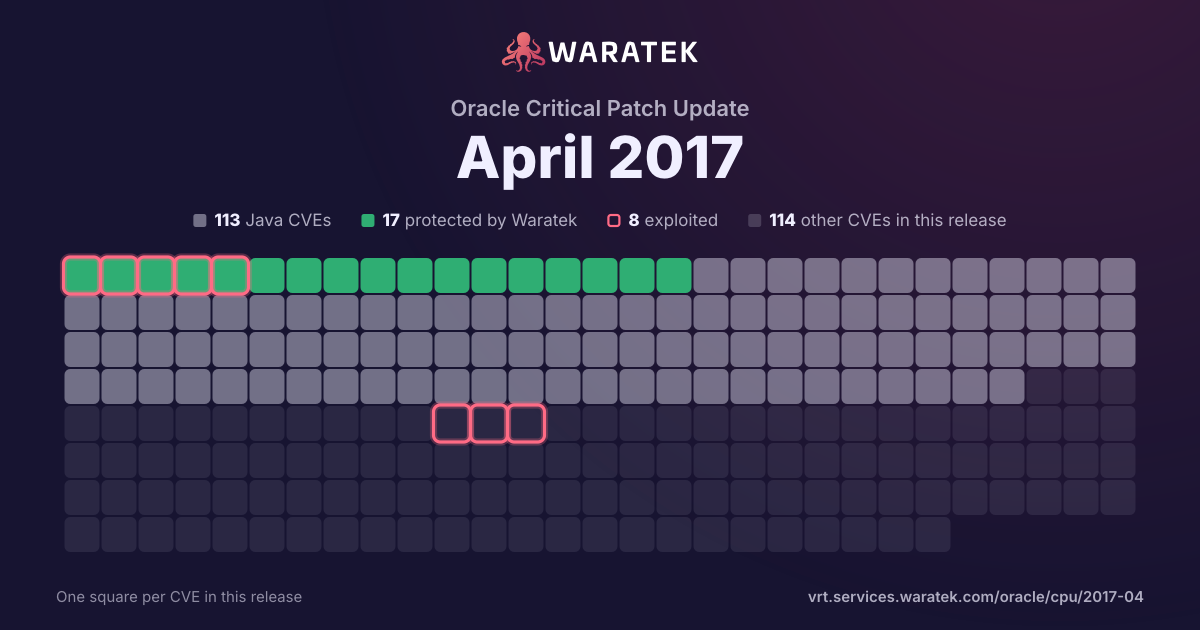
By status
17Protected by Waratek1Mitigation candidate95No exploit published13Outside Waratek scope101Not applicable
8Exploited, marked by the ring
No exploit published. For 93 of them, Oracle's security advisory is the source of public detail.
Protected by Waratek. Waratek RASP can block exploitation of these on systems that have not applied the patch yet.
Overview 18 matches · 0 in Waratek scope · 0 protected · 1 exploited · 0 CISA KEV · 3 public PoC · 3 EPSS ≥ 0.5
18matches
0in Waratek scope0.0%
0protected0.0%
1exploited5.6%
0CISA KEV0.0%
3public PoC16.7%
3EPSS ≥ 0.516.7%
Protected by Waratek
0
0.0%
Rule in development
0
0.0%
Mitigation candidate
0
0.0%
No exploit published
0
0.0%
Outside Waratek scope
0
0.0%
Not applicable
18
100.0%
Withdrawn CVE
0
0.0%
blocked by ARMR today
0
0.0%
partly blocked
0
0.0%
not blocked
18
100.0%
not established
0
0.0%
unrecorded
0
0.0%
Exploited
1
5.6%
Working exploit published
2
11.1%
Proof of concept only
0
0.0%
Forecast only
1
5.6%
No public exploit
14
77.8%
split by
peak 9 / year
20091
Not applicable1
Critical1
not blocked1
Working exploit published1
20100
20110
20122
Not applicable2
High1
Medium1
not blocked2
No public exploit2
20132
Not applicable2
High1
Medium1
not blocked2
No public exploit2
20140
20153
Not applicable3
High1
Medium2
not blocked3
Exploited1
No public exploit2
20169
Not applicable9
Critical4
High3
Medium2
not blocked9
Working exploit published1
Forecast only1
No public exploit7
20171
Not applicable1
High1
not blocked1
No public exploit1
200920102011201220132014201520162017
| CVE | Severity | Published▾ | Status | Exploitation | Description |
|---|---|---|---|---|---|
| CVE-2017-3302 | High | 2017-02-12 | Not applicable | No public exploit | Crash in libmysqlclient.so in Oracle MySQL before 5.6.21 and 5.7.x before 5.7.5 and MariaDB through 5.5.54, 10.0.x through 10.0.29, 10.1.x through 10.1.21, and 10.2.x through 10.2.3. |
| CVE-2016-5407 | Critical | 2016-12-13 | Not applicable | No public exploit | The (1) XvQueryAdaptors and (2) XvQueryEncodings functions in X.org libXv before 1.0.11 allow remote X servers to trigger out-of-bounds memory access operations via vectors involving length specifications in received data. |
| CVE-2016-6304 | High | 2016-09-26 | Not applicable | Forecast only | Multiple memory leaks in t1_lib.c in OpenSSL before 1.0.1u, 1.0.2 before 1.0.2i, and 1.1.0 before 1.1.0a allow remote attackers to cause a denial of service (memory consumption) via large OCSP Status Request extensions. |
| CVE-2016-6303 | Critical | 2016-09-16 | Not applicable | No public exploit | Integer overflow in the MDC2_Update function in crypto/mdc2/mdc2dgst.c in OpenSSL before 1.1.0 allows remote attackers to cause a denial of service (out-of-bounds write and application crash) or possibly have unspecified other impact via unknown vectors. |
| CVE-2016-6290 | Critical | 2016-07-25 | Not applicable | No public exploit | ext/session/session.c in PHP before 5.5.38, 5.6.x before 5.6.24, and 7.x before 7.0.9 does not properly maintain a certain hash data structure, which allows remote attackers to cause a denial of service (use-after-free) or possibly have unspecified other impact via vectors related to session deserialization. |
| CVE-2016-3506 | High | 2016-07-21 | Not applicable | No public exploit | Unspecified vulnerability in the JDBC component in Oracle Database Server 11.2.0.4, 12.1.0.1, and 12.1.0.2; the Oracle Retail Xstore Point of Service 5.5, 6.0, 6.5, 7.0, 7.1, 15.0, and 16.0; the Oracle Retail Warehouse Management System 14.04, 14.1.3, and 15.0.1; the Oracle Retail Workforce Management 1.60.7, and 1.64.0; the Oracle Retail Clearance Optimization Engine 13.4; the Oracle Retail Markdown Optimization 13.4 and 14.0; and Oracle Retail Merchandising System 16.0 allows remote attackers to affect confidentiality, integrity, and availability via unknown vectors. |
| CVE-2016-3739 | Medium | 2016-05-20 | Not applicable | No public exploit | The (1) mbed_connect_step1 function in lib/vtls/mbedtls.c and (2) polarssl_connect_step1 function in lib/vtls/polarssl.c in cURL and libcurl before 7.49.0, when using SSLv3 or making a TLS connection to a URL that uses a numerical IP address, allow remote attackers to spoof servers via an arbitrary valid certificate. |
| CVE-2016-2176 | High | 2016-05-05 | Not applicable | No public exploit | The X509_NAME_oneline function in crypto/x509/x509_obj.c in OpenSSL before 1.0.1t and 1.0.2 before 1.0.2h allows remote attackers to obtain sensitive information from process stack memory or cause a denial of service (buffer over-read) via crafted EBCDIC ASN.1 data. |
| CVE-2016-2107 | Medium | 2016-05-05 | Not applicable | Working exploit published | The AES-NI implementation in OpenSSL before 1.0.1t and 1.0.2 before 1.0.2h does not consider memory allocation during a certain padding check, which allows remote attackers to obtain sensitive cleartext information via a padding-oracle attack against an AES CBC session. NOTE: this vulnerability exists because of an incorrect fix for CVE-2013-0169. |
| CVE-2016-0729 | Critical | 2016-04-07 | Not applicable | No public exploit | Multiple buffer overflows in (1) internal/XMLReader.cpp, (2) util/XMLURL.cpp, and (3) util/XMLUri.cpp in the XML Parser library in Apache Xerces-C before 3.1.3 allow remote attackers to cause a denial of service (segmentation fault or memory corruption) or possibly execute arbitrary code via a crafted document. |
| CVE-2015-5252 | High | 2015-12-29 | Not applicable | No public exploit | vfs.c in smbd in Samba 3.x and 4.x before 4.1.22, 4.2.x before 4.2.7, and 4.3.x before 4.3.3, when share names with certain substring relationships exist, allows remote attackers to bypass intended file-access restrictions via a symlink that points outside of a share. |
| CVE-2015-3237 | Medium | 2015-06-22 | Not applicable | No public exploit | The smb_request_state function in cURL and libcurl 7.40.0 through 7.42.1 allows remote SMB servers to obtain sensitive information from memory or cause a denial of service (out-of-bounds read and crash) via crafted length and offset values. |
| CVE-2015-0204 | Medium | 2015-01-09 | Not applicable | Exploited | The ssl3_get_key_exchange function in s3_clnt.c in OpenSSL before 0.9.8zd, 1.0.0 before 1.0.0p, and 1.0.1 before 1.0.1k allows remote SSL servers to conduct RSA-to-EXPORT_RSA downgrade attacks and facilitate brute-force decryption by offering a weak ephemeral RSA key in a noncompliant role, related to the "FREAK" issue. NOTE: the scope of this CVE is only client code based on OpenSSL, not EXPORT_RSA issues associated with servers or other TLS implementations. |
| CVE-2013-5209 | High | 2013-08-29 | Not applicable | No public exploit | The sctp_send_initiate_ack function in sys/netinet/sctp_output.c in the SCTP implementation in the kernel in FreeBSD 8.3 through 9.2-PRERELEASE does not properly initialize the state-cookie data structure, which allows remote attackers to obtain sensitive information from kernel stack memory by reading packet data in INIT-ACK chunks. |
| CVE-2013-1982 | Medium | 2013-06-15 | Not applicable | No public exploit | Multiple integer overflows in X.org libXext 1.3.1 and earlier allow X servers to trigger allocation of insufficient memory and a buffer overflow via vectors related to the (1) XcupGetReservedColormapEntries, (2) XcupStoreColors, (3) XdbeGetVisualInfo, (4) XeviGetVisualInfo, (5) XShapeGetRectangles, and (6) XSyncListSystemCounters functions. |
| CVE-2012-5881 | Medium | 2012-11-16 | Not applicable | No public exploit | Cross-site scripting (XSS) vulnerability in the Flash component infrastructure in YUI 2.4.0 through 2.9.0 allows remote attackers to inject arbitrary web script or HTML via vectors related to charts.swf, a similar issue to CVE-2010-4207. |
| CVE-2012-0920 | High | 2012-06-05 | Not applicable | No public exploit | Use-after-free vulnerability in Dropbear SSH Server 0.52 through 2012.54, when command restriction and public key authentication are enabled, allows remote authenticated users to execute arbitrary code and bypass command restrictions via multiple crafted command requests, related to "channels concurrency." |
| CVE-2004-2761 | Critical | 2009-01-05 | Not applicable | Working exploit published | The MD5 Message-Digest Algorithm is not collision resistant, which makes it easier for context-dependent attackers to conduct spoofing attacks, as demonstrated by attacks on the use of MD5 in the signature algorithm of an X.509 certificate. |