
Oracle Critical Patch Update April 2017
Released April 2017 · Oracle's advisory ↗ · ← Critical Patch Update, January 2017 · Critical Patch Update, July 2017 →
227 CVEs in this release, one square each
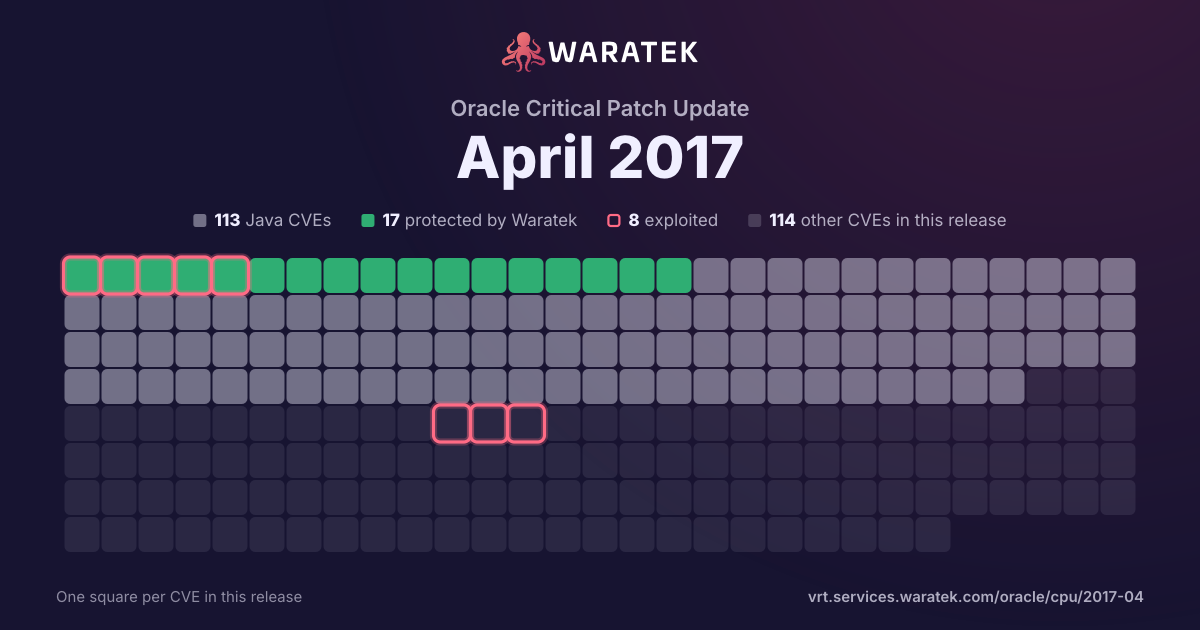
By status
17Protected by Waratek1Mitigation candidate95No exploit published13Outside Waratek scope101Not applicable
8Exploited, marked by the ring
No exploit published. For 93 of them, Oracle's security advisory is the source of public detail.
Protected by Waratek. Waratek RASP can block exploitation of these on systems that have not applied the patch yet.
Overview 2 matches · 0 in Waratek scope · 0 protected · 0 exploited · 0 CISA KEV · 1 EPSS ≥ 0.5
Protected by Waratek
0
0.0%
Rule in development
0
0.0%
Mitigation candidate
0
0.0%
No exploit published
0
0.0%
Outside Waratek scope
0
0.0%
Not applicable
2
100.0%
Withdrawn CVE
0
0.0%
blocked by ARMR today
0
0.0%
partly blocked
0
0.0%
not blocked
2
100.0%
not established
0
0.0%
unrecorded
0
0.0%
Exploited
0
0.0%
Working exploit published
2
100.0%
Proof of concept only
0
0.0%
Forecast only
0
0.0%
No public exploit
0
0.0%
split by
peak 1 / year
20092010201120122013201420152016
| CVE | Severity | Published▾ | Status | Exploitation | Description |
|---|---|---|---|---|---|
| CVE-2016-2107 | Medium | 2016-05-05 | Not applicable | Working exploit published | The AES-NI implementation in OpenSSL before 1.0.1t and 1.0.2 before 1.0.2h does not consider memory allocation during a certain padding check, which allows remote attackers to obtain sensitive cleartext information via a padding-oracle attack against an AES CBC session. NOTE: this vulnerability exists because of an incorrect fix for CVE-2013-0169. |
| CVE-2004-2761 | Critical | 2009-01-05 | Not applicable | Working exploit published | The MD5 Message-Digest Algorithm is not collision resistant, which makes it easier for context-dependent attackers to conduct spoofing attacks, as demonstrated by attacks on the use of MD5 in the signature algorithm of an X.509 certificate. |