
Oracle Critical Patch Update January 2017
Released January 2017 · Oracle's advisory ↗ · ← Critical Patch Update, October 2016 · Critical Patch Update, April 2017 →
163 CVEs in this release, one square each
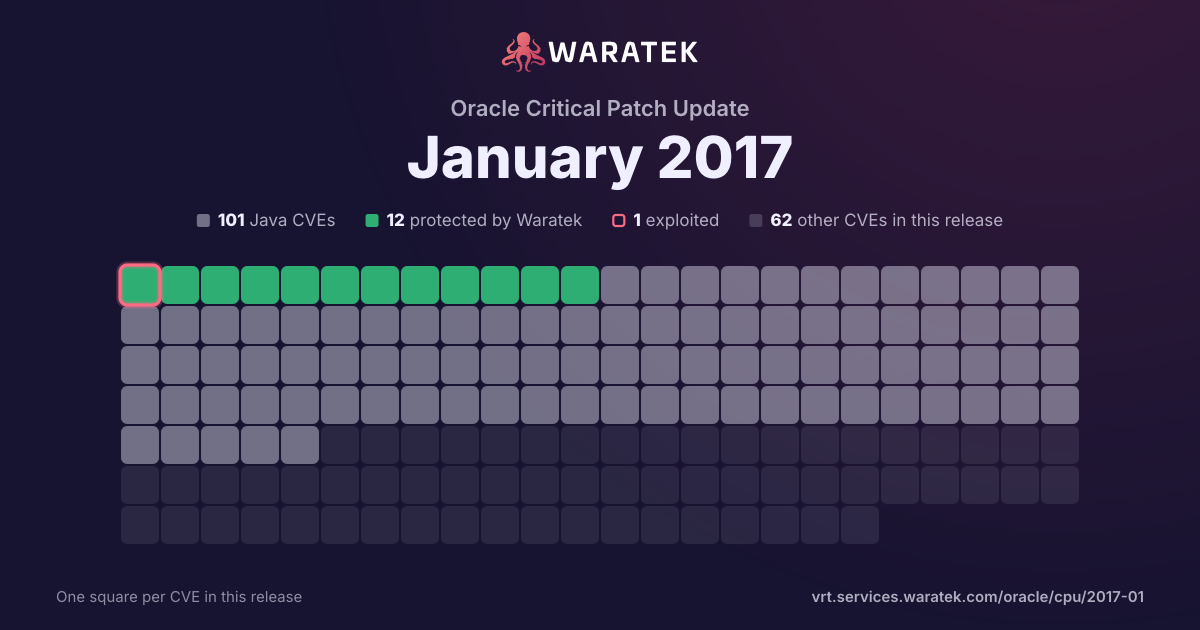
By status
12Protected by Waratek89No exploit published16Outside Waratek scope46Not applicable
1Exploited, marked by the ring
No exploit published. For 86 of them, Oracle's security advisory is the source of public detail.
Protected by Waratek. Waratek RASP can block exploitation of these on systems that have not applied the patch yet.
Overview 3 matches · 1 in Waratek scope · 1 protected · 0 exploited · 0 CISA KEV · 1 public PoC
Protected by Waratek
1
33.3%
Rule in development
0
0.0%
Mitigation candidate
0
0.0%
No exploit published
0
0.0%
Outside Waratek scope
1
33.3%
Not applicable
1
33.3%
Withdrawn CVE
0
0.0%
blocked by ARMR today
1
33.3%
partly blocked
0
0.0%
not blocked
2
66.7%
not established
0
0.0%
unrecorded
0
0.0%
Exploited
0
0.0%
Working exploit published
1
33.3%
Proof of concept only
1
33.3%
Forecast only
1
33.3%
No public exploit
0
0.0%
split by
peak 2 / month
Sep 16Oct 16Nov 16Dec 16Jan 17
| CVE | Severity | Published▾ | Status | Exploitation | Description |
|---|---|---|---|---|---|
| CVE-2017-3248 | Critical | 2017-01-27 | Protected by Waratek | Working exploit published | Vulnerability in the Oracle WebLogic Server component of Oracle Fusion Middleware (subcomponent: Core Components). Supported versions that are affected are 10.3.6.0, 12.1.3.0, 12.2.1.0 and 12.2.1.1. Easily exploitable vulnerability allows unauthenticated attacker with network access via T3 to compromise Oracle WebLogic Server. Successful attacks of this vulnerability can result in takeover of Oracle WebLogic Server. CVSS v3.0 Base Score 9.8 (Confidentiality, Integrity and Availability impacts). |
| CVE-2016-6304 | High | 2016-09-26 | Not applicable | Forecast only | Multiple memory leaks in t1_lib.c in OpenSSL before 1.0.1u, 1.0.2 before 1.0.2i, and 1.1.0 before 1.1.0a allow remote attackers to cause a denial of service (memory consumption) via large OCSP Status Request extensions. |
| CVE-2016-2183 | High | 2016-09-01 | Outside Waratek scope | Proof of concept only | The DES and Triple DES ciphers, as used in the TLS, SSH, and IPSec protocols and other protocols and products, have a birthday bound of approximately four billion blocks, which makes it easier for remote attackers to obtain cleartext data via a birthday attack against a long-duration encrypted session, as demonstrated by an HTTPS session using Triple DES in CBC mode, aka a "Sweet32" attack. |