
Oracle Critical Patch Update October 2016
Released October 2016 · Oracle's advisory ↗ · ← Critical Patch Update, July 2016 · Critical Patch Update, January 2017 →
205 CVEs in this release, one square each
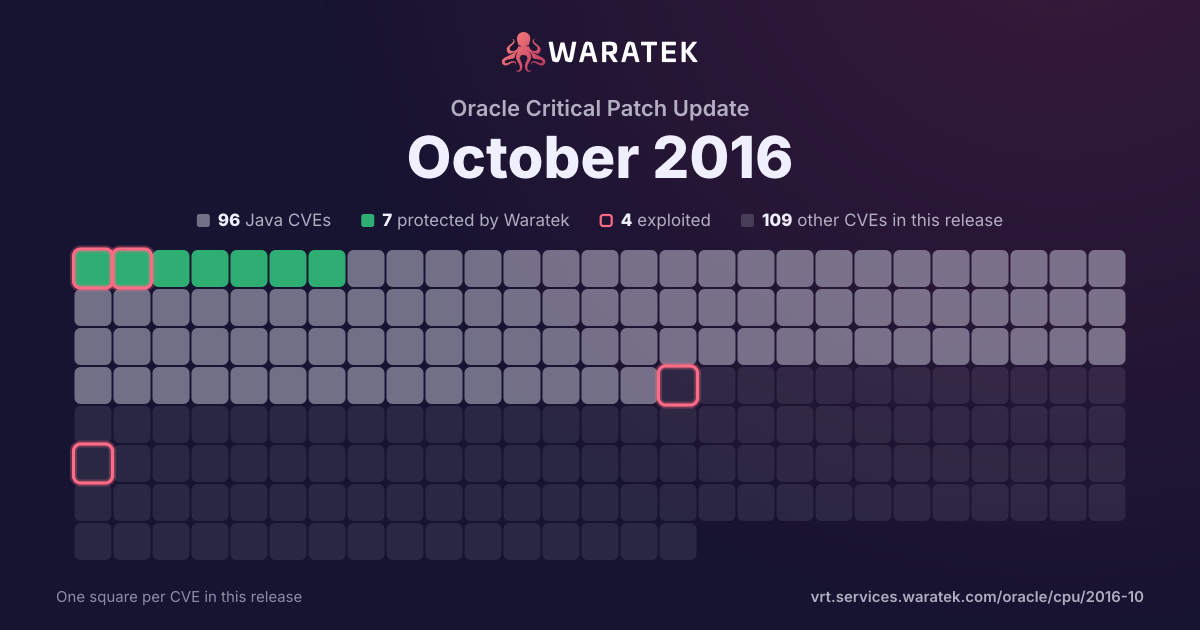
By status
7Protected by Waratek2Mitigation candidate87No exploit published39Outside Waratek scope68Not applicable2Withdrawn CVE
4Exploited, marked by the ring
No exploit published. For 83 of them, Oracle's security advisory is the source of public detail.
Protected by Waratek. Waratek RASP can block exploitation of these on systems that have not applied the patch yet.
Overview 96 matches · 7 protected · 2 exploited · 1 CISA KEV · 4 public PoC · 3 EPSS ≥ 0.5
Protected by Waratek
7
7.3%
Rule in development
0
0.0%
Mitigation candidate
2
2.1%
No exploit published
87
90.6%
blocked by ARMR today
7
7.3%
partly blocked
0
0.0%
not blocked
89
92.7%
not established
0
0.0%
unrecorded
0
0.0%
Exploited
2
2.1%
Working exploit published
2
2.1%
Proof of concept only
0
0.0%
Forecast only
0
0.0%
No public exploit
92
95.8%
split by
peak 85 / quarter
Q1 142
Protected by Waratek1
No exploit published1
Medium2
blocked by ARMR today1
not blocked1
No public exploit2
Q2 145
Protected by Waratek2
Mitigation candidate1
No exploit published2
High1
Medium4
blocked by ARMR today2
not blocked3
Working exploit published1
No public exploit4
Q3 141
No exploit published1
Medium1
not blocked1
No public exploit1
Q4 140
Q1 150
Q2 150
Q3 150
Q4 150
Q1 160
Q2 161
Protected by Waratek1
High1
blocked by ARMR today1
Exploited1
Q3 161
Protected by Waratek1
High1
blocked by ARMR today1
No public exploit1
Q4 1685
Protected by Waratek1
Mitigation candidate1
No exploit published83
Critical4
High33
Medium45
Low3
blocked by ARMR today1
not blocked84
Working exploit published1
No public exploit84
Q1 170
Q2 170
Q3 170
Q4 171
Protected by Waratek1
Critical1
blocked by ARMR today1
Exploited1
Q2 14Q4 14Q2 15Q4 15Q2 16Q4 16Q2 17Q4 17
| CVE | Severity | Published▾ | Status | Exploitation | Description |
|---|---|---|---|---|---|
| CVE-2015-7501 | Critical | 2017-11-09 | Protected by Waratek | Exploited | Red Hat JBoss A-MQ 6.x; BPM Suite (BPMS) 6.x; BRMS 6.x and 5.x; Data Grid (JDG) 6.x; Data Virtualization (JDV) 6.x and 5.x; Enterprise Application Platform 6.x, 5.x, and 4.3.x; Fuse 6.x; Fuse Service Works (FSW) 6.x; Operations Network (JBoss ON) 3.x; Portal 6.x; SOA Platform (SOA-P) 5.x; Web Server (JWS) 3.x; Red Hat OpenShift/xPAAS 3.x; and Red Hat Subscription Asset Manager 1.3 allow remote attackers to execute arbitrary commands via a crafted serialized Java object, related to the Apache Commons Collections (ACC) library. |
| CVE-2016-8296 | High | 2016-10-25 | No exploit published | No public exploit | Unspecified vulnerability in the PeopleSoft Enterprise PeopleTools component in Oracle PeopleSoft Products 8.54 and 8.55 allows remote authenticated users to affect confidentiality and integrity via vectors related to LDAP. |
| CVE-2016-8295 | Medium | 2016-10-25 | No exploit published | No public exploit | Unspecified vulnerability in the PeopleSoft Enterprise HCM component in Oracle PeopleSoft Products 9.2 allows remote authenticated users to affect confidentiality via unknown vectors. |
| CVE-2016-8294 | Medium | 2016-10-25 | No exploit published | No public exploit | Unspecified vulnerability in the PeopleSoft Enterprise PeopleTools component in Oracle PeopleSoft Products 8.54 and 8.55 allows remote authenticated users to affect confidentiality via unknown vectors. |
| CVE-2016-8293 | High | 2016-10-25 | No exploit published | No public exploit | Unspecified vulnerability in the PeopleSoft Enterprise PeopleTools component in Oracle PeopleSoft Products 8.54 and 8.55 allows remote attackers to affect confidentiality and integrity via vectors related to Integration Broker, a different vulnerability than CVE-2016-5529 and CVE-2016-5530. |
| CVE-2016-8292 | Medium | 2016-10-25 | No exploit published | No public exploit | Unspecified vulnerability in the PeopleSoft Enterprise HCM component in Oracle PeopleSoft Products 9.2 allows remote authenticated users to affect confidentiality and integrity via vectors related to Talent Acquisition Manager. |
| CVE-2016-8291 | High | 2016-10-25 | No exploit published | No public exploit | Unspecified vulnerability in the PeopleSoft Enterprise PeopleTools component in Oracle PeopleSoft Products 8.54 and 8.55 allows remote attackers to affect confidentiality and integrity via vectors related to Mobile Application Platform. |
| CVE-2016-8285 | Medium | 2016-10-25 | No exploit published | No public exploit | Unspecified vulnerability in the PeopleSoft Enterprise HCM component in Oracle PeopleSoft Products 9.2 allows remote administrators to affect confidentiality and integrity via vectors related to Candidate Gateway. |
| CVE-2016-8281 | High | 2016-10-25 | No exploit published | No public exploit | Unspecified vulnerability in the Oracle Platform Security for Java component in Oracle Fusion Middleware 12.1.3.0.0, 12.2.1.0.0, and 12.2.1.1.0 allows remote authenticated users to affect confidentiality, integrity, and availability via unknown vectors, a different vulnerability than CVE-2016-5536. |
| CVE-2016-5622 | Medium | 2016-10-25 | No exploit published | No public exploit | Unspecified vulnerability in the Oracle FLEXCUBE Universal Banking component in Oracle Financial Services Applications 11.3.0, 11.4.0, 12.0.1 through 12.0.3, 12.1.0, and 12.2.0 allows remote attackers to affect confidentiality and integrity via vectors related to INFRA. |
| CVE-2016-5621 | Medium | 2016-10-25 | No exploit published | No public exploit | Unspecified vulnerability in the Oracle FLEXCUBE Universal Banking component in Oracle Financial Services Applications 11.3.0, 11.4.0, 12.0.1 and 12.0.3, 12.1.0, and 12.2.0 allows remote authenticated users to affect confidentiality via vectors related to INFRA, a different vulnerability than CVE-2016-5603. |
| CVE-2016-5620 | Medium | 2016-10-25 | No exploit published | No public exploit | Unspecified vulnerability in the Oracle FLEXCUBE Universal Banking component in Oracle Financial Services Applications 11.3.0, 11.4.0, 12.0.1 through 12.0.3, 12.1.0, and 12.2.0 allows remote authenticated users to affect confidentiality and integrity via vectors related to INFRA, a different vulnerability than CVE-2016-5619. |
| CVE-2016-5619 | High | 2016-10-25 | No exploit published | No public exploit | Unspecified vulnerability in the Oracle FLEXCUBE Universal Banking component in Oracle Financial Services Applications 11.3.0, 11.4.0, 12.0.1 through 12.0.3, 12.1.0, and 12.2.0 allows remote authenticated users to affect confidentiality and integrity via vectors related to INFRA, a different vulnerability than CVE-2016-5620. |
| CVE-2016-5618 | Low | 2016-10-25 | No exploit published | No public exploit | Unspecified vulnerability in the Oracle Data Integrator component in Oracle Fusion Middleware 11.1.1.7.0, 11.1.1.9.0, 12.1.2.0.0, 12.1.3.0.0, 12.2.1.0.0, and 12.2.1.1.0 allows remote authenticated users to affect confidentiality via vectors related to Code Generation Engine. |
| CVE-2016-5607 | High | 2016-10-25 | No exploit published | No public exploit | Unspecified vulnerability in the Oracle FLEXCUBE Universal Banking component in Oracle Financial Services Applications 11.3.0, 11.4.0, 12.0.1 through 12.0.3, 12.1.0, and 12.2.0 allows remote authenticated users to affect confidentiality, integrity, and availability via vectors related to INFRA. |
| CVE-2016-5604 | Medium | 2016-10-25 | No exploit published | No public exploit | Unspecified vulnerability in the Enterprise Manager Base Platform component in Oracle Enterprise Manager Grid Control 12.1.0.5 allows local users to affect confidentiality and integrity via vectors related to Security Framework, a different vulnerability than CVE-2016-3563. |
| CVE-2016-5603 | Medium | 2016-10-25 | No exploit published | No public exploit | Unspecified vulnerability in the Oracle FLEXCUBE Universal Banking component in Oracle Financial Services Applications 11.3.0, 11.4.0, 12.0.1 through 12.0.3, 12.1.0, and 12.2.0 allows remote authenticated users to affect confidentiality via vectors related to INFRA, a different vulnerability than CVE-2016-5621. |
| CVE-2016-5602 | Medium | 2016-10-25 | No exploit published | No public exploit | Unspecified vulnerability in the Oracle Data Integrator component in Oracle Fusion Middleware 11.1.1.7.0, 11.1.1.9.0, 12.1.3.0.0, 12.2.1.0.0, and 12.2.1.1.0 allows remote authenticated users to affect confidentiality via vectors related to Code Generation Engine. |
| CVE-2016-5601 | Medium | 2016-10-25 | No exploit published | No public exploit | Unspecified vulnerability in the Oracle WebLogic Server component in Oracle Fusion Middleware 12.1.3.0, 12.2.1.0, and 12.2.1.1 allows local users to affect confidentiality and integrity via vectors related to CIE Related Components. |
| CVE-2016-5600 | Medium | 2016-10-25 | No exploit published | No public exploit | Unspecified vulnerability in the PeopleSoft Enterprise SCM Services Procurement component in Oracle PeopleSoft Products 9.1 and 9.2 allows remote authenticated users to affect confidentiality and integrity via unknown vectors. |
| CVE-2016-5599 | Critical | 2016-10-25 | No exploit published | No public exploit | Unspecified vulnerability in the Oracle Advanced Supply Chain Planning component in Oracle Supply Chain Products Suite 12.2.3 through 12.2.5 allows remote attackers to affect confidentiality and integrity via vectors related to MscObieeSrvlt. |
| CVE-2016-5596 | Medium | 2016-10-25 | No exploit published | No public exploit | Unspecified vulnerability in the Oracle CRM Technical Foundation component in Oracle E-Business Suite 12.1.1 through 12.1.3 and 12.2.3 through 12.2.6 allows remote authenticated users to affect confidentiality via unknown vectors. |
| CVE-2016-5595 | High | 2016-10-25 | No exploit published | No public exploit | Unspecified vulnerability in the Oracle Customer Interaction History component in Oracle E-Business Suite 12.1.1 through 12.1.3, 12.2.3, and 12.2.4 allows remote attackers to affect confidentiality and integrity via unknown vectors, a different vulnerability than CVE-2016-5592. |
| CVE-2016-5594 | Medium | 2016-10-25 | No exploit published | No public exploit | Unspecified vulnerability in the Oracle FLEXCUBE Universal Banking component in Oracle Financial Services Applications 11.3.0, 11.4.0, and 12.0.1 through 12.0.3 allows remote authenticated users to affect confidentiality via vectors related to INFRA. |
| CVE-2016-5593 | High | 2016-10-25 | No exploit published | No public exploit | Unspecified vulnerability in the Oracle Customer Interaction History component in Oracle E-Business Suite 12.1.1 through 12.1.3, 12.2.3, and 12.2.4 allows remote attackers to affect confidentiality and integrity via unknown vectors, a different vulnerability than CVE-2016-5587 and CVE-2016-5591. |
| CVE-2016-5592 | High | 2016-10-25 | No exploit published | No public exploit | Unspecified vulnerability in the Oracle Customer Interaction History component in Oracle E-Business Suite 12.1.1 through 12.1.3, 12.2.3, and 12.2.4 allows remote attackers to affect confidentiality and integrity via unknown vectors, a different vulnerability than CVE-2016-5595. |
| CVE-2016-5591 | High | 2016-10-25 | No exploit published | No public exploit | Unspecified vulnerability in the Oracle Customer Interaction History component in Oracle E-Business Suite 12.1.1 through 12.1.3, 12.2.3, and 12.2.4 allows remote attackers to affect confidentiality and integrity via unknown vectors, a different vulnerability than CVE-2016-5587 and CVE-2016-5593. |
| CVE-2016-5589 | High | 2016-10-25 | No exploit published | No public exploit | Unspecified vulnerability in the Oracle CRM Technical Foundation component in Oracle E-Business Suite 12.1.1 through 12.1.3 and 12.2.3 through 12.2.6 allows remote attackers to affect confidentiality and integrity via unknown vectors. |
| CVE-2016-5587 | High | 2016-10-25 | No exploit published | No public exploit | Unspecified vulnerability in the Oracle Customer Interaction History component in Oracle E-Business Suite 12.1.1 through 12.1.3, 12.2.3, and 12.2.4 allows remote attackers to affect confidentiality and integrity via unknown vectors, a different vulnerability than CVE-2016-5591 and CVE-2016-5593. |
| CVE-2016-5586 | High | 2016-10-25 | No exploit published | No public exploit | Unspecified vulnerability in the Oracle Email Center component in Oracle E-Business Suite 12.1.1 through 12.1.3 and 12.2.3 through 12.2.6 allows remote attackers to affect confidentiality and integrity via unknown vectors. |
| CVE-2016-5585 | Medium | 2016-10-25 | No exploit published | No public exploit | Unspecified vulnerability in the Oracle Interaction Center Intelligence component in Oracle E-Business Suite 12.1.1 through 12.1.3 allows remote attackers to affect confidentiality and integrity via unknown vectors. |
| CVE-2016-5583 | Medium | 2016-10-25 | No exploit published | No public exploit | Unspecified vulnerability in the Oracle One-to-One Fulfillment component in Oracle E-Business Suite 12.1.1 through 12.1.3 and 12.2.3 through 12.2.6 allows remote attackers to affect integrity via unknown vectors. |
| CVE-2016-5581 | Medium | 2016-10-25 | No exploit published | No public exploit | Unspecified vulnerability in the Oracle iRecruitment component in Oracle E-Business Suite 12.1.1 through 12.1.3 and 12.2.3 through 12.2.6 allows local users to affect confidentiality, integrity, and availability via unknown vectors. |
| CVE-2016-5575 | Medium | 2016-10-25 | No exploit published | No public exploit | Unspecified vulnerability in the Oracle Common Applications Calendar component in Oracle E-Business Suite 12.1.1 through 12.1.3 and 12.2.3 through 12.2.6 allows remote attackers to affect confidentiality via vectors related to Resources Module. |
| CVE-2016-5571 | Medium | 2016-10-25 | No exploit published | No public exploit | Unspecified vulnerability in the Oracle Applications DBA component in Oracle E-Business Suite 12.1.3 and 12.2.3 through 12.2.6 allows remote administrators to affect confidentiality and integrity via vectors related to AD Utilities, a different vulnerability than CVE-2016-5567. |
| CVE-2016-5570 | Medium | 2016-10-25 | No exploit published | No public exploit | Unspecified vulnerability in the Oracle Applications DBA component in Oracle E-Business Suite 12.2.3 through 12.2.6 allows remote administrators to affect confidentiality and integrity via vectors related to AD Utilities. |
| CVE-2016-5569 | Medium | 2016-10-25 | No exploit published | No public exploit | Unspecified vulnerability in the Oracle FLEXCUBE Enterprise Limits and Collateral Management component in Oracle Financial Services Applications 12.0.0 and 12.1.0 allows remote authenticated users to affect confidentiality and integrity via unknown vectors. |
| CVE-2016-5567 | Medium | 2016-10-25 | No exploit published | No public exploit | Unspecified vulnerability in the Oracle Applications DBA component in Oracle E-Business Suite 12.1.3 and 12.2.3 through 12.2.6 allows remote administrators to affect confidentiality and integrity via vectors related to AD Utilities, a different vulnerability than CVE-2016-5571. |
| CVE-2016-5565 | High | 2016-10-25 | No exploit published | No public exploit | Unspecified vulnerability in the Oracle Hospitality OPERA 5 Property Services component in Oracle Hospitality Applications 5.4.0.0 through 5.4.3.0, 5.5.0.0, and 5.5.1.0 allows remote authenticated users to affect confidentiality via vectors related to OPERA. |
| CVE-2016-5564 | High | 2016-10-25 | No exploit published | No public exploit | Unspecified vulnerability in the Oracle Hospitality OPERA 5 Property Services component in Oracle Hospitality Applications 5.4.0.0 through 5.4.3.0, 5.5.0.0, and 5.5.1.0 allows remote authenticated users to affect confidentiality, integrity, and availability via vectors related to OPERA. |
| CVE-2016-5563 | High | 2016-10-25 | No exploit published | No public exploit | Unspecified vulnerability in the Oracle Hospitality OPERA 5 Property Services component in Oracle Hospitality Applications 5.4.0.0 through 5.4.3.0, 5.5.0.0, and 5.5.1.0 allows remote administrators to affect confidentiality, integrity, and availability via vectors related to OPERA. |
| CVE-2016-5562 | High | 2016-10-25 | No exploit published | No public exploit | Unspecified vulnerability in the Oracle iProcurement component in Oracle E-Business Suite 12.1.1 through 12.1.3 and 12.2.3 through 12.2.6 allows remote authenticated users to affect confidentiality and integrity via unknown vectors. |
| CVE-2016-5560 | Medium | 2016-10-25 | No exploit published | No public exploit | Unspecified vulnerability in the Siebel UI Framework component in Oracle Siebel CRM 16.1 allows remote authenticated users to affect confidentiality and integrity via vectors related to OpenUI. |
| CVE-2016-5557 | High | 2016-10-25 | No exploit published | No public exploit | Unspecified vulnerability in the Oracle Advanced Pricing component in Oracle E-Business Suite 12.1.1 through 12.1.3 and 12.2.3 through 12.2.6 allows remote attackers to affect confidentiality and integrity via unknown vectors. |
| CVE-2016-5543 | Medium | 2016-10-25 | No exploit published | No public exploit | Unspecified vulnerability in the Oracle FLEXCUBE Enterprise Limits and Collateral Management component in Oracle Financial Services Applications 12.0.0 and 12.1.0 allows remote attackers to affect confidentiality and integrity via vectors related to INFRA. |
| CVE-2016-5540 | Medium | 2016-10-25 | No exploit published | No public exploit | Unspecified vulnerability in the Oracle Retail Xstore Payment component in Oracle Retail Applications 1.x allows local users to affect confidentiality and integrity via unknown vectors. |
| CVE-2016-5539 | High | 2016-10-25 | No exploit published | No public exploit | Unspecified vulnerability in the Oracle Retail Xstore Payment component in Oracle Retail Applications 1.x allows local users to affect confidentiality, integrity, and availability via unknown vectors. |
| CVE-2016-5537 | Medium | 2016-10-25 | Protected by Waratek | No public exploit | Unspecified vulnerability in the NetBeans component in Oracle Fusion Middleware 8.1 allows local users to affect confidentiality, integrity, and availability via unknown vectors. NOTE: the previous information is from the October 2016 CPU. Oracle has not commented on third-party claims that this issue is a directory traversal vulnerability which allows local users with certain permissions to write to arbitrary files and consequently gain privileges via a .. (dot dot) in a archive entry in a ZIP file imported as a project. |
| CVE-2016-5536 | High | 2016-10-25 | No exploit published | No public exploit | Unspecified vulnerability in the Oracle Platform Security for Java component in Oracle Fusion Middleware 12.1.3.0.0, 12.2.1.0.0, and 12.2.1.1.0 allows remote authenticated users to affect confidentiality, integrity, and availability via unknown vectors, a different vulnerability than CVE-2016-8281. |
| CVE-2016-5535 | Critical | 2016-10-25 | No exploit published | No public exploit | Unspecified vulnerability in the Oracle WebLogic Server component in Oracle Fusion Middleware 10.3.6.0, 12.1.3.0, 12.2.1.0, and 12.2.1.1 allows remote attackers to affect confidentiality, integrity, and availability via unknown vectors. |
| CVE-2016-5534 | Medium | 2016-10-25 | No exploit published | No public exploit | Unspecified vulnerability in the Siebel Apps - Customer Order Management component in Oracle Siebel CRM 16.1 allows remote authenticated users to affect confidentiality via unknown vectors. |
| CVE-2016-5533 | Medium | 2016-10-25 | No exploit published | No public exploit | Unspecified vulnerability in the Primavera P6 Enterprise Project Portfolio Management component in Oracle Primavera Products Suite 8.4, 15.x, and 16.x allows remote authenticated users to affect confidentiality and integrity via unknown vectors. |
| CVE-2016-5532 | Medium | 2016-10-25 | No exploit published | No public exploit | Unspecified vulnerability in the Oracle Shipping Execution component in Oracle E-Business Suite 12.1.1 through 12.1.3 and 12.2.3 through 12.2.6 allows remote attackers to affect confidentiality via vectors related to Workflow Events. |
| CVE-2016-5531 | Critical | 2016-10-25 | No exploit published | No public exploit | Unspecified vulnerability in the Oracle WebLogic Server component in Oracle Fusion Middleware 10.3.6.0, 12.1.3.0, and 12.2.1.0 allows remote attackers to affect confidentiality, integrity, and availability via vectors related to WLS-WebServices. |
| CVE-2016-5530 | Medium | 2016-10-25 | No exploit published | No public exploit | Unspecified vulnerability in the PeopleSoft Enterprise PeopleTools component in Oracle PeopleSoft Products 8.54 and 8.55 allows remote attackers to affect confidentiality and integrity via vectors related to Integration Broker, a different vulnerability than CVE-2016-5529 and CVE-2016-8293. |
| CVE-2016-5529 | Medium | 2016-10-25 | No exploit published | No public exploit | Unspecified vulnerability in the PeopleSoft Enterprise PeopleTools component in Oracle PeopleSoft Products 8.54 and 8.55 allows remote attackers to affect confidentiality and integrity via vectors related to Integration Broker, a different vulnerability than CVE-2016-5530 and CVE-2016-8293. |
| CVE-2016-5527 | Medium | 2016-10-25 | No exploit published | No public exploit | Unspecified vulnerability in the Oracle Agile PLM component in Oracle Supply Chain Products Suite 9.3.4 and 9.3.5 allows remote attackers to affect confidentiality via unknown vectors, a different vulnerability than CVE-2016-5524. |
| CVE-2016-5526 | High | 2016-10-25 | No exploit published | No public exploit | Unspecified vulnerability in the Oracle Agile PLM component in Oracle Supply Chain Products Suite 9.3.4 and 9.3.5 allows remote attackers to affect confidentiality, integrity, and availability via vectors related to Apache Tomcat. |
| CVE-2016-5524 | Medium | 2016-10-25 | No exploit published | No public exploit | Unspecified vulnerability in the Oracle Agile PLM component in Oracle Supply Chain Products Suite 9.3.4 and 9.3.5 allows remote attackers to affect confidentiality via unknown vectors, a different vulnerability than CVE-2016-5527. |
| CVE-2016-5523 | High | 2016-10-25 | No exploit published | No public exploit | Unspecified vulnerability in the Oracle Agile PLM component in Oracle Supply Chain Products Suite 9.3.4 and 9.3.5 allows remote authenticated users to affect confidentiality, integrity, and availability via vectors related to AutoVue Java Applet. |
| CVE-2016-5522 | Medium | 2016-10-25 | No exploit published | No public exploit | Unspecified vulnerability in the Oracle Agile PLM component in Oracle Supply Chain Products Suite 9.3.4 and 9.3.5 allows remote authenticated users to affect confidentiality via unknown vectors. |
| CVE-2016-5521 | Medium | 2016-10-25 | No exploit published | No public exploit | Unspecified vulnerability in the Oracle Agile PLM component in Oracle Supply Chain Products Suite 9.3.4 and 9.3.5 allows remote attackers to affect confidentiality and integrity via unknown vectors, a different vulnerability than CVE-2016-5512. |
| CVE-2016-5519 | High | 2016-10-25 | No exploit published | No public exploit | Unspecified vulnerability in the Oracle GlassFish Server component in Oracle Fusion Middleware 2.1.1, 3.0.1, and 3.1.2 allows remote authenticated users to affect confidentiality, integrity, and availability via vectors related to Java Server Faces. |
| CVE-2016-5518 | High | 2016-10-25 | No exploit published | No public exploit | Unspecified vulnerability in the Oracle Agile Engineering Data Management component in Oracle Supply Chain Products Suite 6.1.3.0 and 6.2.0.0 allows remote attackers to affect confidentiality, integrity, and availability via vectors related to webfileservices. |
| CVE-2016-5517 | Medium | 2016-10-25 | No exploit published | No public exploit | Unspecified vulnerability in the Oracle Applications DBA component in Oracle E-Business Suite 12.1.3 allows local users to affect confidentiality via vectors related to AD Utilities. |
| CVE-2016-5515 | High | 2016-10-25 | No exploit published | No public exploit | Unspecified vulnerability in the Oracle Agile PLM component in Oracle Supply Chain Products Suite 9.3.4 and 9.3.5 allows remote authenticated users to affect confidentiality, integrity, and availability via vectors related to RMIServlet. |
| CVE-2016-5514 | High | 2016-10-25 | No exploit published | No public exploit | Unspecified vulnerability in the Oracle Agile PLM component in Oracle Supply Chain Products Suite 9.3.4 and 9.3.5 allows remote authenticated users to affect confidentiality, integrity, and availability via vectors related to ExportServlet. |
| CVE-2016-5513 | Medium | 2016-10-25 | No exploit published | No public exploit | Unspecified vulnerability in the Oracle Agile PLM component in Oracle Supply Chain Products Suite 9.3.4 and 9.3.5 allows remote authenticated users to affect confidentiality via vectors related to File Manager. |
| CVE-2016-5512 | Medium | 2016-10-25 | No exploit published | No public exploit | Unspecified vulnerability in the Oracle Agile PLM component in Oracle Supply Chain Products Suite 9.3.4 and 9.3.5 allows remote attackers to affect confidentiality and integrity via unknown vectors, a different vulnerability than CVE-2016-5521. |
| CVE-2016-5511 | Medium | 2016-10-25 | No exploit published | No public exploit | Unspecified vulnerability in the Oracle WebCenter Sites component in Oracle Fusion Middleware 12.2.1.0.0, 12.2.1.1.0, and 12.2.1.2.0 allows remote attackers to affect integrity via unknown vectors. |
| CVE-2016-5510 | Medium | 2016-10-25 | No exploit published | No public exploit | Unspecified vulnerability in the Oracle Agile PLM component in Oracle Supply Chain Products Suite 9.3.4 and 9.3.5 allows remote attackers to affect confidentiality via unknown vectors. |
| CVE-2016-5506 | Low | 2016-10-25 | No exploit published | No public exploit | Unspecified vulnerability in the Oracle Identity Manager component in Oracle Fusion Middleware allows local users to affect confidentiality and integrity via vectors related to App Server. |
| CVE-2016-5504 | Medium | 2016-10-25 | No exploit published | No public exploit | Unspecified vulnerability in the Oracle Agile Product Lifecycle Management for Process component in Oracle Supply Chain Products Suite 6.1.0.4, 6.1.1.6, and 6.2.0.0 allows local users to affect confidentiality via vectors related to Supplier Portal. |
| CVE-2016-5502 | Medium | 2016-10-25 | No exploit published | No public exploit | Unspecified vulnerability in the Oracle FLEXCUBE Universal Banking component in Oracle Financial Services Applications 11.3.0, 11.4.0, 12.0.1 through 12.0.3 allows remote authenticated users to affect confidentiality and integrity via vectors related to INFRA. |
| CVE-2016-5500 | High | 2016-10-25 | No exploit published | No public exploit | Unspecified vulnerability in the Oracle Discoverer component in Oracle Fusion Middleware 11.1.1.7.0 allows remote attackers to affect confidentiality via vectors related to Viewer. |
| CVE-2016-5495 | High | 2016-10-25 | No exploit published | No public exploit | Unspecified vulnerability in the Oracle Discoverer component in Oracle Fusion Middleware 11.1.1.7.0 allows remote attackers to affect confidentiality via vectors related to EUL Code & Schema. |
| CVE-2016-5493 | Medium | 2016-10-25 | No exploit published | No public exploit | Unspecified vulnerability in the Oracle FLEXCUBE Private Banking component in Oracle Financial Services Applications 12.0.1 through 12.0.3 allows remote authenticated users to affect confidentiality and integrity via unknown vectors. |
| CVE-2016-5491 | High | 2016-10-25 | No exploit published | No public exploit | Unspecified vulnerability in the Oracle Commerce Service Center component in Oracle Commerce 10.0.3.5 and 10.2.0.5 allows remote attackers to affect confidentiality and integrity via unknown vectors. |
| CVE-2016-5490 | Low | 2016-10-25 | No exploit published | No public exploit | Unspecified vulnerability in the Oracle FLEXCUBE Universal Banking component in Oracle Financial Services Applications 11.4.0 allows local users to affect confidentiality via vectors related to INFRA. |
| CVE-2016-5489 | High | 2016-10-25 | No exploit published | No public exploit | Unspecified vulnerability in the Oracle iStore component in Oracle E-Business Suite 12.1.1 through 12.1.3, 12.2.3, and 12.2.4 allows remote attackers to affect confidentiality and integrity via vectors related to Runtime Catalog. |
| CVE-2016-5488 | Medium | 2016-10-25 | No exploit published | No public exploit | Unspecified vulnerability in the Oracle WebLogic Server component in Oracle Fusion Middleware 10.3.6.0 and 12.1.3.0 allows remote attackers to affect availability via vectors related to Web Container, a different vulnerability than CVE-2016-3445. |
| CVE-2016-5482 | High | 2016-10-25 | No exploit published | No public exploit | Unspecified vulnerability in the Oracle Commerce Guided Search component in Oracle Commerce 6.2.2, 6.3.0, 6.4.1.2, and 6.5.0 through 6.5.2 allows remote attackers to affect confidentiality and integrity via unknown vectors. |
| CVE-2016-5479 | Medium | 2016-10-25 | No exploit published | No public exploit | Unspecified vulnerability in the Oracle FLEXCUBE Universal Banking component in Oracle Financial Services Applications 11.3.0, 11.4.0, and 12.0.1 allows remote authenticated users to affect confidentiality via vectors related to INFRA. |
| CVE-2016-3551 | Critical | 2016-10-25 | No exploit published | No public exploit | Unspecified vulnerability in the Oracle Web Services component in Oracle Fusion Middleware 11.1.1.7.0, 11.1.1.9.0, 12.1.3.0.0, and 12.2.1.0.0 allows remote attackers to affect confidentiality, integrity, and availability via vectors related to JAXWS Web Services Stack. |
| CVE-2016-3505 | High | 2016-10-25 | No exploit published | No public exploit | Unspecified vulnerability in the Oracle WebLogic Server component in Oracle Fusion Middleware 10.3.6.0, 12.1.3.0, and 12.2.1.0 allows remote authenticated users to affect confidentiality, integrity, and availability via vectors related to JavaServer Faces. |
| CVE-2016-3473 | High | 2016-10-25 | Mitigation candidate | Working exploit published | Unspecified vulnerability in the BI Publisher (formerly XML Publisher) component in Oracle Fusion Middleware 11.1.1.7.0, 11.1.1.9.0, and 12.2.1.0.0 allows remote authenticated users to affect confidentiality via unknown vectors. |
| CVE-2016-1181 | High | 2016-07-04 | Protected by Waratek | No public exploit | ActionServlet.java in Apache Struts 1 1.x through 1.3.10 mishandles multithreaded access to an ActionForm instance, which allows remote attackers to execute arbitrary code or cause a denial of service (unexpected memory access) via a multipart request, a related issue to CVE-2015-0899. |
| CVE-2016-3081 | High | 2016-04-26 | Protected by Waratek | Exploited | Apache Struts 2.3.19 to 2.3.20.2, 2.3.21 to 2.3.24.1, and 2.3.25 to 2.3.28, when Dynamic Method Invocation is enabled, allow remote attackers to execute arbitrary code via method: prefix, related to chained expressions. |
| CVE-2013-4444 | Medium | 2014-09-12 | No exploit published | No public exploit | Unrestricted file upload vulnerability in Apache Tomcat 7.x before 7.0.40, in certain situations involving outdated java.io.File code and a custom JMX configuration, allows remote attackers to execute arbitrary code by uploading and accessing a JSP file. |
| CVE-2014-0119 | Medium | 2014-05-31 | Protected by Waratek | No public exploit | Apache Tomcat before 6.0.40, 7.x before 7.0.54, and 8.x before 8.0.6 does not properly constrain the class loader that accesses the XML parser used with an XSLT stylesheet, which allows remote attackers to (1) read arbitrary files via a crafted web application that provides an XML external entity declaration in conjunction with an entity reference, related to an XML External Entity (XXE) issue, or (2) read files associated with different web applications on a single Tomcat instance via a crafted web application. |
| CVE-2014-0099 | Medium | 2014-05-31 | No exploit published | No public exploit | Integer overflow in java/org/apache/tomcat/util/buf/Ascii.java in Apache Tomcat before 6.0.40, 7.x before 7.0.53, and 8.x before 8.0.4, when operated behind a reverse proxy, allows remote attackers to conduct HTTP request smuggling attacks via a crafted Content-Length HTTP header. |
| CVE-2014-0096 | Medium | 2014-05-31 | Protected by Waratek | No public exploit | java/org/apache/catalina/servlets/DefaultServlet.java in the default servlet in Apache Tomcat before 6.0.40, 7.x before 7.0.53, and 8.x before 8.0.4 does not properly restrict XSLT stylesheets, which allows remote attackers to bypass security-manager restrictions and read arbitrary files via a crafted web application that provides an XML external entity declaration in conjunction with an entity reference, related to an XML External Entity (XXE) issue. |
| CVE-2014-0075 | Medium | 2014-05-31 | No exploit published | No public exploit | Integer overflow in the parseChunkHeader function in java/org/apache/coyote/http11/filters/ChunkedInputFilter.java in Apache Tomcat before 6.0.40, 7.x before 7.0.53, and 8.x before 8.0.4 allows remote attackers to cause a denial of service (resource consumption) via a malformed chunk size in chunked transfer coding of a request during the streaming of data. |
| CVE-2014-0050 | High | 2014-04-01 | Mitigation candidate | Working exploit published | MultipartStream.java in Apache Commons FileUpload before 1.3.1, as used in Apache Tomcat, JBoss Web, and other products, allows remote attackers to cause a denial of service (infinite loop and CPU consumption) via a crafted Content-Type header that bypasses a loop's intended exit conditions. |
| CVE-2013-4590 | Medium | 2014-02-26 | Protected by Waratek | No public exploit | Apache Tomcat before 6.0.39, 7.x before 7.0.50, and 8.x before 8.0.0-RC10 allows attackers to obtain "Tomcat internals" information by leveraging the presence of an untrusted web application with a context.xml, web.xml, *.jspx, *.tagx, or *.tld XML document containing an external entity declaration in conjunction with an entity reference, related to an XML External Entity (XXE) issue. |
| CVE-2013-4322 | Medium | 2014-02-26 | No exploit published | No public exploit | Apache Tomcat before 6.0.39, 7.x before 7.0.50, and 8.x before 8.0.0-RC10 processes chunked transfer coding without properly handling (1) a large total amount of chunked data or (2) whitespace characters in an HTTP header value within a trailer field, which allows remote attackers to cause a denial of service by streaming data. NOTE: this vulnerability exists because of an incomplete fix for CVE-2012-3544. |